
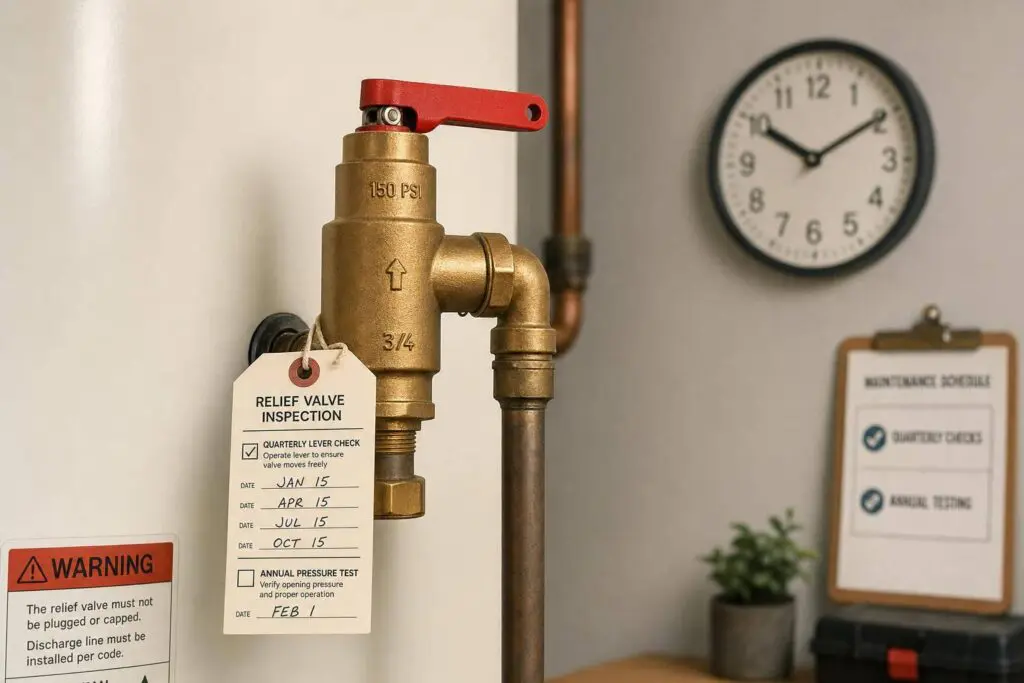
If you own a standard home boiler, I’d stick to two checkpoints: test the try lever every 3 months and have the valve pressure-tested once a year. That’s the short answer for most low-pressure steam and hot-water boilers.
Here’s what matters most:
- Quarterly lever check: shows the valve moves and discharges
- Yearly pressure test: shows the valve opens at its stamped set pressure
- Common home hot-water setting: 30 psi
- After a problem event: test again before restart if there was overpressure, water hammer, or dry-firing
- Shut the boiler down at once if the valve leaks nonstop, sticks, will not reseat, or the discharge pipe is blocked
A lever test and a pressure test are not the same thing. One checks movement. The other checks opening pressure. You need both if you want to know the valve can do its job.
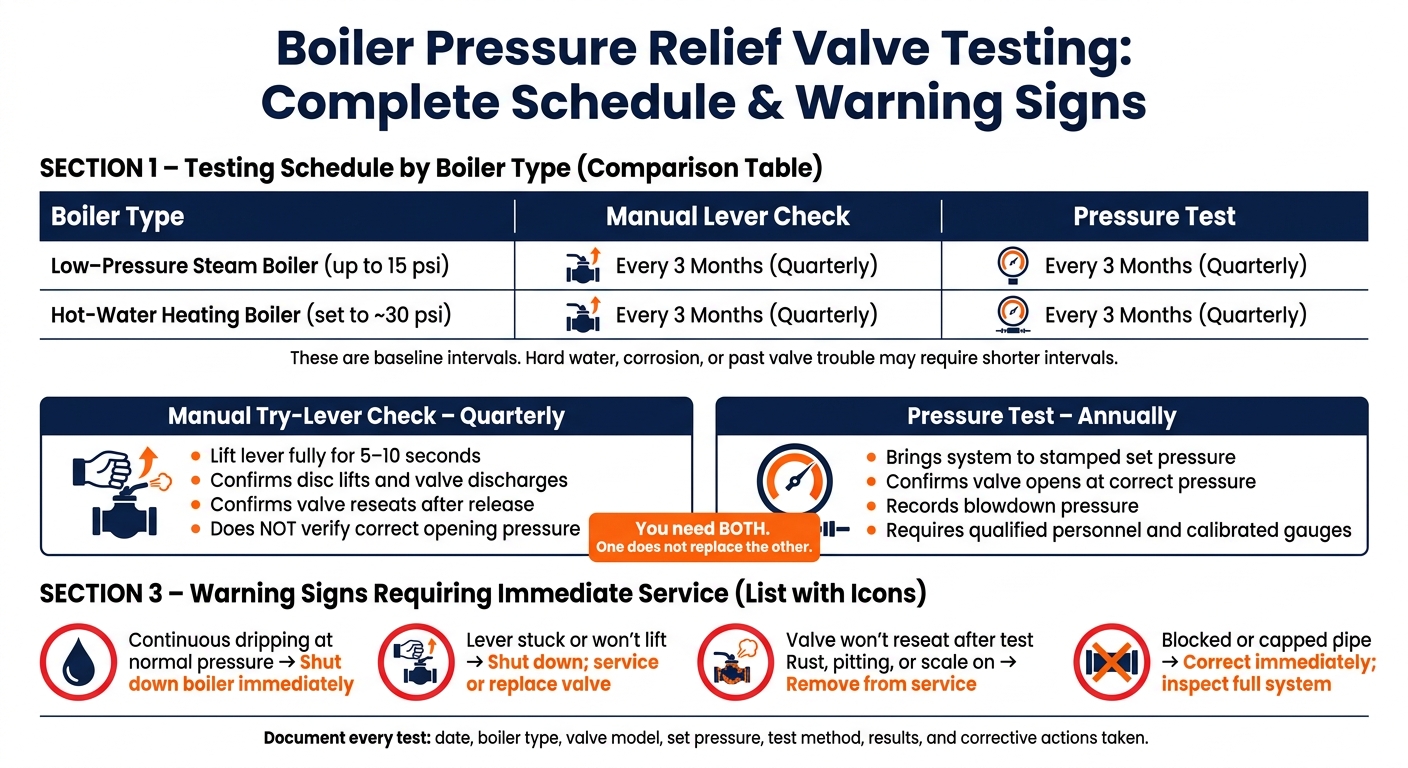
Boiler Pressure Relief Valve Testing Schedule & Warning Signs
Boiler Safety 101: When to Test Your Relief Valve (and When NOT To) – Weekly Boiler Tip
sbb-itb-b5c10b1
Quick comparison
| Boiler type | Lever check | Pressure test | Notes |
|---|---|---|---|
| Low-pressure steam boiler | Every 3 months | Once a year | Often up to 15 psi |
| Hot-water heating boiler | Every 3 months | Once a year | Many home valves are set to 30 psi |
I’d treat that schedule as the starting point, not the limit. Hard water and scale, rust, past leaks, or heavy cycling can mean shorter intervals make more sense.
Below, I’d focus on the plain answer: when to test, what each test shows, and which warning signs mean service cannot wait.
Recommended testing intervals by boiler type
Test frequency depends on the type of boiler and how it’s used. The table below gives you the baseline schedule to start from.
| Boiler Type | Manual Check Frequency | Pressure Test Frequency |
|---|---|---|
| Low-pressure steam heating boilers (up to 15 psi) | Every 3 months (quarterly) | Annually |
| Hot-water heating boilers | Every 3 months (quarterly) | Annually |
These are baseline intervals. Local codes, manufacturer instructions, insurance requirements, and service conditions can all require shorter intervals.
Manual checks vs. pressure tests
A manual lever check confirms the valve moves and discharges. A pressure test confirms it opens at its stamped set pressure.
Here’s the plain-English version: during a manual check, a technician lifts the lever by hand. That shows the valve can move and isn’t stuck in place. But it does not prove the valve opens at the correct pressure.
A pressure test does that. It brings the boiler pressure up to the valve’s stamped set point and checks that the valve opens and reseats the way it should. This test calls for qualified personnel and the right equipment, which is why heating boilers usually get it once a year, not every quarter.
When to test more frequently
Shorter intervals make sense when the valve shows wear or the boiler has already had trouble. Common triggers include:
- Hard water can leave scale on the disc or seat, causing sticking or simmering
- Documented history of sticking or prior leakage
- Visible corrosion on the valve body or lever
- Frequent system cycling
After overpressure, water hammer, or dry-firing, inspect and retest the valve before returning the boiler to service.
How boiler pressure relief valves are tested
Here’s what those quarterly and annual checks look like in practice. Boiler pressure relief valves are tested either with a manual try-lever check or with a pressure test at the valve’s set pressure.
Manual try-lever check on equipped valves
On valves that have a test lever, the technician lifts the lever all the way open and holds it there for about 5 to 10 seconds. That simple step checks three things at once: the disc lifts, the valve releases water or steam, and the valve seats again once the lever is let go.
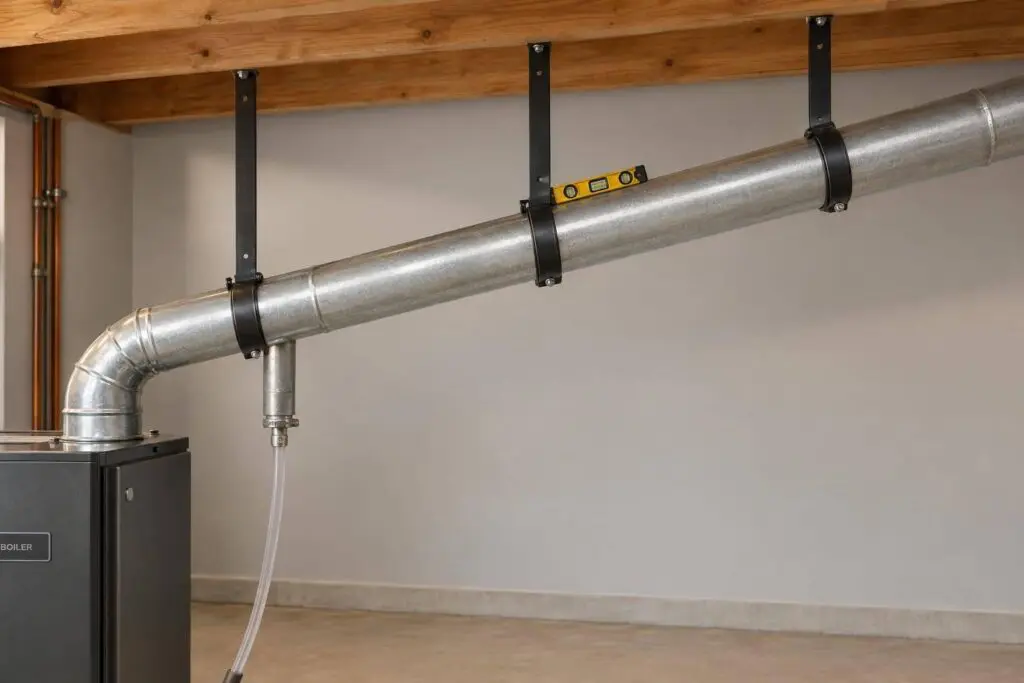
Before anyone touches the lever, the discharge piping needs to be clear, routed the right way, and free of blockages. That matters because hot water or steam can come out during the test. The area around the discharge should be kept clear, and the technician should use the right protective equipment. If the discharge pipe is blocked or the setup is unsafe, the test should not move forward.
Once the lever is released, the technician watches the valve closely. A valve that’s working as it should will reseat cleanly and stop flowing without continued dripping. If it keeps dripping or leaking, that usually points to deposits, corrosion, or damaged seating surfaces. And if repeated lever checks don’t stop the leak, the valve needs professional boiler maintenance.
Pressure testing at the valve set point
A pressure test brings system pressure up under controlled conditions until the valve opens at its opening point. Then the technician records the pressure where it closes again, called the blowdown pressure. This shows whether the valve opens at its stamped set pressure.
This isn’t a casual field check. It calls for calibrated gauges, written procedures, and qualified personnel. On commercial or higher-pressure boilers, some jurisdictions or safety codes require the valve to be removed and bench-tested by a certified relief-valve repair organization instead of being tested in place. Bench testing gives a documented record of opening pressure, blowdown, and seat tightness.
If the valve does not open, does not reseat, or will not hold tight, it needs service before the boiler goes back online.
Signs a relief valve needs immediate service
Even with routine testing, some warning signs mean stop and deal with the boiler right away.
Leakage, corrosion, scale, and sticking
If the relief valve drips nonstop at normal operating pressure, it isn’t sealing the way it should. At that point, the boiler should be shut down. The discharge line should stay dry between tests.
Rust, pitting, or mineral stains around the valve outlet or nearby piping are bad signs too. Corrosion can lock up the parts inside the valve. Scale and mineral buildup can also get in the way when the valve needs to open or close.
A try-lever that feels stuck or stiff is just as serious. If the lever doesn’t move smoothly during a manual check, or the valve doesn’t open during a pressure test at its set point, the valve has failed. Shut the boiler down at once. Hissing, whistling, or chattering near the valve can mean it’s cycling open and closed, which is a sign you can’t rely on it.
Blocked, capped, or upward-sloping discharge piping makes the valve unsafe no matter how the valve itself looks. Fix that right away, then inspect the whole system before restart.
The table below sums up the most common warning signs and what to do next:
| Warning Sign | What It Means | What to Do |
|---|---|---|
| Continuous dripping at normal pressure | Valve is not sealing properly | Shut the boiler down and call a technician |
| Lever stuck or won’t lift | Internal seizing or blockage | Shut the boiler down; have the valve serviced or replaced |
| Valve won’t reseat after test | Valve is not closing tightly | Remove from service |
| Rust, pitting, or scale on valve body | Corrosion or mineral buildup may be affecting operation | Schedule service; cleaning or replacement may be needed |
| Blocked or capped discharge pipe | Safe pressure relief is impossible | Correct immediately; inspect the full system before restart |
What to document after each inspection or test
If a check fails or you spot a visible defect, record what happened before putting the boiler back into service. After each inspection or test, write down:
- Date and time
- Boiler type and location
- Valve manufacturer and model
- Nameplate set pressure
- Test method used
- Results
- Any corrective actions taken
That record helps track repeat issues and makes the next service visit a lot easier.
Conclusion: Follow the right interval and call a professional when needed
Testing intervals depend on the boiler you have, but for most residential hot-water and low-pressure steam boilers, the usual schedule is quarterly lever checks and annual pressure tests. It’s best to handle the annual test before the heating season begins.
Both types of testing matter. A manual try-lever check can spot obvious mechanical trouble. A pressure test shows whether the valve opens at the set pressure and then closes the way it should. You need both. One doesn’t replace the other.
Treat published intervals as the floor, not the ceiling. If your system has poor water conditions or a record of valve trouble, shorten the interval instead of stretching it out.
If a valve sticks, leaks, or fails a test, shut the boiler down and schedule service right away. Know your interval, document each check, and call a qualified technician for any leak, sticking, or failed test.
FAQs
Can I test a boiler relief valve myself?
If local codes allow it, you may be able to do a manual lift test. Still, it’s usually best to have a certified professional inspect the pressure relief valve.
If you notice constant dripping from the discharge pipe, the valve may be faulty and needs professional attention. Never cap or disable it.
Eco Temp HVAC can include a safety valve inspection as part of routine maintenance.
What causes a relief valve to fail early?
A pressure relief valve can fail early when debris, mineral deposits, or corrosion stop it from sealing the way it should or block it outright.
It can also wear out from opening too often due to system over-pressurization. That usually points to another problem in the system, like a failed or waterlogged expansion tank, a faulty automatic fill valve, or poor maintenance.
If sludge or scale builds up and the valve becomes seized or clogged, it may stop releasing excess pressure the way it’s supposed to.
Should the valve be replaced after it leaks?
Yes. If the pressure relief valve still leaks after a manual lift test and reseating attempt, replace it right away.
Don’t try to recalibrate a leaking valve. If you see moisture, dripping water, or steam, contact Eco Temp HVAC for a professional inspection to help keep your system safe and working as it should.