
If you live in Chicagoland, the best furnace is usually not the one with the top AFUE number. It’s the one that fits your home, venting, ducts, and comfort needs.
I’d narrow it down like this:
- 80%–85% non-condensing: lower upfront cost, simple swap if the chimney and metal vent are still in good shape
- 90%–94% condensing: lower gas use, but now you need PVC venting and a condensate drain
- 95%–98% two-stage: often the best middle ground for comfort, efficiency, and rebate access
- 95%–98% modulating with variable-speed ECM: best for the most even heat and quieter airflow, but costs more and needs the right controls
- Furnace + duct and thermostat upgrades: the right move when hot/cold rooms, high static pressure, or leaky ducts are part of the problem
In Chicago, that choice matters. The area gets about 6,300–6,500 heating degree days each year, and winter temperatures can drop below 0°F. On a home using roughly 1,200–1,600 therms in heating season, the jump from 80% to 95% AFUE can mean about $250–$500 a year in gas cost difference, depending on gas prices, insulation, and thermostat use.
My short take: if you want the best mix of price and day-to-day comfort, a 95%–98% two-stage furnace is often the safe bet. If you care most about quiet operation and steadier room temperatures, go modulating. If your venting setup is simple and your budget is tight, an 80% furnace can still make sense. And if your ducts are in poor shape, fixing the duct system may matter as much as the furnace itself.
High Efficiency Gas Furnace Buying Guide: Top Models Compared
Quick Comparison
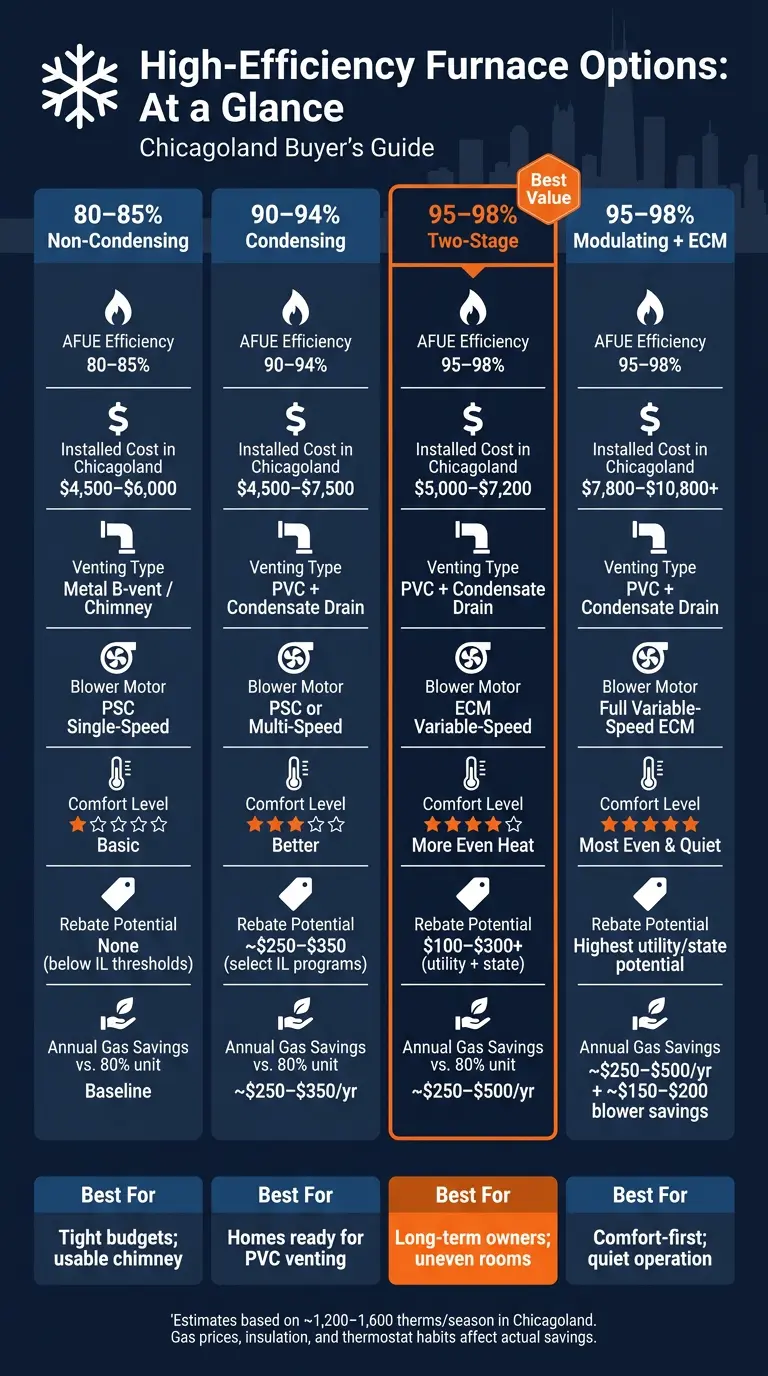
High-Efficiency Furnace Comparison: AFUE, Cost & Comfort for Chicagoland Homes
| Option | AFUE | Installed Cost | Venting | Comfort Level | Thermostat Need | Best Fit |
|---|---|---|---|---|---|---|
| 80%–85% Non-Condensing | 80%–85% | $4,500–$6,000 | Metal B-vent / chimney | Basic | Single-stage | Lower budget, usable chimney |
| 90%–94% Condensing | 90%–94% | $4,500–$7,500 | PVC + drain | Better | Single-stage | Homes ready for venting changes |
| 95%–98% Two-Stage | 95%–98% | $5,000–$7,200 | PVC + drain | More even heat | Two-stage | Long-term value, uneven rooms |
| 95%–98% Modulating + ECM | 95%–98% | $7,800–$10,800+ | PVC + drain | Most even and quiet | Communicating / advanced | Comfort-first buyers |
| Furnace + Duct/Controls Upgrades | Varies | Varies | Depends on furnace | Fixes airflow issues | Must match system | Homes with duct problems |
The main thing I’d keep in mind is simple: a high-efficiency furnace won’t perform like it should if the venting, thermostat, or ducts are the weak point.
1. 80%–85% AFUE Non-Condensing Furnace
The 80%–85% AFUE tier is usually the easiest swap when the home’s venting and ductwork are still in decent shape. It’s the baseline option – the one higher-efficiency furnaces get compared against for comfort, venting needs, and rebate access.
AFUE & Operating Cost
An 80% AFUE furnace converts 80% of the fuel it burns into heat. The other 20% goes out through the exhaust.
For a typical Chicagoland single-family home that uses around 1,200–1,600 therms during heating season, the gap between 80% and 95% AFUE can add up to about $250–$500 per year in heating costs. The exact number depends on gas prices, thermostat habits, and how well the home is insulated.
Typical installed cost in Chicagoland runs about $4,500–$6,000, depending on home size and the amount of work involved.
Venting & Installation Changes
This tier makes the most sense when the current venting system is still sound. These furnaces use metal Type B vent pipe tied into an existing masonry chimney or B-vent. They do not need PVC venting or condensate drain lines, which makes a like-for-like replacement pretty simple when the flue is in good condition.
That said, the install still needs a careful check. The contractor should confirm:
- chimney liner condition
- proper draft
- correct vent connector sizing
If the water heater shares the same flue, that shared vent has to meet fuel gas code rules so it doesn’t backdraft. There’s also a catch with furnace sizing. If you replace an oversized furnace with one that’s sized correctly, the lower flue gas volume can mean a chimney reliner is needed to keep draft safe.
Comfort & Blower Performance
Most 80%–85% furnaces come with single-speed PSC blowers. These run at full output each cycle, which can leave rooms feeling a bit uneven between heating runs.
Some models offer ECM or multi-speed blower upgrades. Those can help with airflow, cut noise, and use less electricity, even though they don’t change the furnace’s gas efficiency rating. If comfort is a big deal but you need to stay in this price range, that blower upgrade is often money well spent.
Controls, Rebates & Duct Fit
A few practical details matter here.
- Thermostat: These furnaces work with standard single-stage thermostats, including Wi-Fi and smart models. It’s also smart to check filter access at the cabinet. Front-access designs are easier to service when space is tight.
- Rebates: This tier usually doesn’t qualify. Illinois utility programs and federal tax credits often require at least 92%–95% AFUE, so after incentives, the price difference between this tier and a higher-efficiency model can shrink fast.
- Duct condition: Leaky ducts or high static pressure can wipe out a lot of the gains from any furnace replacement, including this one. A visual duct inspection and a static pressure test during installation help the new system do the job it’s supposed to do.
That puts 80%–85% furnaces in the role of the baseline pick for homes that want simple venting and a lower upfront cost, while the next tier asks for more install work in exchange for better efficiency.
2. 90%–94% AFUE Condensing Furnace
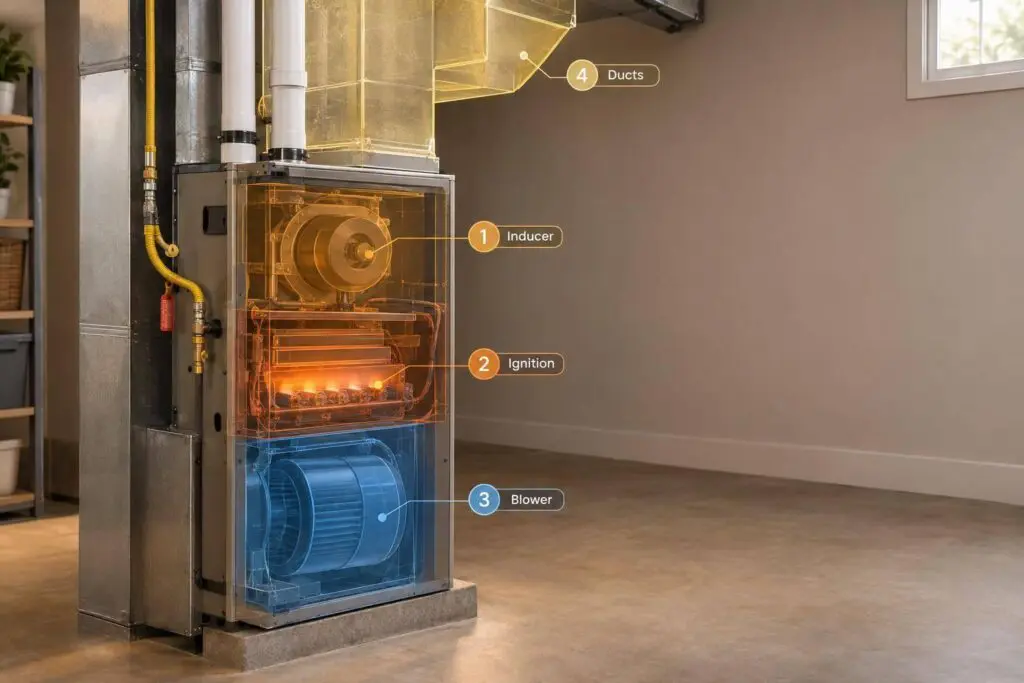
This is the point where furnace venting changes in a big way. Move up from 80%–85% AFUE and you’re in condensing territory. That means the furnace pulls so much heat from the exhaust that water vapor condenses inside the unit.
For a lot of homes, this tier sits right in the middle: lower gas use than basic models, but without stepping up to staged or modulating equipment. The catch is simple. Installation usually gets more involved.
AFUE & Operating Cost
A 90%–94% AFUE furnace turns 90%–94% of the fuel it burns into usable heat. A 92% model can save about $250–$350 per year compared with an older 75% AFUE furnace, depending on gas prices, weather, and insulation.
Installed cost is usually higher than the 80%–85% range because the venting and condensate drainage setup takes more work.
Venting & Installation Changes
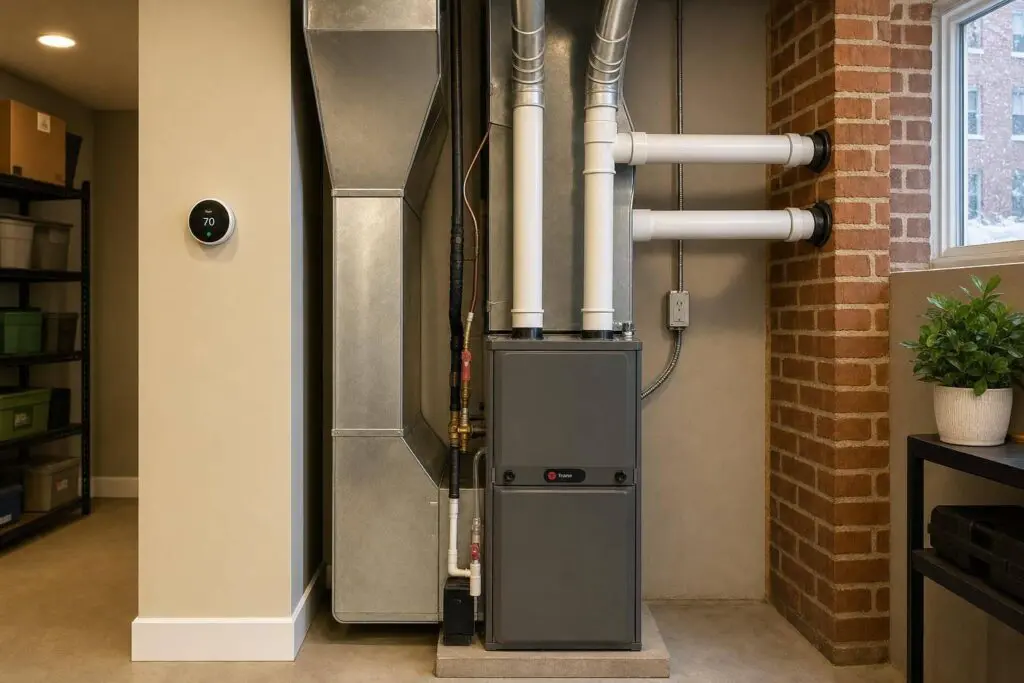
This is the biggest day-to-day difference from the tier below. Condensing furnaces send out cooler flue gases – about 100–130°F – and that moisture condenses inside the furnace. Because of that, standard metal flue pipe isn’t used. These systems use PVC, CPVC, or polypropylene vent pipe, usually 2–3 inches in diameter, routed through a sidewall or roof penetration.
They also use sealed combustion, so the furnace doesn’t pull indoor air for combustion. Horizontal vent runs need to slope back toward the furnace at 1/4 inch per foot so condensate drains the right way instead of sitting in the pipe.
The furnace also makes acidic condensate during normal use. That means the installer has to run a condensate drain line to a floor drain, condensate pump, or other approved drain point, often through a neutralizer before it enters plumbing.
If the old furnace shared a chimney with a water heater, that setup usually needs to change too. The water heater may need direct venting, or the chimney may need a new liner for the water heater by itself. That’s where a lot of the extra labor comes from. The efficiency gain is nice, but the venting and drainage work is the tradeoff.
Once that part is handled, comfort mostly comes down to the blower.
Comfort & Blower Performance
Many 90%–94% condensing furnaces come with multi-speed or ECM blower motors. ECM motors use less electricity for airflow and can help keep room temperatures more even. Most furnaces in this range still use single-stage burners.
Blower electricity use is often 20%–50% lower with ECM motors than with PSC motors.
Controls, Rebates & Duct Fit
A single-stage 90%–94% condensing furnace should be paired with a thermostat that matches the furnace’s staging. Many homeowners also add a programmable or Wi‑Fi smart thermostat for easier scheduling and control when they’re away.
If the furnace sits in a cramped utility area, front-access filter doors can make service a lot less annoying. Rebate programs from local utilities and states may apply in this tier, and some also include incentives for qualifying smart thermostats. That said, the bigger rebates are often saved for 95%+ AFUE furnaces, which can shrink the price difference between tiers.
One more thing: leaky or undersized ducts can wipe out a big chunk of the comfort and efficiency gain.
3. 95%–98% AFUE Two-Stage Furnace
If the 90%–94% tier boosts efficiency, this tier changes how the heat feels in the house. A 95%–98% AFUE furnace uses the same condensing setup as the 90%–94% group, but adds staged operation to deliver heat in a smoother way.
AFUE & Operating Cost
A 95%–98% AFUE furnace will usually cut heating costs by 15%–20% compared with an 80%–85% model, and ENERGY STAR units can save up to 30%.
Venting & Installation Changes
Because these are condensing furnaces, they need PVC or other corrosion-resistant venting and a condensate drain. In most cases, the old chimney can’t be reused. The big change at this tier isn’t the venting setup. It’s the staged heating. Venting rules stay the same as they are for the 90%–94% tier.
Comfort & Blower Performance
This is where two-stage equipment starts to stand out. Most of the time, the furnace runs at about 65%–70% capacity and only shifts to full output during colder weather.
That leads to longer, steadier heating cycles instead of short bursts. In plain English, the house feels more even. You get fewer temperature swings, less noise, and better humidity control, which can help in homes with hot and cold spots or longer duct runs. Two-stage operation can also use 10%–15% less fuel than a similar single-stage furnace in day-to-day use.
These systems often pair with ECM blowers, which help keep airflow steady in both stages.
Next, the thermostat and duct system need to support that staged setup.
Controls, Rebates & Duct Fit
A two-stage furnace needs a compatible two-stage thermostat and matching wiring. In some homes, that means adding an extra heat-stage wire or a common wire. Many homeowners also add a smart thermostat so they can get more out of staging and scheduling.
Before you buy, check Illinois utility rebates along with current federal or state incentives. High-efficiency models often qualify, while lower-tier units may not.
It also pays to inspect the ductwork for leaks, undersizing, and balance problems with professional duct system maintenance. If the ducts are in rough shape, they can wipe out much of the comfort gain you expected from a two-stage furnace.
4. 95%–98% AFUE Modulating Furnace With Variable-Speed ECM
If a two-stage furnace smooths things out, a modulating furnace goes a step further. Instead of switching between a couple of output levels, it adjusts heat in small steps, usually from about 35% to 100% of capacity. Pair that with a variable-speed ECM blower, and you get some of the most even, quiet heat a gas furnace can deliver.
AFUE & Operating Cost
The 95%–98% AFUE range overlaps with the two-stage category, so the gas savings gap is smaller than a lot of homeowners expect. Going from a 96% two-stage furnace to a 98% modulating model cuts gas use by only about 2%–3%, or around $20–$30 per year on a typical Chicagoland heating bill.
A big part of the payoff comes from the blower motor. Variable-speed ECM motors use 60%–80% less electricity than standard PSC motors when running at lower speeds, and that can mean about $150–$200 per year in blower energy savings.
In the Chicago area, installed pricing for a modulating furnace with variable-speed ECM usually lands around $7,800–$10,800. That’s about $1,500–$3,000 more than simpler high-efficiency models. So no, fuel savings by themselves usually don’t make the case. The bigger draw is better comfort, lower noise, and steadier airflow.
Venting & Installation Changes
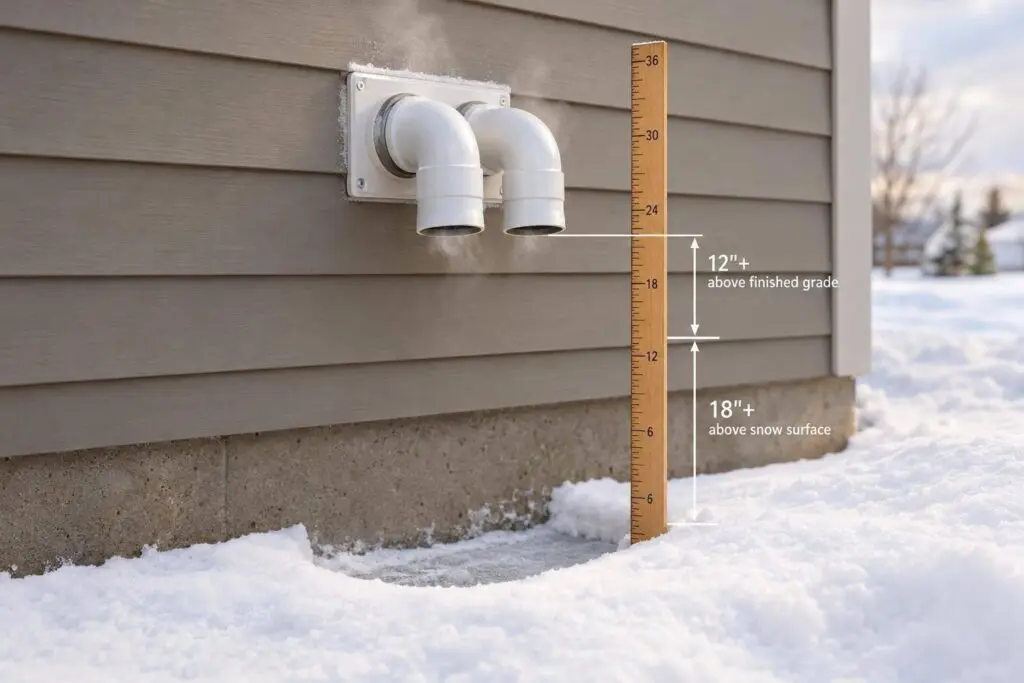
These are condensing furnaces, so they need PVC or CPVC venting plus a condensate drain. Vent termination also needs careful placement to help avoid icing during Chicago winters.
In most cases, the old metal chimney can’t be reused. And if another appliance, like a gas water heater, still vents into that chimney, the installer needs to deal with draft and liner rules on its own.
Comfort & Blower Performance
This is where modulating equipment stands out. The furnace tracks the heating load and adjusts output to match it, instead of cycling hard on and off. That means longer, quieter runs at lower fire, with indoor temperature often staying within about ±1°F of the thermostat setting.
You’ll tend to notice that most in homes with:
- long duct runs
- multiple floors
- rooms that usually feel too warm or too cold
Those longer low-fire cycles can also help with winter humidity, so the air may feel less dry. At the same time, the ECM blower keeps airflow steady as furnace output shifts.
Controls, Rebates & Duct Fit
A modulating furnace needs the right thermostat to do what you’re paying for. A basic thermostat can limit the furnace and keep it from using its full modulation range. In plain English: you could spend more for a top-tier furnace and then never get the full comfort it was built to deliver.
Ask the installer if the system includes a communicating thermostat or an advanced multi-stage control, and make sure it can manage fan speed, staging, and humidity control together.
Rebates are often about $150 for 95% AFUE units and about $225 for models rated 97% AFUE or higher. Add a smart thermostat bundle, and the total may reach about $200–$275. The federal Energy Efficient Home Improvement Credit may also cover up to $600 for a qualifying high-efficiency gas furnace, subject to annual limits.
Ductwork matters just as much here as the furnace itself. If the ducts are undersized or leaky, a lot of the comfort gain from modulation can disappear. That’s why a duct inspection before installation is a smart move.
At this level, the furnace, the controls, and the duct system all have to work together.
5. High-Efficiency Furnace Replacement With Ductwork and Controls Upgrades
This path handles the furnace, ductwork, and controls as one job, not three disconnected fixes. That matters when the furnace isn’t the only issue. If the house still has hot and cold spots, loud airflow, or weak comfort upstairs, the problem often runs deeper than the equipment itself.
This option makes the most sense when the existing ducts are undersized, leaky, or out of balance. A new furnace can only hit its rated performance if air moves through the house the way it should. If the duct system is struggling, the furnace ends up working around those limits.
AFUE & Operating Cost
Replacing an old 80% AFUE furnace with a 95%–98% unit can cut gas use by a meaningful amount. But there’s a catch: leaky or undersized ducts can eat away at much of that rated efficiency. Duct sealing and control upgrades help protect those savings and help the furnace deliver the output it’s designed for.
Venting & Installation Changes
High-efficiency condensing furnaces need PVC sidewall venting and a condensate drain. It’s smart to plan the vent path and duct changes at the same time. That helps avoid rework, added labor, and condensate-freeze problems. Splitting the work into separate phases usually means more mess, more disruption, and more labor cost.
Comfort & Blower Performance
Duct condition directly affects how well the furnace blower can do its job. Most residential systems should stay at or below 0.5 in. w.c. of total external static pressure. Once static pressure goes above 0.8 in. w.c., airflow drops fast, creating severe airflow restriction that even a variable-speed ECM blower can’t fully overcome.
Fixing undersized returns, sealing leaky joints with mastic, and resizing supply trunks can bring static pressure back into range. That gives the blower room to run longer at lower speeds instead of straining against the system. In plain terms, the house tends to feel more even from room to room and floor to floor, with quieter airflow and better air mixing.
Controls, Rebates & Duct Fit
The thermostat needs to match the furnace’s staging and blower controls, especially with two-stage or modulating units. Otherwise, the system can act like separate parts instead of one setup working together.
ENERGY STAR-certified smart thermostats often qualify for separate utility rebates in addition to equipment incentives. It also helps to itemize the work clearly:
- Duct sealing
- Thermostat
- Equipment installation
Rebates often depend on clean documentation, so breaking out each part can save headaches later.
That whole-system view sets up the next side-by-side comparison of cost, venting, and comfort.
Side-By-Side Comparison: Efficiency, Venting, Comfort, and Fit
Use this table for a quick look at venting, comfort, and fit for Chicagoland homes and small buildings. It shows where things start to shift, especially once you move from a basic furnace swap to a setup that needs new venting and extra controls.
| Furnace Option | Typical AFUE | Typical Installed Cost | Venting Type | Condensate Drain | Blower/Motor Type | Thermostat Requirement | Rebate Potential | Best For |
|---|---|---|---|---|---|---|---|---|
| 80%–85% Non-Condensing | 80%–85% | $4,500–$6,000 | Metal B-vent / chimney | No | PSC single-speed | Basic single-stage | None (below most IL thresholds) | Tight budgets; homes with functional chimneys |
| 90%–94% Condensing | 90%–94% | $4,500–$7,500 | PVC sidewall or roof | Yes | PSC or multi-speed | Single-stage; smart thermostat compatible | ~$250–$350 (select IL programs) | Standard upgrades; homes ready for PVC venting; moderate comfort goals |
| 95%–98% Two-Stage | 95%–98% | $5,000–$7,200 | PVC sidewall | Yes | ECM variable-speed | Two-stage thermostat or compatible control | $100–$300+ (utility + state programs) | Long-term owners; uneven homes; Chicagoland’s long heating season |
| 95%–98% Modulating Furnace With Variable-Speed ECM | 95%–98% | $7,800–$10,800+ | PVC sidewall | Yes | Full variable-speed ECM | Communicating smart thermostat | Highest utility/state potential | Maximum comfort priority; high-use homes |
The big split here is install complexity. On one side, you have a basic replacement. On the other, you have systems that need PVC venting, drainage, and more setup on the control side.
The 80%–85% tier usually keeps the existing metal flue or chimney. Once you step into condensing furnaces, starting at 90% and up, the install changes. These systems need PVC venting, a condensate drain, and in below-drain setups, often a condensate pump too.
Comfort changes with the equipment as well. Single-stage furnaces tend to cycle harder, which can make temperature swings more noticeable. Modulating units with ECM blowers run longer at lower output, so the house tends to feel more even from room to room.
That said, the modulating upgrade usually earns its keep through comfort, not major gas-use cuts. So the decision often comes down to two things: can the building handle the venting change, and is the comfort bump worth the extra install work?
Next, weigh the pros and cons of each option.
Pros and Cons of Each Furnace Option
The comparison above helps narrow your options. This section gets into the main tradeoffs in plain English.
For Chicagoland homes, the best pick often comes down to three things: your current venting setup, the state of your ductwork, and how long you expect to stay in the home. From there, it’s mostly a balance of price, comfort, and install work.
| Furnace Option | Pros | Cons | Upfront Cost | Installation Complexity | Best Fit |
|---|---|---|---|---|---|
| 80%–85% Non-Condensing | Lowest upfront price; simple swap on existing metal venting; no condensate drain needed | Highest fuel loss of the four options; typically does not qualify for rebates; single-stage operation can create wider temperature swings | Low | Low | Tight budgets; rentals; short-term owners; smaller homes or condos with a good existing metal flue |
| 90%–94% Condensing | Meaningful fuel savings over 80% units; can qualify for utility rebates; improved comfort options with multi-speed blower configurations | Needs new PVC venting and drainage; more labor and permits than a straight swap; may not qualify for the strongest rebates | Moderate | Moderate | Cost-conscious owners planning to stay a few years; homes that can accommodate new PVC venting and a condensate drain |
| 95%–98% Two-Stage | Highest efficiency in this group; two-stage operation cuts temperature swings and short cycling; can qualify for stronger rebates | Noticeably higher upfront cost than 80% units – often 25% to 40% more installed; needs PVC venting, a condensate drain, and a compatible two-stage or smart thermostat | Higher | Moderate | Long-term owners in detached homes or larger townhouses; anyone dealing with uneven room temperatures |
| 95%–98% Modulating With Variable-Speed ECM | Most stable temperatures, often within about ±1°F of setpoint; quietest operation; better airflow and humidity control; strong rebate potential | Highest equipment and install cost; requires a communicating or modulating thermostat; older or undersized ducts may need modification; the 96% to 98% AFUE jump saves little on gas bills alone | Highest | High | Comfort-focused, long-term homeowners; larger or multi-story homes with temperature imbalance problems; buyers who prioritize quiet operation and indoor air quality |
Once venting and thermostat requirements are sorted out, the choice usually comes down to payback vs. comfort.
The middle options often make the most sense on cost. Moving from 80% to 95% AFUE can cut heating gas use by about 18% to 19%. On a $1,200 yearly heating bill, that works out to around $200 to $225 in savings per year.
That’s why the 90%–94% and 95%–98% two-stage units often land in the sweet spot. You get lower gas use and better day-to-day comfort without jumping all the way to the most expensive setup.
The modulating ECM option is a different kind of buy. It’s harder to justify on gas savings alone. The bigger draw is steadier temperatures, quieter operation, and lower blower electricity use – not just the AFUE number printed on the spec sheet.
Conclusion
After looking at efficiency, venting, comfort, and controls, the choice usually comes down to six practical questions: Can the home be vented with PVC? What does a Manual J load calculation show? How long will you stay in the home? How much comfort do you want day to day? What shape are the ducts in? And what thermostat or control setup will actually work with the equipment?
Here’s the short version.
- 80%–85% furnaces make sense for homes with sound chimneys and tighter budgets.
- 90%–94% condensing furnaces fit homes that can use PVC venting and have a condensate drain.
- For many Chicagoland homes, 95%–98% two-stage furnaces hit the sweet spot for efficiency, comfort, and rebate eligibility.
If you have a larger multi-story home, or certain rooms are always too hot or too cold, a 95%–98% modulating furnace with a variable-speed ECM blower is usually the better pick. It gives you tighter temperature control and quieter operation, which can make a big difference in how the house feels.
One last piece matters more than many people expect: airflow and controls. Ductwork isn’t something to tack on at the end. Even a top-tier furnace won’t work as promised if the ducts are undersized, leaky, or poorly balanced. And two-stage or modulating systems need compatible thermostats or smart controls, or you leave part of the system’s performance on the table.
Eco Temp HVAC can handle load calculations, duct static pressure checks, furnace installation, and rebate paperwork across Chicagoland.
Choose the furnace that fits the home, the duct system, and the way you actually live in the space.
FAQs
Do I need new venting for a high-efficiency furnace?
Yes. High-efficiency gas furnaces, usually rated above 90% AFUE, vent differently than older non-condensing units.
Most condensing furnaces use PVC or polypropylene vent piping and need a condensate drain. They don’t rely on the old metal flue or masonry chimney setup many older furnaces used. Eco Temp HVAC can inspect your current system and make sure the new install meets safety rules and local building codes.
Is a two-stage furnace worth it in Chicagoland?
Yes. For many Chicagoland homeowners, a two-stage furnace is worth it. The long heating season makes its lower, steadier heat output a smart fit for the area.
It can help cut short-cycling, keep room temperatures more even, and make winter feel a lot more comfortable. When you pair it with a variable-speed blower, you get a strong mix of efficiency and better climate control.
Should I upgrade my ducts with the furnace?
It depends on the condition of your ducts and whether they fit the new system. Leaky or poorly insulated ducts can waste 20% to 40% of your system’s energy output, so it’s smart to check them before installation. Otherwise, you could end up paying for heat that never makes it into your living space.
If your ducts are in good shape, you can often reuse them with a few small tweaks. But if they’re damaged, old, or your new furnace is a different size, you may need sealing, insulation, or resizing to get proper airflow.