
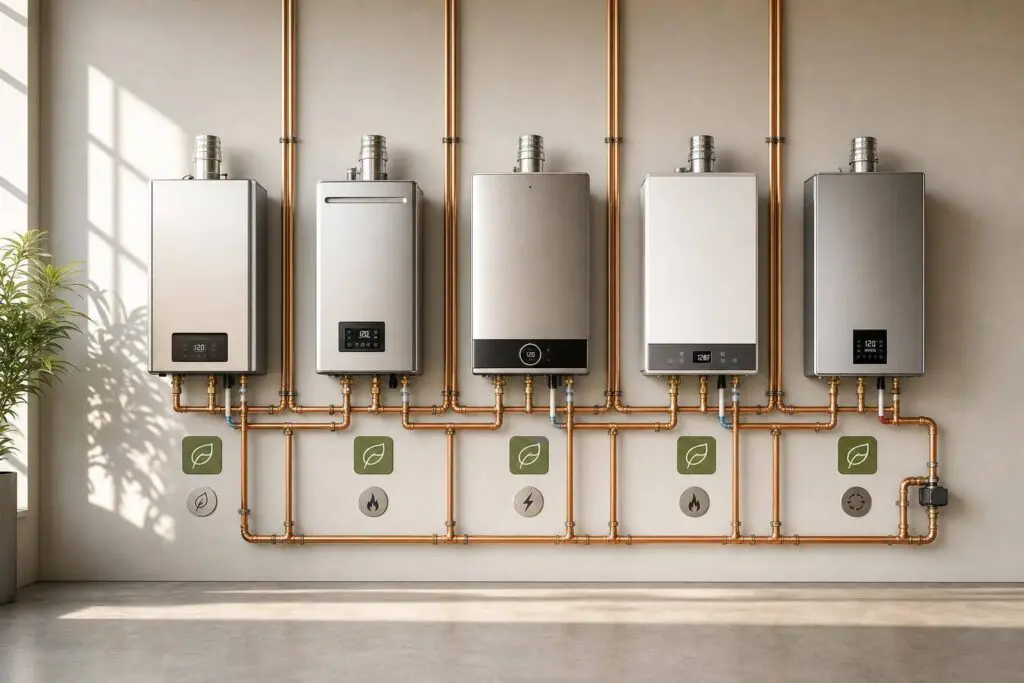
Tankless water heaters can cut water-heating energy use by 24% to 34% compared with storage-tank units, and the best picks here are Navien, Rheem, Noritz, A. O. Smith, and Rinnai.
If I were narrowing this list fast, I’d look at four things first: UEF, fuel type, recirculation, and install needs. In this group, Navien leads on top-end gas efficiency, Rheem is the main electric value pick, Noritz stands out for recirculation and long service life, A. O. Smith covers both gas and electric use cases, and Rinnai is a strong gas-only option for homes and businesses.
Here’s the short version:
- Navien: up to 0.99 UEF, condensing gas, built-in recirculation options
- Rheem: up to 99% UEF, electric, no venting needed
- Noritz: condensing gas, integrated recirculation on some models, 15+ years with care
- A. O. Smith: gas and electric options for home, light commercial, and point-of-use use
- Rinnai: high-efficiency gas lineup with home and commercial coverage
What matters most?
You should match the unit to your hot water demand, incoming water temperature, gas line or panel capacity, and water hardness. A low-cost unit that’s undersized or hard to install can cost more over time.
Top Energy-Efficient Tankless Water Heaters
Quick Comparison
| Brand | Best Fit | Fuel Type | Efficiency Highlight | Main Watch-Out |
|---|---|---|---|---|
| Navien | Cold climates, high-demand homes | Gas | Up to 0.99 UEF | Venting and condensate drain needed |
| Rheem | Buyers who want electric and lower upfront unit cost | Electric | 98%–99% UEF | May need panel upgrade |
| Noritz | Homes that want recirculation and long life | Gas | ENERGY STAR models available | Gas venting required |
| A. O. Smith | Buyers comparing more install types | Gas / Electric | Broad model range | Specs vary a lot by model |
| Rinnai | Buyers focused on gas systems | Gas | High-efficiency gas models | Less focus on electric in this comparison |
Bottom line: if you want the shortest path to a smart pick, compare efficiency, install cost, maintenance, and fuel type before brand name alone. That will usually tell you more than the label on the box.
Why Eco-Friendly Tankless Water Heaters Matter
Before you compare brands, it helps to know which numbers separate a good unit from an average one. Eco-friendly tankless water heaters use less energy, cut emissions, and reduce water waste, all while giving you hot water on demand.
Lower Energy Use and Utility Costs
For many homeowners, the higher upfront price pays back in about 5 to 8 years, followed by yearly utility savings of around $100 to $400. That’s a pretty solid trade if you plan to stay in your home for a while.
There’s also a space-saving perk. Because these units mount on the wall, they work well in small homes, apartments, and tight utility closets.
Lower Emissions and Less Waste
Tankless systems heat water only when you need it. That means the burner or heating element isn’t running all day just to keep a tank hot. Less runtime usually means less fuel use.
Many eco-friendly models also use low-NOx burners and condensing technology to cut emissions even more. And since these units often last a long time, you may deal with fewer replacements over the years, which means less waste.
Those gains show up most clearly in UEF, GPM, BTU/h, and ENERGY STAR ratings.
Key U.S. Buying Metrics
When you compare U.S. models, focus on these four numbers:
| Metric | What It Means for You |
|---|---|
| UEF (Uniform Energy Factor) | The standard U.S. efficiency rating. Higher is better, and top models can reach 0.99 |
| GPM (Gallons Per Minute) | How much hot water the unit can deliver. Size the system by adding the GPM of the fixtures you expect to run at the same time |
| BTU/h | Heating power for gas units. This matters more in colder climates |
| ENERGY STAR Certification | Shows the unit meets EPA efficiency rules and may qualify for rebates |
Fuel type matters too. Natural gas units usually deliver higher BTU output, which helps in colder parts of the country. In northern states, incoming groundwater can drop to 35°F to 40°F, so higher BTU or kW output can make a big difference.
Electric units don’t need venting, which can make installation simpler. The catch? A whole-home electric model may need an electrical panel upgrade.
There’s a money angle here too. Qualifying ENERGY STAR models may unlock up to $2,000 in federal tax credits under the Inflation Reduction Act through 2032, plus local utility rebates that can be around $600 in some areas. It’s smart to check local rebate programs before you buy.
These metrics set up the brand-by-brand comparison below.
1. Navien
Navien stands out for buyers who want high efficiency, solid hard-water protection, and steady performance in cold climates. Some models reach a UEF of up to 0.99 and meet ENERGY STAR efficiency standards.
One reason people lean toward Navien is its dual stainless-steel heat exchangers. They help fight corrosion and scale, which matters a lot in hard-water homes. With annual maintenance, these units can last 15 to 20 years.
Its ComfortFlow® system pairs an insulated buffer tank with a recirculation pump to cut down on the cold-water sandwich effect. If you want more control, NaviLink™ is available for remote monitoring and temperature changes from your phone.
Eco Temp HVAC, a Navien Service Specialist-certified contractor, recommends Navien for Chicago’s cold-climate performance and durable design.
There’s also the space factor. The wall-mounted setup can free up up to 80% of the room a tank heater would take up.
Looking at UEF, lifespan, and how well it fits different installs, Navien is one of the top all-around picks.
2. Rheem
Rheem is sold all over the U.S. in both retail stores and pro channels. It’s the value pick for buyers who want strong efficiency without paying a premium upfront. If your main goal is dependable hot water at a lower starting cost, Rheem sits in a good spot.
Rheem’s electric RTEX line posts UEF ratings from 98% to 99%. The RTEX-36 (36 kW) hits 99% UEF and can deliver up to 7 GPM at a 67°F rise, which is enough to support several fixtures at once. The RTEX-13 (13 kW) runs at 98% UEF and costs about $10 per month to operate, which makes it a solid pick for point-of-use use cases. Both models use copper immersion elements and scale-resistant coils.
Those efficiency numbers can also help on the incentive side. Rheem has ENERGY STAR certified models, and some qualifying units may be eligible for federal tax credits up to $2,000 or rebates of $600.
Rheem units usually last 12 to 15 years and come with a 5–10 year heat exchanger warranty. There’s a tradeoff, though. The copper heat exchanger needs more descaling in hard-water areas than stainless-steel units, so yearly maintenance matters if you want to protect efficiency and keep warranty coverage in place. And because the lifespan is shorter than some other options, replacement tends to happen sooner, which adds more material waste over time.
| Rheem Model | Power | Max Flow Rate | UEF |
|---|---|---|---|
| RTEX-36 | 36 kW | 7 GPM | 99% |
| RTEX-13 | 13 kW | 3 GPM | 98% |
On price, the unit itself usually runs $800–$1,500, while full professional installation often lands in the $3,500–$4,500 range. That’s the core pitch with Rheem: high efficiency and a lower cost to get started, not the longest run of service.
3. Noritz
For buyers looking at UEF, water waste, and long-term durability, Noritz is a strong pick. The brand focuses on high-efficiency tankless water heaters for both homes and commercial spaces. Many of its models are ENERGY STAR-certified. Its condensing, on-demand setup helps cut fuel use and reduce standby loss.
On the hardware side, the NRCR PRO series uses a stainless steel heat exchanger. That matters because stainless steel does a good job standing up to corrosion and thermal stress, which can help the unit last longer. The series also includes integrated recirculation, which shortens wait times for hot water and reduces wasted water. With regular maintenance every 18 to 24 months, these units can last 15+ years.
Noritz also adds control features that help with day-to-day efficiency. The EZ Start Plus app lets users manage temperature and recirculation settings to help reduce waste. From a phone, users can check system status, adjust temperature, schedule hot water, and control recirculation through Bluetooth. Noritz recommends licensed installation. Key specs are below.
| Spec | Noritz |
|---|---|
| Heat Exchanger | Stainless steel (NRCR PRO series) |
| Efficiency Certification | ENERGY STAR-certified models available |
| Lifespan | 15+ years with regular maintenance |
| Smart Controls | EZ Start Plus app via Bluetooth |
sbb-itb-b5c10b1
4. A. O. Smith
A. O. Smith makes high-efficiency tankless water heaters for residential, light commercial, and point-of-use use. The main draw here is simple: on-demand hot water for homes, commercial spaces, and small remote installs.
Its tankless lineup includes whole-home hot water systems, light commercial units, and point-of-use options for sinks and showers in out-of-the-way spots.
If you’re comparing brands, the big things to look at are efficiency, fit, and installation type.
| Spec | A. O. Smith |
|---|---|
| Fuel Types | Gas and electric configurations |
| Applications | Residential, light commercial, and point-of-use setups |
5. Rinnai

Rinnai is a well-known gas tankless brand with a strong reputation for efficient, long-lasting systems. If you’re comparing energy use and long-term running costs, Rinnai’s gas lineup is built with that in mind.
Its high-efficiency gas models are designed to use less fuel without sacrificing steady hot water. That matters if you want lower utility bills but don’t want your shower turning cold halfway through.
| Spec | Rinnai |
|---|---|
| Fuel Types | Gas tankless |
| Applications | Residential and commercial |
| Eco Features | High-efficiency gas lineup |
| Warranty Perk | Additional 4 years of labor coverage available |
Gas tankless systems are where Rinnai stands out most, though it also offers electric options for buyers who want to stick with one brand. That makes it fairly easy to compare Rinnai with other names based on efficiency, fuel type, and what the install will call for.
Eco Features Compared Across All 5 Brands
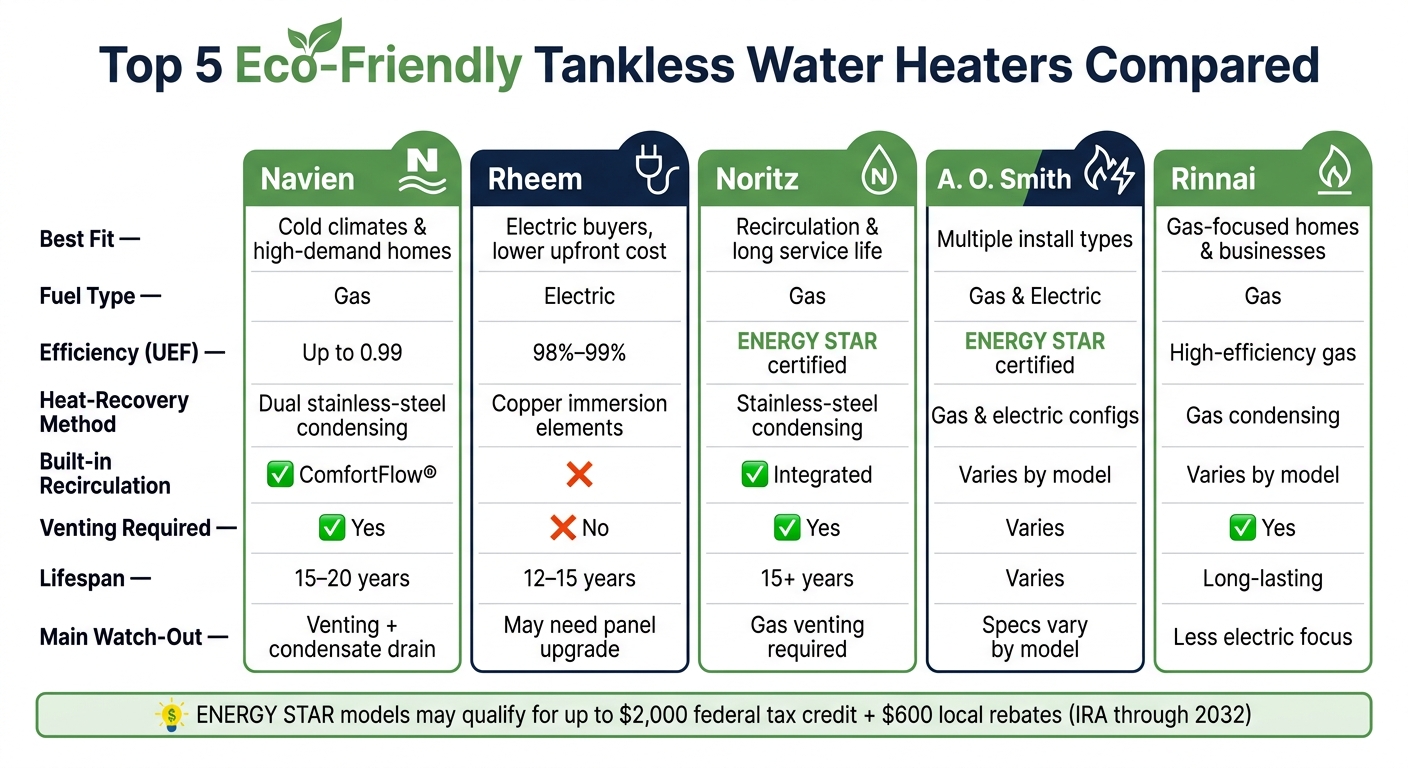
Top 5 Eco-Friendly Tankless Water Heaters Compared (2024)
The main eco differences come down to heat-recovery design, fuel type, and recirculation. Those three things shape how much energy a unit uses, how it handles hot water delivery, and what kind of install you’re dealing with.
Brand Comparison Table
| Brand | Efficiency (UEF) | Heat-Recovery Method | Recirculation | Venting | Fuel Type |
|---|---|---|---|---|---|
| Navien | Up to 0.99 | Dual stainless-steel condensing heat exchangers | ComfortFlow® built-in | Required | Gas |
| Rheem | Up to 99% | Self-modulating copper immersion elements | Not built-in | Not required | Electric |
| Noritz | ENERGY STAR-certified models | Stainless-steel condensing (NRCR PRO series) | Integrated recirculation | Required | Gas |
| A. O. Smith | ENERGY STAR-certified models | Gas and electric configurations | Varies by model | Varies by fuel type | Gas and electric |
| Rinnai | High-efficiency gas lineup | Gas condensing design | Varies by model | Required | Gas |
Out of all these features, heat-recovery design does the most work on efficiency. Condensing models from Navien, Noritz, and Rinnai pull heat from exhaust that non-condensing units send out through the vent. That’s a big deal because it cuts waste at the source.
Rheem takes a different path. Its electric lineup can hit similar efficiency numbers without combustion. No combustion also means no venting, which makes placement easier in many homes. The catch? Some homes may need electrical panel upgrades.
Condensing vs. Non-Condensing Models
The clearest efficiency gap is condensing vs. non-condensing.
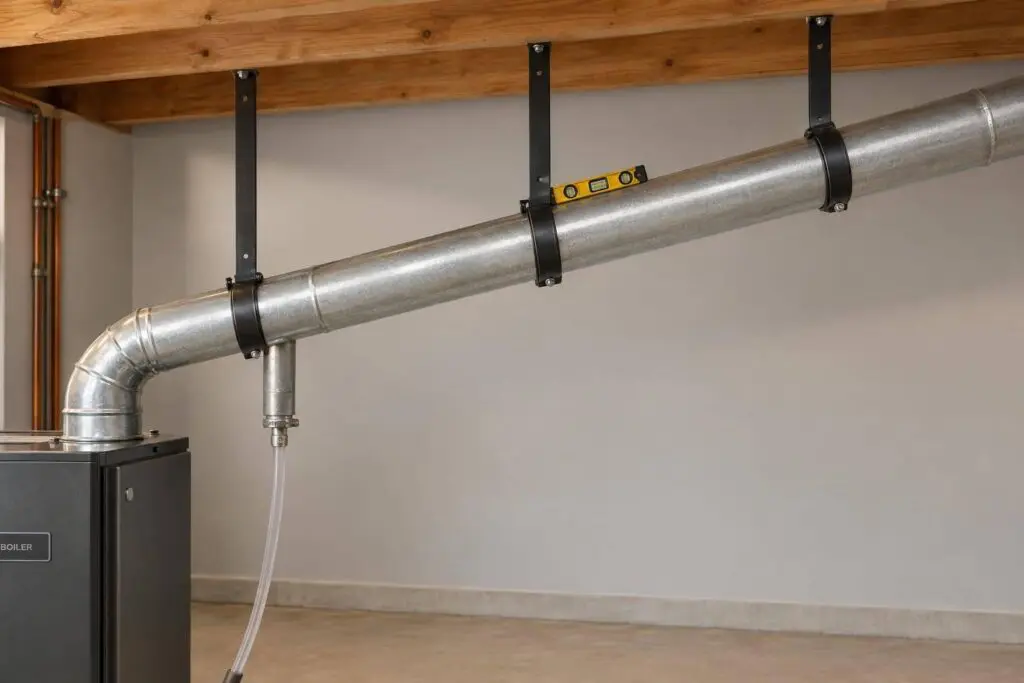
A non-condensing unit heats water, then sends exhaust outside. Some heat goes with it. A condensing unit adds a second heat exchanger to grab more of that heat before it leaves. That’s how units like Navien’s NPE and NCB series can reach up to 0.99 UEF.
There’s a tradeoff, though. Condensing units produce acidic condensate, so they need proper drainage. That can add install work and cost. Non-condensing and electric models often cost less to install and can fit more easily in tight spaces.
That makes installation factors the next filter for choosing the right model.
Installation and Local Factors for U.S. Homes and Businesses
Once you cut down your brand options, installation details decide which unit will work well in the first place. A high-efficiency model won’t do much for you if it’s the wrong size, vented the wrong way, short on gas or electrical capacity, or left unprotected in hard-water conditions.
Correct Sizing and Flow Rate
Sizing comes down to two numbers: peak flow rate in GPM and temperature rise in °F. If you live in a colder part of the country, the unit has to work harder because the incoming water starts out colder. That means you need to match the heater’s output to your local inlet water temperature and your home’s peak demand.
A simple way to think about it: add up the GPM of the fixtures that may run at the same time. If two showers, a faucet, and a dishwasher could all be on during your busiest hour, that’s the load your unit needs to handle.
After that, you need to check whether your home can support the unit’s venting or power needs.
Venting, Gas Supply, and Electrical Requirements
Gas tankless units need proper venting and the right gas-line size. That can add about $500 to the installation cost. Electric models skip venting, which sounds simpler, but they can put a heavy load on your electrical system.
For example, a 36 kW whole-home electric unit usually needs 150A of dedicated service and three 50A breakers. If your panel can’t handle that, an upgrade may cost $500 to $1,000 before installation even starts. That’s why checking panel capacity before you buy the unit is a smart move.
Water Quality and Maintenance
Even with the right size and power setup, hard water can chip away at performance. Mineral buildup can scale the heat exchanger and cut efficiency over time. Chicago’s municipal water supply is known for relatively high mineral content, so this is more than a small detail for Chicagoland homeowners and businesses.
Annual descaling usually costs about $100. That’s a small price to help prevent efficiency loss and early equipment failure.
Local installation and service matter just as much as the equipment itself.
Professional Installation in Chicagoland
For Chicagoland homes and businesses, Eco Temp HVAC installs and services tankless water heaters across Chicago, St. Charles, Bartlett, Lemont, Downers Grove, and Palatine. The company holds Navien Service Specialist certification and provides installation and maintenance for high-efficiency Navien systems.
Conclusion
After comparing efficiency, fuel type, and installation needs, the choice comes down to fit.
Navien, Rheem, Noritz, A. O. Smith, and Rinnai all make eco-friendly tankless options. Navien leads on condensing efficiency. Rheem stands out for high-efficiency electric models. Noritz, A. O. Smith, and Rinnai round out the list with reliable systems for homes and businesses.
If you want the fastest way to narrow your shortlist, use the comparison table above.
Focus on the factors that matter most:
- UEF
- Condensing design
- Installation requirements
- Total operating cost
The right model can lower energy use, cut emissions, and may qualify for rebates or tax credits.
Before you buy, match the unit to your hot water demand and your building’s infrastructure.
The best eco-friendly tankless water heater is the one that fits your demand, your utilities, and your budget.
FAQs
How do I size a tankless water heater for my home?
Size a tankless water heater by looking at flow rate and temperature rise.
Start with flow rate. Add up the gallons per minute (GPM) from the fixtures you might run at the same time, like a shower and the kitchen faucet. Most homes land around 3.0–4.0 GPM, though short bursts can hit 6.0–8.0 GPM.
Then figure out temperature rise. Subtract your local groundwater temperature from the output temperature you want, which is usually 120°F. If you live in a cold area, the unit needs more BTU/h to heat that water, so base your sizing on the coldest winter groundwater temperatures.
If you want to play it safe, a pro can help match the unit to your household’s hot water use.
Is gas or electric better for my house?
It comes down to your home’s hot water use, the setup you already have, and where you live.
Gas tankless water heaters are usually the better pick for whole-house use. That’s especially true in colder climates, where incoming water is colder and the system has to work harder. They offer higher flow rates and can keep up with multiple fixtures at the same time.
Electric models tend to be more efficient. They’re often a good fit for point-of-use setups or smaller homes in warmer climates. They also don’t need venting, which can make installation simpler. The tradeoff is that they may need major electrical panel upgrades.
Eco Temp HVAC can help assess the best fit.
Do tankless water heaters need a lot of maintenance?
Tankless water heaters usually need less upkeep than storage-tank models. Since they don’t hold water in a tank, there’s less chance for sediment buildup and corrosion over time.
That said, they’re not maintenance-free. Annual professional descaling is still a big deal, especially if you live in a hard-water area. Some condensing models may also need routine service, such as neutralizer cartridge replacement. Eco Temp HVAC offers expert maintenance to help keep your system running reliably.