
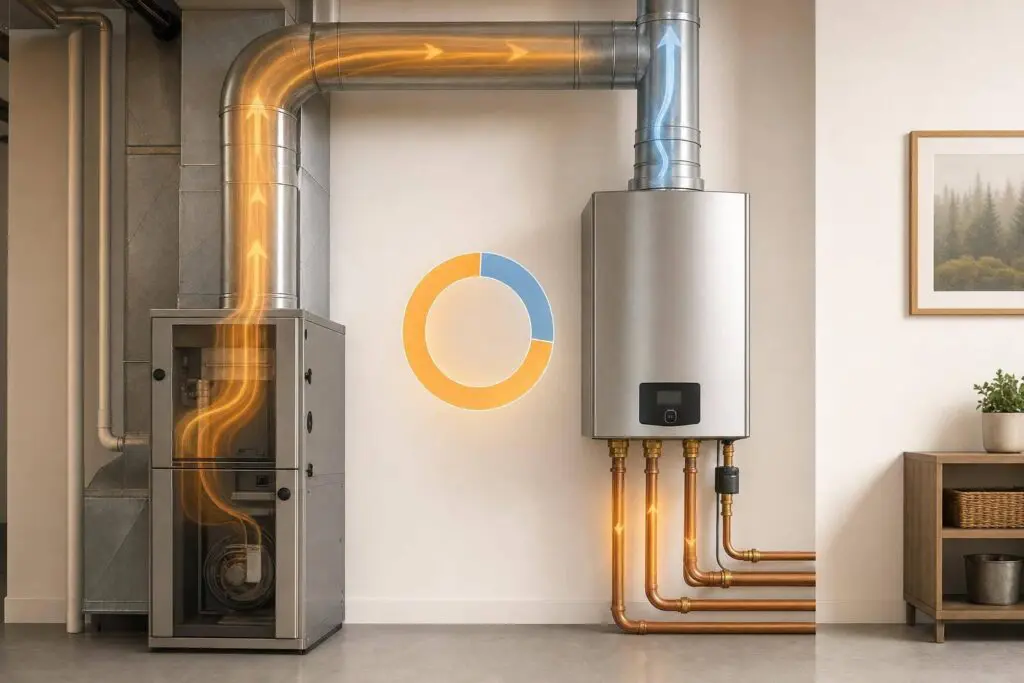
AFUE tells you how much of your fuel turns into heat. If a furnace is 95% AFUE, about $0.95 of every $1.00 you spend on fuel goes to heating your home, while about $0.05 is lost.
If I had to boil the whole topic down, it would be this:
- AFUE = fuel-to-heat efficiency
- Higher AFUE usually means lower gas or oil use
- 80% AFUE is the old baseline for many standard units
- 90% to 98.5% AFUE is common for high-efficiency condensing furnaces
- A 95% AFUE unit can cut heating costs compared with a 70% AFUE unit
- AFUE does not include electricity used by blowers or pumps
- AFUE also does not show duct leaks, poor sizing, bad setup, or skipped maintenance
That last point matters more than most people think.
A furnace can have a high AFUE rating on paper and still waste heat in the house if the ducts leak, the unit is oversized, or the install is poor. So when I look at AFUE, I treat it as a starting point, not the whole answer.
Here’s the short version of the main AFUE tiers:
| System type | Common AFUE range | What it usually means |
|---|---|---|
| Older furnace or boiler | 56%–70% | More fuel lost through exhaust |
| Standard non-condensing furnace | 80%–85% | Basic modern efficiency |
| High-efficiency condensing furnace | 90%–98.5% | Lower fuel waste; usually PVC venting |
| High-efficiency boiler | 90%–96% | Lower fuel use; condensing design |
For cold places like Chicagoland, these numbers can have a bigger effect because heating systems often run for 5 to 6 months a year. In that kind of climate, the gap between 70% AFUE and 95% AFUE can mean hundreds of dollars per year in fuel costs.
So if you’re shopping for a furnace or boiler, the simple takeaway is this: check the AFUE rating, but also look at venting, sizing, ductwork, install quality, and rebates before you decide.
How AFUE Is Calculated and Tested
The AFUE Formula Explained
AFUE is the percentage you see on the equipment label. Here’s how that number is figured:
AFUE = (Annual heat output in BTUs ÷ Annual fuel input in BTUs) × 100
Put simply, AFUE shows how much of the fuel a system turns into usable heat over a heating season. The higher the percentage, the more heat you get from the fuel you pay for.
What AFUE Includes and Leaves Out
AFUE accounts for start-up, shutdown, and standby losses, but it does not include electricity used by blowers, inducer fans, and circulator pumps. So AFUE looks at fuel-to-heat efficiency only.
That’s an important detail. A furnace can post a strong AFUE rating and still use extra electricity in day-to-day operation. In other words, AFUE is not a measure of total system efficiency.
Why Lab Ratings and Field Performance Can Differ
AFUE is tested in a controlled lab under ANSI/ASHRAE 103 standards. That makes it a benchmark, not a promise of what will happen in your home.
In the field, performance can come in lower. Common reasons include:
- Duct leakage
- Heat loss in piping
- Poor setup
- Weak maintenance
So while AFUE is a useful way to compare equipment, it doesn’t tell the whole story once furnace installation and upkeep enter the picture.
Next, compare AFUE tiers and U.S. minimum standards.
sbb-itb-b5c10b1
AFUE Furnace Ratings | What Does It Mean?
AFUE Ratings, Efficiency Tiers, and U.S. Minimum Standards
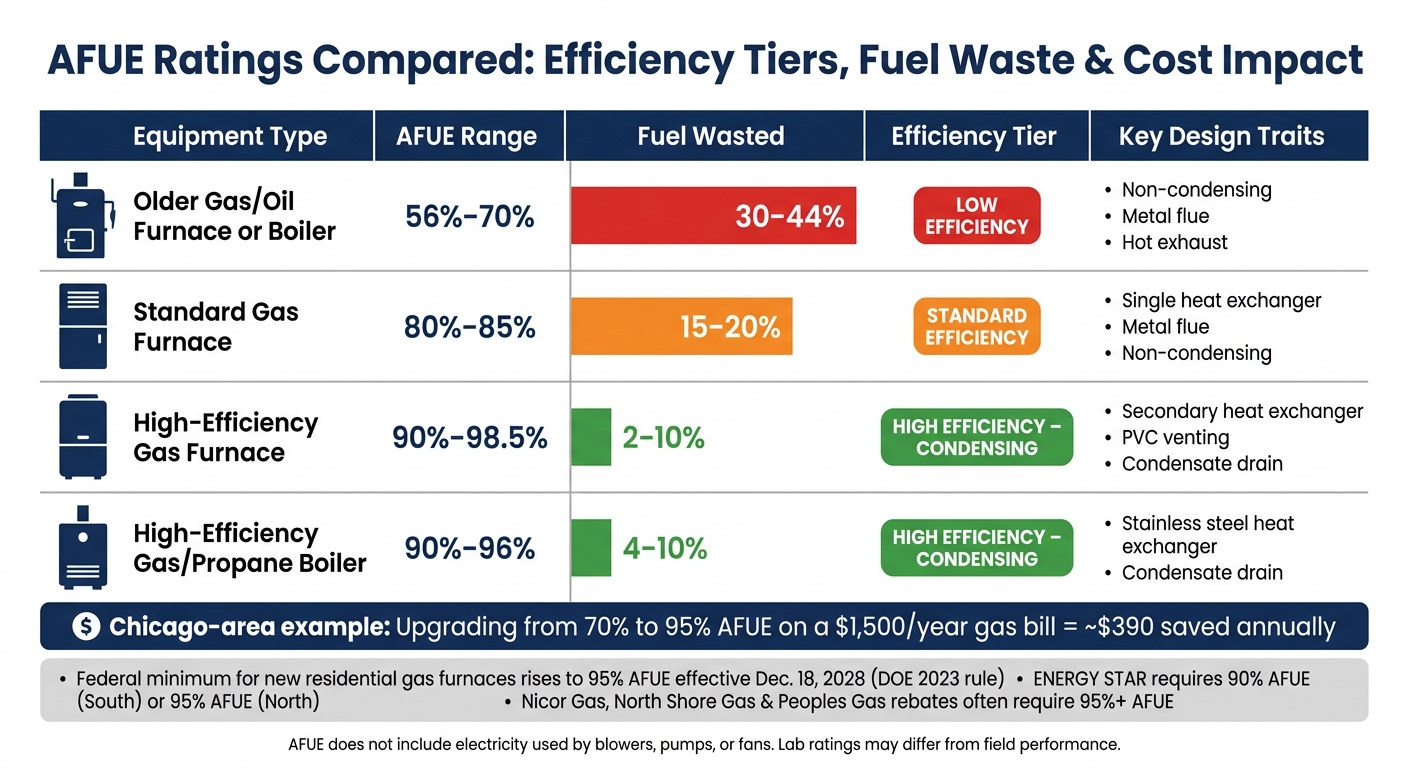
AFUE Ratings Compared: Efficiency Tiers, Fuel Waste & Cost Impact
Common AFUE Ranges for Furnaces and Boilers
Most systems land in three main ranges: 56–70% AFUE for older units, 80–85% for standard non-condensing units, and 90–98.5% for high-efficiency condensing units.
Once you get above 90% AFUE, most gas systems are condensing models. That usually means a secondary heat exchanger and PVC venting.
Federal rules have shifted the market, too. Since 2015, 80% AFUE has been the federal minimum for non-weatherized gas furnaces. A 2023 DOE rule pushes that minimum to 95% for new residential gas furnaces manufactured on or after Dec. 18, 2028. In plain terms, newer gas furnaces are moving toward condensing systems as the default.
Where to Find the AFUE Rating
After you know the rough tier, check the exact rating on the label or spec sheet. Start with the yellow EnergyGuide label. Manufacturer spec sheets and the nameplate also list the AFUE, input, and model number. The EnergyGuide label also helps you see how a unit stacks up against similar models.
ENERGY STAR units have to hit set cutoffs: 90% AFUE or higher in the U.S. South and 95% or higher in the U.S. North. Rebate paperwork can help too. In the Chicagoland area, utility rebate programs often require at least 95% AFUE for eligibility.
Comparison Table: Common AFUE Tiers for Furnaces and Boilers
Use these tiers as a quick way to compare models side by side.
| Equipment Type | Typical AFUE Range | Efficiency Tier | Key Design Traits | Heat Delivered vs. Fuel Wasted |
|---|---|---|---|---|
| Older gas/oil furnace or boiler | 56–70% | Low efficiency | Non-condensing; metal flue; hot exhaust | Wastes ~30–44% of fuel; highest bills |
| Standard gas furnace | 80–85% | Standard efficiency | Non-condensing; single heat exchanger; metal flue | Wastes ~15–20% of fuel; modern baseline |
| High-efficiency gas furnace | 90–98.5% | High efficiency (condensing) | Secondary heat exchanger; PVC venting; condensate drain | Wastes ~2–10% of fuel; lowest fuel use |
| High-efficiency gas or propane boiler | 90–96% | High efficiency (condensing) | Secondary heat exchanger; stainless steel heat exchanger; condensate drain | Significant reduction in gas consumption |
Why AFUE Matters for Operating Cost, Comfort, and Upgrades
How AFUE Affects Heating Bills
A higher AFUE means more of the money you spend on heat turns into usable heat inside your home. And over a full heating season, that gap can add up fast.
For example, a Chicago-area home spending $1,500 per year on gas with a 70% AFUE furnace could save about $390 per year by moving to 95% AFUE. That’s not pocket change.
A simple way to estimate savings is to compare your current AFUE with the AFUE of the new system, line that up with your annual heating cost, and then divide the extra upfront cost by the yearly savings to get a rough payback period.
When winters drag on for months, those savings have more time to stack up.
Why High AFUE Matters More in Chicagoland
In Chicagoland, AFUE tends to matter more in dollar terms because the heating season is long. Furnaces and boilers run more often and for more months, so there’s more room for a higher-AFUE system to cut fuel use.
That’s also why utility rebates can make these systems more appealing. Providers such as Nicor Gas, North Shore Gas, and Peoples Gas often offer rebates for furnaces in the 95% to 98% AFUE range.
Still, the number on the label doesn’t tell the whole story.
What AFUE Does Not Tell You on Its Own
AFUE does not account for system sizing, duct losses, install quality, or maintenance. And each of those can chip away at how the system performs in an actual home.
An oversized furnace can short-cycle, which wastes start-up energy and lowers efficiency. Leaky ducts running through an uninsulated attic or crawl space can lose heat before it ever reaches the rooms you live in, which cuts the delivered efficiency of even a high-AFUE furnace. Dirty heat exchangers, clogged filters, and skipped tune-ups can also pull efficiency down over time.
So while AFUE is a useful starting point, it makes more sense when you look at it alongside install quality, proper sizing, and venting details.
Using AFUE to Choose a Furnace or Boiler
What to Compare Beyond the AFUE Number
AFUE is the starting point. After that, the job is to match the system to your fuel, venting, and heating load.
When you compare furnace or boiler options, look past the sticker. Installed performance depends on a few practical details: fuel cost, venting, sizing, controls, and incentives.
- Fuel type: Compare AFUE with local fuel prices and seasonal demand. In Chicagoland, natural gas usually has a lower heating cost per BTU than propane or oil.
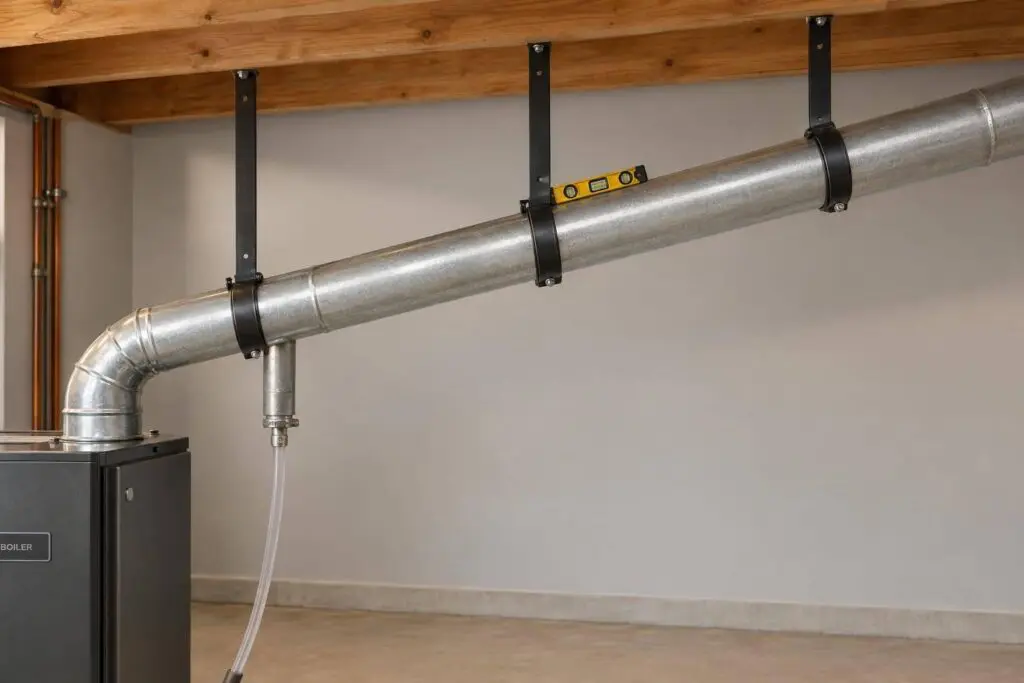
- Venting design: Condensing furnaces and boilers need PVC or polypropylene venting and a condensate drain. Non-condensing units may be able to reuse a metal flue or masonry chimney.
- Equipment sizing: Match the unit to a Manual J load calculation before you compare AFUE numbers.
- Controls: Two-stage or modulating burners with variable-speed blowers can cut short-cycling and make the home feel more even.
- Incentives: Local utilities such as Nicor Gas, North Shore Gas, and Peoples Gas may offer rebates for high-efficiency equipment, and gas furnaces at or above 97% AFUE may qualify for federal tax credits. That can lower the installed cost enough to shift the payback.
Once the venting works for the home, it makes sense to compare controls and sizing side by side. That’s often where the day-to-day comfort difference shows up.
How Eco Temp HVAC Helps with Efficient Heating Decisions

Eco Temp HVAC can inspect your current furnace or boiler, troubleshoot common furnace problems, verify the AFUE rating, review venting and ductwork, and size replacement equipment the right way for Chicagoland homes and businesses. Those checks help the system run closer to its rated AFUE.
Key Points to Remember About AFUE
The label rating is only the first step. Installation quality, proper sizing, duct condition, venting, and regular maintenance all play a part in how close your system gets to its rated AFUE in daily use.
Pick the system that fits your fuel, venting, and heating load, not just the one with the highest AFUE.
FAQs
Is a higher AFUE always worth the extra cost?
Not always. A higher AFUE only makes sense if the added upfront cost lines up with the energy savings you’ll get over time. Your local climate plays a big part too.
In colder areas like Chicagoland, high-efficiency systems often cut utility bills enough to make that extra cost worth it. The best value usually comes from pairing the right efficiency level and system size with your home’s heating needs and ductwork.
Can a high-AFUE furnace still waste energy?
Yes. A high-AFUE furnace can still waste energy.
Here’s why: AFUE only measures the furnace itself. It does not measure how well the full heating system delivers that heat through your home.
So even if the equipment looks efficient on paper, heat can still slip away through leaky ducts or uninsulated piping in attics, garages, or crawl spaces. And that loss isn’t small. In some homes, it can account for up to 35% of a furnace’s energy output.
How do I find my furnace or boiler’s AFUE?
Check the yellow EnergyGuide label on your furnace or boiler. It shows the unit’s AFUE rating, which the Federal Trade Commission requires.
You can also verify the rating in the AHRI Directory or in the manufacturer’s documentation. If you’re not sure what you’re looking at, Eco Temp HVAC can help identify your system’s efficiency with a professional assessment in the Chicagoland area.