
A new expansion tank won’t stop pressure from climbing if it’s incorrectly charged, too small, or blocked from the boiler loop. I’d start by comparing cold, hot, and cooled pressure readings – using existing readings if another heating cycle could be unsafe.
- Pressure climbs during heating: Have a technician check the tank’s connection, isolation valve, size, and air precharge. Precharge must be checked with 0 psi on the tank’s water side.
- Pressure creeps up while cold: Have the fill valve, bypass, and other possible water-entry paths checked.
- After repairs: Verify stable pressure through a complete heat-and-cool cycle.
Many residential boilers use a 30-psi relief valve, but your system’s specified limit applies. <u>If pressure approaches that limit or the relief pipe discharges, shut down safely and call for expert boiler repair.</u> Don’t repeatedly drain water or block the relief outlet. The goal is to fix the cause – not just lower the gauge reading.
Boiler Pressure Rising After a New Expansion Tank?
Pressurizing an Expansion Vessel
Record Boiler Pressure When Cold, Hot, and Cooled
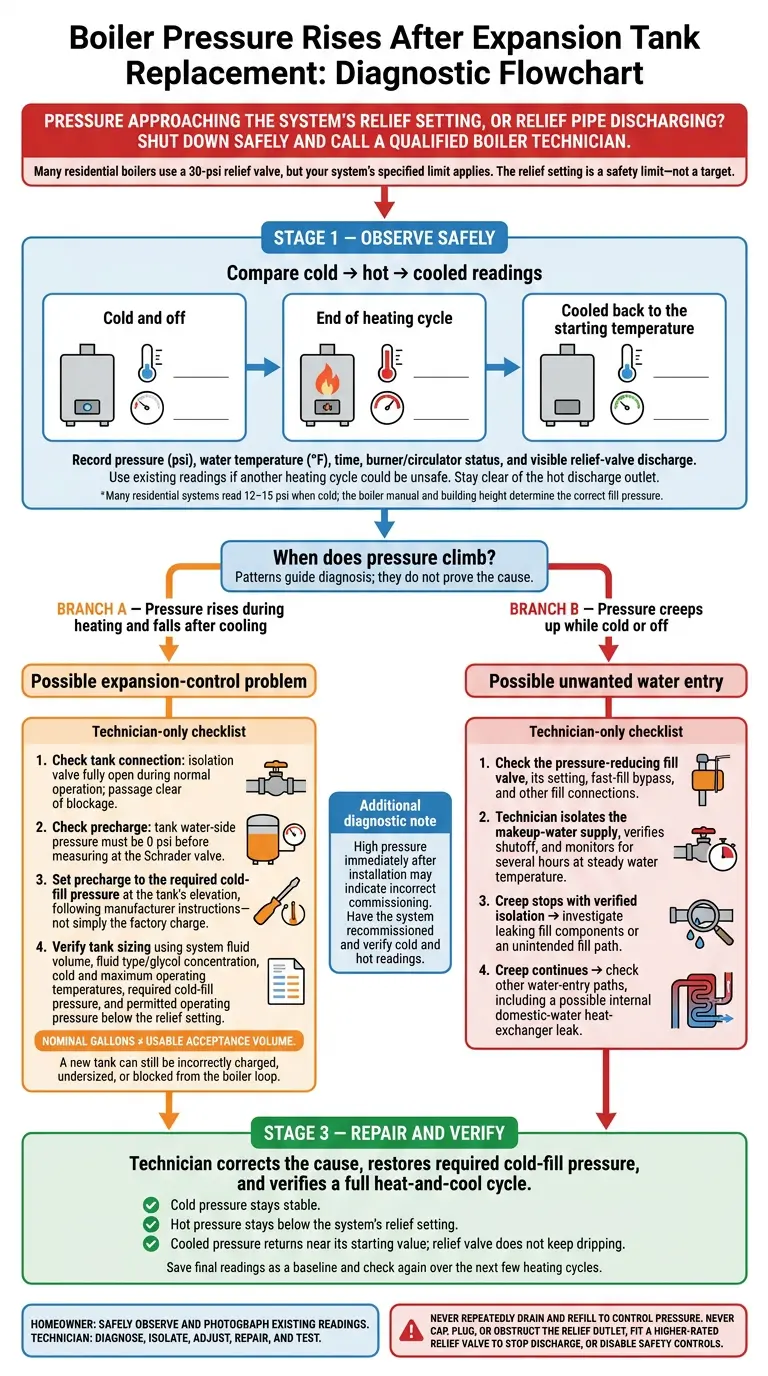
Record boiler pressure in psi and water temperature in °F at three points: when the system is cold and off, at the end of a heating cycle, and after it cools back to the starting temperature. Include the time, whether the burner or circulator is running, and any visible relief-valve discharge.
Many residential systems read 12–15 psi when cold, but the boiler manual and building height determine the correct fill pressure.
Use existing readings if another heating cycle could bring pressure near the relief setting or if the relief valve is discharging. The relief setting is a safety limit – not a target. Leave gauge checks and fill-line isolation to a technician.
Compare Heating Pressure Changes With Cold Pressure Creep
Check whether pressure tracks water temperature or keeps climbing without heat. These patterns don’t prove the cause, but they can guide the next diagnostic step.
| Pressure behavior | Visible symptoms | Likely cause | Corrective action |
|---|---|---|---|
| Large rise during heating; falls after cooling | Gauge swings with water temperature | Incorrect precharge, undersized tank, closed tank valve, or blocked connection | Have a technician check tank size, connection, valve position, and precharge |
| Gradual rise while cold or off | Gauge climbs without a temperature increase | Leaking fill valve or another unwanted water-entry path | Have the fill assembly tested |
| High pressure immediately after installation | Excessive cold reading or steep first-cycle rise | Incorrect commissioning | Recommission the system and verify stable cold and hot readings |
| Relief-valve discharge | Dripping or flowing water at the discharge pipe | Overpressure or a valve that has not reseated | Stop unsafe operation and get prompt service; never cap, plug, or replace the valve with a higher-rated valve |
Note whether the relief valve discharged water during the cycle. Stay clear of the hot discharge outlet.
If pressure rises with heat, have the tank inspected next. If it rises while cold, have the fill assembly inspected.
Check the Expansion Tank Connection, Precharge, and Size
Even a new tank can let pressure climb if its connection is blocked, its precharge is wrong, or it’s too small. Leave pressure adjustments to a qualified boiler technician.
Check for a Closed Tank Valve or Blocked Connection
Any isolation valve between the tank and heating loop must stay fully open during normal operation. Have the technician check the piping, the tank orientation required by the manufacturer, and the connection point near the air separator and circulator.
The nipple, adapter, and separator fitting also need checks for sealant, debris, sludge, and corrosion. A blocked passage can look like a failed tank. Before removing any fittings, the technician must safely isolate, cool, and depressurize the system.
If the valve is open and the connection is clear, check precharge next.
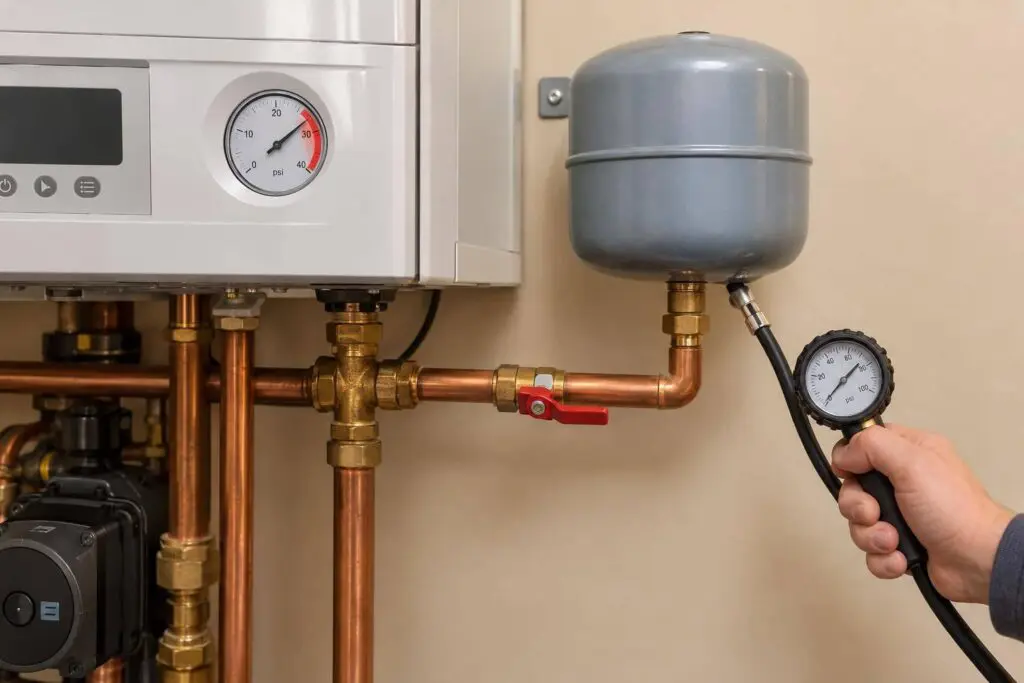
Measure Precharge With Water-Side Pressure at Zero
The technician should shut down the boiler, prevent accidental firing, and let it cool. If suitable valves are available, they can isolate the tank. Otherwise, they must safely depressurize the system.
Water pressure at the tank must be 0 psi before checking precharge at the Schrader valve. System pressure can skew the reading. Following the manufacturer’s instructions, set precharge to the required cold-fill pressure at the tank’s elevation – not simply the factory charge. Then restore system pressure and recheck both cold and hot readings.
Low precharge lets water enter too early, leaving less room for expansion. Too much precharge keeps water out until system pressure exceeds the air charge. Water coming from the Schrader valve generally points to a failed diaphragm or bladder, even in a newly installed tank.
Size the Tank for System Volume and Temperature
Use the manufacturer’s sizing calculation, accounting for:
- Water volume in the boiler, piping, radiators, radiant tubing, coils, and other connected equipment, plus fluid type and glycol concentration.
- Cold and maximum operating temperatures, required cold-fill pressure, and permitted operating pressure below the relief setting.
Nominal gallons aren’t the same as usable acceptance volume. Part of the tank must hold the air cushion. Don’t simply match the old tank’s size, especially in systems with extensive radiant tubing, high-volume radiators, or small commercial systems. Choose the tank by calculated acceptance capacity – not its appearance or the boiler’s input rating.
If the tank is correctly connected, charged, and sized but pressure still climbs – especially while cold – check the fill assembly next.
Check the Fill Assembly and Confirm the Repair
If the tank checks out, check the fill assembly next. A leaking pressure-reducing fill valve, an incorrect setting, or an open fast-fill bypass can keep adding water even when the expansion tank works. Compare cold, hot, and cooled readings at matching temperatures – not just one high reading. Set the cold-fill pressure to the requirement for the boiler and building height.
Distinguish Fill-Valve Leakage From Thermal Expansion
A technician should isolate the makeup-water supply using the manufacturer-specified service valve, then monitor pressure for several hours while water temperature stays steady. The technician must confirm that the shutoff stops flow and check every bypass, temporary fill hose, and separate makeup-water connection.
| Cause | Pressure behavior | Isolation-test result | Corrective action |
|---|---|---|---|
| Passing fill valve | Cold pressure creeps upward without warming | Creep stops with verified supply isolation | Repair or replace the valve, check its adjustment, and inspect the check valve or strainer where applicable. |
| Open fast-fill bypass or fill connection | Pressure rises while water enters | Rise stops when the fill path is correctly closed | Close and secure the connection; repair valves that leak through. |
If pressure keeps climbing with the fill supply isolated, check for another water-entry path. This could include an internal domestic-water heat-exchanger leak in a combination boiler or indirect water-heater system.
Recommission the Boiler and Verify Stable Pressure
After correcting the fill path, restore the system and check pressure through a full heat-and-cool cycle. Follow this sequence:
- Homeowner and technician checks: If safe, the homeowner can shut down the boiler using normal controls, let it cool, and photograph pressure and temperature readings. Note any leaks or relief-pipe discharge without touching it. The technician reviews the cold, heating, and cooled readings, confirms that the tank valve is open and its connection is clear, verifies precharge at zero water-side pressure, and checks tank sizing.
- Technician repairs and refill: Correct leaking or misadjusted fill components, close unintended fill paths, refill to the required cold pressure, and purge as specified. Restore normal service-valve positions and inspect for leaks.
- Technician cycle test: Run one full heat-and-cool cycle, recording pressure and temperature when cold, hot, and cooled. Confirm that cold pressure stays stable, hot pressure stays below the relief setting, and the relief valve does not keep dripping.
Stable cold pressure and a normal hot-pressure rise confirm the repair.
If pressure still rises after tank replacement, never try to control it by repeatedly draining and refilling. Never plug or obstruct the relief outlet or disable safety controls. Continued dripping needs diagnosis. If pressure approaches the relief setting or discharge repeats, shut down when safe and get qualified service.
Conclusion: Correct the Cause and Verify Safe Pressure
A new tank doesn’t prove the problem is fixed. Pressure that climbs during heating usually points to an expansion-control problem. Pressure that creeps up while the boiler is cold points to unwanted water entry. Have a technician check the tank connection, precharge at zero water-side pressure, tank size, and fill assembly. After correcting those items, test the system through a new heat-and-cool cycle.
Use the readings to check the repair. Save the final readings as your baseline, then check them again over the next few heating cycles. Cold pressure should stay stable, hot pressure should remain below the relief setting, and the cooled reading should return near its starting value.
Stop and get professional service if pressure won’t stay stable, approaches the relief setting, or causes repeated relief-valve discharge. Do the same if you see leaks, aren’t sure about a valve’s position or function, or suspect the tank connection is blocked.
For boiler service in Chicagoland, Eco Temp HVAC provides installation, repair, and maintenance for residential and commercial systems.
FAQs
Could a faulty gauge explain my boiler’s high pressure?
A faulty gauge can show an incorrect reading, but it rarely explains pressure that stays high. Pressure spikes during heating cycles usually come from a failed or waterlogged expansion tank, incorrect precharge, or a faulty automatic fill valve that keeps adding water.
If readings stay high, have a professional inspect the system to check whether the pressure is too high or the gauge is faulty.
Can I add a second expansion tank instead of upsizing?
Yes – often, but both tanks need the right setup and pressure settings. Each tank’s precharge must match the boiler’s cold fill pressure at the tank connection. Otherwise, pressure can still climb toward the relief valve’s setting.
Check for blocked connections or closed isolation valves. Isolate each tank correctly before checking its precharge. If pressure keeps rising, the cause may be a faulty fill valve or a failed or waterlogged tank.
Will my relief valve need replacement after discharging?
Usually, no – provided the discharge is brief and pressure returns to normal once the cause is fixed. Repeated discharge or steady dripping may point to a faulty valve or mineral buildup. A technician should inspect the valve and may need to replace it.
If pressure reaches about 30 psi or higher when hot, the problem is more likely related to the expansion tank, its air charge, or the fill valve. That issue must be fixed to prevent further discharge.