
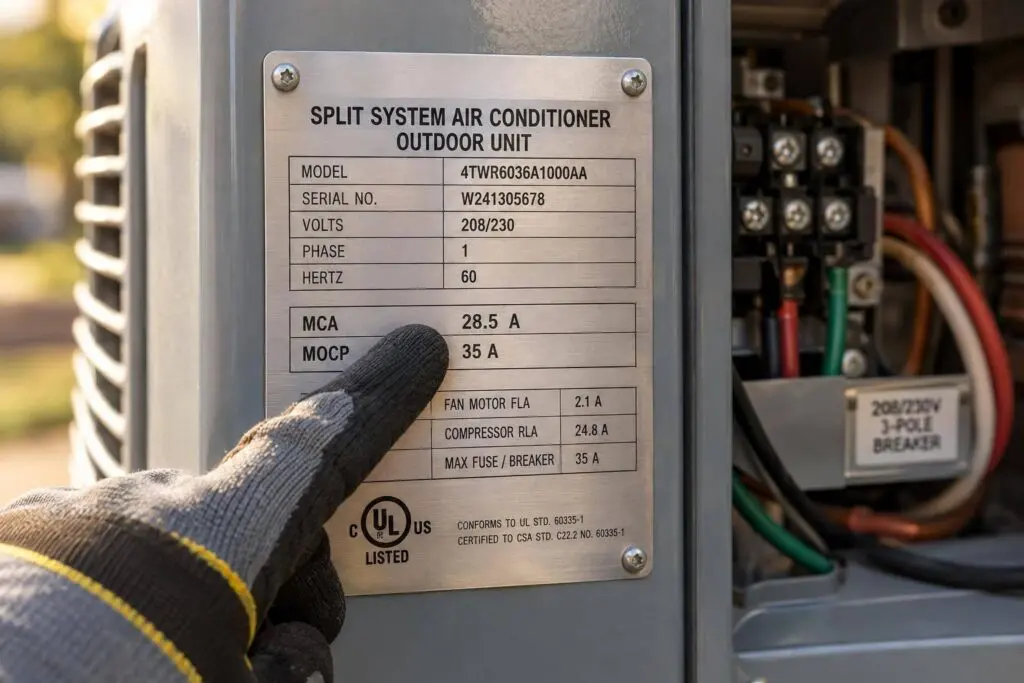
I use the AC nameplate – not tonnage – to check circuit requirements. A unit marked 22 A MCA and 35 A MOCP needs conductors with at least 22 A of allowable ampacity and a permitted breaker or fuse no larger than 35 A. That does not mean it requires a 35 A breaker.
Before a circuit is reused or power is restored, I check:
- The exact model and supply: Match the outdoor unit’s label, voltage, phase, and frequency.
- The wiring: Account for conductor material, heat, grouping, terminal limits, and voltage drop.
- The protection and installation: Verify the permitted breaker or fuse, disconnect, grounding, equipment pairing, and accessory circuits against the manual and locally adopted code.
<u>Matching tonnage does not prove an existing circuit is suitable.</u> Electrical checks belong to qualified personnel; unresolved conflicts between the label, manual, and installed circuit mean keeping the unit de-energized.
AC Nameplate Checks: MCA vs. MOCP
AC Breaker Size & Wire Size – The Nameplate Is LAW
Understand What MCA and MOCP Mean
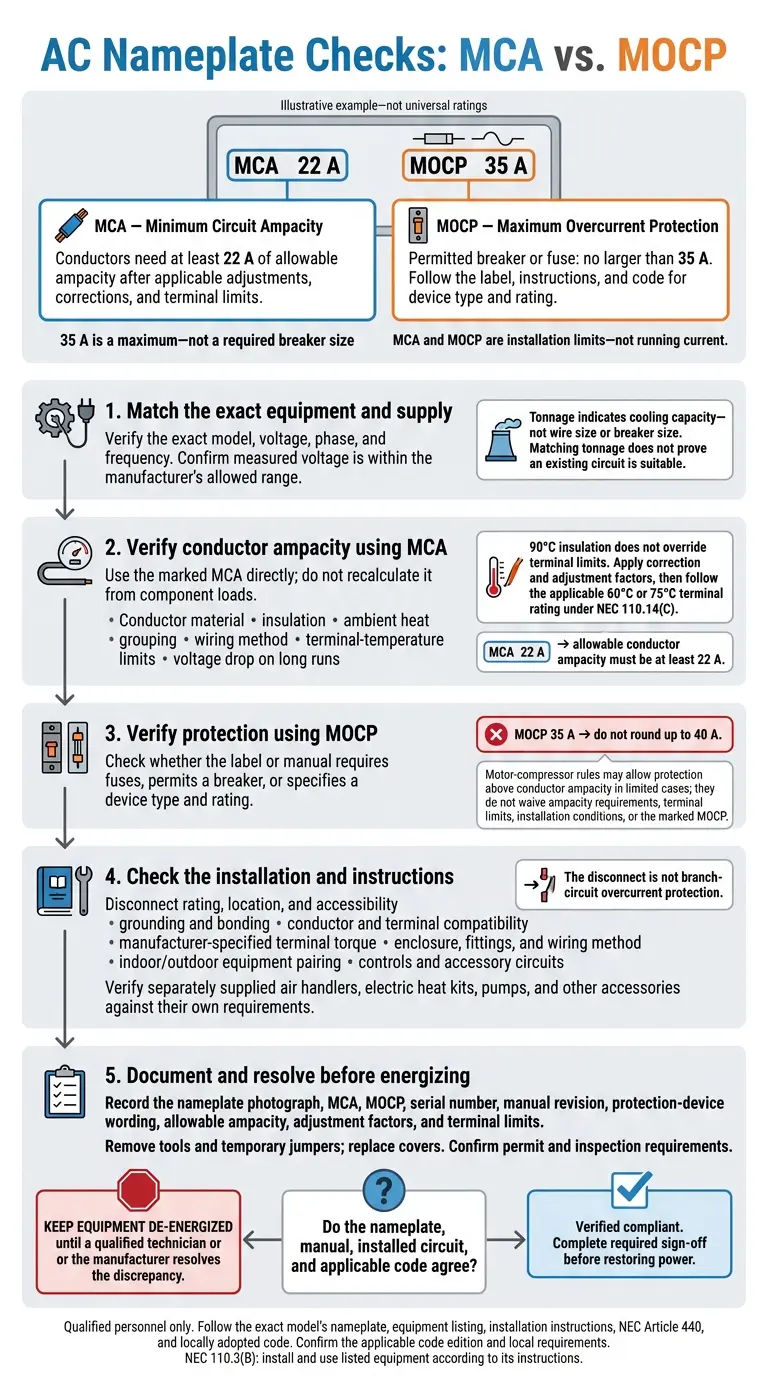
On the sample label above, MCA and MOCP set installation limits – not running current. Manufacturers calculate these ratings from the compressor, fan, controls, and other connected loads. MCA sets the minimum conductor ampacity. MOCP sets the largest allowed breaker or fuse and accounts for startup current.
Read MCA first to size the conductors, then MOCP to select the breaker or fuse.
Use MCA for Ampacity and MOCP for Protection
Rating Installation decision MCA – Minimum Circuit Ampacity On the sample label above, size conductors for at least 22 A of allowable ampacity after accounting for adjustment and correction factors, ambient temperature, bundling, installation method, and terminal-temperature limits. MOCP – Maximum Overcurrent Protection On the sample label above, select a fuse or breaker no larger than 35 A, using the device type required by the label, installation instructions, and code.
Motor-compressor equipment has special overcurrent-protection rules to allow for startup current. Those rules don’t waive conductor ampacity requirements, terminal ratings, or installation conditions.
Why Tonnage Does Not Determine Wire Size
Tonnage tells you cooling capacity, not electrical load. Units with similar cooling capacity can have different compressors, fan motors, controls, voltage, efficiency, and accessories. That means their MCA and MOCP can differ, too.
| Equipment information | What it tells the technician | What it cannot establish alone |
|---|---|---|
| Tonnage | Nominal cooling capacity | Wire size, breaker size, MCA, or MOCP |
| MCA | Minimum permitted supply-conductor ampacity | Wire gauge without checking installation conditions and terminal limits |
| MOCP | Largest permitted fuse or circuit-breaker rating | Breaker or fuse size without checking label wording and code |
| Voltage | Required supply voltage and, where shown, phase and frequency | Conductor ampacity, breaker rating, or existing-circuit suitability |
| Installation instructions | Required wiring methods, device types, disconnect details, and site-specific limitations | A substitute for verifying the actual nameplate and adopted code |
Don’t size wiring from tonnage, running amps, or the old circuit. Measured running current shows one operating condition – not every startup or connected-load requirement. Before reusing an existing circuit, check the replacement unit’s nameplate and instructions, even if the tonnage matches. Then compare those ratings with the installed conductors and overcurrent device.
Check the Wiring and Circuit Protection
Follow NEC Article 440, the locally adopted code, the equipment listing, and the installation manual. Confirm the code edition before reusing an existing circuit.
Verify Conductor Ampacity
Compare the nameplate limits with the installed circuit.
For the sample 22 A MCA, verify the installed conductors can carry the required allowable ampacity.
Check conductor material, insulation, terminal temperature limits, ambient heat, grouping, and wiring method. Use the marked MCA directly – don’t recalculate the load from the unit’s components.
90°C insulation does not override terminal limits. Apply correction and adjustment factors, then follow the applicable 60°C or 75°C terminal rating under NEC 110.14(C). For long runs, check voltage drop against the manufacturer’s limits, too.
Article 440 may allow overcurrent protection above conductor ampacity in limited cases, but never above the marked MOCP. Don’t rely on a generic breaker-to-wire shortcut.
After confirming conductor ampacity, check the overcurrent device against MOCP.
Check the Breaker or Fuse and Disconnect
Verify that the breaker or fuse and the disconnect meet the nameplate requirements.
For MOCP 35 A, do not round up to 40 A.
Check whether the nameplate or manual requires fuses, permits a breaker, or specifies a device type and rating.
Before reusing a residential or small-business circuit, check the disconnect’s rating, location, and accessibility. Also verify grounding, bonding, and terminal compatibility with the conductor size and material.
The disconnect is not branch-circuit overcurrent protection. Resolve unclear requirements with the authority having jurisdiction or a qualified electrical professional before restoring power.
Review the Installation Before Energizing
Once the conductor and breaker checks pass, compare the installation with the exact model’s manual and listing before turning on power. NEC 110.3(B) requires listed equipment to be installed and used according to its instructions.
Use the checklist below to confirm that MCA, MOCP, and the installation match the manual before restoring power.
Follow the Technician’s Final Checklist
- Verify the supply: Confirm voltage, phase, and frequency. Check that the measured supply voltage falls within the manufacturer’s allowed range.
- Complete the records: File the nameplate photograph, MCA, MOCP, serial number, manual revision, and protection-device wording with the installation records.
- Sign off on conductor checks: Document allowable ampacity, adjustment factors, and terminal temperature limits. Tighten terminals to the manufacturer’s specified torque.
- Match the protection device to the label: Use the permitted fuse or breaker type, and never exceed MOCP.
- Finish the physical inspection: Check grounding, bonding, terminals, enclosure, fittings, and wiring method. Remove tools and temporary jumpers, then replace covers.
- Check system pairing and accessory loads: Confirm indoor/outdoor equipment pairing, required controls, and circuit requirements for separately supplied air handlers, electric heat kits, pumps, and other accessories.
Check permit and inspection requirements with the authority having jurisdiction. Local amendments and procedures vary.
If the nameplate, manual, or installed components disagree, keep the equipment de-energized until a qualified technician or the manufacturer resolves the discrepancy.
Conclusion: Follow the Nameplate, Manual, and Code
Once you’ve checked the conductors and protection, apply this rule:
In the sample label, MCA governs conductor ampacity and MOCP limits the breaker or fuse size.
Use the exact model’s ratings, its installation instructions, and the applicable code. Matching tonnage alone does NOT mean you can reuse an existing circuit.
FAQs
How do I choose a breaker below the MOCP limit?
Use the nameplate’s Maximum Overcurrent Protection (MOCP) – not the unit’s tonnage – to determine the breaker’s upper limit. A breaker rated below the MOCP is acceptable if it handles the system’s electrical needs, including the compressor’s startup surge.
Size the wiring to meet the nameplate’s Minimum Circuit Ampacity (MCA), and follow the installation instructions. Always consult a licensed electrician for 240V circuit work.
What if my AC nameplate is unreadable?
If your AC nameplate is unreadable, don’t guess its electrical requirements based on system tonnage or past installations. The wrong wire or breaker size can cause a fire or damage your equipment. Contact a professional technician to assess your system.
Eco Temp HVAC offers diagnostic and installation services across Chicagoland to check that your equipment is correctly rated and safely connected in accordance with the National Electrical Code.
Why does my AC trip a correctly sized breaker?
If your AC trips a breaker that seems correctly sized, the problem may be the installation or an electrical fault – not the breaker’s rating.
Possible causes include loose or oxidized connections that produce heat, wiring that’s too small for the run length and causes voltage drop, faulty grounding, or an internal short circuit.
Check the nameplate’s maximum overcurrent protection (MOCP) rating and the installation instructions, including whether the manufacturer requires an HACR-labeled breaker.