
If your boiler pressure is off, the fix usually comes down to 3 things: remove extra water, add missing water, or find the bad part. In most U.S. hot-water boilers, cold pressure should sit around 12 to 15 psi. When the system heats up, it often moves to about 20 to 25 psi. If it hits 30 psi, the relief valve may dump water.
Here’s the short version:
- Pressure too high when cold often means the system was overfilled.
- Pressure keeps climbing while heating often points to an expansion tank problem.
- Pressure too low often happens after bleeding radiators or from a small leak.
- Dripping from the relief valve pipe means you should not ignore it.
- If pressure keeps changing after you reset it once, call a pro.
What I’d check first:
- Read the gauge when the boiler is cold
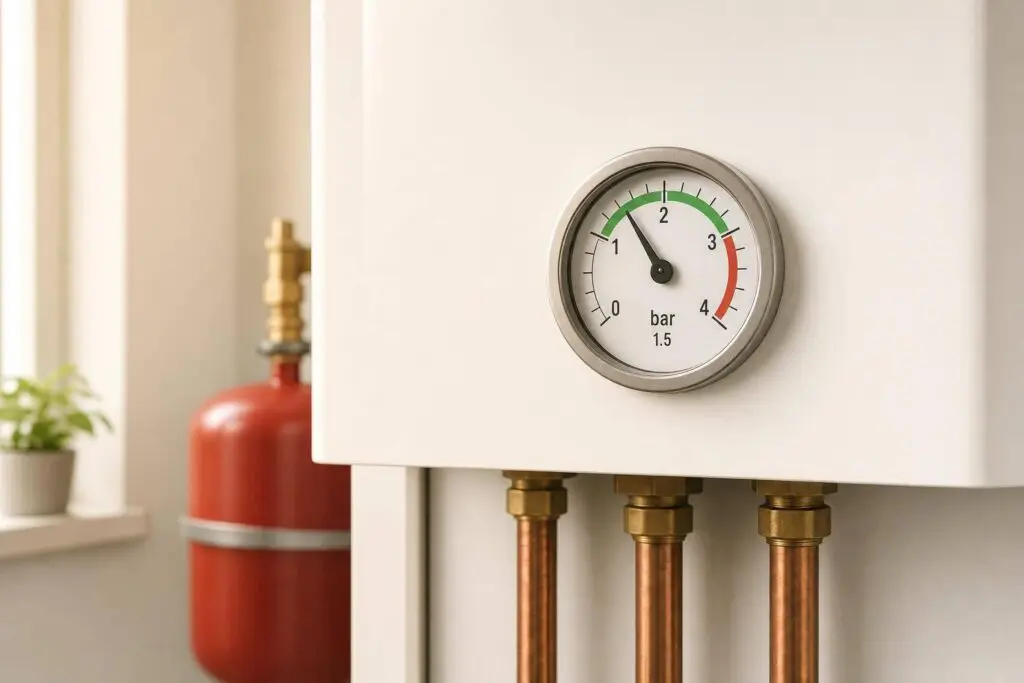
- Look for a pressure range of 12–15 psi
- If pressure is high, make sure the fill valves are fully closed
- If pressure is low, add water slowly
- If the gauge keeps moving out of range, stop resetting it again and again
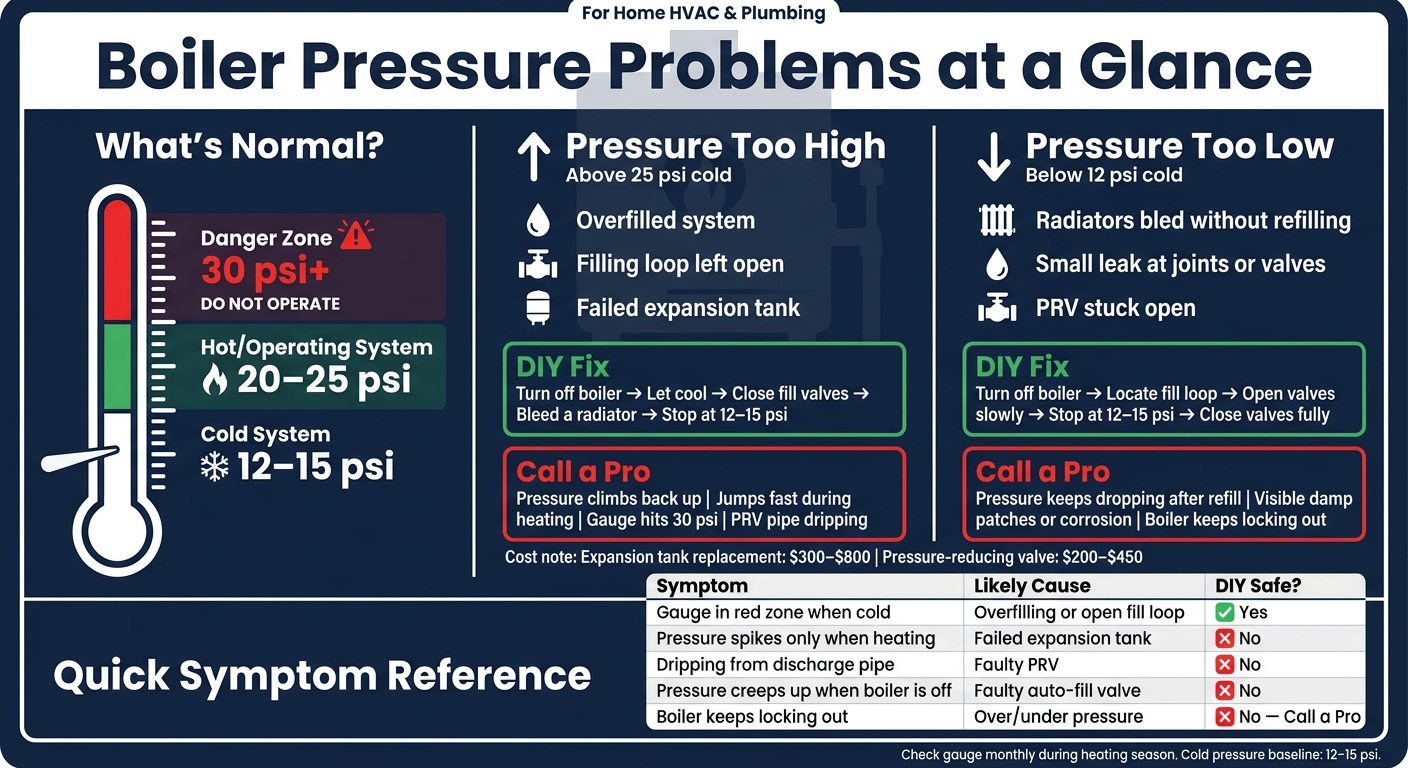
Boiler Pressure Problems: Causes, Fixes & When to Call a Pro
Boiler Pressure TOO High | How to Reduce Water Pressure DIY Guide
sbb-itb-b5c10b1
Quick Comparison
| Issue | Common cause | What I’d do first | When to stop DIY |
|---|---|---|---|
| High pressure | Overfilled system, fill valve left open | Bleed a little water and check the gauge | If it climbs back up or nears 30 psi |
| Low pressure | Water lost from bleeding or a leak | Add water slowly to 12–15 psi cold | If it keeps dropping |
| Pressure swings a lot when heating | Expansion tank trouble | Watch cold vs. hot readings | If hot pressure jumps fast |
| Relief pipe dripping | Relief valve opened or valve fault | Shut boiler off and inspect | If dripping does not stop |
| Boiler lockout | Pressure too low or too high | Check gauge before reset | If lockout keeps coming back |
A steady gauge is the goal. A small change from cold to hot is normal. A big swing usually means there’s more going on than a simple top-up.
Boiler Pressure Too High: Causes and Fixes
Why Boiler Pressure Gets Too High
High boiler pressure usually comes down to one of three things: too much water in the system, a filling loop that wasn’t shut all the way, or a part that has failed. If you bleed the pressure down and it keeps coming back, that usually narrows it down fast.
The most common cause is overfilling. That happens when too much water is added while repressurizing the system. Another common issue is a filling loop left open. This is the loop under the boiler that connects to the cold-water supply. If those valves aren’t fully closed after a top-up, water keeps feeding into the system and the pressure keeps climbing.
| Symptom | Likely Cause | DIY Safe? |
|---|---|---|
| Gauge in red zone while system is cold | Overfilling or open filling loop | Yes – bleed radiators |
| Pressure spikes only when heating is on | Failed or waterlogged expansion tank | No – requires a pro |
| Constant dripping from the discharge pipe | Faulty pressure relief valve (PRV) | No – requires a pro |
| Pressure creeps up while the boiler is off | Faulty auto-fill or pressure-reducing valve | No – requires a pro |
| Gauge reaches 30 psi and the boiler locks out | Critical over-pressurization | No – call a pro immediately |
How to Lower Boiler Pressure Safely
If the gauge reads above 25 psi while the system is cold, the fix is often pretty simple. The main thing is to go slowly and do it in the right order.
- Turn the boiler off at the power switch.
- Let it cool all the way down. A hot boiler can burn you, and rushing water into the system can harm the heat exchanger.
- Check the filling loop valves and make sure they’re fully closed.
- Bleed a radiator using a radiator key. Open the bleed valve slowly counterclockwise and let a small amount of water drain into a container while you watch the boiler gauge.
- Stop when the pressure drops to about 12 to 15 psi for a cold system.
Never cap or disable a dripping pressure relief valve. That valve is the last line of defense against a dangerous pressure buildup.
If the pressure goes back up after you’ve closed the fill loop and bled a radiator, it’s time to look past overfilling and start thinking about a failed part.
When High Pressure Points to a Part Failure
Overfilling is usually a one-and-done fix. But if the pressure climbs back within a few days, or jumps fast as soon as the boiler starts heating, that points to an internal problem.
A failed expansion tank is one of the most common causes of pressure spikes during a heating cycle. The tank is there to absorb extra pressure as water heats up and expands. If the internal bladder ruptures or the tank becomes waterlogged, that pressure has nowhere to go. The result? The gauge can shoot up fast. A technician can test the tank’s charge and bladder.
A faulty automatic fill valve can also cause trouble by adding water when it shouldn’t. At that point, you’re outside safe DIY work. Expansion tank replacement usually costs $300 to $800 installed, while a pressure-reducing valve replacement often runs $200 to $450. A licensed technician can figure out which part failed and replace it. If the pressure keeps rising, stop resetting the system and get it inspected.
Boiler Pressure Too Low: Causes and Fixes
Why Boiler Pressure Drops Below Normal
If the gauge is too high, you usually fix it by bleeding off water. If it’s too low, you need to add water back in – carefully.
When pressure drops below the normal cold range, the boiler’s safety shutoff may keep the unit from firing to protect the heat exchanger and pump.
One of the most common causes is bleeding radiators and not topping the system back up afterward. Letting air out also lets some water out, so the pressure drops on the gauge. Small leaks at pipe joints, radiator valves, or around the boiler base can also bring pressure down over time.
A sudden drop usually points to an active leak. If the pressure keeps dropping after you refill it, that often means there’s a hidden leak or a failed part somewhere in the system.
Check for:
- Damp patches near pipe joints
- Green corrosion deposits on copper fittings
- Water stains on baseboards or ceilings
- Dripping from the discharge pipe outside, which can mean the pressure relief valve (PRV) opened during an earlier high-pressure spike
How to Add Pressure Using the Fill Valve
Once you’ve ruled out visible leaks, add pressure slowly through the fill valve. Go too fast, and it’s easy to overfill the system.
- Turn off the boiler and let it cool.
- Locate the filling loop hose – usually under the boiler with a valve on each end. Make sure both ends are attached securely before you open anything.
- Open both valves slowly until you hear water moving into the system. Watch the gauge closely because pressure can climb faster than you’d think.
- Stop at 12–15 psi (the green zone on most gauges). That’s the target for a cold system.
- Close both valves fully – perpendicular to the pipe – and disconnect the hose if local code requires it.
After refilling, turn the boiler back on and keep an eye on the gauge as the system heats up. The hot pressure should move only into the normal operating range. If it starts climbing toward 30 psi, the pressure relief valve may open.
What Recurring Pressure Loss Usually Means
If pressure keeps falling after a refill, this has moved past basic boiler maintenance.
"Ideally, you shouldn’t need to top up your boiler pressure very often. But if the pressure drops more than once or twice a year, check all visible pipes for signs of water leaks." – EDF Energy
Recurring pressure loss usually points to one of these problems:
- A hidden leak in pipework, radiators, or valves
- A waterlogged expansion tank
- A PRV stuck open
- A faulty automatic fill valve
- An internal heat exchanger failure
If the pressure drops right after the heating cycle ends, the expansion tank is likely no longer absorbing thermal expansion.
At that stage, a technician should inspect the system for hidden leaks or failing parts. If pressure keeps dropping after a refill, stop topping it up and call a technician.
How to Prevent Future Pressure Problems
Once you fix the pressure issue, the next step is simple: keep an eye on the system so it doesn’t slip out of range again. A few routine checks can stop the same headache from coming back.
Checking Pressure During Heating Season
Check the gauge once a month during heating season, and also after bleeding radiators or after any service visit. It also makes sense to check it more often during the first cold snap or during a long deep freeze.
Write down the cold-pressure reading and use it as your baseline. Then watch for white mineral deposits or rust stains around visible joints, since both can hint at a slow leak. Keep an eye out for drips from the pressure relief valve discharge pipe too, or cold spots that keep coming back after bleeding.
Annual Service for Expansion Tanks, Fill Valves, and Relief Valves
If the pressure keeps drifting even after you top it up, have the key parts checked once a year. A technician should inspect the expansion tank, pressure relief valve, and fill valve during annual service, and swap out any part that is worn or sticking.
A waterlogged expansion tank is a common reason pressure climbs during heating cycles. During service, the technician should check the tank’s air charge, inspect the PRV for corrosion or mineral buildup, and make sure the fill valve is not stuck open or clogged with sediment.
Eco Temp HVAC provides boiler maintenance and repair for residential and commercial properties across Chicagoland, with 24/7 urgent service.
Conclusion: Fix the Pressure Problem and Know When to Call a Pro
Once you deal with the immediate pressure issue, the next job is figuring out what that pattern is telling you. In most cases, boiler pressure trouble comes back to overfilling, leaks, or a part that has failed.
Your boiler’s cold pressure should stay within the range your system calls for. When the system heats up, that pressure should go up a little, not spike.
Simple tasks like bleeding a radiator or topping up a low-pressure system are often fine for a homeowner to handle. But after that, the gauge should stay steady. If it doesn’t, you’re no longer dealing with basic upkeep.
If pressure keeps dropping or climbing again after a reset, there’s likely a leak or a failed part in the system, and it’s time to bring in a technician.
If the PRV discharge pipe keeps dripping or the gauge is climbing past 30 psi, shut the boiler off and call a technician. If the boiler keeps locking out, stop troubleshooting and call a pro.
Eco Temp HVAC offers boiler repair and maintenance in Chicagoland, including 24/7 service.
FAQs
What boiler pressure is normal?
For most residential boilers, normal pressure is 1.0 to 1.5 bar when the system is cold and off. Once the heat kicks on, the pressure usually climbs a bit to around 1.5 to 2.0 bar.
In U.S. systems, that usually works out to about 12 psi when cold and under 20 psi when hot. If the reading goes above 2.5 to 3.0 bar or drops below 1.0 bar, that can point to a problem.
Why does boiler pressure keep changing?
Boiler pressure will change a bit on its own as water heats up and expands. That part is normal.
But if the pressure keeps swinging, or starts doing it often, that usually means something in the system isn’t working as it should.
Common causes include:
- Small leaks from pipes, radiators, or valves
- A failed expansion vessel, or one that’s become waterlogged
- Pressure dropping after you bleed radiators
- Pressure rising when the filling loop is left open and the system takes in too much water
When should I call a pro?
Call a professional if your boiler pressure keeps moving up and down. That kind of swing usually means there’s a deeper problem, and simple tweaks won’t fix it.
Get help right away if you notice active water leaks, water near electrical parts, a discharging pressure relief valve, loud banging or hissing, or a system that keeps cycling on and off. In the Chicagoland area, Eco Temp HVAC offers 24/7 service.