
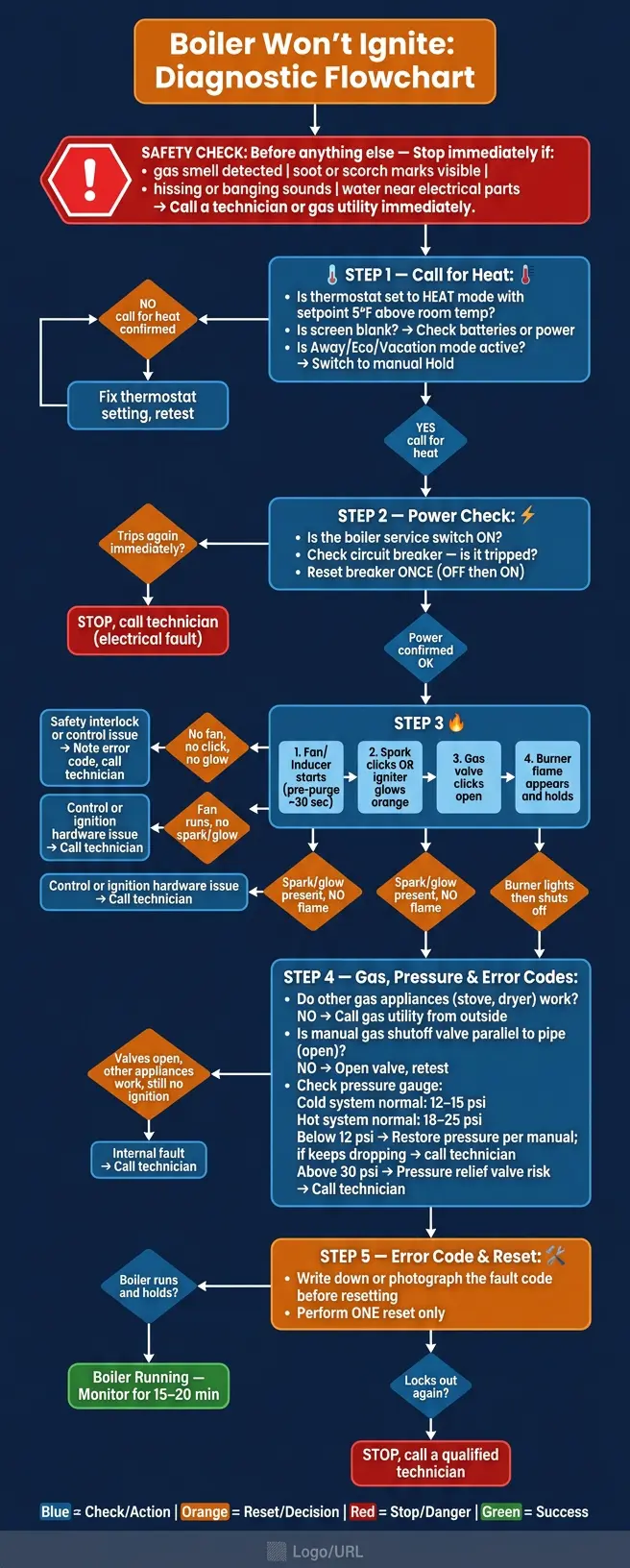
If your boiler won’t ignite, the first thing I’d do is check for danger signs and then follow the startup path in order. In most cases, the problem falls into one of six spots: no call for heat, no power, ignition sequence stops, no gas flow, low system pressure, or a lockout code.
Here’s the short version:
- Stop at once if you smell gas, see soot or scorch marks, hear hissing or banging, or find water near electrical parts.
- Set the thermostat to Heat and move the setting about 5°F above room temperature.
- Check the service switch and breaker. If the breaker trips again after one reset, stop.
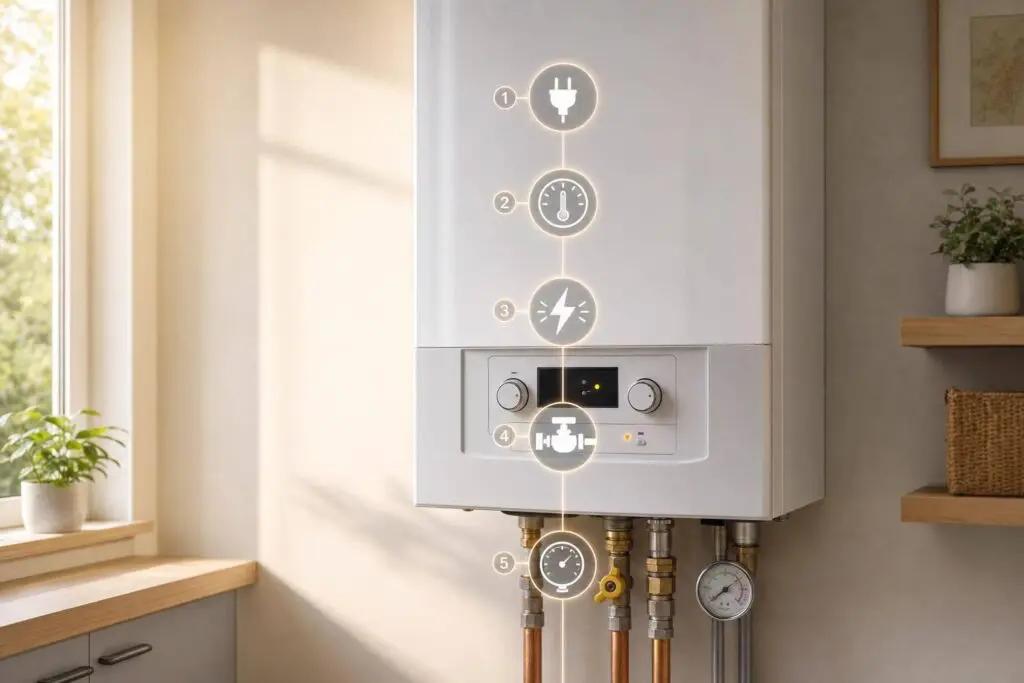
- Watch the startup sequence: fan, spark or glow, gas valve click, flame.
- If there’s spark or glow but no flame, look at gas supply and shutoff valves.
- Check system pressure. Many home boilers need about 12–15 psi when cold and often 18–25 psi when hot.
- Write down the error code before resetting. One reset is enough.
A lot of no-ignite calls come down to simple things like a thermostat setting, power loss, a closed gas valve, or pressure below 12 psi. And if the boiler lights and then shuts off, that often points to flame sensing, pressure, or another safety stop.
Use this page to narrow down where the failure starts so I can describe the issue clearly or know when it’s time to call a technician.
Boiler Not Igniting? Step-by-Step Troubleshooting Flowchart
Spark But No Flame? Weil McLain Steam Boiler Ignition Failure Explained
1. Confirm the Boiler Is Getting a Call to Heat
First, make sure the boiler is actually being told to turn on.
Check thermostat mode, setpoint, and schedule
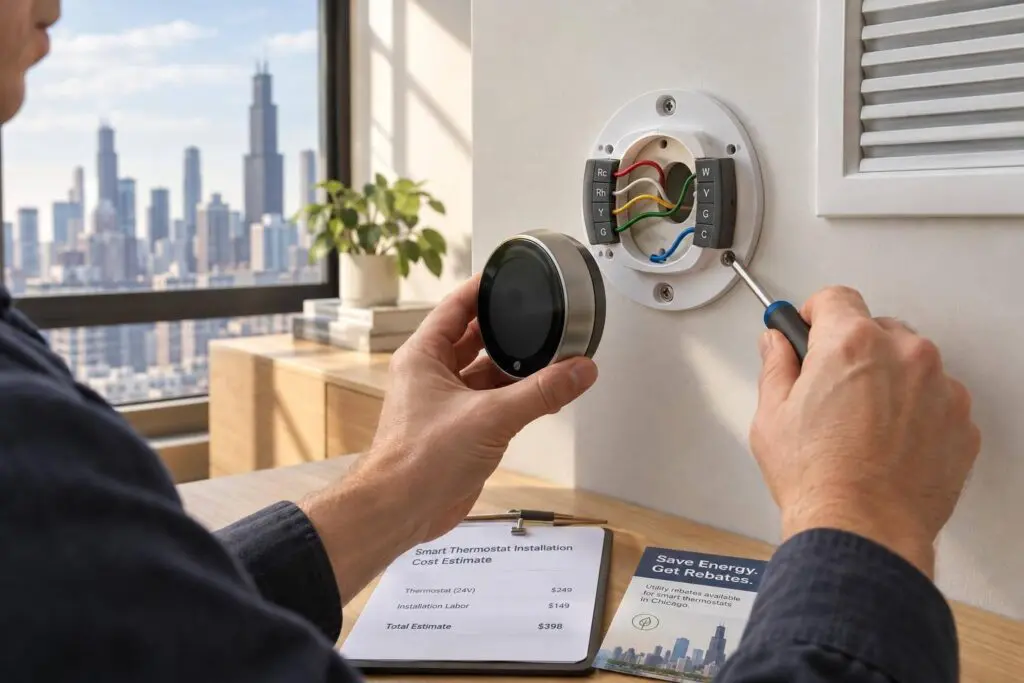
Start with the thermostat. Set it to Heat, not Cool or Off. Then look at the setpoint. It should be about 5°F above the current room temperature to trigger a call for heat.
Here’s a simple example: if the room is 68°F, set the thermostat to 73°F. Then give it a few minutes and see if the boiler reacts.
A blank thermostat screen usually points to dead batteries or a power problem. If you have a smart thermostat, check for Away, Eco, or Vacation mode. Those settings can stop the system from heating when you expect it to. Use a manual Hold while testing so the schedule doesn’t get in the way.
If the thermostat is calling for heat and the boiler is still silent, the problem is likely farther down the line.
Check the service switch and circuit breaker
If the thermostat looks fine but nothing happens, check the power next. Find the boiler service switch and make sure it’s set to ON.
Then head to the electrical panel and check the breaker for the boiler. A tripped breaker may sit halfway between ON and OFF, or it may have flipped all the way to OFF. Reset it one time: turn it fully OFF, then back ON. If it trips again right away, stop there.
That usually means there’s an electrical problem, like a short, bad wiring, or a failing part. Resetting it again can make the situation worse. At that point, it’s best to call a technician instead of pushing ahead on your own.
If both the thermostat and power checks look good, move on to the ignition sequence.
2. Watch the Ignition Sequence Step by Step
Once you’ve confirmed the boiler has power and is getting a call for heat, the next move is simple: watch what happens during startup. You’re trying to spot the first step that fails. If the boiler begins its startup routine but stops before flame appears, your next clues usually point to gas supply and pressure.
Identify whether the boiler uses a pilot, spark, or hot surface igniter
Before you watch the sequence, figure out what "normal" looks like for your boiler. In U.S. homes, boilers usually use one of three ignition types: standing pilot, intermittent pilot or spark system, or hot surface igniter (HSI).
A standing pilot keeps a small flame burning all the time. If you look through the sight glass near the burner area while the boiler is idle and see a small flame, that’s a standing pilot. That flame should look blue and steady. If it looks yellow or flickers, that’s a sign something isn’t right.
An intermittent pilot or spark system works differently. It doesn’t keep a flame on constantly. When the boiler gets a call for heat, you’ll usually hear rapid clicking as the spark electrode fires and lights the pilot flame before the main burner opens.
An HSI system also stays dark when idle, but instead of clicking, you’ll see a ceramic element glow bright orange before the gas valve opens. Many newer high-efficiency condensing boilers use HSI systems.
Check the rating plate or manual for terms like "standing pilot", "intermittent pilot," or "HSI."
Listen and look for fan, clicks, spark, glow, and burner ignition
Most boilers follow a set startup order, even though the details can change a bit by ignition type. If you know the order, it’s much easier to tell where things stop.
Here’s the usual sequence:
- Fan or inducer starts – Many boilers begin with a fan or inducer during a pre-purge cycle. In one HSI sequence, the inducer pre-purges for about 30 seconds and the igniter warms for about 17 seconds before the gas valve opens. So if you hear the fan first and don’t get spark or glow right away, that’s normal.
- Spark or glow appears – In an intermittent pilot or spark system, you’ll hear rapid clicking and may see a spark near the burner edge. In HSI systems, the igniter heats up and glows orange or yellow before the gas valve opens.
- Gas valve opens – You may hear a soft click when gas opens to the burner.
- Burner ignition – A steady flame should spread across the burner ports. In one HSI sequence, flame must be proven within 4 to 7 seconds after the gas valve opens, or the control shuts the system down.
The table below shows what each clue usually points to:
| What You See or Hear | What It Likely Means |
|---|---|
| No fan, no click, no glow | No ignition attempt; check power and safety interlocks |
| Fan runs, but no spark or glow | Control, ignition hardware, or airflow issue |
| Spark or glow present, but no burner flame | Gas supply or gas valve problem |
| Burner lights briefly, then shuts off | Flame sensor not detecting or maintaining flame |
If you see spark or glow but still get no flame, move on to gas valve and pressure checks next.
Write down exactly what you see and hear, and note where the sequence stops. That’s much more useful to a technician than saying, "it won’t turn on."
Stop right away if you smell gas or hear repeated failed ignition attempts. If the boiler gets to the ignition stage but still won’t light, the next step is to check gas supply, system pressure, and fault codes.
3. Check Gas Supply, System Pressure, and Error Codes
If you can see spark or glow but the flame still won’t stay on, shift your attention to three things: gas supply, system pressure, and the fault code. At this stage, the boiler tried to light and failed, so the problem is usually somewhere in that chain.
Confirm gas supply and note gas valve response
Start with the simple stuff. Check whether other gas appliances in the house – like the stove, dryer, or water heater – are working as usual. If they’re also out, stop and call the gas utility from outside.
Then locate the manual gas shutoff valve on the line feeding the boiler. Check that valve and any inline shutoff valve too. On most home setups, the handle is parallel to the pipe when open. If it’s perpendicular, it’s closed.
If gas service is on and the shutoff valves are open, don’t go further. At that point, the fault is likely inside the boiler, and a technician should handle gas valve, burner, igniter, or control board issues. Put plainly: if the valves are open and the other gas appliances work, the fault is internal.
Read the boiler pressure gauge
Low pressure can block ignition or put the boiler into lockout. Find the pressure gauge on the front, underneath the unit, or on the digital display if you have a newer condensing model. Most U.S. home hot-water boilers show pressure in psi.
A cold hydronic system usually sits at 12–15 psi, or in the green zone if your gauge has one. Once the system is up to temperature, that usually climbs to about 18–25 psi. If the reading drops below 12 psi, the boiler may refuse to ignite or may lock out with a low-pressure fault. If it goes above 30 psi, the pressure relief valve opens to protect the system.
"Low system pressure (below 12 psi cold) starves the pump of water to move." – Eco Temp HVAC
If the pressure is low and you recently bled the radiators, that lines up. If the pressure keeps dropping after you refill the system, there’s probably a leak, and that needs a pro.
| Boiler State | Normal Pressure Range | What It May Signal |
|---|---|---|
| Cold (system off) | 12–15 psi | Below 12 psi: possible lockout or leak |
| Hot (system running) | 18–25 psi | Above 30 psi: possible expansion tank failure |
Review error codes and lockout messages
Before you hit reset, check the display. Most modern boilers show a fault code when something goes wrong. Write the code down exactly as shown, or snap a photo. Then match it to the manual and share it when you call for service.
The code often helps narrow things down fast. An ignition failure code, along with the fan-and-click pattern you already noticed, points to gas delivery or ignition hardware. A pressure fault code with a low gauge reading points to water loss somewhere in the system.
One reset is enough if the manual says the code can be reset and there are no gas or burning odors. If the boiler locks out again, stop there and call a technician.
4. Match the Symptom to the Root Cause and Decide What to Do Next
Use the pattern you wrote down to figure out which step failed. That makes it much easier to narrow the cause and choose the next move.
Quick symptom-to-cause summary
Match what you saw to the step where the sequence broke down. The chart below points to the most likely fault.
| What You Observed | Most Likely Root Cause | Next Step |
|---|---|---|
| Boiler screen blank, no lights, no sound | No power or no call for heat | Check the thermostat, service switch, and breaker; reset once if safe |
| Boiler powered, but no fan, no clicks, no glow | A safety switch or control is open | Note any error code; confirm thermostat mode and setpoint |
| Fan runs, clicking heard, but burner never lights | Gas valve not opening or no gas supply | Check accessible gas shutoff valves; call a technician if it still won’t light |
| Burner lights, then shuts down | Flame failure, low pressure, blocked condensate, or a sensor issue | Record the error code; stop repeating resets |
| Pressure gauge below 12 psi and boiler won’t fire | Low system water pressure | Restore pressure per the manual; call for help if pressure keeps dropping |
| Fault code returns after one reset | Persistent safety fault | Stop resetting and call a technician |
If ignition never starts, first recheck the thermostat mode and schedule. It sounds simple, but that small setting can throw off the whole process.
When to reset, when to stop, and when to call a technician
Reset the boiler once only after you record the code and fix a simple setting or pressure problem. If the boiler starts and keeps running, watch it for a bit to make sure the pressure stays steady and the fault doesn’t come back.
Stop troubleshooting and call a qualified technician if any of these happen:
- The boiler locks out again after one reset
- The circuit breaker trips a second time
- You find water near electrical controls or the pump
- You notice a burning odor
- The gas valve shows no response during the ignition sequence even though the shutoff valves are open
"If your carbon monoxide detector is alarming, evacuate immediately and call 911 from outside the home." – Eco Temp HVAC
If the same fault comes back after one reset, stop there and call a technician.
FAQs
Why does my boiler click but not ignite?
A clicking boiler usually means the ignition sequence has started, but no flame is being established.
In plain English: the unit is trying to fire, but something in that process is failing.
Common causes include trouble with the pilot or igniter, such as:
- a faulty thermocouple
- a dirty flame sensor
- an incorrect electrode gap
It can also happen due to a gas supply problem, a bad gas valve, or a safety control, like a low-water cutoff or pressure switch, stopping the system from running.
Because this involves gas and electrical parts, it’s best to have a professional inspect it.
Can low boiler pressure stop ignition?
Yes. If boiler pressure falls below the normal cold operating range of 12 to 15 psi, the safety shutoff may stop the boiler from firing. That helps protect the heat exchanger and the pump.
Check the pressure gauge first. If it’s below the recommended range, the system may need more water. But don’t top it off right away without checking for leaks, because pressure loss often happens after a leak or after recent radiator bleeding.
When should I stop and call a technician?
Call a professional technician right away if your boiler has a burning smell, keeps showing error codes, has major water leaks, or shows signs of overheating like whistling, banging, or water coming from the pressure relief valve.
You should also call if a tripped circuit breaker keeps resetting. That can point to a repeat electrical fault, and it’s not something to ignore.
For urgent or safety-related problems, contact Eco Temp HVAC at 224-253-8131 for 24/7 emergency service.