
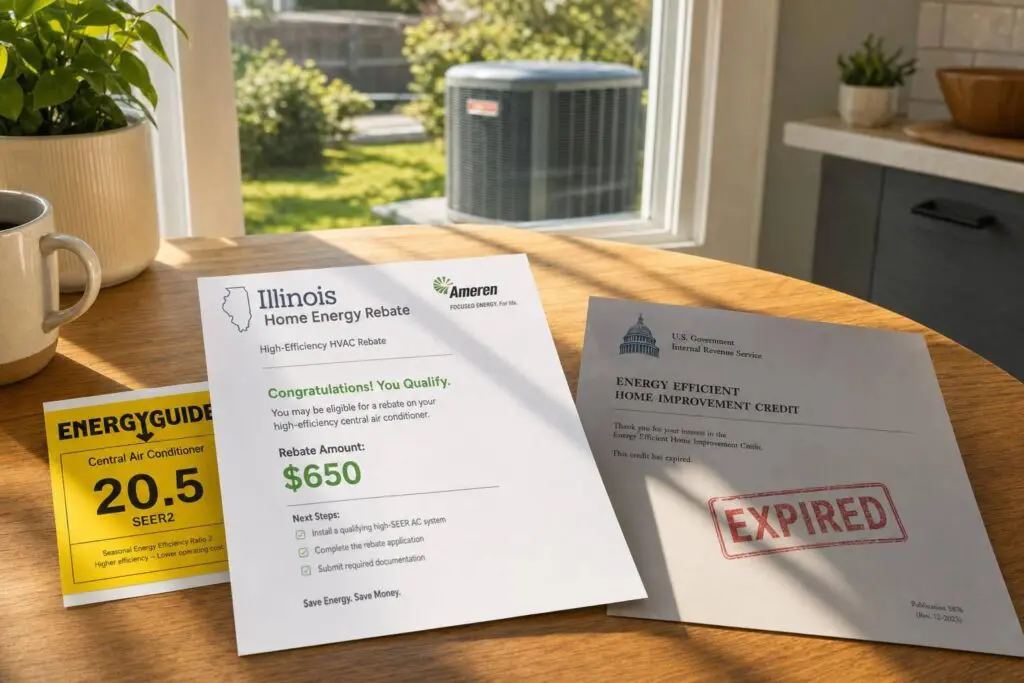
If you’re replacing a central AC in 2026, the old federal tax credit is off the table. For systems placed in service after December 31, 2025, the federal Section 25C credit no longer applies. So for most homeowners in Illinois, the main savings now come from state and utility rebates.
Here’s the short version:
- Federal 25C for central AC: expired for new 2026 installs
- Old federal value: 30% of installed cost, up to $600
- State and utility rebates: still active in many parts of Illinois
- Heat pump rebates: often much higher than standard central AC rebates
- How savings arrive: rebates may show up at purchase, as a bill credit, or by check within 60 to 90 days
- Main catch: rules depend on income, utility area, contractor status, equipment match, and filing deadlines
If I compare the two, the difference is simple: a tax credit cuts what you owe later when you file taxes, while a rebate cuts the price much sooner. In 2026, that makes the choice easy for new central AC installs: state and utility programs matter more because the federal option is gone.
A few numbers stand out:
- HEAR rebates: up to $8,000 for income-qualified heat pump projects
- ComEd rebates: up to $3,600 for qualifying heat pumps
- Ameren Illinois: $900 for ducted systems and $630 for ductless
- Smaller utilities/co-ops: up to $1,800
- MidAmerican Energy: up to $600 per unit
The main point: if you want the biggest discount, check whether your project can combine state rebates, utility rebates, and manufacturer offers. But watch the rules. Some programs need pre-approval before work starts, and some require a trade ally contractor or a matched AHRI certificate.
This SEER AC Mistake Could Cost You THOUSANDS!
sbb-itb-b5c10b1
Quick Comparison
| Feature | Federal Tax Credit | State/Utility Rebate |
|---|---|---|
| Status in 2026 | Expired for new central AC installs | Active in many Illinois programs |
| How you get the money | At tax filing time | Upfront discount, bill credit, or check |
| Typical central AC value | Up to $600 before expiration | Often $100 to $500 |
| Higher incentives | Limited | Heat pumps in Chicago may get $900 to $8,000+ |
| Income limits | None | Some programs have them |
| Main requirements | IRS rules, tax filing, proof docs | Utility area, approved equipment, deadlines, contractor rules |
| Best fit in 2026 | Older installs placed in service by 12/31/2025 | New Illinois AC and heat pump projects |
So if I boil the article down to one line, it’s this: for 2026 high-SEER cooling upgrades in Illinois, rebates matter more than the old federal credit, and paperwork decides whether you get the money.
Federal Incentives for High-SEER Air Conditioners
Section 25C used to give homeowners a federal tax credit for some high-efficiency central AC systems. But that credit does not apply anymore to units installed and operating after December 31, 2025.
Section 25C Credit: Amount, Limits, and How to Claim It
While Section 25C was still in effect, homeowners could claim 30% of the installed cost of a qualifying central air conditioner, up to $600 per year. That $600 sat within a separate $1,200 annual cap for eligible home upgrades. To claim it, homeowners used IRS Form 5695 with their federal tax return.
"The credit will not be allowed for any property placed in service after December 31, 2025." – IRS Official Guidance (IR-2025-86)
That line sums up the big 2026 change: Section 25C no longer covers central air conditioners installed and operating after December 31, 2025. A law signed on July 4, 2025 moved that end date up.
Eligibility also depended on the kind of system you bought and its efficiency ratings.
Federal Eligibility Rules for High-SEER and SEER2 Systems
When the credit was active, split-system central ACs had to meet SEER2 of at least 17.0 and EER2 of at least 12.0. Packaged systems had to meet SEER2 of at least 16.0 and EER2 of at least 11.5. The unit also had to be installed in an existing U.S. home that the taxpayer used as a residence. In most cases, new construction did not qualify.
Paperwork mattered too. Homeowners needed:
- An itemized contractor invoice
- A manufacturer’s certification statement
- An AHRI certificate showing the system’s efficiency ratings
Federal Credit: Pros and Cons
| Federal tax credit advantages | Federal tax credit drawbacks |
|---|---|
| Available when the credit applied and the equipment met IRS rules | The benefit usually arrived later at tax filing time rather than at purchase |
| Rules were more standardized than many local rebate programs | Annual caps limited the total savings |
| Could often be combined with state or utility incentives when allowed | Non-refundable – value depended on tax liability |
| Clear documentation requirements made qualification easier to verify | No longer available for central ACs installed and operating after Dec. 31, 2025 |
Now that Section 25C has expired for central ACs, the more useful comparison is with state and utility rebates.
State and Utility Rebates for High-SEER ACs in Illinois
With Section 25C expired, Illinois homeowners now look to state and utility rebates to cut upfront AC costs.
Common Rebate Types and Typical Dollar Amounts
Illinois Home Electrification and Appliance Rebates, or HEAR, work as point-of-sale discounts. That means the savings come off the invoice when the system is installed, not later at tax time. Utility rebates from ComEd and Ameren Illinois usually show up as an instant discount, a bill credit, or a check within 60 to 90 days.
The dollar amounts depend on the program and the equipment. ComEd offers rebates up to $3,600 for qualifying air-source heat pumps. Ameren Illinois offers instant discounts of $900 for ducted systems and $630 for ductless mini-splits. For income-qualified households, HEAR can provide up to $8,000 for a qualifying heat pump system. Smaller Illinois utilities such as EnerStar, Corn Belt, and MJM can offer rebates up to $1,800, while MidAmerican Energy offers up to $600 per unit. A lot of the bigger rebates are tied to heat pumps, which can also deliver high-SEER cooling.
Here’s the quick breakdown of where the money comes from, how it’s paid, and where each program applies.
| Program | Maximum Rebate | How Paid | Region |
|---|---|---|---|
| HEAR (income-qualified) | Up to $8,000 | Point-of-sale | Statewide |
| ComEd | Up to $3,600 | Instant discount, bill credit, or check | Northern Illinois / Chicago |
| Ameren Illinois | $900 ducted / $630 ductless | Instant discount | Central / Southern Illinois |
| EnerStar / Corn Belt / MJM | Up to $1,800 | Varies | Rural co-ops |
| MidAmerican Energy | Up to $600 | Varies | Various Illinois territories |
Eligibility, Paperwork, and Timing Rules
HEAR rebates are income-restricted. Households at or below 150% of Area Median Income (AMI) may qualify. Utility rebates, by contrast, are usually open to residential customers no matter their income, as long as they follow the program rules on approved contractors and approved equipment.
In Cook County, the 80% AMI threshold for a family of four is $92,200, and the 150% limit is $172,875. One rule matters a lot here: do not start installation before IL EPA pre-approval. If work begins too early, the rebate is lost.
On the utility side, ComEd usually requires a Residential Heating and Cooling Trade Ally for point-of-sale rebates, and applications must be submitted within 90 days of installation. If the installer is not a trade ally, the homeowner generally needs to file a mail-in application instead. A standard license by itself does not mean the job will meet program rules.
The paperwork is pretty similar across programs. Homeowners usually need:
- An itemized invoice with model numbers
- An AHRI certificate showing the efficiency ratings
- Proof of the installation date
- Proof of mechanical or electrical permits in many Illinois jurisdictions
The equipment also has to meet current SEER2 and HSPF2 targets. For ducted systems, that usually means SEER2 15.2+ and HSPF2 7.5+. For ductless mini-splits, the target is usually SEER2 18.0+ and HSPF2 9.0+.
State and Utility Rebates: Pros and Cons
State and utility rebates can be appealing because the money often arrives sooner. In some cases, the discount shows up right on the invoice. In others, it comes back as a bill credit or check. The rebate amounts can also beat the old federal AC tax credit, and some programs give more for higher SEER2 equipment or cold-climate systems. Local programs also tend to line up with utility offers and regional efficiency goals.
The tradeoff is that these programs can be picky. They may be limited by utility territory, state funding rules, or annual budget caps. Rules can shift from one year to the next, and funds can run out. Some rebates also come with extra steps, like pre-approval, contractor limits, or inspections. Miss a deadline or submit the wrong document, and the rebate can disappear.
Next, compare these rebates directly with the former federal credit.
Federal vs. State Rebates: Direct Comparison and Stacking Rules
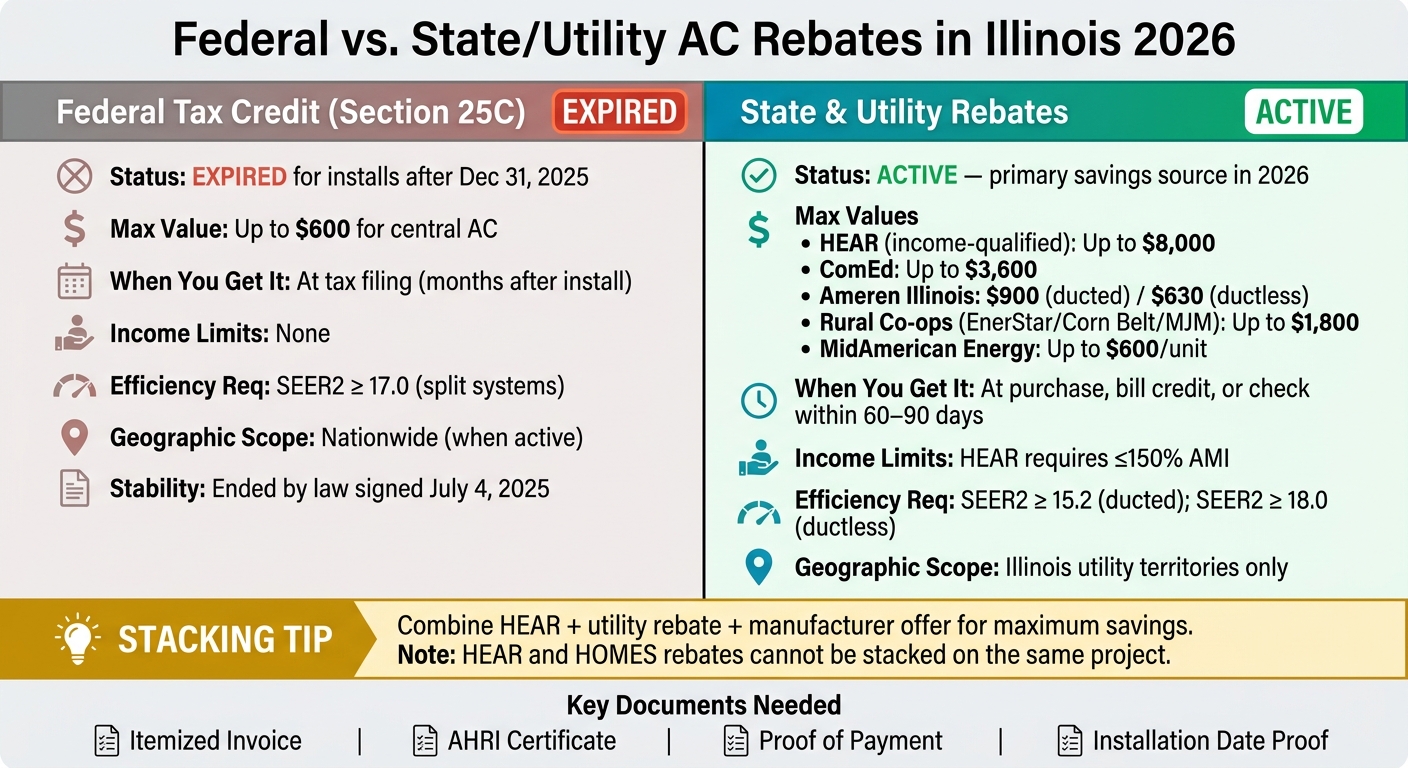
Federal vs. State AC Rebates in Illinois 2026: Side-by-Side Savings Breakdown
With 25C gone for new central AC installs, the main comparison in 2026 is state and utility rebates.
Comparison Table: Tax Credit vs. Rebate
Here’s how the two options line up on the points most homeowners care about.
| Feature | Federal Tax Credit (25C) | State and Utility Rebate |
|---|---|---|
| Incentive type | Non-refundable income tax credit | Point-of-sale discount, bill credit, or cash reimbursement |
| Typical value | Up to $600 for central AC before expiration | $200–$500 for central AC; higher amounts available for qualifying heat pump systems |
| 2026 status | Expired for new installs under OBBBA | Active and the main savings source |
| Timing of benefit | Claimed when filing federal taxes, months after install | Received at purchase, at install, or within 60–90 days |
| Program administrator | IRS under federal tax law | State energy offices, utilities, or local program administrators |
| Income limits | None | Often income-qualified for state programs; HEAR is limited to households at or below 150% AMI |
| Efficiency requirements | Fixed federal thresholds when active (e.g., SEER2 ≥ 17.0 for split systems) | Program-specific SEER2 rules; many 2026 programs require SEER2 around 15.2 to 16 |
| Program stability | Consistent year to year, but subject to legislative change | Tied to funding cycles; can run out mid-year |
| Geographic limits | Available across the U.S. | Limited to eligible states, utility territories, or service areas |
Stacking Federal and State Incentives
For 2026 projects, there’s no federal credit to stack with a new central AC install. So the focus shifts to combining state rebates with utility offers.
For example, an Illinois homeowner who installs a qualifying heat pump in 2026 may be able to pair an Illinois HEAR rebate with a utility rebate from ComEd or Ameren Illinois on the same job. That can make a big dent in the upfront cost.
There is one hard stop: HEAR and HOMES (Home Efficiency Rebates) can’t be stacked on the same project. Before you count on any savings, check the rules for each program and confirm that the rebate combo is allowed.
After that, it comes down to paperwork. The equipment details, model numbers, and submission forms all need to match the program requirements.
Which Option Saves You More Money
For most Illinois homeowners replacing a central AC in 2026, state and utility rebates are now doing the heavy lifting.
The old federal cap of $600 only covered a small slice of the price of a central AC replacement. Utility rebates for high-efficiency AC systems often land between $100 and $500, while heat pump rebates can hit $2,500 or more. If your household meets the income rules, HEAR may add up to $8,000 for a heat pump.
In plain English: if you qualify for more than one offer, stack them. That usually beats relying on a single program. An income-qualified Chicagoland household installing a high-efficiency heat pump in 2026 may be able to combine HEAR, a utility rebate, and a manufacturer promotion to cut total project cost by a large amount.
The next section covers how to document the equipment and paperwork so those savings don’t slip away.
How to Get the Most Out of Rebates on a High-SEER AC Upgrade
Once you know choosing the right HVAC system and program for your project, the next move is simple: protect the savings with the right paperwork. A rebate can look great on paper, then disappear because of one wrong model number or a missed deadline.
Confirm Equipment Ratings and Keep the Right Documents
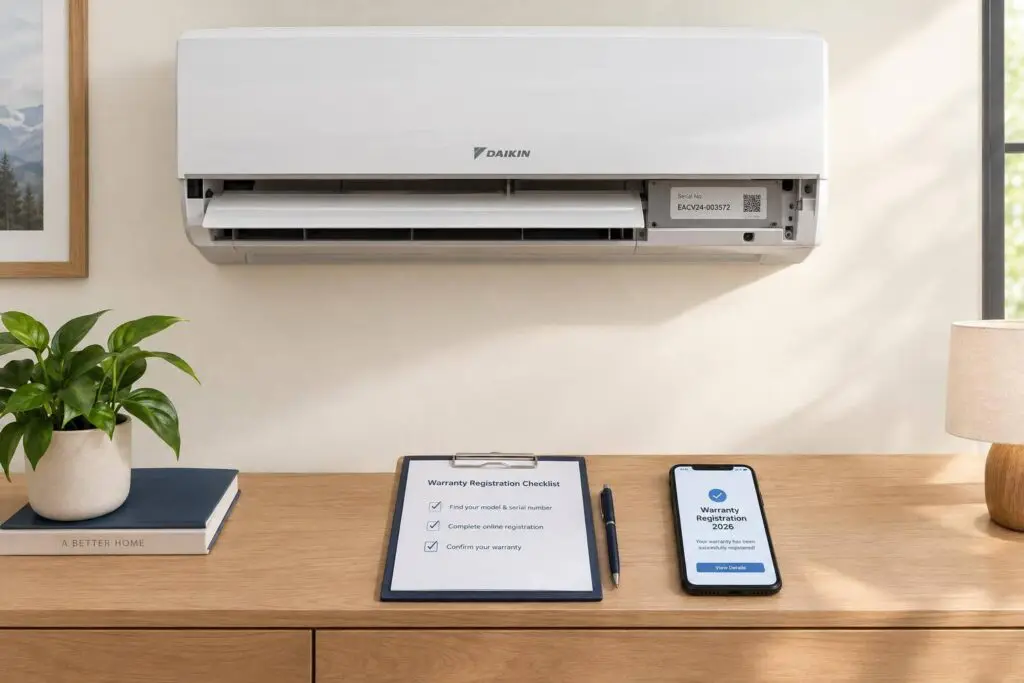
Before installation starts, confirm that the exact system meets the rebate program’s SEER2 and EER2 minimums. Check the AHRI directory to make sure the outdoor unit and indoor coil are listed as a matched system with a valid AHRI certificate. That step matters. If the equipment is mismatched, the rated efficiency can drop, and the rebate can be denied.
Submit rebate paperwork right after installation. Some utility programs require filing within 90 days. Miss that window, and the savings may be gone for good.
Keep these documents in one place:
| Document | Why You Need It |
|---|---|
| Itemized invoice | Shows model numbers, installation date, and labor costs |
| AHRI certificate | Confirms the matched system’s SEER2/EER2 ratings |
| Proof of payment | Documents the purchase for rebates and audits |
A small paper trail problem can turn into a big headache later. That’s why it helps to have the installer handle the job the right way from day one.
Work With a Local Installer Who Knows the Rebate Process
Paperwork mistakes and missed pre-approvals can cost you the rebate. Some programs – especially HEAR rebates – require a state-registered contractor and pre-approval before installation begins. If that step gets skipped, there’s often no easy fix after the fact.
Use a Chicagoland installer who knows how to handle pre-approval, system sizing, and rebate paperwork correctly. It’s one of those details that doesn’t seem flashy, but it can make the difference between getting the money and missing out.
Conclusion: Key Takeaways for Choosing Between Federal and State Incentives
With the model confirmed, the forms saved, and the deadlines met, collecting the rebate gets a lot easier. In Illinois, state and utility rebates are now the main way to cut the cost of a high-SEER AC upgrade, and careful documentation is what determines whether that money shows up. Stack every rebate the rules allow.
FAQs
Can I still get a federal AC tax credit in 2026?
No. Standard air-source air conditioners and heat pumps installed in 2026 do not qualify for the federal Section 25C tax credit. That credit for those systems ended on December 31, 2025.
If you installed qualifying equipment on or before that date, you can still claim the credit.
Geothermal ground-source heat pumps are different. They remain eligible for the 30% federal credit under Section 25D through 2032.
Which Illinois rebates can I combine for one HVAC project?
In Illinois, you can often combine utility rebates with federal programs as long as the total amount doesn’t go over the full project cost.
For example, ComEd or Ameren rebates may be stacked with income-qualified federal incentives like the HEAR program, which offers up to $8,000 for qualifying heat pump installations.
You may also be able to bundle upgrades. Say you install a new HVAC system and add an ENERGY STAR-certified smart thermostat – that can bring an extra $75 incentive.
Because these rules can shift, it’s smart to confirm eligibility with your installer before you move ahead.
What paperwork could make me lose a rebate?
Missing paperwork or skipping a required step can cost you the rebate.
For federal tax credits, one of the most common mistakes is failing to attach IRS Form 5695 to your tax return.
You may also need an itemized contractor invoice that includes:
- Model numbers
- The manufacturer’s PIN
- The QMID
- Proof of the installation date
For state programs like HEEHRA or HOMES, the rules can be stricter. You may need to work with a state-certified contractor and follow pre-approval or filing rules exactly. Miss one of those steps, and the rebate could slip through your fingers.