
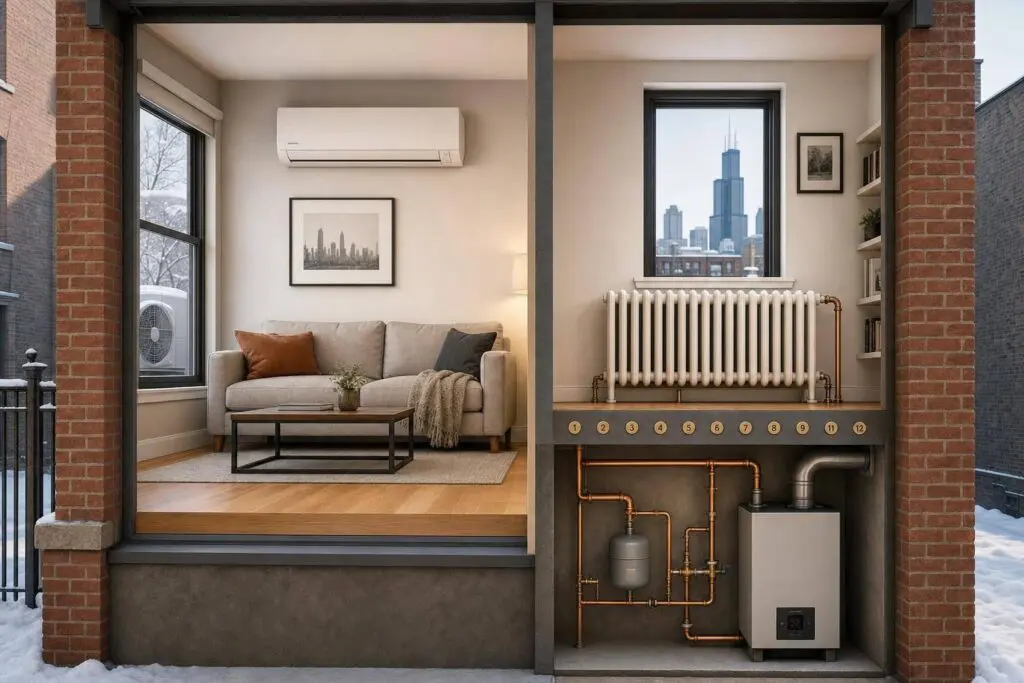
If your Chicago-area home needs both heat and AC, a cold-climate mini split will often cost less over 12 years. In the article’s estimate, a multi-zone mini split totals about $34,400 over 12 years, while a boiler plus separate AC lands around $40,600+.
Here’s the short version:
- Boilers cost less for heat-only replacement in many radiator homes
- Mini splits include cooling, so you avoid buying a second system
- Boilers usually cost more to run overall once you add gas, AC, service, and repairs
- Mini splits often run at about $700–$1,200 per year, while gas boiler heating is often about $1,000–$1,800 per year, plus cooling
- In Chicago’s 6,300–6,500 HDD climate, winter output matters more than sticker price
- Boilers hold full heat output in deep cold
- Cold-climate mini splits still work in low temps, often down to about -13°F, but output and efficiency drop as outdoor temperature falls
- Boilers fit older homes with radiators
- Mini splits fit additions, room-by-room control, and homes needing both heating and cooling
Bottom line: If you already have radiators and only need heat, a boiler can still make sense. If you need a full heating-and-cooling setup, a mini split often wins on total 12-year cost.
Heating Systems: Hydronic vs Forced-Air vs Mini-Split
sbb-itb-b5c10b1
Quick Comparison
| Factor | Boiler + Separate AC | Cold-Climate Mini Split |
|---|---|---|
| Upfront setup | Often about $10,000–$20,000+ combined | Often near boiler+AC on multi-zone jobs |
| 12-year total | About $40,600+ | About $34,400 |
| Heating cost | Gas-based; often higher total once cooling is added | Often lower yearly total |
| Cooling | Not included | Included |
| Cold-weather output | Strong in deep freeze | Good, but drops in very low temps |
| Comfort feel | Quiet, even radiator heat | Room-by-room control with fan-based air delivery |
| Best fit | Older radiator homes | Homes needing both heat and AC |
If I were comparing the two, I’d focus on three numbers first: install price, yearly energy cost, and whether cooling is already covered. That tells most of the story fast.
Boiler Costs Over 12 Years in Chicago
Installation, Fuel, and Separate Cooling Costs
For a typical 1,800–2,400 sq ft home in Chicago, boiler installation usually costs $3,500–$11,000. The final price depends on the unit’s efficiency and whether the job also needs piping changes or chimney work. Standard-efficiency models, usually around 80–84% AFUE, cost less at the start. Condensing boilers, which run about 95–98% AFUE, cost more up front but can trim annual gas use by about 10%–20%.
That first install bill is only part of the story.
At Illinois residential gas rates of about $1.00–$1.50 per therm, a standard-efficiency boiler in a typical Chicago home can cost around $1,200–$2,000 per year for heating fuel alone. Over 12 years, that comes to about $14,000–$24,000 in gas costs. A high-efficiency condensing boiler can lower that total to roughly $12,000–$20,000 over the same period.
There’s another catch: a boiler handles heat, not cooling. So most homes also need a separate AC system. In Chicago, central AC installation usually runs $5,000–$12,500 if the home already has ductwork. That price can climb to $14,000–$16,000+ for high-efficiency equipment or homes that need electrical upgrades. Put those two systems together, and the total upfront cost for both heating and cooling often lands in the $10,000–$20,000+ range before you’ve paid a single utility bill.
Maintenance, Common Repairs, and Comfort Tradeoffs
Boilers also come with yearly service costs. A standard boiler tune-up usually costs $150–$250. Condensing boilers tend to cost more to service, often $200–$400 per visit, because they use condensate systems and electronic controls. Across 12 years, routine maintenance adds up to about $1,800–$3,000 for a standard boiler and $2,400–$4,800 for a condensing model.
Repairs are part of the picture too. The most common issues over a 12-year span are:
- Circulator pumps: $300–$1,100 installed
- Zone valves: $200–$500
- Expansion tanks: $200–$800
A fair repair budget is $1,000–$3,000 over 12 years, though poorly maintained systems or condensing units with more parts can cost more.
As for day-to-day comfort, boilers do have a strong upside. They deliver steady, quiet heat during Chicago winters and tend to dry out the air less than forced-air systems. But there’s a tradeoff. Hydronic heat responds more slowly when you change the thermostat, and the system does not provide cooling, dehumidification, or air filtration.
| Cost Category | Estimated 12-Year Range |
|---|---|
| Boiler installation | $3,500–$11,000 |
| Separate cooling system | $5,000–$16,000+ |
| Natural gas (fuel) | $12,000–$24,000 |
| Routine maintenance | $1,800–$4,800 |
| Repairs & component replacement | $1,000–$3,000 |
| Estimated 12-Year Total | $28,000–$54,000+ |
Mini Split Costs Over 12 Years in Chicago
Installation, Winter Efficiency, and Year-Round Use
In a Chicago home, a single-zone cold-climate mini split usually lands in the $3,000–$5,500 installed range. More involved jobs can cost more, based on the brand, system size, and how tricky the line-set routing is. Multi-zone systems climb in price fast once you add more indoor heads and more routing work.
What makes that upfront cost easier to justify is simple: the same system handles both heating and cooling. You’re not paying for one setup for winter and another for summer. And in Chicago, where the heating season drags on, the bigger question is often not the sticker price. It’s what the system costs to run month after month.
That’s where cold-climate mini splits start to make sense. Models like the Mitsubishi Hyper-Heat (H2i) series are built for cold-weather markets like Chicago. They can deliver 100% of rated heating capacity at 5°F and continue operating down to −13°F. Their COP is about 3.9–4.0 at 47°F, then falls to about 2.0 at 5°F. In milder weather, efficiency stays above 2.5, which can trim seasonal electric costs. Of course, those numbers don’t mean much if the system is neglected. Over time, upkeep plays a big part in what ownership costs.
Eco Temp HVAC‘s Mitsubishi Diamond Elite Contractor status supports up to 12-year Mitsubishi product warranties.
Maintenance, Repair Risk, and Zoned Comfort
Mini split upkeep is pretty straightforward. The repair issues that show up most often are refrigerant leaks ($250–$550), control board replacements ($300–$800), and smaller fixes like sensor swaps or condensate pump repairs in the $150–$650 range. If the system is installed well and serviced on schedule, it can run for years without major trouble. Still, Chicago-area conditions can be hard on outdoor equipment. Road salt, pollen, and dust can wear down the outdoor coil faster, so yearly cleaning is worth doing.
Some maintenance is easy enough for homeowners. Filter rinsing every one to three months is the main DIY task. The rest usually belongs to a service visit:
- Coil cleaning
- Condensate drain inspection
- Refrigerant checks
- Electrical connection verification
Those professional tasks are usually needed once a year. In most cases, annual service costs $75–$150, which puts the 12-year maintenance total at about $900–$1,800 for many single- or dual-zone systems.
Day to day, the biggest draw is often comfort. Each indoor head works on its own, so you can set room-by-room temperatures and schedules. That means empty rooms don’t need the same heating or cooling as the rooms you use all the time. During spring and fall, that can cut run time and lower energy use. In summer, the same indoor units that help keep the house warm in January can deliver quiet, targeted cooling in July with high SEER2 ratings and no duct losses. In a small commercial space, that kind of control can help avoid conditioning rooms that sit empty.
Here is the 12-year cost picture in one view.
| Cost Category | Estimated 12-Year Range |
|---|---|
| Single-zone installation | $3,000–$5,500 typical; more complex projects can run higher |
| Multi-zone installation | $4,480–$45,000+ depending on zone count and equipment tier |
| Separate cooling system needed | $0 (built-in) |
| Electricity (heating + cooling) | Varies by zones and usage |
| Routine maintenance | About $900–$1,800 over 12 years |
| Repairs & component replacement | Often a few hundred dollars every several years |
Boiler vs Mini Split: Side-by-Side 12-Year Cost Comparison
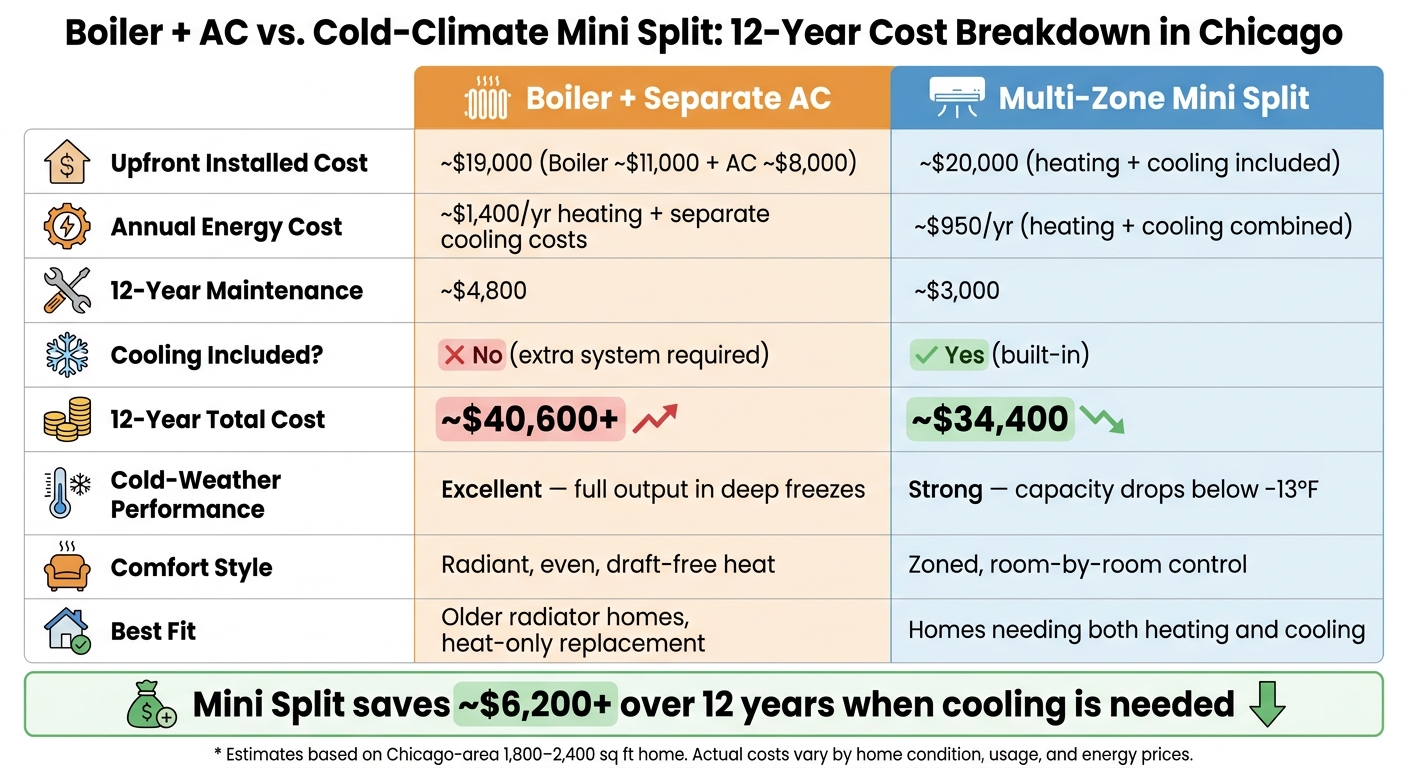
Boiler vs Mini Split: 12-Year Cost Comparison in Chicago
Upfront Cost vs Long-Term Operating Cost
Once you split out installation, fuel, maintenance, and cooling, the choice gets a lot clearer: the main question is the full 12-year cost.
In Chicago, the biggest pricing gap often isn’t the equipment by itself. It’s whether you’re buying heat only or a heating-and-cooling setup. A boiler plus separate AC often starts lower on day one, but a multi-zone mini split can close that gap because one system handles both jobs. Using a fair midpoint, a boiler-plus-AC setup comes in at about $19,000 installed, compared with about $20,000 for a multi-zone mini split.
Year to year, cold-climate mini splits often cost less to run in Chicago: about $700–$1,200 per year versus about $1,000–$1,800 per year for a gas boiler.
| Cost Category | Boiler + Separate AC | Multi-Zone Mini Split |
|---|---|---|
| Total installed cost (midpoint estimate) | About $19,000 ($11,000 boiler + $8,000 AC) | About $20,000 |
| Estimated annual heating + cooling cost | About $1,400/yr for heating, plus separate cooling costs | About $950/yr |
| 12-year maintenance | About $4,800 total | About $3,000 total |
| Cooling included? | No | Yes |
| Estimated 12-year total* | About $40,600+ | About $34,400 |
There is some overlap in those totals. Still, once you add separate cooling to the boiler side, the boiler setup usually ends up costing more.
Comfort, Cold-Weather Performance, and Best-Fit Chicago Scenarios
Cost matters, but it’s not the whole story. Comfort and winter performance can easily tip the decision.
Hydronic boiler heat is often described as steady, draft-free warmth, especially in older homes with cast-iron radiators. That’s a big reason some Chicago homeowners don’t want to give it up. Mini splits, on the other hand, give you room-by-room control. Boilers tend to deliver more even radiant heat, while mini splits let you dial in different temperatures by space. Over 12 years, that zoning can trim energy use by cutting run time in rooms no one is using.
When the weather gets brutally cold, boilers still have a practical edge. A properly sized gas boiler can keep putting out full heat during deep freezes. Cold-climate mini splits can still perform well, but they have to work within rated limits. ENERGY STAR Cold Climate criteria include COP ≥ 1.75 at 5°F and at least 70% of rated capacity at 5°F.
| Factor | Boiler | Mini Split |
|---|---|---|
| Extreme cold reliability | Excellent; full output in deep freezes | Strong with cold-climate models; capacity and efficiency drop in extreme cold |
| Comfort feel | Radiant, even, draft-free | Forced-air, fast response, zoned |
| Noise inside home | Very quiet | Quiet; slight fan sound from indoor heads |
| Cooling capability | None | Built-in, high-efficiency |
| Zoning flexibility | Limited without costly retrofits | Native room-by-room control |
| Best fit | Older radiator homes, high heating loads | Additions, renovations, homes without ducts |
You see these tradeoffs most clearly in a few common Chicago setups. In a 1920s Chicago bungalow with cast-iron radiators, replacing a failed boiler is often the lower-cost move because the heat distribution system is already there. In a rear addition or an in-law suite, a single-zone mini split is usually the easier fit because it adds heating and cooling on its own, without tying into the rest of the house.
Variables That Can Change the 12-Year Outcome
Three things move the 12-year total more than anything else: insulation quality, energy prices, and how many rooms you use on a regular basis.
A leaky house tends to lean more in the boiler’s favor. A well-sealed house tends to lean more toward a mini split. In Chicago, gas rates still often make gas look cheaper on a per-unit-energy basis, but the mini split’s efficiency multiplier can make up for that. If electricity prices climb, boilers look better. If you only use certain rooms every day, mini splits tend to look better.
Conclusion: Which System Usually Makes More Sense in Chicagoland
The 12-year numbers lead to a pretty simple rule: buy for the full time you expect to own the system, not just the install quote. Boilers tend to hold up well through Chicago-area winters. Cold-climate mini splits often come out ahead on 12-year cost when a home needs both heating and cooling. Still, the right pick comes down to load calculations, the home’s condition, and the quality of the install. In Chicagoland, those three things shape heating-heavy ownership costs more than almost anything else.
If you’re ready to compare both options for your own house, the next move is a load calculation and site review. For a home-specific recommendation in Chicagoland, Eco Temp HVAC handles boiler and ductless mini split installation, repair, and maintenance across Chicago and nearby suburbs.
Key Decision Factors to Keep in Mind
The biggest factors are upfront cost, energy use, repair risk, cooling needs, and the kind of comfort you want day to day. Boilers usually cost less to install. Mini splits often cost less to own over 12 years when cooling is part of the picture. A higher upfront price can make sense over time through lower energy use and built-in cooling, but that only works if the system is sized correctly and maintained by a pro over the full 12 years.
When the cost gap is small, comfort often becomes the tie-breaker. If you care most about steady, draft-free radiant heat, a boiler is tough to beat. If you want room-by-room control and efficient summer cooling from one system, a cold-climate mini split is often the better match. In plain terms, the more heat a home loses, the stronger the case for a boiler. The tighter the home, the more appealing a mini split can look over 12 years.
FAQs
Which system is better for my home layout?
For Chicagoland homes, a ductless mini-split is often the better pick if you:
- don’t have ductwork
- want room-by-room zoning
- need heating and cooling for an addition or finished basement
A condensing boiler may make more sense if you already have hydronic heating or need steady, high-output performance during freezing weather.
Either way, the final size should be based on your home’s heating load.
Will a mini split need backup heat in Chicago winters?
Yes – often. A mini-split heat pump may need backup heat during Chicago’s coldest winter weather.
Many cold-climate models still run well when temperatures drop far below freezing. But when the city gets hit with extreme cold – or when the system goes through a defrost cycle – auxiliary or emergency heat may switch on. That extra heat helps keep the house comfortable and stops cold air from blowing indoors.
How do insulation and air leaks affect the 12-year cost?
Insulation and air leaks can drive up 12-year operating costs because they let heat slip out of the home. And when that happens, your heating system has to work harder just to keep rooms comfortable.
The cost impact can be huge. A poorly insulated home may use 5 to 10 times more electricity than a well-insulated home in the same climate.
Air leaks add another layer to the problem. Drafty windows, weak sealing, and leaky ducts or piping can waste up to about 35% of heating energy. That means the boiler or mini-split runs longer, uses more power, and pushes utility bills higher over time.