
Here’s the short answer: the research points to three material choices that matter most in HVAC: low-GWP refrigerants, low-outgassing enclosure parts, and heat-resistant components that last longer.
If I were boiling the article down for a Chicago reader, I’d put it this way:
- R290 refrigerant stands out because its GWP is 3, far below many older refrigerants.
- Cold-climate heat pumps can still run at -10°F to -18°F, depending on the model and test case.
- Some “halogen-free” parts still release VOCs under heat, and one study found formaldehyde above 0.08 ppm during thermal cycling.
- Simple material changes can cut emissions inside the unit:
- EVOH film cut VOC permeation by 82%
- Activated-carbon gaskets removed more than 94% of aldehydes
- PPS-GF40 lowered enclosure temperatures by 11 to 15°C
- Cheap parts can cost more later: one study found 4.3x higher field failure rates in lower-quality HFFR control modules.
So the main takeaway is simple: the best HVAC material choices are not just about energy use. They also affect leak risk, indoor air, and repair costs over 5 to 10 years.
For homes and small businesses in Chicagoland, that matters more because long winters and heavy system use put extra stress on equipment. If I were using this study to guide a retrofit or replacement, I’d focus on cold-weather heat pump performance, refrigerant type, VOC test data, and long-term durability under repeated heating cycles.
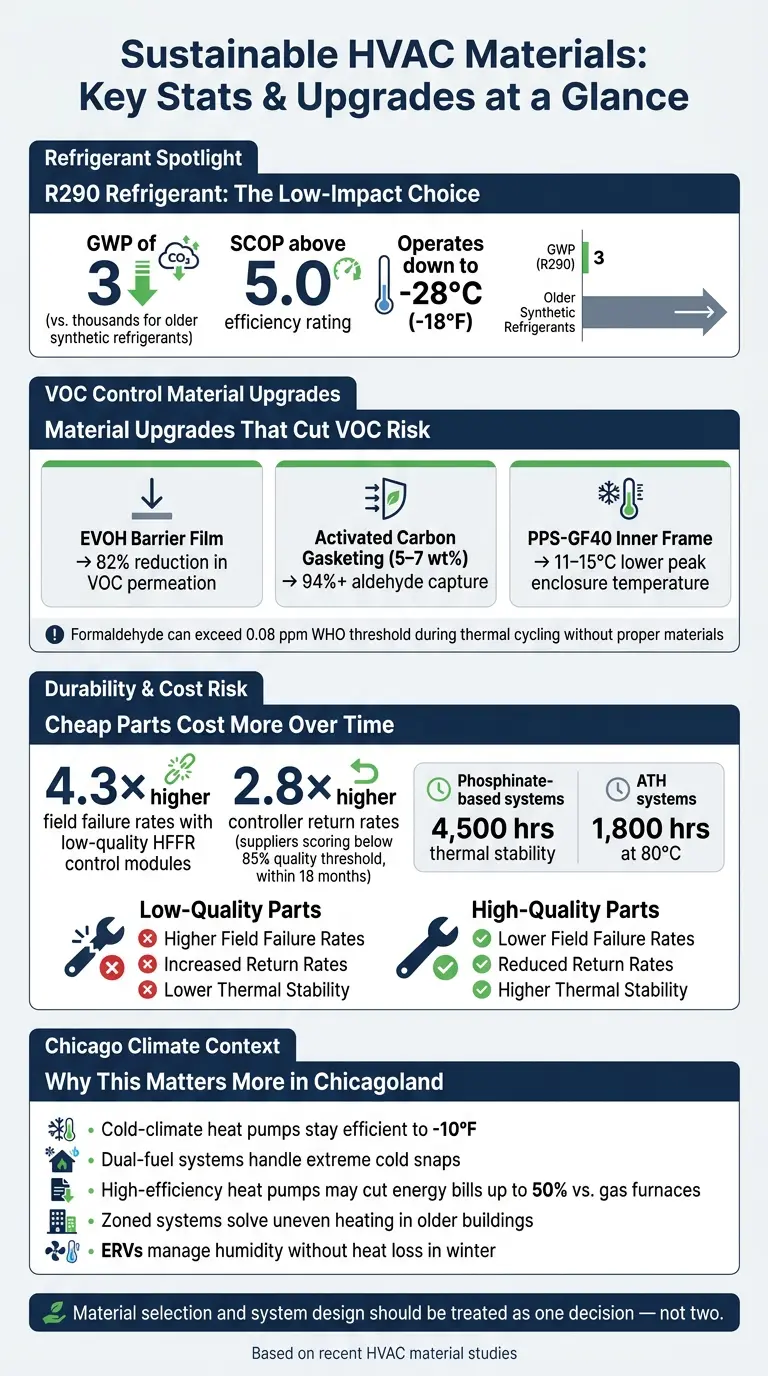
Sustainable HVAC Materials: Key Stats & Upgrades at a Glance
Heat Pumps: The Future of Sustainable Heating | Podcast4Engineers | Infineon

Quick comparison
| Area | What the studies point to | Why it matters in Chicago |
|---|---|---|
| Refrigerants | R290 with GWP 3 and SCOP above 5.0 | Lower climate impact and solid cold-weather output |
| Enclosure materials | Some halogen-free parts still release VOCs under heat | Indoor air and sensor drift can become issues |
| VOC control | 82% less permeation with EVOH film; 94%+ aldehyde removal with carbon gaskets | Helps limit heat-driven outgassing |
| Durability | Better thermal life from phosphinate-based systems vs. ATH systems | Fewer failures during long heating seasons |
| System choice | Cold-climate heat pumps, dual-fuel setups, ductless mini-splits vs. traditional HVAC, ERVs, zoning | Better fit for older Chicago buildings and winter demand |
Bottom line: I’d treat material selection and system design as one decision, not two separate ones. The article shows that the parts inside the unit can shape carbon output, air quality, and repair bills just as much as the equipment label on the outside.
Environmental Findings From Recent HVAC Material Studies
Embodied Carbon vs. Operating Emissions in HVAC Systems
Recent HVAC studies tend to split climate impact into two buckets: embodied carbon from manufacturing and operating emissions from day-to-day use.
That split matters because the biggest sources of impact don’t always come from the same place. For example, a hydraulic module that’s 30% smaller cuts embodied carbon before the unit is even installed. But once the system is running, the main levers shift to electrification and refrigerant choice.
Swapping a gas boiler for a heat pump cuts direct emissions. It also removes carbon monoxide risk. And when paired with the right refrigerant, it can shrink the damage tied to leaks too. That’s a big deal because older synthetic refrigerants can be thousands of times more damaging to the atmosphere than CO2. In current research, that puts refrigerants and housing materials at the center of the material side of HVAC impact.
Research on Refrigerants, Ductwork, and Insulation Materials
Among refrigerants, R290 stands out in testing. R290, or propane, has a Global Warming Potential (GWP) of just 3. It also performs well in use: R290 heat pumps can reach a SCOP above 5.0 and keep operating at -28°C (-18°F).
Research on enclosures and insulation is less cut-and-dried. Halogen-free materials may sound like the safer pick, but tests show they can still outgas VOCs when exposed to heat. That’s why thermal-cycling data tells you more than static chamber tests. In one study, repeated cycling between 104°F and 185°F (40°C and 85°C) pushed formaldehyde above 0.08 ppm, which is the WHO indoor-air threshold.
Tests also point to a few material fixes that make a clear difference:
- An 18 µm EVOH film cut VOC permeation by 82%
- Silicone gaskets with 5% to 7% activated carbon captured more than 94% of aldehydes
- Glass-fiber–reinforced polyphenylene sulfide (PPS-GF40) lowered peak enclosure temperatures by 11 to 15°C, which helped limit outgassing
Economic Findings: Upfront Cost, Energy Savings, and Payback
Environmental gains only matter if the material choices also hold up over time.
What Studies Say About Life-Cycle Cost
Upfront price rarely tells the whole story. A cheaper part can look good on paper, then turn into a slow leak on the budget through more failures, more service visits, and more replacements.
That pattern shows up in the research. Low-quality HFFR components fail more often, which pushes up service and replacement costs. In one set of findings, components using low-quality HFFRs showed 4.3× higher field failure rates in control modules, and suppliers scoring below 85% had 2.8× higher controller return rates in the first 18 months.
Thermal performance also matters over the long haul. ATH systems hit thermal limits sooner than phosphinate-based systems, which becomes a bigger issue across a 5–10 year service life.
Cost and Reliability Effects of Selected Material and System Upgrades
The studies do not give exact payback periods. Still, they point to a clear pattern: some upgrades cut failure risk and make installation less of a hassle.
Adding a 12–18 µm EVOH barrier film reduces VOC permeation by 82%, which lowers VOC-related failures. Adsorbent-integrated gasketing with 5–7 wt% activated carbon captures more than 94% of aldehydes, helping limit outgassing damage to sensitive electronics.
| Upgrade | Key Finding | Implementation Note |
|---|---|---|
| EVOH barrier film (12–18 µm) | 82% reduction in VOC permeation; fewer VOC-related failures | Small tooling change; modest lead-time delay |
| Activated carbon gasketing (5–7 wt%) | More than 94% aldehyde capture; less outgassing damage | Helps reduce outgassing-related failures |
| Glass-fiber–reinforced PPS (PPS-GF40) inner frame | Reduces peak enclosure wall temperatures by 11–15°C; lower thermal stress on components | Supports thermal decoupling |
| Phosphinate (AlPi) + Nano-TiO₂ vs. ATH systems | 4,500 vs. 1,800 hours thermal stability at 80°C; longer service life under heat | Better long-term durability under thermal stress |
Across these upgrades, the pattern is pretty simple: fewer failures, fewer service calls, and longer replacement intervals. Procurement teams that look only at upfront compliance labels, instead of thermal-cycling reports with at least 500 cycles, tend to set themselves up for higher long-term costs.
In Chicagoland, that matters even more. Long heating seasons and big temperature swings can make each failure more expensive. In Chicago’s cold-weather, high-runtime conditions, the durability tradeoff carries extra weight.
What the Research Means for Chicagoland Homes and Small Businesses
Material Choices That Fit Chicago-Area Climate Conditions
Chicago weather is hard on HVAC gear. Bitter winters, sticky summers, and sharp humidity swings can push systems in both directions fast. That’s why material choice matters more here than it might in a milder part of the country.
For cold-weather performance, the research points to modern cold-climate heat pumps. Current models stay efficient down to -10°F. In deep-freeze conditions, dual-fuel systems add a gas furnace alongside the heat pump, which helps cover those brutal cold snaps. High-efficiency heat pumps may also cut energy bills by up to 50% compared with standard gas furnaces.
Some Chicago-area buildings have uneven heating and cooling needs. Older two-flats are a good example: the top floor runs hot while the basement stays chilly. In that setup, zoned systems let you control temperatures by area instead of forcing the whole building into one setting. And when you need to deal with humidity without dumping heat in winter, Energy Recovery Ventilators (ERVs) make a lot of sense.
One small but important detail: low-outgassing enclosures. Research shows that low-outgassing, halogen-free flame retardants may help reduce VOC spikes and sensor drift during thermal cycling.
"Halogen-free is a compliance label, not a performance guarantee."
Before installation, ask for ISO 16000-9 VOC data. It’s a simple way to screen components that could push formaldehyde above the 0.08 ppm WHO threshold.
Applying Study Findings in Retrofit and Replacement Projects
If a building already has ductwork, the next issues are usually humidity control and fresh-air exchange. For many Chicagoland homeowners and small business owners, that leads to a few plain decisions when it’s time to replace equipment.
If the ductwork is poor – or there isn’t any – the path looks different. Older buildings without usable ducts are often a strong fit for ductless mini-splits. ERVs still matter in both cases because ventilation and humidity don’t stop being a problem just because the equipment changes.
Cost matters too. Federal tax credits and Illinois rebate programs may help lower the upfront price of qualifying heat pump and high-efficiency boiler and HVAC installs. Check current program rules before you sign a contract, since eligibility can change.
Eco Temp HVAC serves Chicagoland homes and businesses with heat pump, ductless mini-split, and indoor-air-quality services.
Conclusion: Where the Evidence Is Strong and What to Watch Next
Taken together, the research points to a pretty clear pattern: the strongest support goes to low-GWP refrigerants like R290 and high-efficiency heat pumps. That said, long-term use of R290 in North America still runs into regulatory and insurance barriers that are less of an issue in Europe.
The main open question isn’t whether these materials help. It’s how well they hold up once they leave the lab and get used in the field. Lab data can look great on paper, but field performance is what counts over time. Durability matters just as much as efficiency. For example, some ATH-based materials have shown shorter thermal stability than phosphinate-based options.
Material choice is one part of the story, but system design plays a big role too. Activated-carbon gasketing can capture outgassed aldehydes before they affect indoor air quality or electronics. So while the evidence backs refrigerant shifts and material upgrades, day-to-day results still depend on using the right materials, designing the system well, and making sure installation is done with care.
In practice, sustainable HVAC materials tend to deliver the most when they are paired with compatible system design and careful installation.
FAQs
Is R290 safe for home HVAC systems?
R290, or propane, is a refrigerant with a very low global warming potential of 3. That makes it a more climate-friendly option than many older refrigerants.
For home HVAC systems, it’s considered safe when a certified professional handles the work. That said, there’s a catch: R290 has a high flammability rating of A3.
Because of that rating, it’s usually limited to smaller systems. It also tends to cost more to install, with prices often running 20%–30% higher than baseline systems.
How can I verify low-VOC HVAC materials?
Don’t rely on standard static chamber tests alone. They can miss the kind of heat stress a system faces in actual use.
Instead, ask suppliers for verified data that includes:
- Dynamic thermal cycling reports based on IEC 60068-2-14
- VOC emissions data measured with real-time thermal desorption-gas chromatography/mass spectrometry (TD-GC/MS)
You’ll also want proof of long-term aging performance. A good benchmark is at least 3,000 hours at 80°C. On top of that, ask for batch-to-batch consistency reports, so you can check that VOC levels stay stable across production runs and over the system’s service life.
Which material upgrades improve long-term reliability?
Upgrading HVAC materials can help a system last longer and run better over time.
For example, heat exchangers made from materials like titanium or superalloys stand up well to oxidation and corrosion. That matters because once those problems set in, performance can slip and repair bills can pile up. In harsher settings, protective coatings on metals like stainless steel can also help parts hold up longer.
A few other upgrades can make a difference too:
- R-32 refrigerant can reduce compressor workload.
- ECM blower motors can support longer system life and better efficiency.
- Routine maintenance, including annual coil cleaning and filter changes, helps keep the system in good shape.
Taken together, these choices can support stronger long-term reliability and day-to-day performance.