
Understand Common Thermostat Wiring at a Glance
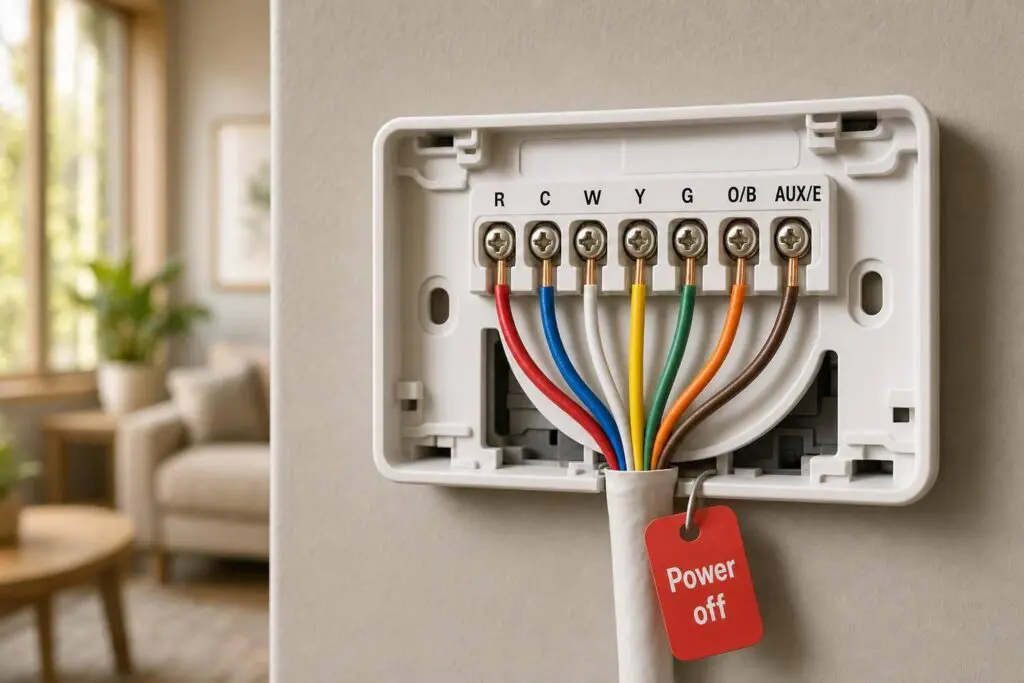
A thermostat wire color code chart can save time when you’re trying to identify what a wire probably does, but it should always be treated as a guide rather than a promise. In many homes, red connects to R, white to W, yellow to Y, green to G, and blue or black to C, yet real-world HVAC wiring doesn’t always follow the textbook.
Why Wire Colors Can Be Misleading
Installers sometimes use whatever conductors are available, especially during repairs, system upgrades, or smart thermostat retrofits. That means a dark blue, brown, or black wire may serve different roles depending on the equipment. Looking up the terminal label is usually more reliable than trusting color alone.
Conventional vs. Heat Pump Wiring
Conventional systems often use standard heat and cooling calls like W and Y. Heat pumps add another layer, commonly using O or B for the reversing valve and AUX/E for backup heat. A good thermostat wire color code chart helps you compare those patterns side by side so you can spot likely matches faster.
Safety First
Before inspecting or reconnecting any thermostat wiring, shut off power to the HVAC system. Then verify terminals at both the thermostat and the control board. That’s the safest way to use any HVAC thermostat wiring chart.
FAQs
Can I trust thermostat wire colors by themselves?
Not completely. Wire colors are often consistent enough to be helpful as a reference, but they are not a guarantee. A red wire is commonly R, white is often W, yellow is usually Y, and green is typically G, but installers sometimes reuse available wire colors or repurpose conductors during replacements and retrofits. The safest approach is to verify the terminal labels at the thermostat and at the furnace, air handler, or heat pump control board before making any connection changes.
What’s the difference between conventional and heat pump thermostat wiring?
A conventional system usually separates heating and cooling into familiar calls like W for heat, Y for cooling or compressor, G for fan, and R for 24V power. A heat pump system still uses R, Y, G, and often C, but it may also include O or B for the reversing valve plus AUX or E for backup and emergency heat. That means a wire color that seems familiar on one system may serve a different purpose on another, which is why system type matters when you look up thermostat wiring.
Why is the C wire often blue or black, but not always?
The common wire, usually labeled C, is frequently blue or black because those colors are often left available in thermostat cable bundles. But there is no universal rule that says C must be blue or black. On some jobs, a brown or other unused conductor may be assigned as common, especially in smart thermostat retrofits where a C wire is needed for power. The label on the terminal matters more than the insulation color.