
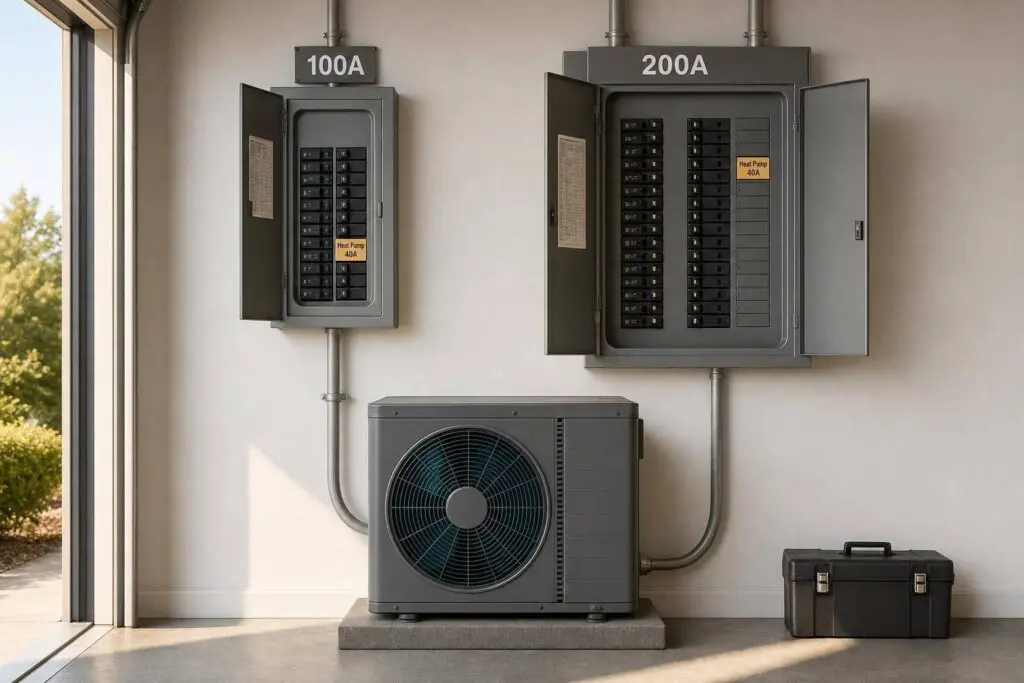
If your heat pump plan includes electric backup heat, a 100-amp service is often too tight. In many homes, 100 amps = about 24,000 watts, while 200 amps = about 48,000 watts. That gap matters fast once you add an outdoor unit, air handler, heat strips, range, dryer, water heater, or EV charger.
Here’s the short answer:
- 100-amp service can work for smaller homes with lower total demand
- 200-amp service is often the safer pick when you have electric strip heat or plan more electric upgrades
- The decision should be based on an NEC Article 220 load calculation, not a guess
- Breaker space matters as much as service size
- A 100A to 200A upgrade often costs about $2,500 to $4,000, with harder jobs running $4,500 to $8,500+
If I had to simplify it even more, I’d put it this way: a small ductless system vs. traditional central HVAC comparison shows that a mini-split in a gas-heavy home may fit on 100 amps, but a ducted heat pump with strip heat often points to 200 amps.
What I’d check first:
- Panel rating and open breaker spaces
- Heat pump size
- Whether backup heat is gas or electric
- Other large loads already in the house
- Future plans like EV charging or electric cooking
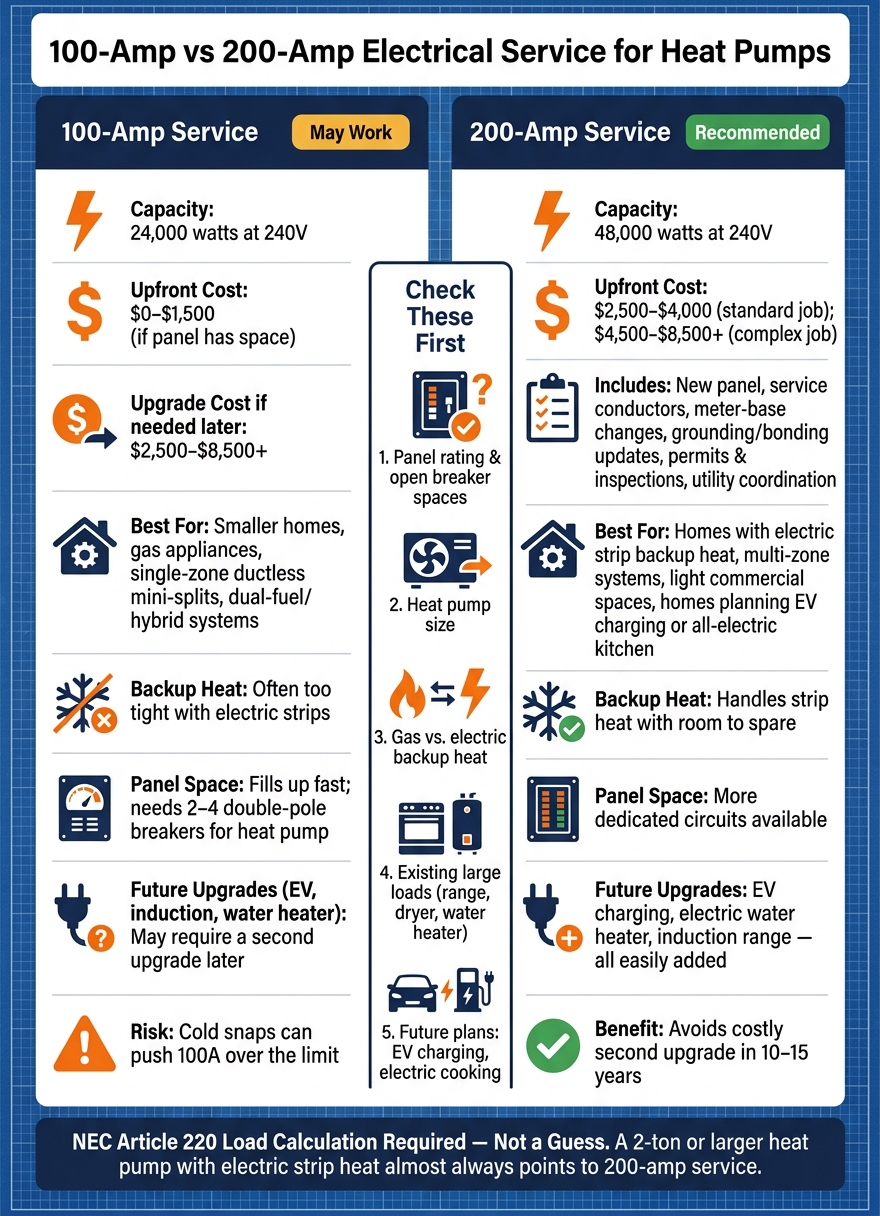
100-Amp vs 200-Amp Service for Heat Pumps: Side-by-Side Cost & Capacity Comparison
100 Amp vs 200 Amp, Do You Need an Upgrade?
Upgrading your electrical panel is often a critical step during a professional heat pump installation to ensure your home can handle the increased load.
sbb-itb-b5c10b1
Quick Comparison
| Checkpoint | 100-Amp Service | 200-Amp Service |
|---|---|---|
| Total capacity at 240V | 24,000 watts | 48,000 watts |
| Best fit | Smaller homes with lighter electric demand | Homes with heat strips and more electric loads |
| Backup heat | Often tight with electric strips | More room for strip heat |
| Panel space | Can run out fast | More room for HVAC circuits |
| Future upgrades | May need another upgrade later | More room for EVs, water heaters, and kitchen loads |
| Cost | Lower if panel and load already work | Higher upfront cost |
Bottom line: if your load math is close, or if winter backup heat will be electric, 200 amps usually gives you more room and fewer problems. The rest of the article walks through where 100 amps still works, where it falls short, and what drives the cost difference.
100-amp service: where it works and where it falls short
A 100-amp service gives you about 24,000 watts at 240 V. On paper, that can sound like plenty. In practice, a heat pump with backup heat can chew through that room faster than most people expect.
That’s the key point: total load matters more than breaker count. A panel can look fine at a glance, but only a proper NEC-based load calculation shows whether it can handle the job.
Typical load limits with a heat pump on 100 amps
A standard ducted heat pump usually needs its own 20- to 40-amp double-pole breaker for the outdoor unit. Then the air handler needs another circuit. If the system uses electric resistance strip heat for backup, that backup heat can need a breaker in the 30- to 60-amp range by itself.
That’s where 100-amp service starts to feel tight. In cold weather, strip heat can stay on for long stretches. Add in other big loads at the same time – like a range, dryer, or water heater – and the spare room disappears fast.
Homes that can stay on 100 amps
Some homes can still make 100 amps work. Smaller, well-insulated homes are the best fit, especially when they already use gas for heating, water heating, or cooking.
In that setup, a single-zone ductless mini-split is often the cleanest match. It usually has a lower total draw, doesn’t need large strip heat, and uses a smaller dedicated breaker.
Hybrid, or dual-fuel, systems can also make sense for Chicagoland homes with 100-amp service. In those systems, the heat pump handles milder weather, while the gas furnace takes over during the hardest heating demand. That avoids the big electric load that comes with strip heat.
Once a home starts adding electric backup heat or other major electric loads, 200 amps usually becomes the better fit.
Warning signs that 100 amps is too tight
Some signs are hard to ignore. The biggest one is no open breaker spaces. A heat pump and air handler each need a double-pole slot, so a full panel leaves no room unless more work is done first.
Other red flags include:
- The HVAC design includes electric resistance backup heat strips
- The home already has an electric range, dryer, and water heater
- There are plans for an EV charger
- The main breaker or branch breakers trip more than once during normal use
- The project includes multiple indoor units for a multi-zone or light commercial setup
A common field rule of thumb is that a 2-ton or larger heat pump will likely need a 200-amp upgrade, especially when strip heat is part of the design. If the load math comes out close, going to 200 amps is often the cleaner path for backup heat and future electric loads. That’s usually the point where 200-amp service starts to make more sense.
200-amp service: more room for backup heat and future additions
A 200-amp service gives you more room to work with when a heat pump has to run alongside backup heat and other big electrical loads. That matters a lot once a 100-amp service starts feeling cramped.
Why 200 amps handles larger heat pump and strip-heat loads better
In Chicagoland, the heating season can put a lot of pressure on a home’s electrical service. Auxiliary heat may kick on often, and large strip-heat kits can eat up most of a 100-amp service by themselves.
In many cold-weather heat pump systems, strip heat is the load that turns a service from workable to too tight. A 200-amp service handles that demand with less panel crowding. It also leaves room for the outdoor unit and air handler circuits, so you don’t have to make tradeoffs with other parts of the home.
Panel space for air handlers, heat strips, and other electric equipment
Total electrical capacity is only part of the story. Breaker space matters too.
A heat pump setup often needs dedicated breakers for:
- the outdoor unit
- the indoor air handler
- backup heat strips
Each one takes up panel space. A 200-amp panel gives installers more room for those dedicated circuits. It also leaves space for later additions like EV charging and electric water heating, which can help you avoid a second service change down the road.
That extra room can make later upgrades less of a headache, but it can also affect the upfront price.
When 200 amps makes more sense for light commercial spaces
This same load issue shows up in small commercial spaces, where HVAC, lighting, and tenant equipment all run at the same time.
For small offices, retail storefronts, and mixed-use buildings, 200 amps is often a better fit for overlapping HVAC, lighting, and plug loads. That’s even more true when the space has longer daily run times or more than one HVAC zone.
For light commercial properties, that added capacity often changes both the installation layout and the final service-upgrade cost.
Cost tradeoffs: staying at 100 amps vs. upgrading to 200 amps
Once the load calculation shows both paths can work, the choice usually comes down to cost now versus what you may add later.
What drives the price of a service upgrade
Staying at 100 amps may cost $0–$1,500 if the panel already has enough room. In that case, the work is often limited to breakers and small panel changes.
A basic 100-amp to 200-amp upgrade usually costs $2,500–$4,000. More involved jobs can land in the $4,500–$8,500+ range.
Why the jump? Because this isn’t just a panel swap. The bigger bill usually includes the full service change:
- New panel
- Service conductors
- Meter-base changes
- Grounding and bonding updates
- Permits and inspections
- Utility coordination
Labor can swing the price too. If the panel is in an open garage near the meter, the crew can move through the job with less friction. If it’s tucked into a finished basement with tight access, labor goes up, and patching or repair work can add more cost. That’s often what pushes a project toward the top end of the range.
Upfront savings vs. long-term electrification planning
For smaller homes with lighter demand, staying at 100 amps can make good sense. That’s often the case when the home has modest electrical use, a properly sized heat pump, and little or no strip heat backup. It can also fit homeowners who expect to move within a few years.
The short-term savings are clear. The work is usually simpler, and the timeline is often shorter because utility coordination is not part of the job.
The catch is future load. Add EV charging, induction cooking, electric water heating, or more mini-splits, and a 100-amp service can start to feel tight. At that point, you may end up paying for a second upgrade later.
That second round isn’t cheap. It can mean new permits, more labor, more utility coordination, and possible rework if earlier circuits were packed into the smaller panel. Over 10–15 years, that two-step path can cost more than doing the 200-amp upgrade during the heat pump project.
The table below lays out the tradeoff side by side.
| Cost Factor | Stay at 100 Amps | Upgrade to 200 Amps |
|---|---|---|
| Upfront electrical cost | $0–$1,500 if the panel has space and capacity | $2,500–$4,000 for a straightforward job; $4,500–$8,500+ for complex projects |
| Panel replacement | Usually avoidable | New 200-amp panel required |
| Service entrance work | Not required | Larger conductors and service hardware |
| Meter base | Usually unchanged | May need upgrade to meet utility specs |
| Grounding and bonding | Usually not required to change | Updates typically required under permit |
| Permits, inspections, utility coordination | Less involved | Required; processing can take days to weeks |
| Future EV charging | Likely requires a later upgrade | Easily added as a new circuit |
| All-electric kitchen | May not be feasible | Straightforward circuit addition |
For a local estimate, Eco Temp HVAC can line up the heat pump load with the service-upgrade scope by pairing HVAC load data with a service calculation and cost estimate for Chicagoland homes and small commercial spaces.
Conclusion: Choosing the right service size for a heat pump in Chicagoland
After load, panel space, and cost, the choice comes down to your current demand and what you may add later. The right service size depends on how much power your home uses today and your future plans. 100-amp service can work in smaller homes with a modest total load, especially when gas appliances are already doing much of the heavy lifting and the heat pump is a high-efficiency model with little or no electric strip backup. 200-amp service is usually the better fit when backup heat is electric, more than one system is involved, or more electric upgrades are likely down the road.
In Chicagoland, cold snaps matter. When backup heat turns on, the extra draw is often the thing that makes 100 amps feel too tight.
Key factors to review before installation
Use these checks before making the call:
- Existing panel rating, condition, and breaker space – Older 60-amp or fuse panels almost always need a full replacement. A heat pump system will often need 2–4 dedicated double-pole breakers.
- Heat pump size, backup heat type, and other major electric loads – Electric strips can push demand up fast. A dual-fuel system with gas backup cuts electric load a lot and may allow you to stay with 100 amps. EV chargers, electric dryers, electric water heaters, and ranges all need to be part of the load calculation.
- Future electrification plans – If you may add a major electric load in the next 5–10 years, moving to 200 amps now is often the smarter move.
- Local code and permit requirements – Chicagoland municipalities vary on meter base specs, grounding rules, and inspection timing. That’s why it helps to work with a contractor who knows your local jurisdiction.
A formal NEC Article 220 load calculation is the best way to confirm the right service size. Eco Temp HVAC can pair HVAC load data with the electrical scope before work begins.
FAQs
Do I need a load calculation before installing a heat pump?
Yes. A Manual J load calculation should come before any heat pump installation.
It replaces rough rules of thumb with an actual look at how the home performs. That includes things like insulation, windows, ductwork, air leakage, and the local climate.
Why does that matter? Because heat pumps need to be sized correctly. If the system is too large, it can short cycle and run less efficiently. If it’s too small, it may struggle to keep the home comfortable.
A Manual J calculation helps match the system to the home, which supports comfort, performance, and energy savings.
Can I keep 100-amp service with a heat pump and strip heat?
Maybe. It comes down to your home’s total electrical load.
A heat pump with electric strip heat can pull a lot of power. In some setups, the strips alone may need a 60-amp circuit.
If your panel can’t support that extra load, you may need to move up to 200-amp service. The safest way to know is to have a pro run a load calculation and check whether your current setup can handle it.
Will upgrading to 200 amps help with future EV charging?
Yes. A 200-amp service can do a better job of supporting future electrical needs, including EV charging, along with your current circuits and high-draw equipment like heat pumps.
It also gives your panel more room for the capacity and breaker space needed for dedicated circuits. That matters when you plan to add new loads later instead of squeezing them into an already crowded setup.
A licensed electrician should check whether your current service can handle future expansion.