
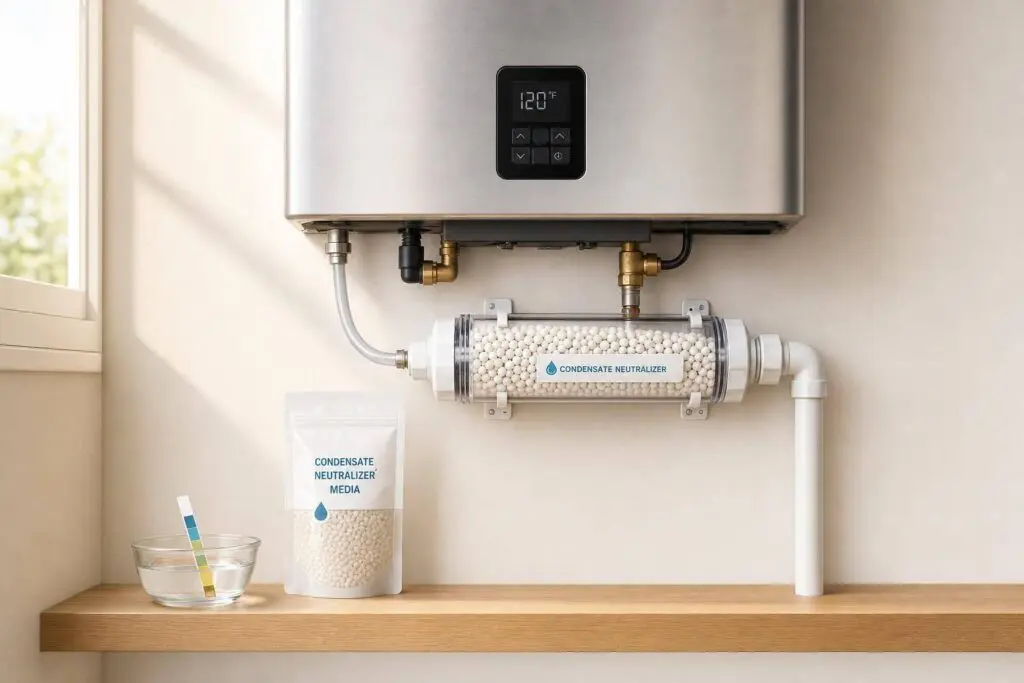
If you have a condensing tankless water heater, the condensate is acidic, and a neutralizer may be required. In many setups, the key checks are simple: confirm the unit is condensing, verify the drain line material, make sure the line slopes down, and test whether the condensate pH stays at or above the level your local code or manufacturer calls for.
Here’s the short version:
- I’d expect condensate from condensing units to land around pH 3–5, and some manuals list values as low as pH 2–3.
- That acidity can wear out metal drain parts over time.
- Many manufacturers allow PVC, CPVC, or other approved plastic drain materials.
- A neutralizer usually uses calcium carbonate or magnesium oxide media.
- Media does not last forever. Some guidance points to testing and replacing it when outlet pH drops below about 6.0.
- If the drain cannot run downhill, you may need a condensate pump rated for acidic condensate.
- Your local AHJ and plumbing code may require treatment even if the heater manual treats the neutralizer as optional.
Neutralizers & Tankless Water Heaters
Quick comparison
| Brand | Neutralizer position | Drain setup notes | Service notes |
|---|---|---|---|
| Navien | Often accessory-based; local code may require it | PVC/CPVC drain; gravity or pump | Check outlet pH; some guidance uses pH 6.0 |
| Rinnai | Kit available for corrosion control | Approved plastic pipe/hose; vented termination; no submersion | Follow kit and manual instructions |
| Noritz | Depends on model | Depends on model | Depends on model |
| Rheem | Follow local code and model manual | Per model manual | Per model manual |
| Takagi | Used when local code requires neutralization | Neutralizer stays below heater; downhill slope only | Some manuals mention about 3 years, but pH testing decides replacement |
What I’d check first: the appliance manual, the drain path, the discharge point, and the neutralizer outlet pH. That gives you the answer fast without guessing.
What Manufacturers Say About Neutralizers and Drain Setups
Manufacturers don’t all say the same thing about neutralizers. The exact manual for the unit and local code drive the install. The main differences usually come down to drain material, drain slope, and when the media or cartridge needs to be replaced.
Manufacturer Comparison of Neutralizer Requirements
| Manufacturer | Neutralizer Language | Approved Drain Arrangement | Replacement Guidance |
|---|---|---|---|
| Navien | Neutralizer kit available as an accessory; local codes may require condensate treatment. | PVC or CPVC drain line; gravity to an approved receptor or through a condensate pump; neutralizer in line where required. | Some neutralizer instructions use a pH 6.0 threshold; treat that guidance as model- and accessory-specific. |
| Rinnai | Neutralizer kit is available and is described as raising condensate pH to help prevent corrosion of drains and the public sewer system. | Corrosion-resistant PVC pipe or plastic hose approved by the manual; drain at least the same diameter as the appliance connection; slope toward a floor drain or approved receptor; use a condensate pump where gravity drainage is unavailable. | No universal interval in the available documentation; follow the kit and manual service instructions. |
| Noritz | Varies by model; check the exact manual. | Varies by model; check the exact manual. | Varies by model; check the exact manual. |
| Rheem | Follow local code and the exact model manual. | Per local code and model manual. | Per model manual. |
| Takagi | Neutralizer assembly treats acidic water formed in the secondary heat exchanger and is required when local codes mandate neutralization. | Connects to the condensate-drain port using supplied connectors; the neutralizer and drain tube must remain below the heater, and the line must slope downward continuously. | Some manuals cite a three-year cartridge design life, but actual life varies with usage; replace when condensate pH falls below 6.0 and test with litmus strips. |
One thing shows up again and again across these brands: local code often makes the final call. So even if a manufacturer frames a neutralizer as optional, local wastewater rules may still make it required.
Drain Materials, Flow Direction, and Connection Details
Navien lists PVC and CPVC as acceptable condensate drain materials. Rinnai points to PVC pipe or a plastic hose approved by the manual. Takagi recommends EPDM or PVC for the condensate tube. In plain terms, don’t assume any drain pipe will do. Metal drain pipe is off the table unless both the manual and local code allow it.
Takagi is also very specific about orientation. If the neutralizer is installed backward, condensate can bypass the media instead of flowing through it. The drain line also needs a continuous downward slope from the heater to the receptor. On top of that, Takagi says the condensate outlet is atmospheric and nonpressurized. That means the neutralizer and all tubing downstream have to stay below the heater and remain free of blockage.
Rinnai adds another detail that matters in the field: the drain termination must stay vented to atmosphere and should not be submerged. That helps avoid restriction and siphoning. If there’s no floor drain, or if the receptor sits above the heater’s condensate outlet, both Rinnai and Navien tell installers to use a condensate pump. But a pump doesn’t fix everything. You still need the right neutralization setup, approved materials, and a proper discharge point.
It helps to look at the whole drain path, not just the neutralizer. The air gap, trap, pipe diameter, and receptor all matter, and they can affect both service life and when the system should be checked, especially if you are losing efficiency in hard water areas.
Acidity, Pipe Materials, and Neutralizer Maintenance
How Acidic Condensate Affects Metal and Plastic Drain Systems
Once the drain path is in place, the next issue is staying within an acceptable pH range over time. Condensate is usually pH 3 to 5. That’s acidic enough to slowly eat away at metal drain parts, fittings, and other connected components. Approved plastic piping holds up much better, but that doesn’t mean neutralizer service can be ignored. It still plays a big part in protecting the drain path farther downstream.
There’s also a code side to this. Plumbing codes generally do not allow corrosive liquid to be discharged unless it has been diluted, neutralized, or treated in an approved device. So even if the first section of the drain line is plastic, local code may still call for a neutralizer before the condensate reaches the approved receptor.
Neutralizer Media Types and Why Service Intervals Vary
Approved pipe materials help limit damage, but the neutralizer is what deals with the acidity before discharge. It sends condensate through alkaline media that reacts with the acid and lifts the liquid’s pH. Common media include calcium carbonate and magnesium oxide, and that media gets used up over time.
That’s why service timing depends on condensate volume, not just the date on the calendar. Media life can change based on:
- Heater capacity
- Operating hours
- Water chemistry
- Media type and media volume
A high-demand setup can burn through media much faster than a lightly used home unit. Navien reflects this in its guidance. The company recommends checking more often during the first year and replacing media as needed instead of sticking to a fixed schedule.
Inspection, pH Testing, and Replacement Timing
A neutralizer may be part of the drain layout, but it only does its job if the outlet pH stays in range. A visual check can catch damage, leaks, or blockage. But visual inspection alone can’t tell you whether the media is still treating the condensate. Only outlet-pH testing can confirm that.
Navien’s neutralizer instructions recommend annual outlet-pH testing and media replacement when the outlet drops below the local minimum pH. If no local value is given, replace the media when the outlet falls below about pH 6.0.
| Maintenance method | What it provides | Key limitation |
|---|---|---|
| Manufacturer-based interval | A simple schedule tied to equipment instructions. | May not reflect actual condensate volume or media use at a given site. |
| Outlet-pH testing | Direct proof that treatment is still working. | Needs test strips or a calibrated meter, plus a safe sampling point. |
| Annual service inspection | Pairs visual checks with media review and drain-path inspection. | Can miss fast media depletion in high-use or undersized setups. |
The best approach is to use all three. Follow the manufacturer’s instructions as your baseline, inspect the unit at least once a year, and verify outlet pH before wrapping up the service call. In plain terms: check the neutralizer during annual service, and test outlet pH before closing the job.
Code Requirements and Drain Design in Practice
What Local Code May Regulate
Once you know the condensate pH and what the system needs in the field, the next step is simple: make sure the install meets code and that the drain layout makes sense.
The manufacturer manual tells you what the unit needs. Local code tells you what the law requires. In some areas, condensate neutralization is required. In others, the main concern is an approved receptor or an indirect connection. That’s why it makes sense to check with the AHJ before the install is locked in.
A lot of installers add a neutralizer anyway. It’s a simple way to avoid trouble later. Untreated condensate with a pH around 3 to 5 can corrode metallic drain fittings and sewer components over time.
Drain Path Review: From Heater to Approved Receptor
After code is confirmed, review the entire drain path from the heater to the receptor. The line should slope downward the whole way, with no sags, no back-pitch, and no low spots where water can sit. Any run in an unconditioned space also needs protection from freezing.
Use this checklist before closeout and final approval.
| Component | Function | What to verify |
|---|---|---|
| Heater condensate outlet | Collects water produced during combustion | Use the model-specific connection and keep the outlet unobstructed. |
| Neutralizer | Raises condensate pH before discharge | Install inline so all condensate passes through it; verify media condition, flow direction, and service access. |
| Drain piping | Carries treated condensate to the receptor | Use approved corrosion-resistant pipe; confirm continuous downward fall and no sags. |
| Condensate pump | Moves condensate when gravity drainage is not possible | Confirm compatibility with acidic condensate, adequate lift capacity, and discharge to an approved receptor. |
| Approved receptor | Receives the final discharge | Verify local approval and required air gap or indirect connection. |
If the receptor is higher than the heater outlet, use a condensate pump rated for acidic condensate. Navien’s installation documentation specifies a 1/2-inch minimum for both the condensate fitting and the drain line, and calls for a pump capable of handling up to 2 gallons per hour per water heater when gravity drainage is not possible. Those figures apply to that manufacturer guidance. They are not universal code values.
Installation Review and Key Takeaways
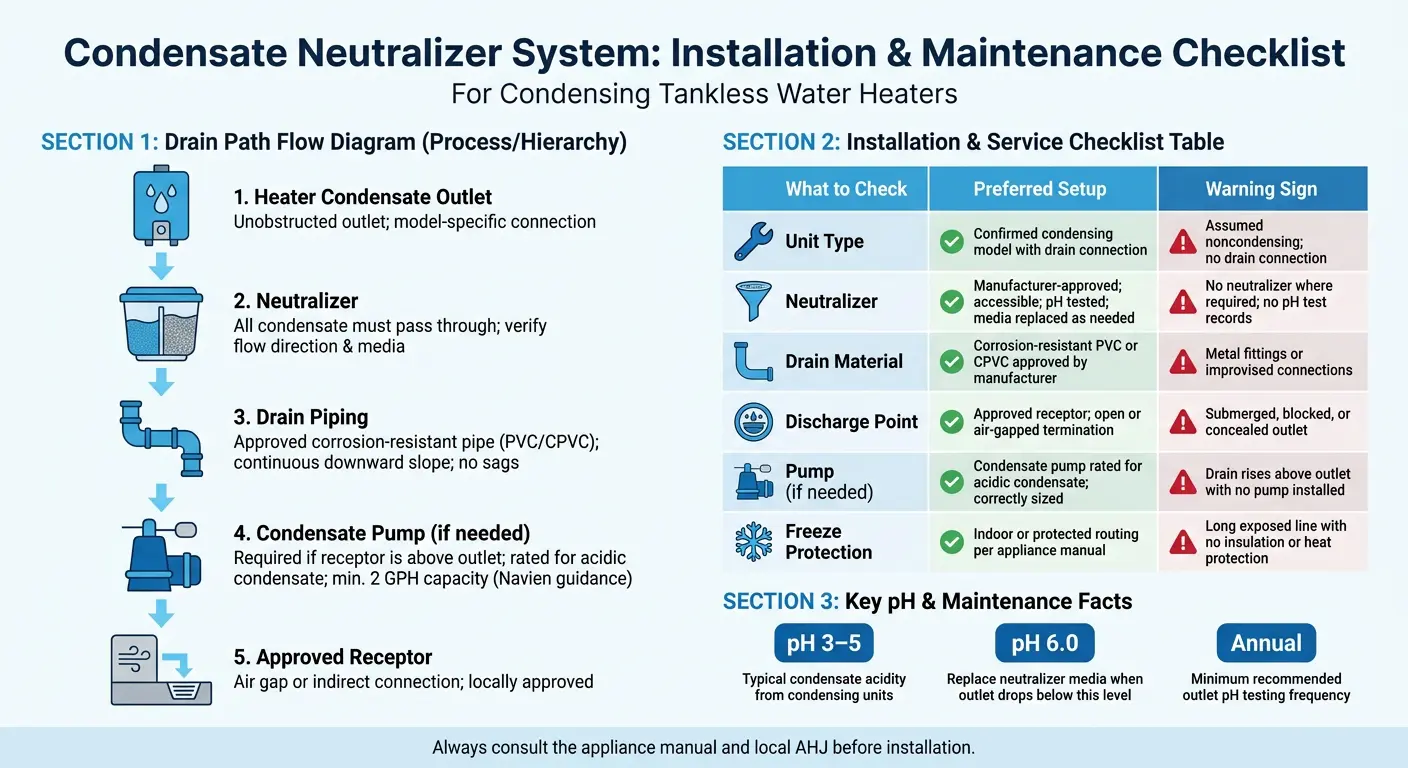
Condensate Neutralizer System: Installation & Maintenance Checklist
A Short Checklist for Evaluating an Existing System
Before you approve a condensing tankless water heater install, run through these checks in order.
Use this checklist during closeout or service calls to confirm the drain path, neutralizer, and discharge point are set up the right way.
| What to check | Preferred setup | Warning sign |
|---|---|---|
| Unit type | Confirmed condensing model with drain connection | Assumed noncondensing; no drain connection present |
| Neutralizer | Manufacturer-approved neutralizer installed, accessible, and serviced on schedule | No neutralizer where required, or no record of pH testing/media replacement |
| Drain material | Corrosion-resistant pipe approved by the manufacturer | Metal fittings or improvised connections |
| Discharge point | Approved receptor with open or air-gapped termination | Submerged, blocked, or concealed outlet |
| Pump (if needed) | Condensate pump rated for acidic condensate, correctly sized | Drain rises above the outlet with no pump installed |
| Freeze protection | Indoor or protected routing per the appliance manual | Long exposed line with no insulation or heat protection |
Conclusion: What to Verify Before Installation or Service
Start with the appliance manual. It spells out the connection size, allowed materials, neutralizer orientation, and discharge arrangement. Local code and the authority having jurisdiction (AHJ) may also add rules that the manual doesn’t cover, including discharge limits.
PVC or CPVC resists corrosion. But that doesn’t mean the job is done. The condensate still needs a compliant route, an approved receptor, and, where required, a working neutralizer.
After the system passes inspection, write down the model, neutralizer type, drain route, and service date. Also record the installation date and the next service date.
FAQs
Do all condensing tankless water heaters need a neutralizer?
No. Not all condensing tankless water heaters need a neutralizer, but many do based on how they’re installed.
The big factors are local building codes, the manufacturer’s instructions, and the drain pipe material. Condensing units produce acidic condensate, so a neutralizer is often required when that condensate drains through metal piping, which can corrode over time.
How do I know when neutralizer media needs replacement?
Check the replacement schedule in your manufacturer’s product data sheet. Some modern tankless systems also send maintenance alerts through self-diagnostics or mobile app notifications.
Acidic condensate can lead to corrosion and may void your warranty, so it’s smart to stick to those replacement intervals. If you’re not sure what your system needs, a certified technician from Eco Temp HVAC can inspect it and confirm that your condensate setup meets code.
Can acidic condensate damage my drain or sewer line?
Yes. Condensing tankless water heaters produce condensate with a pH of 3.0 to 5.0, which is acidic enough to corrode metal piping and drain systems.
That’s why manufacturers or local codes often require a condensate neutralizer. Its job is simple: raise the pH before the water goes into the drain.
If your home has metal drain piping, a neutralizer matters even more. It helps protect the system from corrosion over time.