
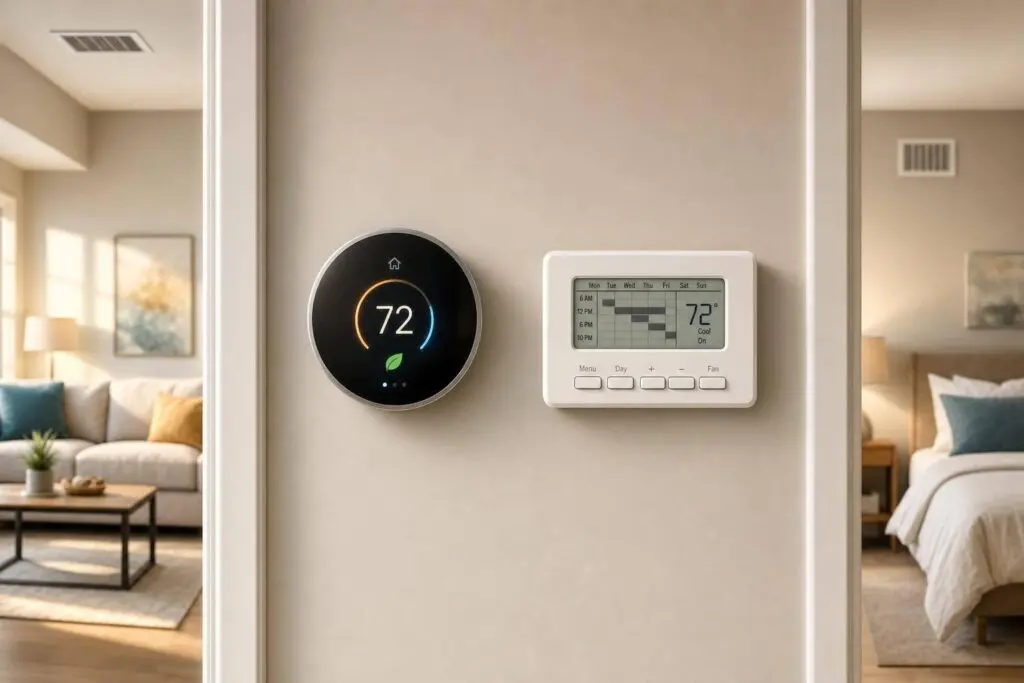
If your schedule stays the same, a programmable thermostat is often enough. If your routine changes, an AI control usually gives you better comfort and more control. That’s the short answer.
I’d break it down like this:
- Programmable thermostats follow the schedule you set.
- AI controls learn patterns, use phone access, and react to weather, occupancy, and run time.
- Older systems may need a C-wire or extra setup for AI controls.
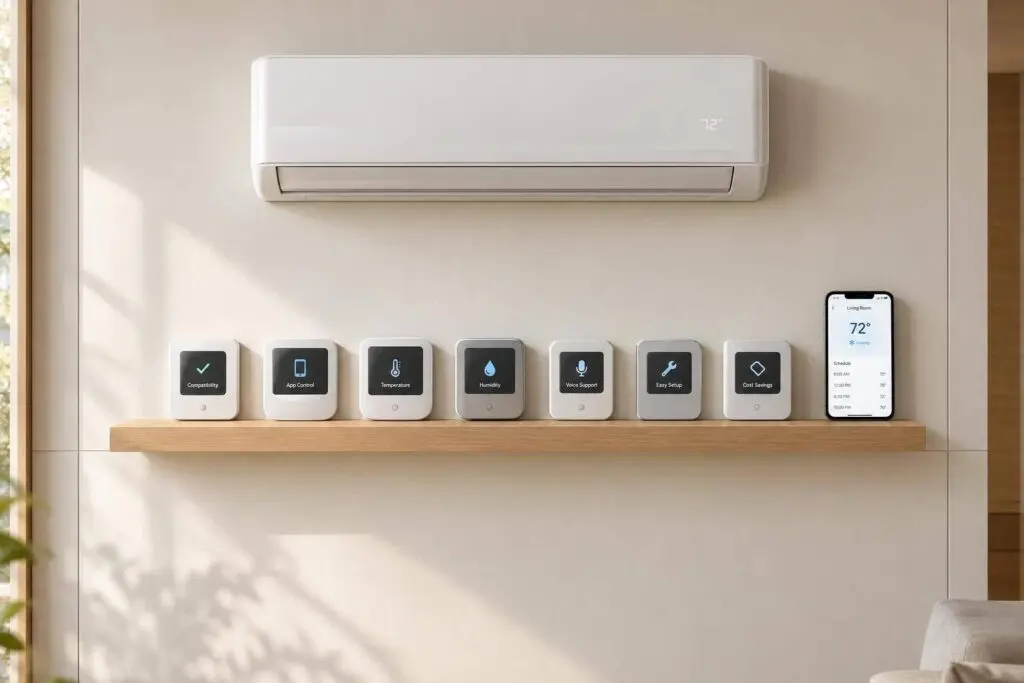
- Mini splits usually need a brand-specific add-on or smart controller.
- Small offices and multi-zone buildings often get more from AI controls than single-zone homes do.
- The U.S. Department of Energy says setbacks of 7°F to 10°F for 8 hours a day can save up to 10% per year on heating and cooling.
So if you want lower upfront cost and a fixed routine works for you, go programmable. If you want less manual adjustment, phone control, room-by-room help, and alerts when performance starts to slip, AI is the better fit.
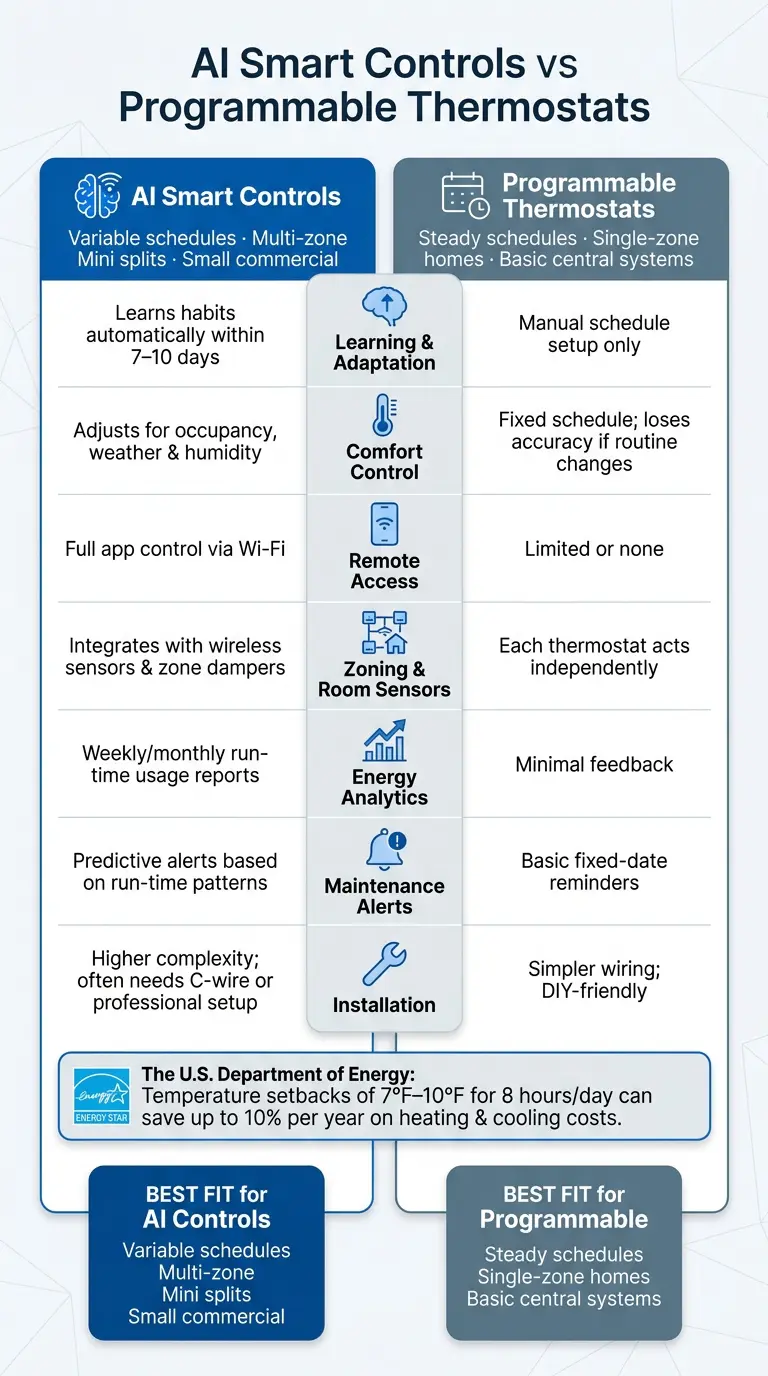
AI vs Programmable Thermostats: Side-by-Side Feature Comparison
Stop Buying The WRONG Smart Thermostat
Quick Comparison
| Criteria | AI Controls | Programmable Thermostats |
|---|---|---|
| How it works | Learns patterns and adjusts on its own | Follows the schedule you enter |
| Comfort control | Responds to occupancy, weather, and humidity | Stays on fixed time and temp settings |
| Remote access | Usually full app control | Limited or none |
| Zoning support | Works well with sensors and dampers | Basic, with each thermostat working alone |
| Energy efficiency feedback | Run-time and usage reports | Very little system feedback |
| Maintenance alerts | Alerts based on run time and system behavior | Usually simple timed reminders |
| Setup | More wiring and setup may be needed | Often simpler to install |
| Best fit | Variable schedules, multi-zone spaces, mini split add-ons, small commercial sites | Steady schedules, single-zone homes, basic central systems |
In short, I’d choose based on your wiring, your HVAC type, and how often your daily routine changes.
AI Controls vs Programmable Thermostats: Feature-by-Feature Breakdown
| Feature | AI Controls | Programmable Thermostats |
|---|---|---|
| Learning/Adaptation | Learns habits automatically within 7–10 days | Manual schedule setup only |
| Comfort Stability | Adjusts for occupancy, outdoor weather, and humidity | Follows fixed schedule; can lose accuracy if routine changes |
| Remote Access | Full app control via Wi-Fi | Limited or none |
| Zoning & Room Sensors | Integrates with wireless sensors and zone dampers | Each thermostat acts independently |
| Energy Analytics | Weekly or monthly run-time reports | Minimal feedback |
| Alerts & Maintenance | Predictive alerts based on run-time patterns | Basic fixed-date reminders |
| Installation Complexity | Higher; often needs C-wire, professional setup | Lower; simpler wiring, DIY-friendly |
Learning Ability, Comfort, and Daily Temperature Control
These differences show up fast in daily use.
AI thermostats learn your routine and adjust when life changes. If you suddenly work from home or a run of hot days throws off your normal pattern, the system can react on its own. It uses room occupancy sensing and may start cooling earlier based on what it has learned. Some models also account for indoor humidity, which can let you keep a slightly higher setpoint without making the house feel less comfortable.
Programmable thermostats are much more fixed. They follow the schedule you entered, period. So when your routine shifts, the thermostat stays put. That can mean cooling an empty house for hours or walking into a warm, stuffy room at the end of the day.
Remote Access, Zoning, and Data Use
With an AI thermostat, you can change the setpoint from your phone as soon as you leave for work or check on system status while you’re across town. Most programmable thermostats don’t offer app control, and some only allow very basic remote changes.
The gap gets even bigger with zoning. AI controls work with wireless room sensors and zone dampers to send cooling where it’s needed most. That means occupied rooms get more attention, while empty rooms don’t keep getting cooled for no reason. Programmable thermostats don’t coordinate across zones, so it’s common to end up with rarely used rooms that are too cold while busier parts of the house still feel warm.
AI systems also track run time, outdoor weather, and usage trends. That gives you a clearer view of when cooling costs start climbing. Programmable models usually don’t offer that kind of feedback.
Alerts, Maintenance Insight, and Setup Complexity
AI controls can spot patterns that hint at trouble. If the AC starts running longer than normal to hit the same setpoint, that often points to low refrigerant, restricted airflow, or a blower motor that’s struggling. Filter reminders are also tied to actual run-time hours instead of a fixed calendar date, so the reminder matches how the system is being used. With programmable thermostats, the homeowner usually has to notice comfort issues or odd sounds on their own.
Installation is another clear difference. Many AI thermostats need a C-wire to keep Wi-Fi and onboard processing powered at all times. In older Chicagoland homes, that wire may not be present at the thermostat location, which can make a DIY install harder than it looks.
Programmable thermostats are usually easier on the wiring side and simpler to set up, which makes them a solid DIY option for many single-zone systems. AI controls, especially in multi-zone setups or homes with older wiring, often make more sense with professional installation so the equipment match, wiring, and feature setup are handled the right way. When the control has to match the system it’s running, that part matters a lot.
Matching the Right Control to Your HVAC System
Not every control works with every HVAC setup. Start with the equipment. That one step cuts through a lot of confusion.
Here’s the quick view by system type:
| System Type | Programmable Thermostat | AI Smart Control |
|---|---|---|
| Older central AC/furnace systems with standard 24V controls | Usually works if the existing wiring supports a standard thermostat | May require a C-wire upgrade or adapter |
| Central AC/furnace systems from the last 15–20 years | Compatible on most standard 24V setups | Compatible if the wiring and control board support it |
| Ductless mini splits | Not natively compatible | Brand-specific module or IR smart controller needed |
| Light commercial, multi-zone buildings | Good for fixed schedules and predictable occupancy | Strong fit for variable occupancy and runtime tracking |
Older Central AC and Furnace-Based Systems
Standard central systems give you the most control options. Most central AC and furnace systems installed in the last 15 to 20 years use standard 24-volt controls, so either type of thermostat will usually work.
The main catch is power. Many AI controls need a C-wire or an adapter to run the way they should. If your system is more than about 20 years old and close to replacement, many HVAC pros suggest waiting and doing the control upgrade with the new equipment. That can save you from paying for a fix now and then doing it all over again later.
Ductless Mini Splits and Room-by-Room Cooling
When comparing ductless mini split vs. traditional central HVAC systems, the controls play by different rules. Mini splits don’t use standard 24-volt thermostat wiring, so a regular programmable thermostat usually won’t connect.
If you want smart control, you’ll usually need one of these:
- A brand-specific Wi‑Fi module
- An IR-based smart controller
For homes with several mini splits in different rooms, app control can make a big difference. You can cool the bedroom overnight while cutting runtime in an empty guest room. But if you’re dealing with one room that’s only used now and then, the built-in timer may be all you need.
Eco Temp HVAC, a Mitsubishi Diamond Elite Contractor, can match the control to the indoor unit and help preserve the 12-year warranty on qualifying Mitsubishi products.
Light Commercial Offices, Retail, and Small Multi-Zone Buildings
In commercial spaces, equipment age matters less than how people use the building. A single-tenant office with the same Monday-through-Friday routine can often run just fine with a well-set programmable thermostat.
AI controls make more sense when occupancy shifts day to day, like in retail stores, clinics, and offices with uneven schedules. Instead of following a fixed clock, they respond to how the space is actually used. Managers also get one place to check temperature, runtime, and alerts across zones.
Cost, Value, and Choosing the Right Control
Price matters, but it’s not the whole story. A programmable thermostat usually costs less at the start. An AI control costs more, but in the right setup, it can do more for the money. That gap shows up pretty clearly in the use cases below.
When Programmable Controls Are the Better Fit
If your routine stays pretty much the same from day to day, lower cost often makes more sense. Programmable controls are a good fit for single-zone homes, steady schedules, and simpler HVAC setups.
When AI Controls Are Worth the Upgrade
When your schedule changes a lot, automation starts to earn its keep. AI controls can make a clear difference when occupancy is less predictable or when a building has multiple zones.
Take a two-story Chicagoland home where upstairs bedrooms get too hot in summer. That’s a strong example. An AI thermostat can learn how fast that area warms up and pre-cool it before bedtime, which cuts down on constant manual tweaks.
Hybrid work schedules are another good fit. Geofencing and occupancy detection can shift the system on their own instead of making you change the schedule every time your plans change. Small businesses can also get a lot out of AI controls, especially from usage dashboards and fault alerts that point out problems before they turn into costly breakdowns.
Why Professional Evaluation Matters for Chicagoland Systems
Picking the right control is one part of the job. Making sure it works with your HVAC equipment is the other part.
Wiring is often the first hurdle. Many AI thermostats need a C-wire or a power adapter, and a lot of older homes don’t have one. The right choice also depends on the system itself, whether that’s a simple single-stage unit, a multi-stage system, a heat pump, or ductless equipment.
In Chicagoland, Eco Temp HVAC can check that fit before installation. Their technicians review existing wiring, equipment staging, and building layout across Chicago, St. Charles, Bartlett, Lemont, Downers Grove, and Palatine, helping make sure the control matches the system.
Conclusion: Choosing Between AI and Programmable Controls
After looking at learning, zoning, alerts, and compatibility, the choice mostly comes down to how you use your system day to day. Both options can do the job. The better fit depends on your setup and your routine.
Programmable thermostats make the most sense for predictable schedules, single-zone systems, and a lower upfront cost. If your routine stays about the same and your equipment is a standard central AC or furnace, a programmable thermostat can handle things just fine.
When schedules change, automation starts to matter more. AI controls are a better fit for variable routines, multi-zone systems, and homes or businesses that want more hands-off control. They can learn patterns, support zoning, and show system performance trends. That makes them a stronger match for ductless mini-split setups and light commercial spaces with shifting occupancy.
For Chicagoland homes and businesses, a professional evaluation can confirm compatibility before installation. Eco Temp HVAC can assess the system and recommend the right control.
FAQs
Do I need a C-wire for an AI thermostat?
Usually, yes. A C-wire gives smart thermostats the steady power they often need for things like Wi-Fi, touchscreens, and built-in sensors.
If your home doesn’t have one, that doesn’t always mean you need to replace your HVAC system. In many cases, a manufacturer-approved power adapter can fix the problem. And if you want to play it safe, a pro can install the adapter or add a C-wire for you.
Can AI controls work with my mini split?
Yes. AI-powered controls can work with a ductless mini-split. But most 24V smart thermostats don’t work out of the box, because mini-splits usually rely on proprietary digital communication instead of standard 24V thermostat wiring.
You generally have three paths:
- A brand-specific Wi-Fi module
- An infrared smart controller
- A wired thermostat interface kit
There’s one catch: each indoor head works as its own zone. So in most cases, you’ll need a separate controller for each room.
Before you buy anything, check your model numbers and confirm compatibility with a professional.
Are AI controls worth it for one-zone homes?
Yes. For one-zone homes, AI controls can still be worth it for energy savings and convenience.
They can cut cooling energy use by 10% to 30%. On top of that, they give you remote access, learn the temperatures you like, and handle schedules for you automatically.
A standard programmable thermostat usually costs less. But an AI model gives you a more hands-off, efficient experience.