
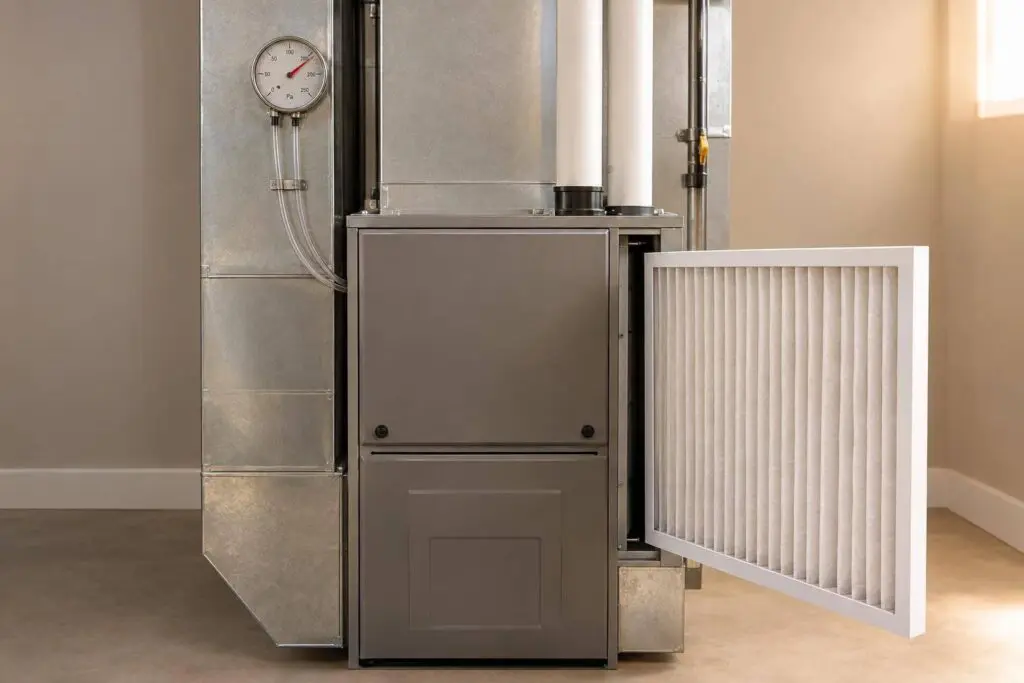
Most standard furnace blowers can’t handle a replacement HEPA filter – even if it fits. I recommend having an HVAC technician check airflow and static pressure before you install one.
HEPA filters remove at least 99.97% of particles at 0.3 microns in lab tests, but that rating doesn’t tell you whether your furnace can move enough air through them. Here’s what I’d check:
- Blower capacity: Can it maintain the required airflow with both a clean filter and one loaded with dust?
- System limits: Do filter resistance, duct restrictions, and heating temperature rise stay within the manufacturer’s limits?
- Warning signs: Weak airflow, coil icing, or repeated overheating shutdowns call for diagnosis – not bypassing a safety control.
- Other options: If HEPA adds too much resistance, use an approved lower-resistance furnace filter, a separately powered ducted HEPA system, or a portable cleaner sized by its clean air delivery rate (CADR).
My bottom line: <u>Match the filtration to your furnace – not just the filter slot.</u> For Chicagoland homes, an airflow assessment can help you choose a setup that cleans the air without cutting safe airflow.
Why HEPA Filters Can Restrict Furnace Airflow
A true HEPA filter removes at least 99.97% of particles at 0.3 microns under lab test conditions. But its dense media resists airflow more than standard furnace filters. Filtering more particles doesn’t mean the blower can move enough air through the filter. That added resistance can cause comfort problems and furnace shutdowns.
Airflow, Static Pressure, and Blower Capacity
Airflow, measured in cubic feet per minute (CFM), is the amount of air the blower moves. Static pressure, measured in inches of water column (in. w.c.), is the resistance the blower must overcome. Filters, ducts, coils, dampers, registers, and other components all add resistance.
Most new furnaces have a total external static-pressure limit near 0.5–0.8 in. w.c., but your furnace’s rating is what matters. If a filter pushes total external static pressure above that rating, it isn’t a match for the system.
A variable-speed blower may speed up to maintain airflow, but that uses more energy – and the blower still has a limit. Other blowers may simply move less air. Compare the proposed filter’s pressure drop at the required CFM with the equipment’s blower performance table. That comparison tells you whether the system can handle the filter.
How Filter Size and Dust Affect Resistance
More filter media area can lower resistance, but it doesn’t override blower limits. To check fit, use the filter’s pressure drop at your system’s required airflow. A larger cabinet alone doesn’t make HEPA compatible. You also need to account for resistance from the cabinet and its duct connections.
Check the loaded-filter pressure drop, not just the clean-filter rating. Dust adds resistance, so the blower must still meet airflow demand as the filter fills.
In heating mode, reduced airflow increases the temperature rise – the difference between supply- and return-air temperatures. In cooling mode, too little airflow can reduce capacity and potentially freeze the evaporator coil. A prefilter and regular filter replacement slow the increase in resistance, but neither fixes an undersized blower.
Use these numbers in the compatibility check below.
Check Filter Compatibility Before Installation
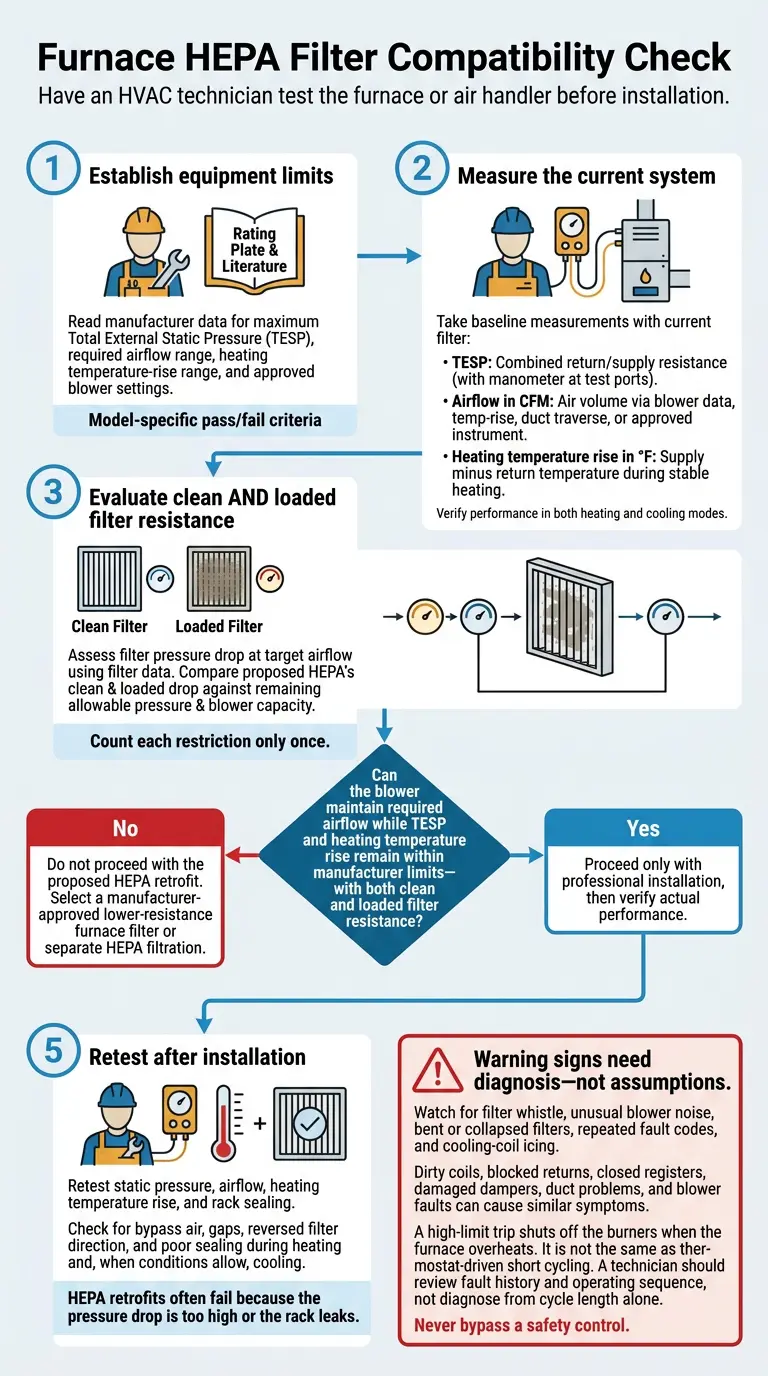
Furnace HEPA Filter Compatibility Check
Use the airflow and static-pressure numbers above to check whether your furnace can handle a HEPA filter. Have an HVAC technician provide professional heating services to test the furnace or air handler before installation. In both heating and cooling modes, the technician should verify maximum total external static pressure (TESP), blower capacity, airflow, heating temperature rise, and rack sealing. HEPA retrofits often fail because the pressure drop is too high or the rack leaks.
Measure Static Pressure, Airflow, and Temperature Rise
Start with baseline measurements of static pressure, airflow, and heating temperature rise while the current filter is in place. Then compare the HEPA filter’s clean and loaded pressure drop at the target airflow against the remaining allowable pressure. Count each restriction only once.
| Measurement | What It Indicates | Why It Matters |
|---|---|---|
| Total external static pressure (TESP) | Combined return- and supply-side resistance, measured with a manometer at manufacturer-specified test ports | Must stay within the equipment’s rated limit. |
| Filter pressure drop | Filter resistance at operating airflow, determined from upstream and downstream pressure readings and filter performance data | Shows whether clean and loaded resistance fit within the remaining allowable pressure. |
| Airflow in CFM | Air volume moved, determined using blower performance data, a temperature-rise calculation, duct traverse, or an approved airflow instrument | Confirms enough airflow for heating and cooling. |
| Heating temperature rise in °F | Supply-air temperature minus return-air temperature during stable heating, measured at manufacturer-specified locations | Too much temperature rise can point to inadequate airflow and trigger a high-limit shutdown. |
| Equipment limits | Maximum TESP, airflow range, temperature-rise range, and approved blower settings from the rating plate and manufacturer literature | Sets model-specific pass/fail criteria. |
After installation, retest static pressure, airflow, heating temperature rise, and rack sealing. Check for bypass air, gaps, reversed filter direction, and poor sealing during heating and, when conditions allow, cooling.
Signs of Restricted Airflow and Limit Trips
A high-limit trip shuts off the burners when the furnace overheats. It isn’t the same as thermostat-driven short cycling. A technician should review fault history and the operating sequence – not diagnose either problem from cycle length alone.
Watch for filter whistle, unusual blower noise, bent or collapsed filters, repeated fault codes, and cooling-coil icing. These can point to restricted airflow, but dirty coils, blocked returns, closed registers, damaged dampers, duct problems, and blower faults can cause the same symptoms. Get a full airflow diagnosis, and never bypass a safety control.
Choose Filtration That Matches Blower Capacity
If testing shows the blower is near its limit, match filtration to the system rather than force a HEPA retrofit. Cleaning performance depends on airflow, runtime, filter loading, leakage, and room mixing – not filter efficiency alone. A lower-resistance furnace filter paired with a portable room air cleaner may work better than a restrictive whole-system filter, or you might compare ductless mini splits vs. traditional central HVAC systems to find a more flexible solution.
Compare Furnace Filters with Separate HEPA Systems
Use the test results above to choose filtration the blower can support.
| Air-Cleaning Approach | Particle Filtration | Main Limitation | Installation Needs | Best Fit |
|---|---|---|---|---|
| Engineered whole-house HEPA system | High particle removal when properly designed and sealed | Needs enough blower or auxiliary-fan capacity | Engineered cabinet, duct connections, and testing with clean and loaded filters | Broad filtration with verified system capacity |
| Low-resistance media cabinet | Depends on the selected media | Published pressure drop still determines compatibility | Cabinet replacement or return-duct modification | Better whole-house filtration with less resistance |
| Approved high-efficiency furnace filter | Depends on the approved media | Must stay compatible as dust builds up | Approved size, specification, and replacement schedule | Existing equipment with a documented compatible option |
| Ducted or bypass HEPA system | HEPA filtration; bypass units clean part of the airflow per pass | Dedicated fan needs proper integration | Duct connections, sealing, power, controls, and commissioning | Whole-house cleaning when direct HEPA resistance is unsuitable |
| Portable HEPA air cleaner | HEPA filtration in one room | Coverage depends on CADR and operating speed | Room sizing and placement | Bedrooms, home offices, and small rooms |
For a ducted unit, check whether it runs continuously, independently, or only with the furnace. For a media cabinet, compare the selected filter’s pressure drop at actual airflow. Cabinet depth or MERV rating alone won’t tell you whether it fits the system.
When a Separate Air Cleaner Makes Sense
Choose separate filtration if the proposed filter exceeds pressure limits, measured airflow falls below equipment requirements, temperature rise becomes excessive, rooms lose comfort, or the furnace repeatedly trips its limit control. A 1-inch filter slot still calls for a cabinet assessment – it doesn’t rule out better filtration.
For room filtration, use CADR, not the HEPA label alone. Choose a unit that supplies the needed CADR at a noise level you can tolerate. Lower speeds clean less air.
Get a Chicagoland HVAC Assessment
If the system’s capacity still needs confirmation, have its airflow checked before upgrading.
Eco Temp HVAC can test static pressure, airflow, filter pressure drop, and duct restrictions in Chicagoland.
Conclusion: Verify Blower Capacity Before Adding HEPA
A running blower doesn’t mean the furnace can handle HEPA. Before installation, check the furnace’s approved filter specifications, blower performance table, and static-pressure limit. The key test is whether the blower maintains rated airflow against HEPA resistance as the filter collects particles. Have a technician check airflow and static pressure, including with a loaded filter.
Repeated high-limit trips need diagnosis – not a blower-speed change. Never bypass a safety control. Restricted airflow can overheat the furnace even while the fan runs. If overheating occurs, shut off the system and have a qualified HVAC professional evaluate it.
If the furnace can’t maintain airflow with HEPA resistance, choose a manufacturer-approved, lower-resistance furnace filter or a separate HEPA air cleaner. Either option should improve particle removal without reducing safe airflow.
For Chicagoland homes, Eco Temp HVAC can assess the furnace, ductwork, and indoor air quality to identify the safest filtration option.
FAQs
Will running my furnace fan longer improve filtration?
Running your furnace fan longer won’t improve filtration if your system can’t handle a HEPA filter’s high static pressure. HEPA filters restrict airflow more than standard filters. That restriction can strain or damage the blower motor and cause the heat exchanger to overheat. Longer fan runtime also uses more energy and adds wear.
For better air quality, have a professional check what your system can handle, or consider a dedicated bypass air cleaner or portable air cleaner.
How can I distinguish overheating shutdowns from short cycling?
Overheating shutdowns usually happen when restricted airflow trips the high-limit switch after the furnace has been running. Short cycling means the furnace turns on and off too often, sometimes before reaching the set temperature.
Timing can help narrow down the cause. Shutdowns within 30 seconds often point to ignition problems. Shutdowns after a longer run more often suggest restricted airflow. A technician can confirm the cause by checking blower motor amperage and testing the safety controls.
When should I retest airflow after upgrading my filter?
Retest airflow immediately after installing a new filter. HEPA and high-efficiency filters add much more airflow resistance. A professional technician should use a manometer to check that total external static pressure stays within the manufacturer’s specified range and does not exceed 0.8 in. w.c.
Also retest after moving the filter, adjusting blower speeds, or repairing ductwork to confirm proper system balance and efficiency.