
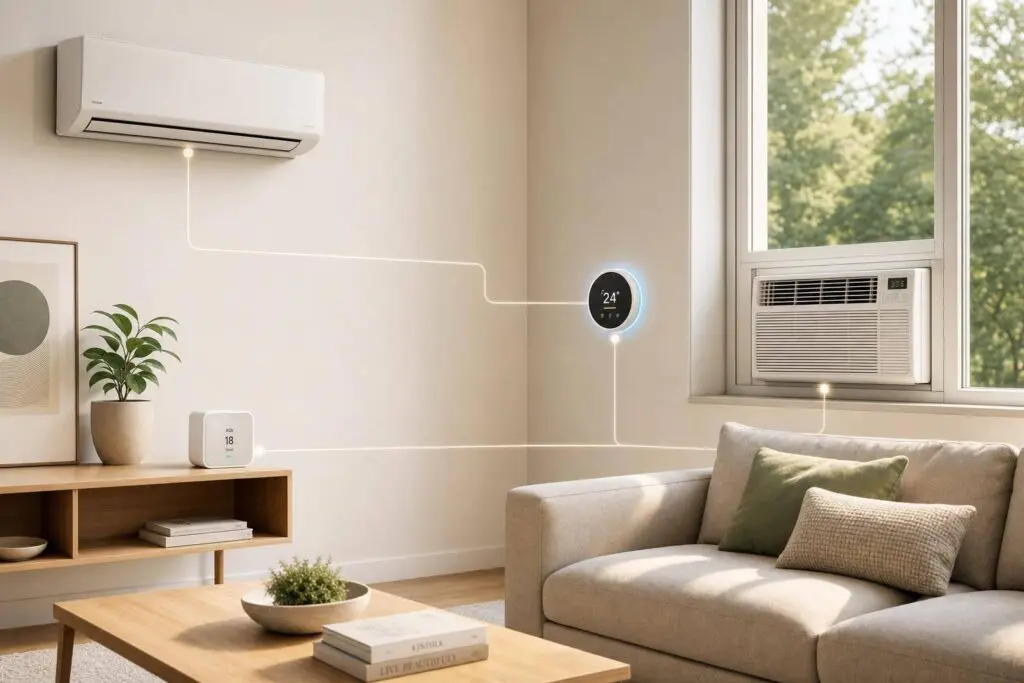
Most “smart” ACs are smart about cooling – not air quality. From the six products compared here, only a few track indoor air conditions in a meaningful way, and just one group gives you both deep comfort control and built-in particle sensing.
If I cut this down to the main answer, it looks like this:
- Best low-cost add-on: Sensibo Air Pro – adds VOC, CO2e, humidity, and temperature tracking to many IR-based ACs for about $139–$149
- Best for ducted homes: ecobee Smart Thermostat Premium – tracks VOCs, eCO2, and humidity for $249.99
- Best window AC for cooling efficiency: LG DUAL Inverter Smart Window AC – strong smart cooling, but no active IAQ sensing
- Best window AC for quiet operation: Midea U Smart Inverter – low noise, offline AI ECO mode, but no air-quality sensing
- Best ductless pick with built-in air sensing: Samsung WindFree AI – higher-end models add PM1.0 sensing, humidity control, and app-based room monitoring
- Best premium long-term pick: Mitsubishi Electric mini-split setup – top efficiency, very low noise, and strong controls, but full IAQ tracking often needs add-ons
Here’s the simple split:
- Want air data without replacing your AC? Go with Sensibo or ecobee
- Want a window unit? Pick LG or Midea for cooling and power savings, not for air tracking
- Want the most complete ductless setup? Look at Samsung
- Want top efficiency and premium install quality? Look at Mitsubishi
How AI Controls Cooling in Modern ACs 🤖❄️ | Smart Inverter AC Explained
sbb-itb-b5c10b1
Quick Comparison
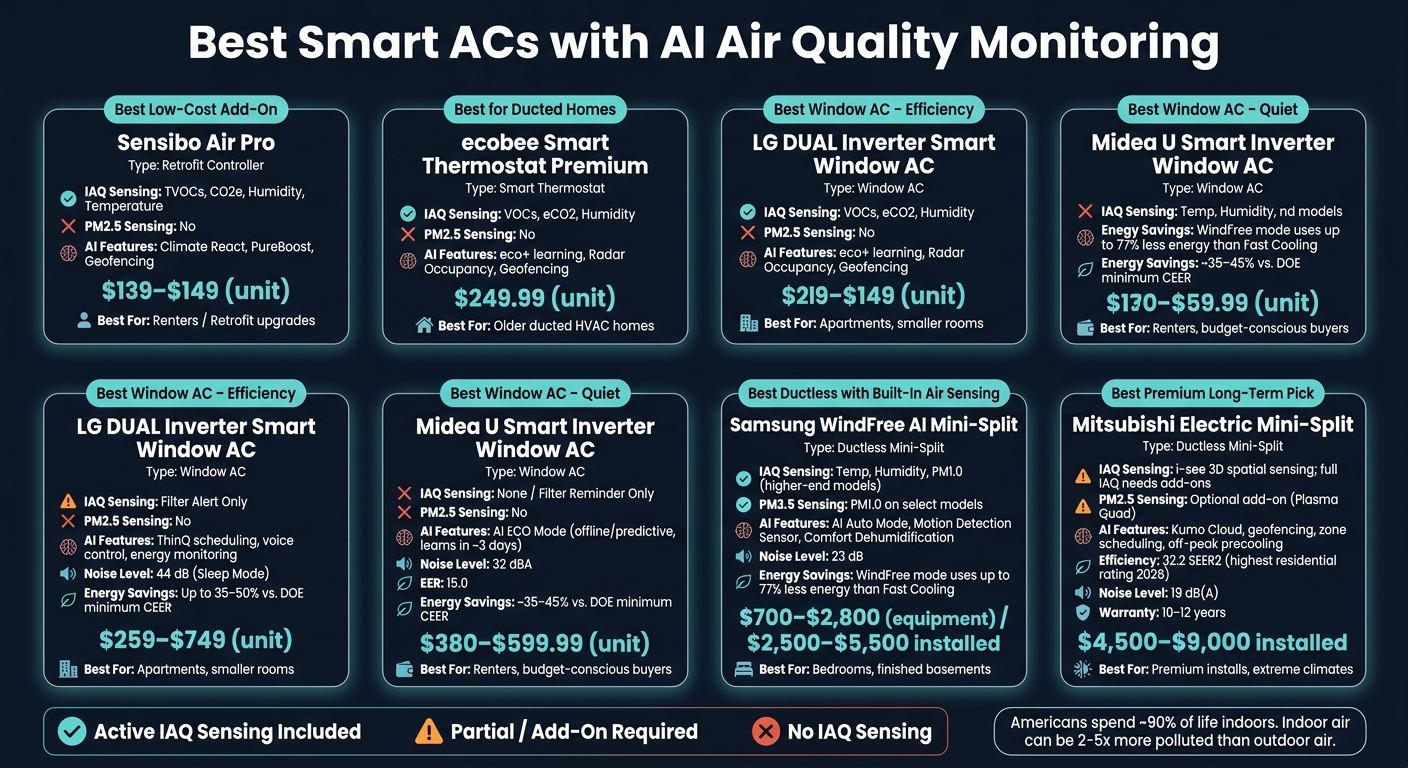
Best Smart ACs with AI Air Quality Monitoring: Side-by-Side Comparison
| Model | Type | Air-quality sensing | Main strength | Price |
|---|---|---|---|---|
| Sensibo Air Pro | Retrofit controller | TVOCs, CO2e, humidity, temperature | Adds smart air-aware control to existing ACs | $139–$149 |
| ecobee Smart Thermostat Premium | Smart thermostat | VOCs, eCO2, humidity | Best fit for ducted HVAC homes | $249.99 |
| LG DUAL Inverter Smart Window AC | Window AC | Filter alert only | Efficient, quiet room cooling | $259–$749 |
| Midea U Smart Inverter Window AC | Window AC | None; filter reminder only | Very quiet, offline AI ECO mode | $380–$599.99 |
| Samsung WindFree AI Mini-Split | Ductless mini-split | Temp, humidity, and PM1.0 on some models | Built-in sensing plus ductless comfort control | $700–$2,800 equipment; $2,500–$5,500 installed |
| Mitsubishi Electric Mini-Split setup | Ductless mini-split | Comfort sensing built in; full IAQ often needs add-ons | 32.2 SEER2, very low noise, premium setup | $4,500–$9,000 installed |
One fact shapes this whole comparison: Americans spend about 90% of life indoors, and indoor air can be 2–5x more polluted than outdoor air. So if you care about both comfort and improving indoor air quality, the key is to separate smart cooling features from actual air-quality monitoring.
1. Sensibo Air Pro
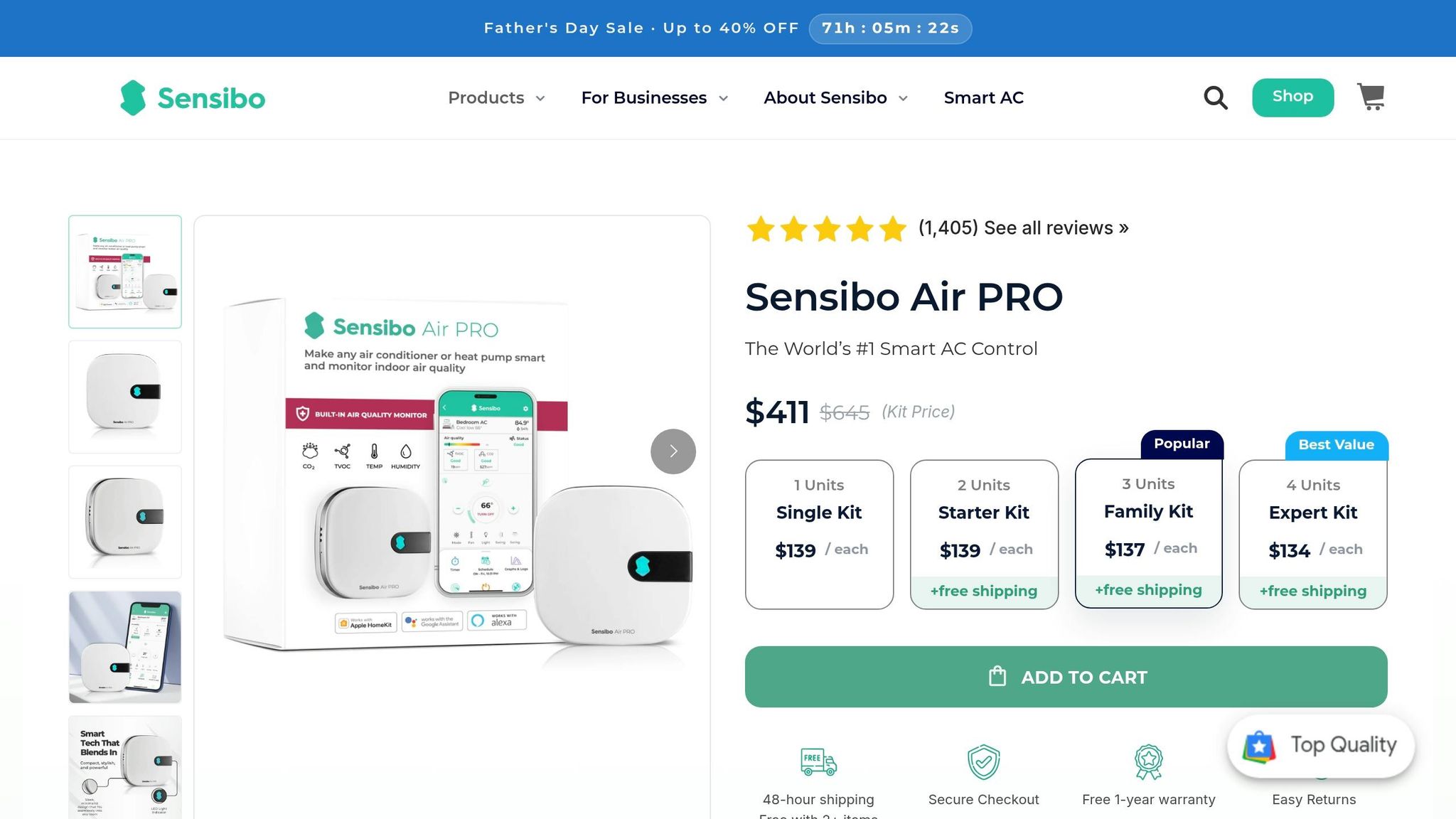
Sensibo Air Pro adds AI-based air quality control to existing IR-driven ACs. It’s a retrofit controller, not an AC itself, so you can upgrade mini-split, window, and portable units without swapping the whole system. That’s the big draw: you get IAQ-aware control from the equipment you already own.
IAQ Sensing
Air Pro tracks temperature, humidity, TVOCs, and CO2e. It does not measure PM2.5 directly, so it won’t replace a dedicated particulate monitor. Its temperature accuracy is ±0.9°F, and humidity accuracy is ±3% RH, which is solid for day-to-day automation.
Those sensors power the rules that let the system respond when indoor air conditions slip.
AI Automation
Climate React can turn the AC on or switch modes when temperature, humidity, or IAQ thresholds are crossed. PureBoost can bump up the AC fan when pollutants show up. Geofencing shuts the AC off when the last person leaves, then turns it back on before the first person gets home. The app also includes an AI assistant that suggests settings based on your habits.
There are a couple of catches. The system depends on the cloud, so if the internet goes down or Sensibo’s servers have an outage, control stops working. It also needs a clear line of sight to the AC’s IR receiver.
Integration and Cost
Setup takes about one minute with a QR code scan. The hardware usually sells for $139 to $149. Energy analytics and AC health checks are part of Sensibo Plus, which costs about $2.49 per month. It works with Apple HomeKit, Amazon Alexa, Google Assistant, and Samsung SmartThings, and it supports more than 10,000 IR-controlled AC and heat pump models. Sensibo says smart scheduling and geofencing can cut energy use.
If you’d rather use native thermostat-based control than a retrofit device, the next option goes in that direction.
2. ecobee Smart Thermostat Premium
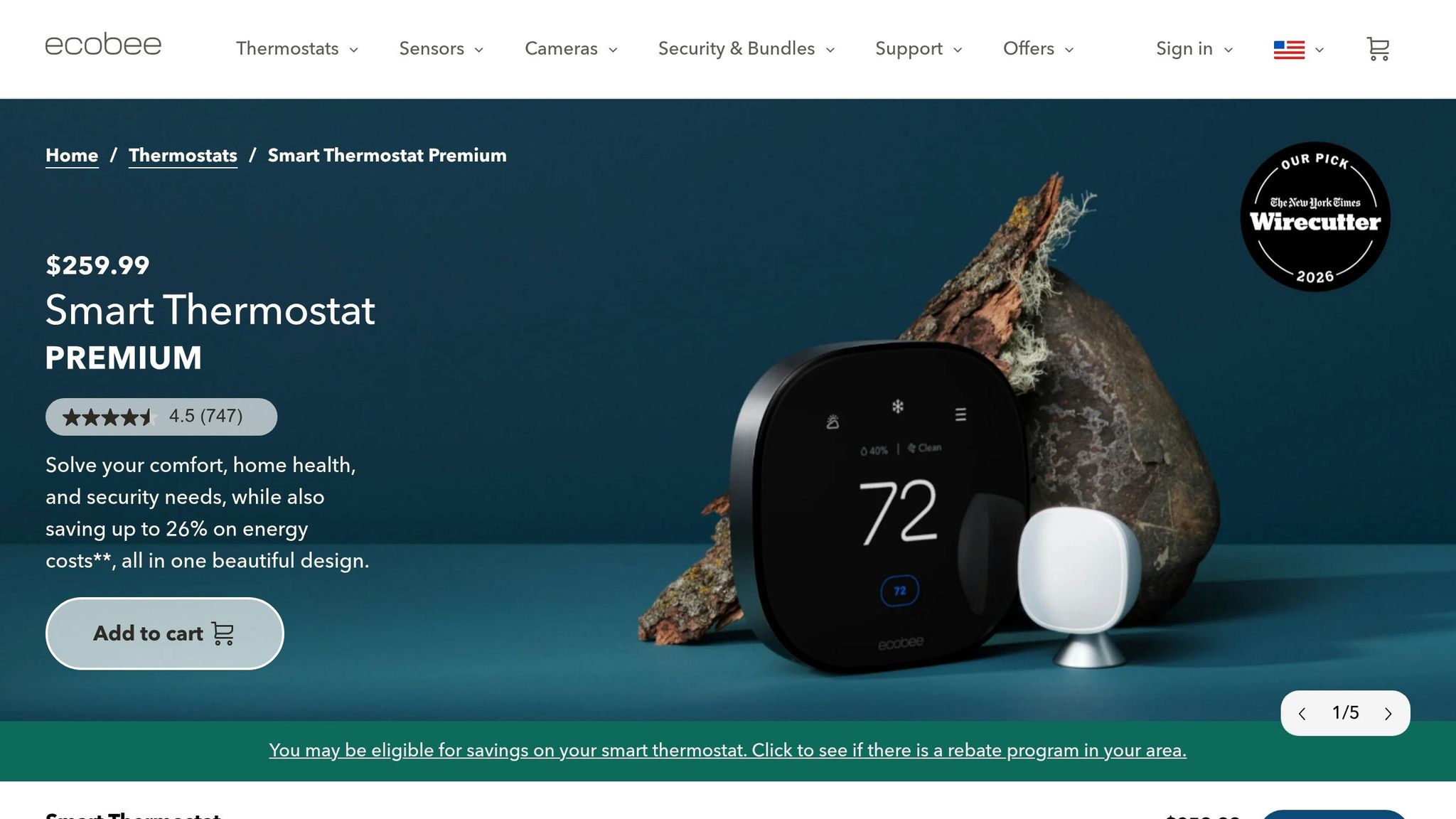
The ecobee Smart Thermostat Premium packs indoor air quality tracking and automation into one device. It costs $249.99 and comes with one SmartSensor, plus a Power Extender Kit for homes that don’t have a C-wire.
IAQ Sensing
This thermostat tracks VOCs, estimated CO2 (eCO2), and humidity. It does not track PM2.5. One thing to know: its eCO2 reading is based on VOC data, so it’s an estimate rather than a direct CO2 reading. Levels above 1,000 ppm are tied to drops in cognitive performance.
It also includes a couple of humidity-focused features that can make a room feel better without extra gear. Feel Like adjusts the set point based on humidity. AC Overcool to Dehumidify runs the AC to pull out extra moisture, even if you don’t have a separate dehumidifier. The goal is to bring humidity closer to the 40% to 60% RH range recommended by the EPA and ASHRAE.
AI Automation
The eco+ system learns your household patterns over five weeks. After that, it can suggest schedules, ease cooling when nobody’s home, and pre-cool during off-peak hours.
ecobee also uses radar occupancy sensing to detect small movements like typing or even breathing. That helps the thermostat figure out whether a room is in use. The included SmartSensor adds another layer of control, so you can give more weight to places like a bedroom or home office.
Cooling Efficiency and Cost
Ecobee says this thermostat can save up to 26% per year on heating and cooling bills. ENERGY STAR puts the average closer to 6% to 8% on cooling and 8% to 12% on heating. So the upside may be there, but average results tend to be more modest. It comes with a 3-year manufacturer warranty.
PCMag rated it 4.5 out of 5 and named it Best Overall Smart Thermostat for 2026.
On the smart home side, it works with:
- Apple HomeKit
- Amazon Alexa
- Google Assistant
- Samsung SmartThings
It also doubles as an Alexa or Siri speaker, which is a nice extra if you want one less device sitting on a table.
If you want IAQ-aware cooling built into the AC unit itself, the next model shifts from thermostat-based control to a smart window AC.
3. LG DUAL Inverter Smart Window AC with ThinQ
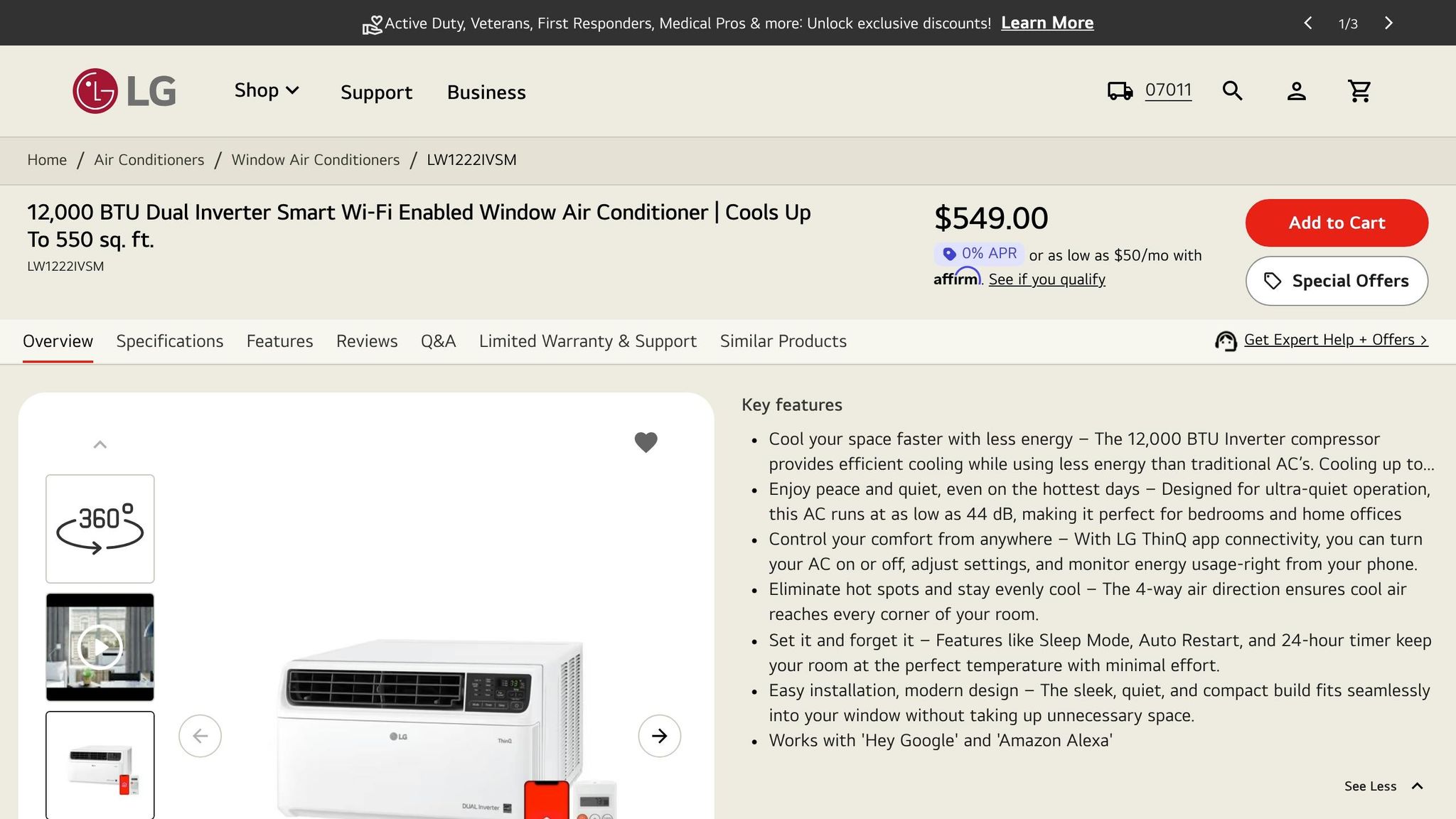
The LG DUAL Inverter Smart Window AC with ThinQ is built first and foremost for efficient cooling. It also gives you app-based control through ThinQ, which is handy day to day. What it does not include is built-in air-quality sensing. Prices start at $259.00 for the 6,000 BTU model and go up to $749.00 for the 23,500 BTU version, depending on capacity.
IAQ Sensing
There’s a Filter Alarm Function that lets you know when the washable filter needs cleaning. You’ll see the alert on the LED display and in the ThinQ app, usually about once a month.
That’s useful as a maintenance reminder, but it’s not the same as active IAQ monitoring. In plain English: it can tell you to clean the filter, but it can’t track indoor air conditions on its own.
AI Automation
ThinQ covers the features most people want from a smart window AC:
- Remote control
- Voice commands
- Scheduling
- Energy monitoring
Some newer AI Air models also detect occupancy and shift airflow direction based on where people are in the room. That adds a nice layer of convenience. Still, the bigger draw here is the inverter system, which helps the unit cool in a steady, less stop-and-start way.
Cooling Efficiency and Cost
The variable-speed compressor is the big selling point. LG says its DUAL Inverter models can deliver up to 35% to 50% more energy savings than the DOE’s minimum CEER standards. They can also run as quietly as 44 dB in Sleep Mode.
So if your main goal is quiet, efficient cooling, this model makes a strong case. Its air-care side is much simpler, though, with filter alerts and basic air cleaners doing most of the work. The next model shifts more attention toward direct IAQ control.
4. Midea U Smart Inverter Window AC
The Midea U Smart Inverter Window AC is a quiet, efficient window unit with smart controls, but it does not include built-in IAQ sensing. It ranks here for two reasons: limited air treatment and AI-based energy tuning. That means you get some extra help with comfort and power use, but not actual air-quality monitoring.
Pricing usually falls between $380 and $399 for the 8,000 BTU model and $479.99 to $599.99 for the 12,000 BTU version. That said, the 12,000 BTU model often shows up on sale for about $398.88.
IAQ Sensing
There are no active air-quality sensors here. The Clean Filter light is simply a reminder to maintain the unit. It does not detect particles, gases, or indoor air changes.
Some higher-end versions, most often the 12,000 BTU models, come with MShield Air Ionizer Technology. This feature is meant to help cut odors, smoke, and gases, but it is a treatment feature, not a sensing tool.
AI Automation
The unit’s AI ECO mode learns a room’s thermal mass over about three days. From there, it adjusts compressor output to improve efficiency while keeping the room comfortable. In plain English: it learns how your space holds heat and cool air, then tweaks performance to avoid wasting power. It still doesn’t monitor air quality.
The 2025 and 2026 models also include Matter certification, which helps them work with Apple Home, Google Home, and Amazon Alexa.
Cooling Efficiency and Cost
The U-shaped design keeps the compressor outside the window, which helps bring indoor noise down to 32 dBA. That’s one of the big selling points here, especially if this AC is going in a bedroom or home office.
On efficiency, the variable-speed inverter delivers about 35% to 45% energy savings compared with the DOE minimum CEER requirement. The unit also posts an EER of 15.0, which is much better than the 11.0 to 12.0 range common in standard models.
A nice bonus: each unit includes a support bracket in the box for professional HVAC installation, a part that usually costs about $50 to $80 on its own.
There’s one thing worth noting. A 2025 recall linked to condensate pooling led to an angled drain plug on post-recall units.
If you want built-in IAQ sensing instead of a filter reminder, the next model moves into ductless control with deeper automation.
5. Samsung WindFree AI Ductless Mini-Split
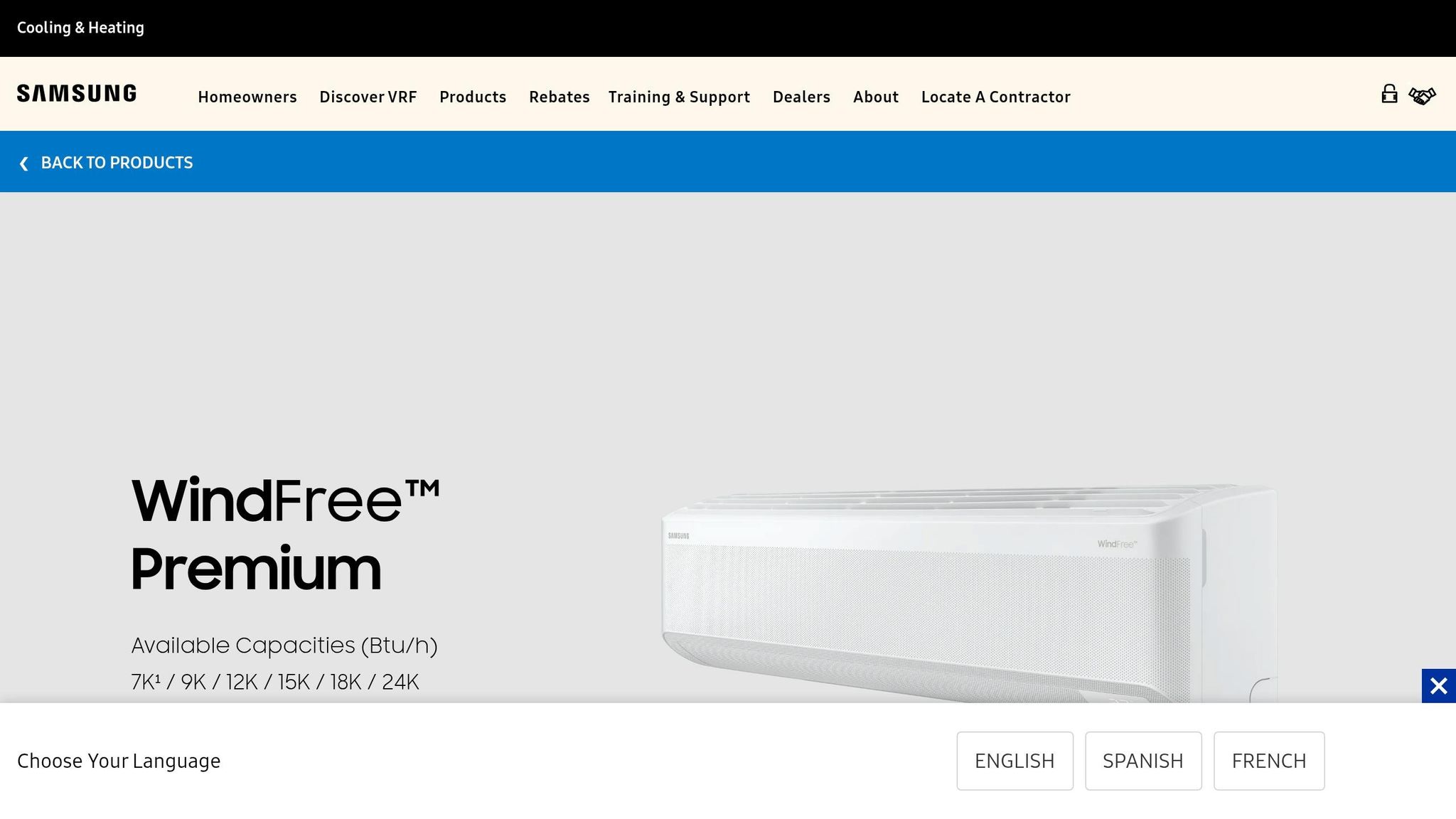
Samsung goes beyond basic smart cooling here. The WindFree line adds room-by-room air quality tracking to a ductless setup, which makes it feel less like a standard mini-split and more like a small home comfort system.
IAQ Sensing
All WindFree models come with built-in temperature and humidity sensors. Higher-end versions, such as the WindFree IAQ and Bespoke AI Pro, also include a built-in PM 1.0 electrostatic filter and sensor that can catch particles as small as 1 micron.
Samsung says the filter removes 99% of certain bacteria and works twice as fast as a standard PM 2.5 filter. Some models also use color indicator lights on the indoor unit, so you can check current air quality without even opening the app.
That app side is a big part of the pitch. Through SmartThings Map View, you get a 3D home layout that shows live air quality, room temperature, and energy use across connected units. All of that sensor data also feeds Samsung’s AI Auto Mode.
AI Automation
AI Auto Mode looks at indoor and outdoor temperature, humidity, your set temperature, and runtime to learn how you use the system and adjust operation on its own. It can switch between Fast Cooling, WindFree, and Dry Comfort modes to help keep the room in the 40%–60% humidity comfort range without overcooling.
Some top-tier models also add a Motion Detection Sensor. That sensor can send airflow toward people or away from them, depending on the setting, and cut power use by up to 58% when the room is empty.
Cooling Efficiency
WindFree mode spreads air through up to 23,000 micro-holes. That keeps air velocity below 0.15 m/s, which ASHRAE 55-2013 defines as "still air". In plain English, you get cooling without that direct blast of air that many mini-splits are known for.
That softer delivery also helps with sound levels, dropping noise as low as 23 dB. On the energy side, WindFree mode uses up to 77% less energy than Fast Cooling mode, and AI Energy Mode can cut total energy use by up to 30%.
Integration and Cost
Equipment runs about $700 to $2,800, while installed cost lands around $2,500 to $5,500 for a single-zone setup. Many WindFree models are ENERGY STAR certified, so federal, state, or local utility rebates may help trim the upfront price.
Setup happens through the SmartThings app, and voice control works with Bixby, Alexa, and Google Assistant. Samsung also backs the AI Inverter Compressor with a 10-year warranty and offers a 10-year limited parts warranty when the product is registered.
6. Mitsubishi Electric Mini-Split with Smart IAQ and Controls Setup
Mitsubishi goes deep on comfort control, but full IAQ monitoring still isn’t built into every system. Air-quality features depend on the model, and if you want a complete picture of what’s in the air, you’ll usually need add-ons.
IAQ Sensing
Higher-end models like the MSZ-FS Deluxe come with the i-see 3D infrared sensor, which scans the room, maps temperature zones, and detects where people are sitting or standing so the system can direct airflow where it’s needed.
But if you want actual air-quality readings for TVOC, eCO2, and PM2.5, you’ll need a retrofit controller such as the Sensibo Air Pro, which costs about $140 to $215. Mitsubishi also offers optional filtration add-ons, including Plasma Quad Connect and Plasma Quad Plus, for particles and contaminants.
So the main sensor package handles comfort first. The automation setup does a lot of the heavy lifting on the air-quality side.
AI Automation
Kumo Cloud adds zone scheduling, geofencing, energy monitoring, and off-peak precooling. That setup can trim monthly utility bills by 12% to 18% on top of standard efficiency gains. It also sends filter maintenance alerts to your phone based on actual runtime, which matters because clogged filters can cut efficiency by 5% to 15%. Voice control works with Alexa, Google Home, and select Apple HomeKit configurations.
Cooling Efficiency
The MSZ-FS06NA hits 32.2 SEER2, the highest residential efficiency rating verified in 2026. Indoor sound levels can go as low as 19 dB(A), so it runs very quietly. With Hyper-Heat (H2i), the system keeps operating down to -13°F and holds 100% heating capacity at 5°F. And because it’s a ductless mini-split, it avoids the 30%+ energy loss that often comes with central air ductwork.
Integration and Cost
A catch here: many Mitsubishi models, including the MSZ-GL series, do not come with built-in Wi-Fi. That means you should plan for about $150 extra for the Kumo Cloud Wi-Fi adapter. Premium single-zone installs usually land between $4,500 and $9,000, depending on system size. The standard warranty is 10 years on parts and the compressor, and certified installation extends that to 12 years. For 2026 installs, it’s also worth checking HEEHRA rebates, which vary by income tier and can help cut the upfront cost.
Mitsubishi’s mix of high efficiency, strong control options, and add-on IAQ tools puts it near the top of the premium tier.
Side-by-Side Comparison: Air Quality, Automation, Efficiency, and Cost
The table below compares the six systems across air-quality data, automation, efficiency, and total cost. The split is pretty simple: some systems measure air quality, while others mainly automate cooling around it.
In Chicagoland, humidity and older housing stock matter a lot. That puts extra weight on dehumidification and system capacity. So when you compare these options, efficiency and humidity control deserve the most attention.
Here’s the fastest side-by-side look at all six.
| Model | Type | IAQ Metrics / Features | AI / Automation | Coverage / Compatibility | Efficiency Highlights | Smart Platforms | Typical U.S. Price Range | Best Fit |
|---|---|---|---|---|---|---|---|---|
| Sensibo Air Pro | Smart Controller | TVOCs, CO2e, temperature, humidity | Climate React, PureBoost, geofencing, AI assistant | Add-on controller for compatible ACs | Depends on host unit | Apple HomeKit, Alexa, Google Assistant, SmartThings | ~$139–$149 (unit) | Retrofit controller add-on |
| ecobee Smart Thermostat Premium | Smart Thermostat | VOCs, eCO2, humidity | Occupancy sensing, geofencing, eco+ learning | Compatible ducted HVAC systems | N/A | HomeKit, Alexa, Google Assistant, SmartThings | ~$249.99 (unit) | Older ducted homes |
| LG DUAL Inverter Smart Window AC with ThinQ | Window AC | Filter alarm only; no active IAQ sensing | ThinQ scheduling, voice control, energy monitoring, occupancy-based airflow (select models) | Room-sized window AC | Up to 35–50% savings vs. DOE minimum CEER; 44 dB Sleep Mode | ThinQ, Alexa, Google Assistant | $259–$749 (unit) | Apartments and smaller rooms |
| Midea U Smart Inverter Window AC | Window AC | Basic dust filtration; no active IAQ sensing | AI ECO mode (offline/predictive; learns thermal patterns over ~3 days), scheduling | Room-sized window AC | EER 15.0; ~35–45% savings vs. DOE minimum CEER | Apple Home, Google Home, Alexa | $380–$599.99 (unit) | Renters, budget-conscious buyers |
| Samsung WindFree AI Ductless Mini-Split | Ductless Mini-Split | Temperature, humidity; PM1.0 sensor and filter (higher-end models) | AI Auto Mode, Motion Detection Sensor, Comfort Dehumidification | Single- or multi-zone; varies by model | WindFree mode uses up to 77% less energy than Fast Cooling; AI Energy Mode cuts use by up to 30% | SmartThings, Alexa, Google Assistant, Bixby | ~$700–$2,800 (equipment); ~$2,500–$5,500 installed (single-zone) | Bedrooms, finished basements |
| Mitsubishi Electric Mini-Split with Smart IAQ and Controls Setup | Ductless Mini-Split | i-see 3D spatial sensing; optional Plasma Quad filtration | Kumo Cloud, geofencing, zone scheduling, off-peak precooling | Single- or multi-zone; varies by model | 32.2 SEER2 (MSZ-FS06NA); 19 dB(A) silent mode | Kumo Cloud, Alexa, Google Home, select HomeKit | ~$4,500–$9,000 installed (single-zone) | Premium installs, extreme climates, mixed-use spaces |
Ductless mini-split vs central air cost comparisons show that installed cost climbs fastest with mini-splits, especially once labor enters the picture.
A few takeaways jump out.
- ecobee Smart Thermostat Premium is the clearest fit if you want VOC and CO2-style monitoring in a thermostat setup.
- Midea U Smart Inverter Window AC stands out because AI ECO works offline, which means its predictive control keeps running even if Wi‑Fi drops.
- Mitsubishi Electric Mini-Split with Smart IAQ and Controls Setup leads on efficiency, with the MSZ-FS06NA rated at 32.2 SEER2.
That gives you a clean way to sort these systems: some are better for air data, some for low-cost automation, and some for top-tier cooling and humidity control.
Pros and Cons
Every option here makes a different trade-off between price, air-quality visibility, and setup effort. Some are cheap and easy to add. Others cost more up front but give you a deeper system upgrade. So the goal isn’t just to compare features. It’s to see what you’re giving up – and what you’re getting back.
| Model | Pros | Cons | Best For |
|---|---|---|---|
| Sensibo Air Pro | Low upfront cost (~$139–$149); DIY setup in minutes; tracks TVOCs, CO2e, temperature, and humidity; no direct PM2.5 sensing; works with IR-controlled mini-splits | Doesn’t improve the base unit’s efficiency or filtration; IAQ data is external, not integrated | Renters or budget users who want smart features without replacing hardware |
| ecobee Smart Thermostat Premium | Lower upfront cost than a full system upgrade; adds IAQ visibility to an existing ducted HVAC system | No cooling unit included; requires a compatible ducted setup; no built-in air purification | Older ducted homes that want smarter thermostat control and air data |
| LG DUAL Inverter Smart Window AC with ThinQ | Quiet inverter cooling; filter alarm via ThinQ app; strong BTU range for room-sized installs | No active IAQ sensing; filter alert is a maintenance reminder, not air-quality monitoring | Apartments and smaller rooms prioritizing efficient, quiet cooling |
| Midea U Smart Inverter Window AC | AI ECO mode works offline; EER 15.0; U-shaped design keeps compressor outside for low indoor noise | No IAQ sensors; ionizer is a treatment feature, not a monitoring tool | Renters and budget-conscious buyers who want predictive efficiency without cloud dependency |
| Samsung WindFree AI Ductless Mini-Split | Full-system upgrade with integrated AI and stronger whole-system efficiency; PM1.0 sensing on higher-end models | Requires professional installation; higher upfront and installed cost than a retrofit controller | Homeowners who want a full ductless upgrade with smart automation |
| Mitsubishi Electric Mini-Split with Smart IAQ and Controls Setup | Top-tier SEER2 ratings; i-see 3D sensor directs airflow based on occupant location; 12-year warranty with certified installation | Requires professional setup; Wi-Fi adapter often sold separately (~$150); premium installed cost | Premium installs where long-term performance and air quality matter most |
A few patterns stand out.
If you’re trying to spend as little as possible, Sensibo Air Pro and ecobee Smart Thermostat Premium make the most sense. They add smart control and air-data tracking without forcing a full HVAC swap. The catch? They don’t change the core cooling hardware. So if your main issue is weak filtration or an older system that wastes energy, these add-ons only go so far.
The two window units – LG DUAL Inverter Smart Window AC with ThinQ and Midea U Smart Inverter Window AC – lean more toward comfort and efficiency than air tracking. That’s a big distinction. A filter reminder or ionizer may sound useful, but it isn’t the same as seeing what your indoor air is doing in real time. If you just want quiet cooling in an apartment or bedroom, that may be fine. If you want actual IAQ data, it probably won’t be enough.
Then you have the ductless mini-split upgrades: Samsung WindFree AI Ductless Mini-Split and Mitsubishi Electric Mini-Split with Smart IAQ and Controls Setup. These are the heavier hitters. They cost more and need pro installation, requiring a professional AC installation, but they do more than tack on a smart feature. You’re upgrading the system itself. Samsung adds PM1.0 sensing on higher-end models, while Mitsubishi Electric leans into long-term performance with top-tier SEER2 ratings, its i-see 3D sensor, and a 12-year warranty when installed by a certified pro.
In plain English, the trade-off looks like this:
- Lower cost and easy setup usually mean less built-in IAQ monitoring and no change to the base system
- Better system performance usually means a higher installed price and pro setup
- IAQ visibility can come from an add-on device or from the HVAC unit itself, depending on the model
That leaves the final step: matching the right system to room type, budget, and IAQ goals.
Conclusion
Choose based on system type, IAQ needs, and install limits – not the number of app features.
The clearest divide comes down to four use cases: retrofit control, whole-home thermostat control, room-unit cooling, and full-system upgrades. Retrofit controllers and smart thermostats can add IAQ visibility to gear you already have, with low upfront cost and little setup. Window ACs focus on quiet, efficient cooling for a single room, not air-quality tracking. Ductless mini-splits offer the deepest mix of sensing, automation, and efficiency, but they cost more to install and usually need a pro. The Mitsubishi Electric Mini-Split stands out as the best premium long-term pick for additions, small offices, or rooms without ductwork.
The main deciding points are sensing depth, internet dependence, and lifecycle cost. Put verified IAQ sensing, offline-capable automation, and total cost of ownership at the top of your list.
For Chicagoland installs, Eco Temp HVAC can match smart AC equipment to the right installation, humidity control, and service plan, including Mitsubishi installs backed by a 12-year warranty through their Diamond Elite Contractor certification.
FAQs
Do I need a new AC for air-quality monitoring?
No. Many modern smart AC systems come with AI-based air-quality monitoring and purification, but that doesn’t mean you need to buy a brand-new unit to get those perks.
Eco Temp HVAC can check your current HVAC system and suggest air-quality upgrades to help you get cleaner, healthier airflow without a full replacement.
Which smart ACs actually measure air quality?
Some smart AC systems come with built-in sensors that keep an eye on indoor air quality as you go about your day.
For example, the Daikin IAQ system measures PM2.5, VOCs, CO2, humidity, and temperature. It also shows real-time, color-coded alerts in compatible thermostats or apps, so you can check air conditions at a glance.
Some Panasonic models do something similar in their apps. They can show shifts in air quality, such as changes from good to moderate, while using purification tech to neutralize particles like PM2.5.
Is PM sensing more useful than VOC or CO2e tracking?
It depends on your environment and what you’re trying to watch for.
PM sensing is often more useful in cities or other high-pollution areas. It helps smart systems respond to allergens, dust, and other tiny particles in the air.
VOC and CO2e tracking tend to be better for checking indoor air freshness. They can help flag buildup from cooking odors, cleaning products, or that stale, stuffy feeling in a room.
Each one does a different job.