
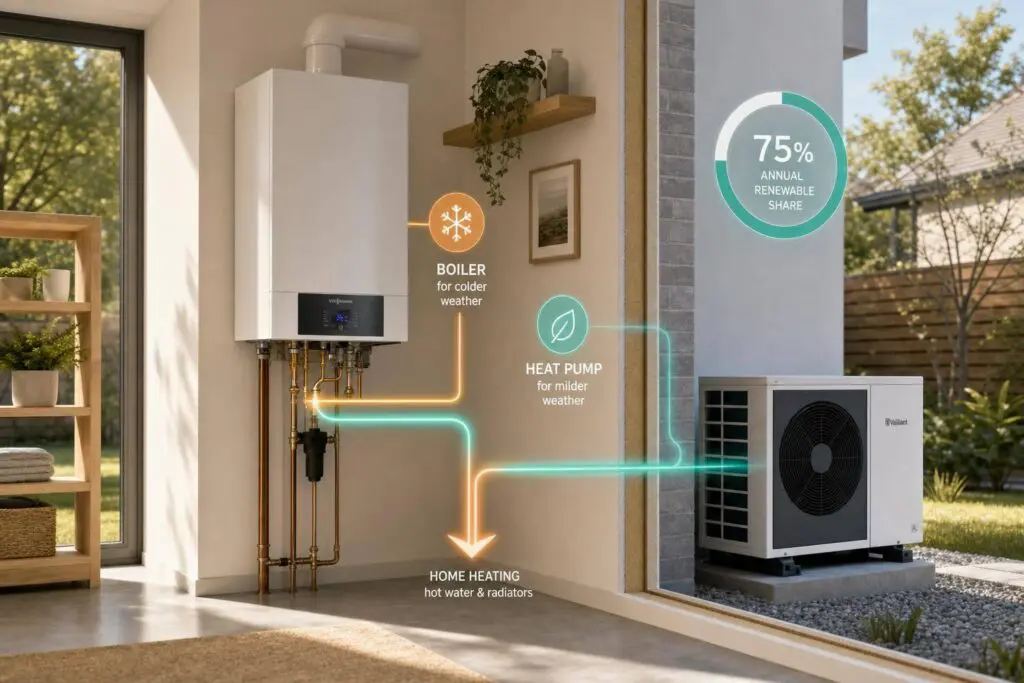
A hybrid boiler cuts fuel use by letting a heat pump do most of the heating, then switching to the boiler when it gets too cold or the system needs hotter water. In many homes, the heat pump can cover 70% to 80% of yearly heating demand, while the boiler handles peak load and very cold days.
If I were explaining it in plain English, I’d put it like this:
- A hybrid system uses two heat sources: usually a boiler and an air-to-water heat pump
- The controls make the call: they switch between the two based on outdoor temperature, water temperature, and demand
- The heat pump runs first in milder weather
- The boiler steps in during colder weather, often when outdoor temperatures drop near 30°F or when the system needs water near 180°F
- Homes with low-temp heat emitters like radiant floors tend to be easier fits
- Costs depend on utility rates and efficiency, insulation, electrical service, and control settings
- A proper setup needs load calculations and tuning, not just new equipment
One simple way to think about it: the renewable side handles the bulk of the season, and the boiler fills the gaps. That setup can lower gas or propane use without giving up steady heat in winter.
For many U.S. homes, the main questions are simple: Will my current heat emitters work at lower water temperatures? Do I have the electrical capacity? And where should the switch point be set so heating costs stay in check?
How does a hybrid heat pump work?
sbb-itb-b5c10b1
How Hybrid Boilers Work With Heat Pumps or Solar Energy
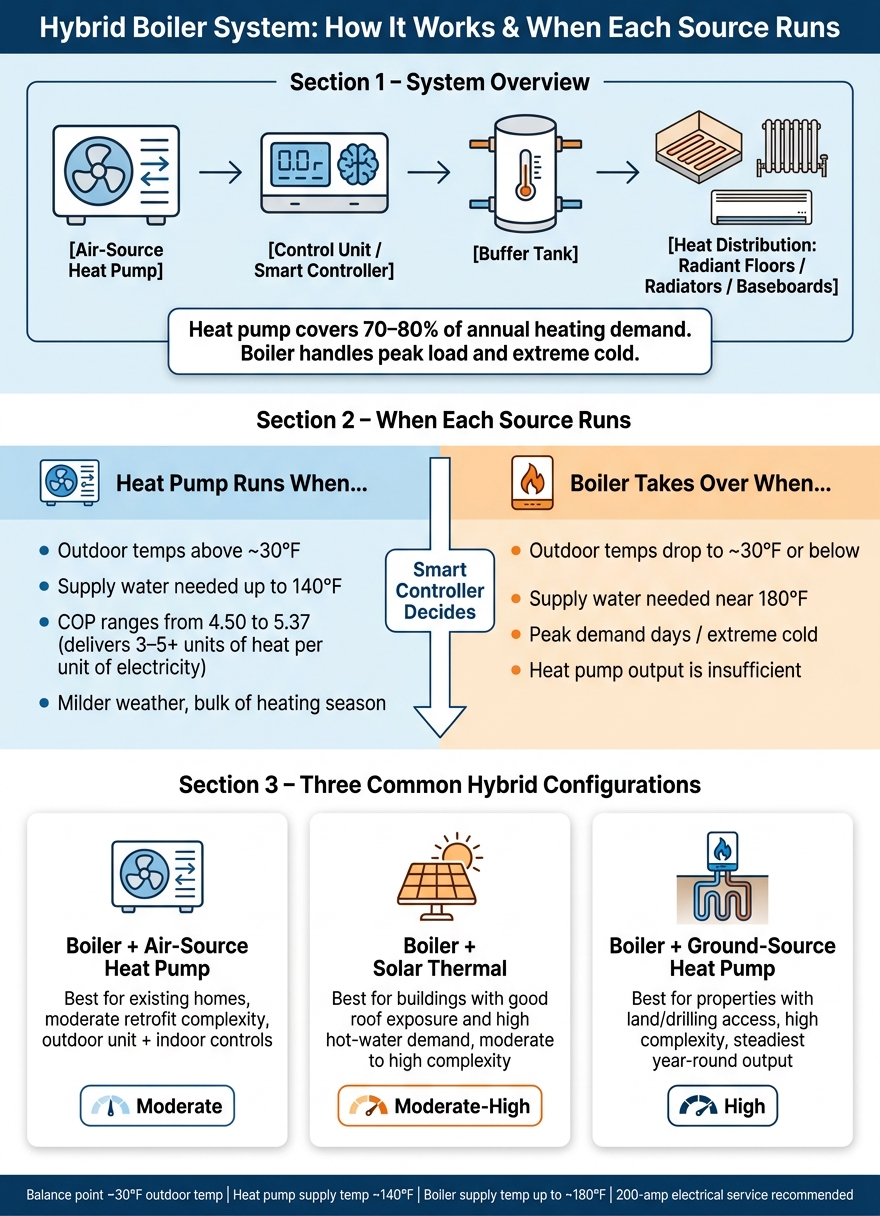
Hybrid Boiler System: Heat Pump vs. Boiler Operation at a Glance
Core Parts of a Hybrid Boiler System
A hybrid system blends a renewable heat source, a condensing boiler, a control unit, storage, and distribution piping. The heat pump or solar thermal loop handles most of the heating in milder weather. When demand climbs, the boiler steps in to cover the extra load.
The control unit is the traffic cop. It switches between heat sources based on outdoor temperature, hot-water demand, and supply-water temperature. A buffer tank helps smooth out changes in demand. Sensors send data to the controller, and pumps and piping move water to radiators or radiant floors. Outdoor reset controls lower supply-water temperature as outdoor temperature goes up, which helps cut frequent start-stop cycling.
Put simply, all of these parts work together to decide when the renewable source should run and when the boiler should take over.
When the Renewable Source Runs and When the Boiler Takes Over
In most setups, the heat pump runs first. The boiler usually takes over when outdoor temperatures drop to around 30°F or when the system needs hotter supply water, often close to 180°F. Heat pumps in hybrid systems usually deliver water at about 140°F, while boilers may be needed to reach 180°F on colder design days.
Heat pump output is measured with COP (Coefficient of Performance). A COP of 3.0 means the unit delivers three units of heat for every one unit of electricity it uses. Modern air-to-water heat pumps can reach a COP between 4.50 and 5.37.
That differs from AFUE (Annual Fuel Utilization Efficiency), which measures how much fuel turns into usable heat. In short, COP tracks heat pump output per unit of electricity, while AFUE tracks boiler fuel-use efficiency.
Common Hybrid Configurations in U.S. Homes and Small Buildings
The three layouts below show up most often in U.S. homes and small buildings.
| Configuration | Best Fit | Space Needs | Retrofit Complexity |
|---|---|---|---|
| Boiler + air-source heat pump | Existing homes with limited outdoor space | Outdoor unit plus indoor controls and piping | Moderate |
| Boiler + solar thermal | Buildings with good roof exposure and high hot-water demand | Roof collector area and storage tank space | Moderate to high |
| Boiler + ground-source heat pump | Properties with enough land or drilling access | Indoor equipment plus loop field or boreholes | High |
For most existing homes, boiler + air-source heat pump is usually the simplest retrofit.
How to Check if Your Building Is a Good Fit
After you pick a likely hybrid setup, the next step is simple: make sure your building can support it without wasting energy or forcing the equipment to work too hard.
Review Your Current Boiler and Distribution System
Start with your boiler and the way heat moves through the building.
Radiant floors are usually the easiest match because they run on lower supply water temperatures. Fin-tube baseboards and older radiators are a different story. They often need hotter water, and that can push past what many heat pumps can deliver.
A simple field test can tell you a lot. On a mild day, lower the supply water temperature to 140°F and watch what happens. If the indoor temperature stays steady, your emitters are likely big enough to work at lower temperatures. And if your baseboards or radiators were oversized in the first place, they may still perform well even with cooler water.
One more thing to watch for: older oxygen-permeable polybutylene radiant tubing can corrode newer system parts. If that tubing is present, isolate the loop with a brazed-plate heat exchanger.
If your emitters pass the test, move on to the building, electrical, and site limits.
Check Building and Site Conditions
A tighter building envelope lowers the heating load. It can also let the system run at lower supply temperatures, which helps hybrid systems perform better.
Then look at the practical stuff. Many hybrid systems need 200-amp electrical service. The outdoor unit also needs the right placement, with proper clearance, drainage, and a raised stand.
You should also confirm that the mechanical room has enough space for a buffer tank or indoor split-unit parts.
| Condition | What to Check | Why It Matters |
|---|---|---|
| Insulation & air sealing | Attic, walls, basement rim joists | Lowers heating load; may allow lower supply temps |
| Electrical service | Panel capacity (200-amp recommended) | Heat pump requires dedicated circuit capacity |
| Outdoor unit space | Clearance, drainage, stand mounting | Required for reliable year-round operation |
| Mechanical room | Space for buffer tank or indoor unit | Required for most hybrid configurations |
Once the building can carry the load, the next piece is cost: when does it make sense to run the heat pump, and when should the boiler step in?
Compare Gas and Electric Operating Costs
Look at 12 months of gas and electric bills and compare them with current utility rates. That gives you a clearer picture of operating cost through the year, not just in one season.
Balance-point temperatures depend on local gas and electric rates. In plain English, those rates help decide when the boiler should take over from the heat pump. Compare 12 months of gas and electric bills against current utility rates to find the balance point between boiler and heat pump operation.
Also check for IRA and utility incentives.
If these checks look favorable, the next step is choosing the renewable partner and control strategy.
How to Plan and Operate a Hybrid Boiler System
Choose the Right Renewable Partner and Control Strategy
After the fit check, the next step is simple: pair your boiler with the heat source and controls that line up with your heating load and utility costs. That choice shapes the upfront cost, install effort, and how much of the heating load the renewable side can handle.
For most homes, an air-source heat pump is the lowest-cost and simplest hybrid setup. When it’s sized the right way, it can offset 70% to 80% of annual heating load.
A ground-source heat pump gives you steadier output through the year because underground temperatures don’t swing like outdoor air. The trade-off is the install. It needs excavation and a bigger budget, so it tends to make more sense for properties with open land or for commercial jobs.
Solar thermal usually works best when the main target is domestic hot-water preheat.
The control side matters too. Some advanced controllers can switch between gas and electricity based on live utility pricing, sending load to whichever source costs less at that time. Put it all together, and the right setup comes down to three things: load, site limits, and local utility rates.
What to Expect From Installation and Professional Setup
Once the design is locked in, the installer sizes the equipment, wiring, and controls around the building’s actual demand. This isn’t just a basic boiler swap. A hybrid system lives or dies by its control logic.
A proper setup starts with a Manual J load calculation so both the heat pump and boiler are sized the right way. In many cases, sizing the heat pump to cover about 60% to 70% of peak demand is the most cost-effective path.
After that, the installer handles the rest of the system buildout, including:
- Piping layout
- Dedicated electrical circuits
- Controls integration
Track Performance and Keep the System Maintained
Once the system is running, pay close attention during the first winter. Watch fuel use, electric use, comfort, and how often the system changes over from one heat source to the other. Those early patterns tell you a lot.
If the boiler is turning on more than expected during mild weather, the balance-point setting is probably off and needs to be adjusted.
Maintenance should cover both sides of the system. That means annual boiler service, plus heat pump care like:
- Cleaning outdoor coils
- Checking filters
- Inspecting sensors
- Clearing condensate drains
Use that first heating season to fine-tune the changeover point and make sure the system is working the way it was designed to.
Conclusion: Key Steps to Using Renewable Energy With a Hybrid Boiler
A hybrid boiler uses a renewable heat source – most often an air-source heat pump, and sometimes solar thermal – for milder weather. Then the boiler steps in for peak demand and extreme cold. After that, the job is simple in theory: match the setup to the building and make sure the controls know when to switch.
The process is pretty direct. Check whether the building is a good fit by looking at insulation, heat emitters, and site conditions. Then pair the right renewable source with a smart controller that can switch between heat sources based on outdoor temperature, utility rates, and real-time demand. Once those parts are set up well, day-to-day results depend on operation and maintenance.
A well-designed hybrid can cover 70% to 80% of annual heating demand. That means less boiler runtime without giving up steady comfort during cold weather. To keep the system running well, schedule annual boiler service and check the controls from time to time. With the right design and regular upkeep, the system can deliver steady comfort and lower heating costs.
For Chicagoland hybrid boiler design, installation, or service, Eco Temp HVAC provides boiler and heat pump support.
FAQs
Can my current radiators or baseboards work with a hybrid boiler?
Yes. A hybrid boiler system will usually work with your current radiators or baseboards because it’s built to connect with the hydronic heating setup you already have.
That means you can often leave your radiators, baseboards, or in-floor piping right where they are. The renewable part of the system handles most of the heating, while the boiler steps in as backup during peak demand or very cold weather.
How do I know when the heat pump should switch to the boiler?
You usually don’t need to watch the changeover yourself. In a hybrid system, the built-in controls decide when the boiler should kick on.
They look at preset inputs like outdoor temperature, the supply water temperature the system needs, current energy costs, and utility rates. Many setups also use a balance point, often around 30°F. Above that mark, the heat pump handles milder weather. Below it, or during periods of heavier demand, the boiler steps in.
Will a hybrid boiler lower my heating bills?
Yes. A hybrid boiler can cut heating bills by switching to the lowest-cost heat source for the conditions at that moment.
In milder weather, the renewable part usually does most of the work. The boiler tends to step in during peak demand or very cold spells, which can lower total fuel use.
Related Blog Posts