
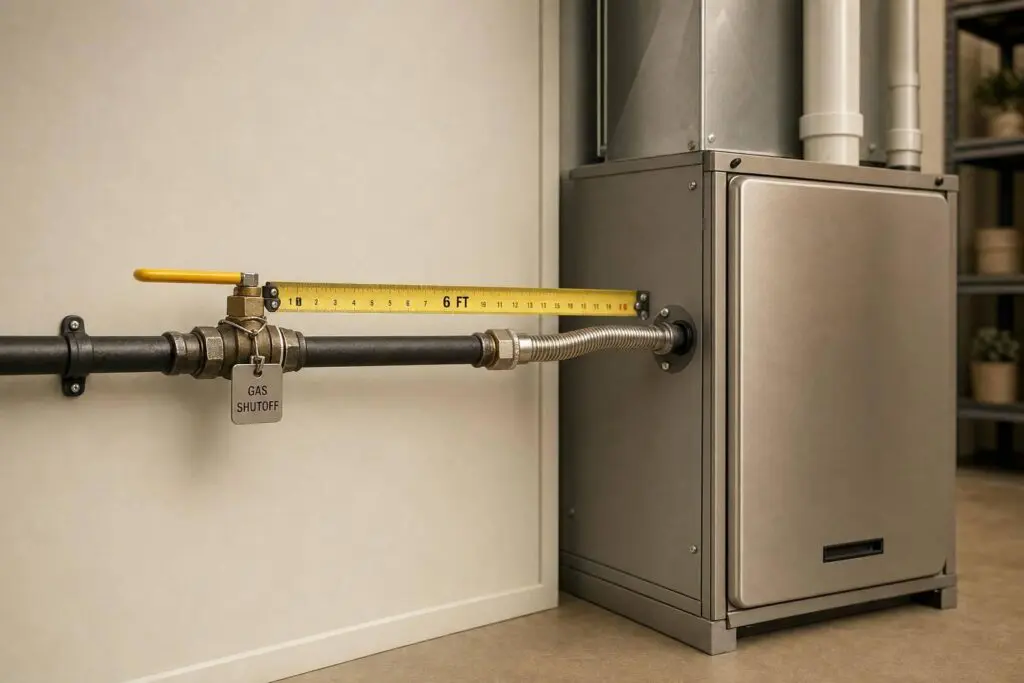
If you only remember four rules, remember these: the furnace needs its own manual gas shutoff valve, the valve must be in the same room, within 6 feet of the furnace measured along the pipe, and it must be easy to see and reach.
If the valve is behind the furnace, inside a wall, above a blocked ceiling, or too high to reach, that setup will often fail inspection. In most homes, the valve is a quarter-turn handle on the fixed gas pipe, and it must sit before the union or connector so gas to the furnace can be shut off before service starts.
Here’s the short version:
- One valve per furnace
- Same room
- Within 6 feet
- Measured along the piping path
- Upstream of the union or connector
- Visible and reachable without tools
- Not hidden behind finishes, shelves, or the unit itself
- Often kept within about 60 inches of the floor for reach
A bad valve location can slow shutoff during a gas issue and can also lead to service delays, failed inspections, or even a red tag in some cases. I’d use this guide as a plain-English check before a furnace replacement, basement finish, or home sale.
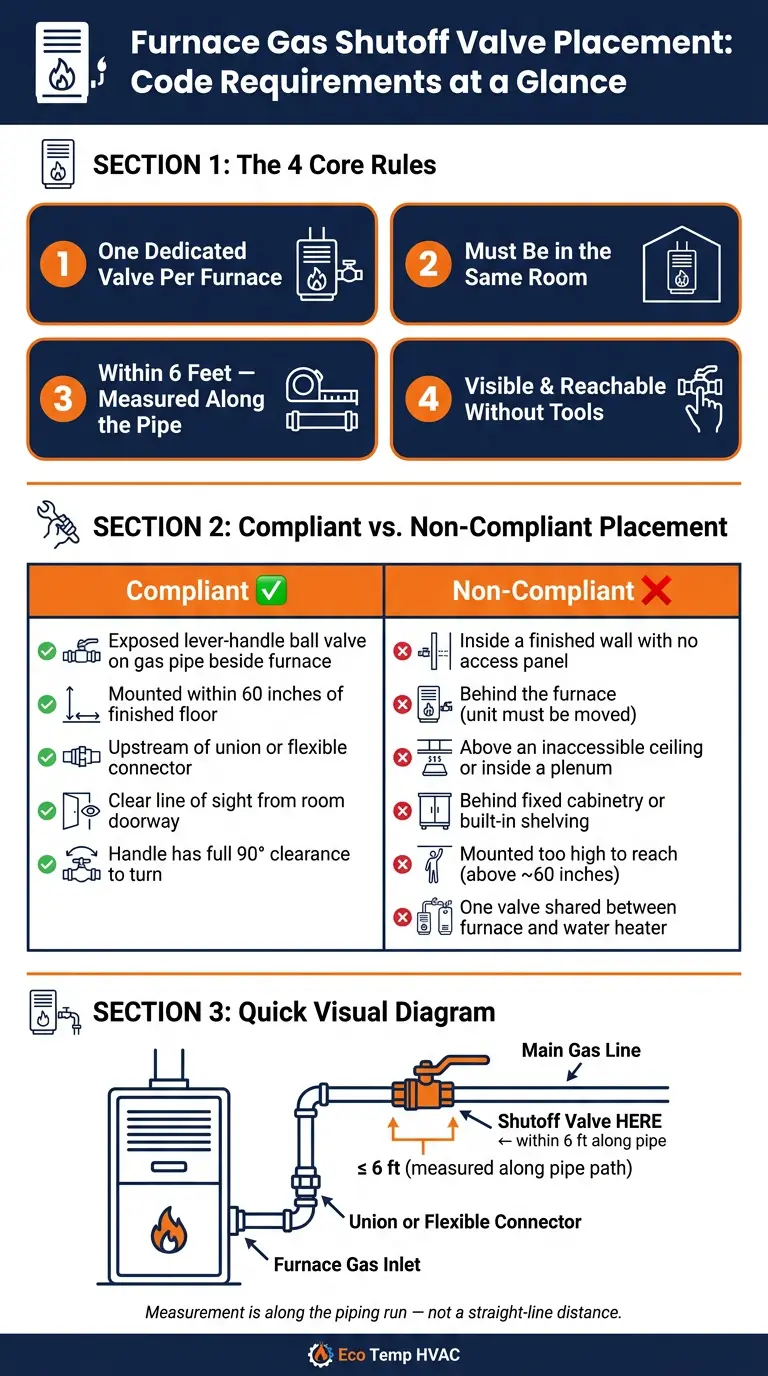
Furnace Gas Shutoff Valve Placement: Code Requirements at a Glance
Furnace Gas Shutoff Valve Basics
What the Shutoff Valve Is and What It Controls
The furnace gas shutoff valve is the manual valve on the fixed gas pipe that feeds the furnace. Its job is simple: it shuts off gas to the furnace only, not to other gas appliances in the home. That means a technician can work on the furnace while other appliances on separate branches stay on.
It’s also easy to mix this up with the combination gas control valve inside the furnace cabinet, but they do different jobs. The outside shutoff valve isolates the gas supply line. The internal valve handles the furnace’s own controls.
In most homes, this is a quarter-turn ball valve. When you turn the lever handle 90 degrees so it sits perpendicular to the pipe, the gas flow is off.
Where Homeowners Usually Find It
You’ll usually find the valve on exposed black iron pipe or approved rigid steel tubing, with a lever handle, placed just beside, above, or just outside the furnace cabinet. If you follow the gas supply pipe toward the furnace, the valve should usually be in plain view nearby. Common spots include:
- A basement mechanical area
- A utility room
- An attic mechanical space
- A mechanical closet
Why Correct Placement Matters for Safety and Service
Placement matters for one big reason: speed. If there’s a gas leak, gas odor, or a furnace issue, a properly placed valve lets someone shut off the gas fast. It also gives HVAC technicians a clear isolation point before working on unions, connectors, or the furnace gas train.
This becomes even more important during furnace replacement. When the valve is in the right spot, the furnace can be isolated without shutting off gas to the whole building or changing nearby piping. If the valve is hidden behind the furnace or tucked inside a wall or ceiling cavity, service takes longer and emergency shutoff can become much harder.
These basics set up the code rules for distance, access, and mounting position.
Gas appliance shut off valves
Code Requirements for Shutoff Valve Location
Once you’ve found the valve, the next thing to check is where it sits.
Same Room and Within 6 Feet of the Furnace
The furnace shutoff valve must be in the same room and within 6 feet of the furnace, measured along the gas piping run.
That last part matters. You measure the full path of the pipe, including any connector, not a straight-line shortcut from the valve to the furnace.
There are a few narrow exceptions for certain listed or specialized setups. But for most residential furnace installation in basements, utility rooms, or closets, the standard rule still applies: same room, within 6 feet.
And distance by itself isn’t enough. The valve also needs to be placed before any disconnect point.
Installed Upstream of the Union or Connector
Install the shutoff valve upstream of any union, connector, or other disconnect fitting that serves the furnace.
Put plainly, the valve has to come before those disconnect points. That way, a technician can shut off gas to the furnace without messing with parts farther down the line. If the valve is installed after the connector, gas can stay in the line during service, and the setup does not meet code.
Location isn’t just about feet and inches, either. Access matters just as much.
Locations That Usually Violate Code
Codes require the valve to be accessible and visible after installation. In plain English, that means no cutting drywall, no grabbing tools, and no moving the furnace just to turn the handle.
If someone can’t reach the handle directly, the setup fails the access rule. Many jurisdictions also treat about 60 inches above the finished floor as a practical upper reach limit.
| Noncompliant Location | Why It Fails |
|---|---|
| Inside a finished wall with no access panel | The valve cannot be seen or reached without opening the wall |
| Above an inaccessible ceiling or inside a plenum | Access is restricted; plenums are not allowed |
| Behind fixed cabinetry or built-in shelving | The handle is blocked from direct reach |
| Behind the furnace itself | The appliance has to be moved to operate the valve |
| Mounted too high to reach | It may be outside normal reach range |
Hidden valves often fail inspection.
Access, Height, and Service Clearance
What ‘Accessible’ Means in Practice
Distance by itself doesn’t tell the whole story. The valve still has to be easy to reach, easy to see, and simple to use during service or an emergency. From the furnace-area doorway, you should be able to spot the valve and get to it without a struggle.
A furnace in an open basement with the valve on an exposed gas line a couple of feet from the unit is a clear example of a compliant setup. A furnace inside a dedicated closet can also work, but only if the door opens all the way and the valve is visible and reachable as soon as you step in. Do not put the valve behind drywall, inside a sealed chase, or behind the furnace.
Height Limits and Handle Reach
Keep the handle within normal standing reach. Many jurisdictions use 60 inches above the finished floor as the practical upper limit.
If the furnace’s gas connection is higher than 60 inches, including suspended or attic-mounted furnaces, place the valve as close as possible while still keeping it reachable. In that kind of setup, a permanent walkway or platform may be needed so someone can operate the valve safely. The handle also needs enough open space to turn the full 90 degrees from open to closed without hitting nearby pipe, conduit, framing, or shelving.
Clear Space Around the Furnace and Valve
Even when the valve is in the right spot, a tight work area can still make it hard to use. Manufacturers may permit close clearances, but service access often calls for more room around the front of the furnace and around the valve handle. That extra space gives a technician room to reach in, get a solid grip, and shut the valve off under normal service conditions or in a hurry.
These access problems are often what turn an otherwise correct valve location into a failed inspection.
Common Placement Problems and When to Call a Licensed HVAC Contractor
Frequent Mistakes That Cause Service or Inspection Issues
Some furnace gas piping problems show up over and over during service visits and inspections.
The biggest one is simple: the shutoff valve is too far from the furnace. That 6-foot limit is measured along the gas pipe run, not “as the crow flies.” So if a valve sits 10 feet away on a main trunk line, and there’s no branch shutoff near the furnace, that setup will usually fail inspection.
Other issues tend to cause trouble too:
- One valve serving both the furnace and water heater
- A valve placed directly behind the furnace or buried inside a finished wall
- A missing or broken handle
- No union or other approved disconnect point downstream of the valve
These aren’t small details. They can slow down an emergency shutoff, make routine service harder, or lead to a code violation during inspection. In more serious cases, a gas tech may place a red tag on the appliance. That means the gas gets capped, and the furnace stays out of service until the problem is fixed.
What Correction Usually Involves
Most repairs follow the same basic path. A licensed contractor shuts off the gas at the main, adds or moves a dedicated shutoff valve on the furnace branch within 6 feet of the unit, and installs a union right downstream. That way, the furnace can be disconnected safely without messing with the main gas piping.
In finished basements or tight utility rooms, part of the job may involve removing a bit of drywall or paneling to reach hidden piping. For most homes, the work takes a few hours. If the setup is more involved – say, several appliances are out of code or multiple valves and unions need to be added – the job can stretch to a full day.
If the current valve is an older plug-cock type, contractors usually swap it out for a lever-handle ball valve. That style turns a clean quarter-turn to show open or closed, and modern code calls for it on new work.
Key Code Points to Remember
Before a remodel, home sale, or furnace replacement, it helps to do a quick visual check. The valve should be:
- In the same room as the furnace
- Reachable by hand without tools
- Upstream of the flexible connector or union
- Serving only the furnace
If the handle is stiff, missing, or painted over – or if you’re not even sure where the shutoff is – it’s smart to bring in a licensed contractor before work begins.
In the Chicagoland area, Eco Temp HVAC can inspect furnace gas piping layouts, check valve placement against current fuel gas code and local rules, and make any needed corrections. That may be as simple as moving one valve, or as involved as reworking a branch line for several appliances. Their certified technicians are available 24/7 and serve Chicago, St. Charles, Bartlett, Lemont, Downers Grove, Palatine, and nearby communities.
FAQs
How do I measure the 6-foot valve distance?
Measure the distance from the furnace to the manual shutoff valve. The valve should be in the same room and stay easy to access.
The main rule is simple: keep the valve within 6 feet of the unit so someone can shut it off fast during repairs or an emergency.
Can a furnace and water heater share one gas shutoff valve?
Yes, a furnace and water heater can share one gas shutoff valve. But the setup still needs to meet code and safety rules for each appliance.
The valve also needs to stay easy to reach and must not block required service clearances. That includes an accessible manual shutoff valve. Eco Temp HVAC also emphasizes clear labeling for safe maintenance.
What should I do if the shutoff valve is hidden or hard to reach?
For safety and code compliance, the manual gas shutoff valve needs to be within 6 feet of the furnace and easy to reach.
If the valve is hidden or tough to access, have a professional move it. That way, it can be shut off fast during an emergency or service visit. It should also be clearly labeled.