
When it comes to maximizing the efficiency of your boiler, the piping layout is just as important as the boiler itself. A well-designed piping system ensures even heat distribution, prevents energy waste, and extends the life of your equipment. Poor layouts, on the other hand, can lead to short-cycling, uneven heating, and higher energy costs.
Key Takeaways:
- Proper piping is crucial for condensing boilers to maintain low return water temperatures (below 130°F) for optimal efficiency.
- Hydraulic separation between the boiler pump and distribution pumps prevents system inefficiencies.
- Use primary-secondary piping for modern condensing boilers to maintain consistent flow and prevent short-cycling.
- Delta T (temperature difference) of 30°F–40°F reduces pump energy use and optimizes system performance.
- Proper placement of components like air separators, bypass valves, and temperature sensors ensures smooth operation and easier maintenance.
Boiler System Build – Circulators, primary/secondary piping and more.
Understanding Boiler and System Requirements
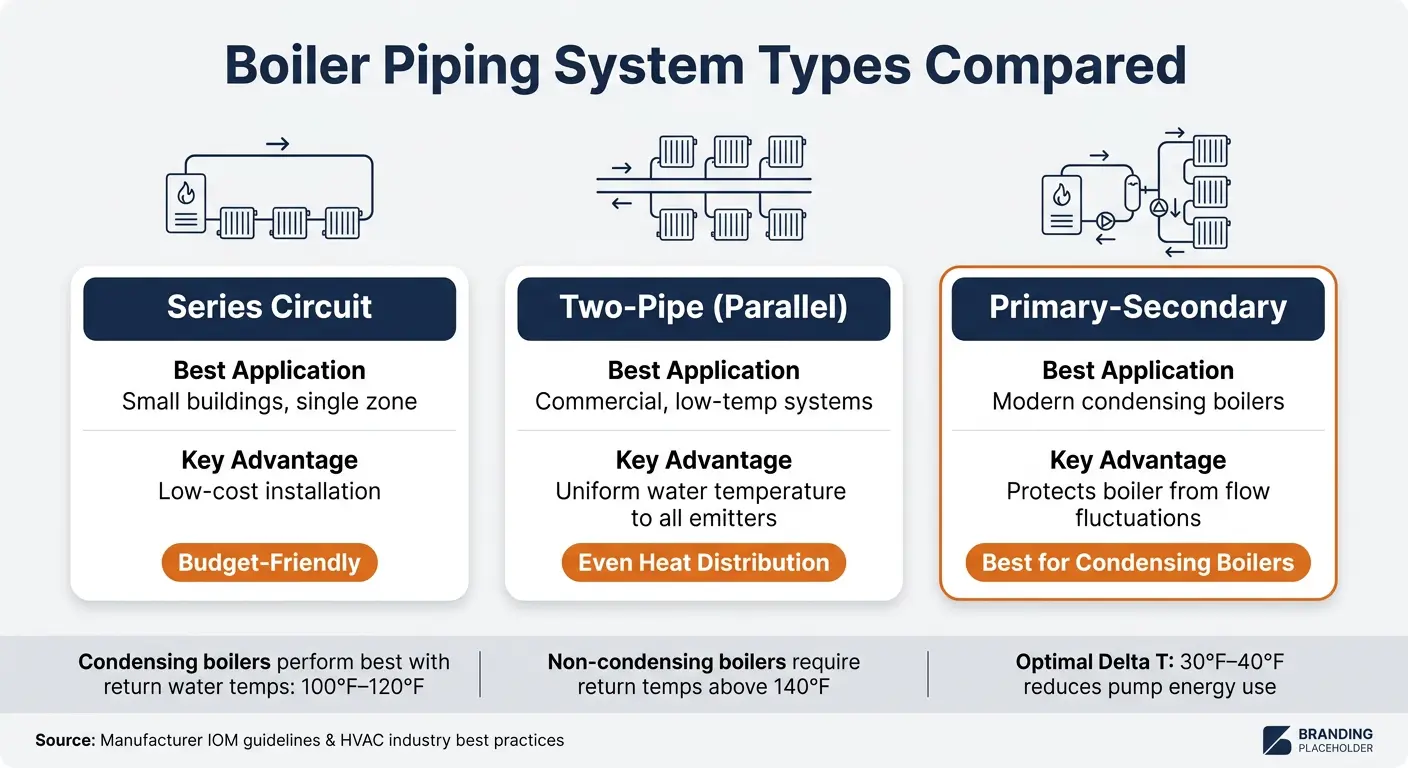
Boiler Piping System Types: Which One Is Right for Your Setup?
Before diving into pipe sizing or routing, it’s crucial to understand what the system actually needs. Skipping this step can lead to costly installation mistakes. Once the system load is determined, you can match it with the right piping design.
Identify System Type and Load
Getting the system type and load right is the foundation for every design decision – and it plays a major role in the system’s overall efficiency. Start with a Manual J heat load calculation to figure out the building’s actual heat loss. Don’t just rely on the old boiler’s BTU output, as many older systems are often 50% oversized. This happens because of improvements like better insulation or new windows, which reduce heat loss but leave oversized equipment running inefficiently and wearing out faster.
Another key factor is Delta T, or the temperature difference between the supply and return water. A Delta T of 30°F–40°F lowers the flow rate, which reduces pump energy use. If you’re using two-way zone valves that might drop the flow below the boiler’s minimum, consider a primary-secondary arrangement to maintain proper operation.
Here’s how different piping systems align with specific needs:
| Piping System Type | Best Application | Key Advantage |
|---|---|---|
| Series Circuit | Small buildings, single zone | Low-cost installation |
| Two-Pipe (Parallel) | Commercial, low-temp systems | Uniform water temperature to all emitters |
| Primary-Secondary | Modern condensing boilers | Protects boiler from flow fluctuations |
Review Boiler Specifications
Always refer to the manufacturer’s Installation, Operation, and Maintenance (IOM) manual before finalizing your design. This ensures you meet the boiler’s requirements for minimum and maximum flow rates, pressure drops, and return water limits. Ignoring these details can lead to oversized or poorly functioning near-boiler piping.
Matthew Freeman, Boilers Product Manager at Bosch Thermotechnology Corp., explains:
"Condensing boilers have much less mass and volume, requiring primary secondary piping or the use of a low loss header."
It’s a common mistake to size near-boiler piping based on the connection tapping size alone. Instead, use the flow data provided by the manufacturer. As Gerry Hogan, Director of Training at PB Heat LLC, warns:
"A designer may simply match the tappings on the boiler… When the piping is too small, the boiler reaches the target quickly and will short-cycle."
The boiler type – condensing or non-condensing – also plays a significant role. Condensing boilers perform best with return water temperatures between 100°F–120°F, while non-condensing boilers need return temperatures above 140°F to prevent damage from flue-gas condensation.
Once your design aligns with the manufacturer’s specifications, make sure it also complies with local codes.
Meet Local Codes and Safety Standards
U.S. code requirements include essentials like properly sized pressure relief valves, backflow preventers, and correct vent clearances, all of which are typically detailed in the IOM. Venting and fuel supply line sizing are particularly critical, as Don DeCarr emphasizes – these factors carry legal weight during inspections. Following these codes not only ensures legal compliance but also prevents design flaws that could hurt boiler performance.
If you’re in the Chicagoland area, Eco Temp HVAC offers certified technicians experienced in local code requirements. They can help make sure your boiler piping is compliant and efficient from the start.
Designing an Efficient Piping Layout
Once you’ve determined your system load and ensured compliance with codes, the next step is creating a piping layout that delivers consistent performance. This involves carefully planning component placement, managing flow, and addressing condensate handling to sustain boiler efficiency. Building on load calculations and code adherence, these strategies help refine the piping layout for better functionality.
Near-Boiler Piping Best Practices
The piping near the boiler plays a crucial role in ensuring proper flow throughout the system. Jim Erhardt, National Market Manager at Watts Water Technologies, compares it aptly:
"Near-boiler piping – like the arteries and valves nearest the heart – play an important role in seeing to it that the rest of the system gets what it needs."
To avoid issues like short-cycling, ensure pipes are sized according to the manufacturer’s flow data. Undersized pipes can cause the boiler to reach its target temperature too quickly.
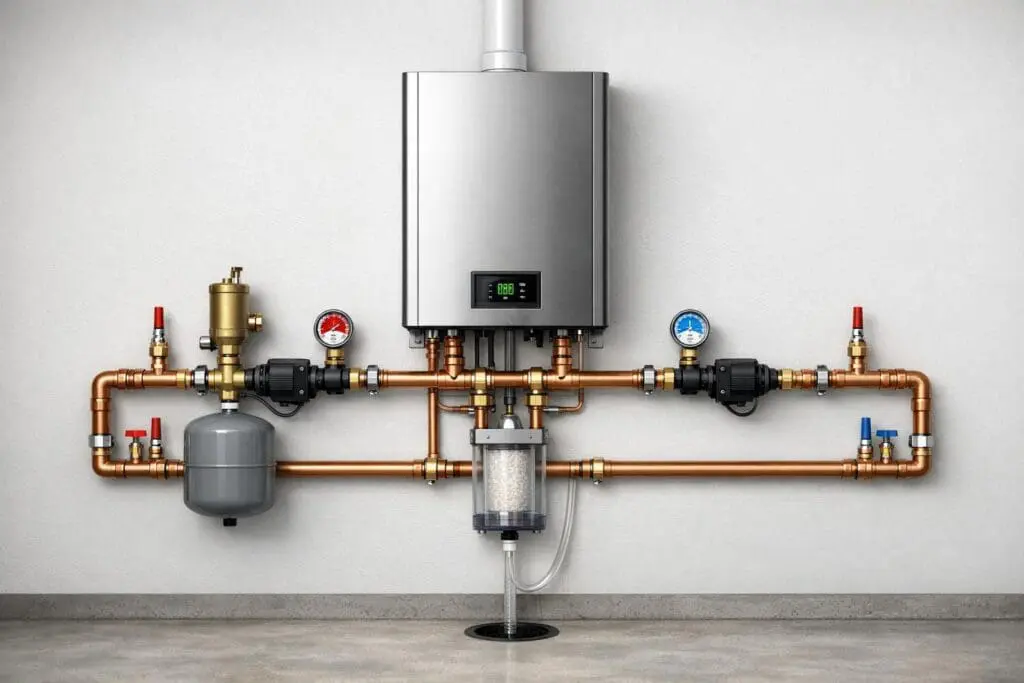
Install air separators at the point where temperature is highest and pressure is lowest. This placement effectively removes dissolved gases. Place the circulating pump immediately downstream of the expansion tank, and include an isolation valve between the system and the tank. This setup allows for annual diaphragm pre-charge checks without draining the system.
For multi-boiler systems, spring-loaded check valves are essential to prevent "ghost flow", which is unwanted circulation through boilers that aren’t in use.
Maintaining Minimum Flow and Bypass Design
Maintaining a steady flow rate is key to preventing boiler shutdowns and protecting the heat exchanger. Adding a bypass, in line with manufacturer guidelines, ensures consistent flow even when zone demands fluctuate.
Primary/secondary piping is particularly effective for modern condensing boilers. This method hydraulically separates the boiler loop from the distribution loop, allowing each circulator to function independently. A three-way bypass valve is used to maintain the minimum boiler flow when zones close. Together, these elements ensure continuous flow, hydraulic separation, and proper pressure drop. For best results, the pressure drop across the common pipe (the decoupler between loops) should stay below 4.0 feet.
In systems with two-way zone valves, a three-way bypass valve ensures minimum boiler flow is maintained when zones are closed.
Aim for a Delta T (temperature difference) of 30°F–40°F. This helps reduce pump energy consumption and keeps return temperatures low.
Condensate Handling in Condensing Boilers
Condensing boilers extract latent heat from flue gases, a process that generates acidic condensate. Proper management of this condensate is essential to protect both the boiler and the drainage system.
Kevin Ricart, P.E. at SmithGroup, explains the process:
"The process requires a return water temperature below the dew point of the flue gas (typically around 130°F) and a heat exchanger designed for corrosive condensate."
To manage condensate effectively, install drains at two critical points: the base of the flue stack and the heat exchanger. Condensate traps should also be added to prevent flue gas from backing up.
When using cast iron drain piping, a condensate neutralizer is usually needed before discharge. Ensure all drainage materials can handle acidic, moisture-heavy exhaust. Ignoring this requirement can void warranties and lead to early corrosion. Always check your boiler manufacturer’s specific guidelines for condensate handling to avoid costly mistakes.
Selecting and Arranging Key System Components
Once you’ve nailed down an efficient piping layout, the next step is choosing and positioning the right hydronic components. This ensures your system operates smoothly and maintains its efficiency over time.
Pump Selection and Placement
Opt for variable-speed ECM (Electronically Commutated Motor) circulators to match flow rates with system demand while keeping energy consumption in check. Joel Southwell, Director of Commercial Heating at The Fulton Cos., explains:
"Designing the hydronic system around a higher Delta T [30°F–40°F] decreases system pump kW requirements and allows colder return water temperatures to the condensing boiler."
By maintaining a Delta T (temperature difference) of 30°F–40°F, you can reduce pump energy demands and ensure return water temperatures stay in the ideal range.
Pump placement is equally important. Always position pumps to pump away from the expansion tank. For primary-variable systems, place the pump at the boiler outlet. In primary-secondary systems, install the primary pump on the boiler inlet and the secondary pump on the outlet. This setup promotes hydraulic separation and helps with efficient air removal. These steps also set the stage for better air and debris management.
Air and Dirt Removal
Air and debris can wreak havoc on hydronic systems, leading to reduced efficiency and premature wear on components. To combat this:
- Install microbubble air separators at the point of highest temperature and lowest pressure – typically off the boiler supply. These separators remove dissolved gases effectively.
- Place dirt and magnetic separators on the return side to catch debris before it reaches the heat exchanger. This is especially crucial for high-efficiency condensing boilers, as their compact heat exchangers are more prone to fouling.
When connecting secondary loops to a primary header, always tie them in at the side or bottom of the pipe. Avoid top connections, as they create air traps that can starve the circulator of water and potentially lead to burnout.
Temperature Sensor Placement and Control
Properly placed temperature sensors are key to monitoring and controlling system performance:
- Install a sensor at the boiler return to track the water temperature entering the heat exchanger. For condensing boilers, this ensures return water remains below the ~130°F dew point required to recover latent heat from flue gases. According to Matthew Freeman, Boilers Product Manager at Bosch Thermotechnology Corp., reducing the supply temperature by just 3°F can save 1% in fuel consumption.
- For systems with motorized mixing valves, place an inlet sensor to regulate hot water flow and keep boiler temperatures above the dew point.
- In multi-boiler setups, add individual temperature sensors and flow-sensing devices to each boiler branch. This ensures balanced flow distribution and prevents high-limit alarms, especially during periods of lower building loads like mild weather.
Planning for Maintenance and Long-Term Performance
When designing systems, it’s not just about achieving peak performance at the start – it’s also about ensuring they remain efficient and serviceable over time. A thoughtful piping layout can make a big difference in reducing maintenance hassles and keeping the system running smoothly for years to come.
Allow Space for Access and Servicing
A simple yet effective strategy is installing shut-off (isolation) valves at every zone and branch. Justin Skinner, Senior Boiler Technician, puts it best:
"Install shut-off valves wherever you can. It will significantly reduce maintenance time and effort later on when a repair is required."
These valves let technicians isolate specific components – like a circulator or zone valve – without draining the entire system. For systems with multiple boilers, piping them in parallel with individual isolation valves ensures that one boiler can be taken offline for maintenance while the others keep operating.
Another important detail: include an isolation valve between the system and the diaphragm-type expansion tank. This setup allows for accurate annual air pre-charge checks without putting system pressure on the diaphragm. Jim Erhardt, National Market Manager at Watts Water Technologies, underscores this point:
"The benefit of this [isolation] valve is to enable easier servicing of a diaphragm-type expansion tank. … the air pre-charge must be checked annually."
Add Test Ports and Monitoring Tools
Strategically adding test ports and monitoring tools can make servicing even more efficient. Brian Gomski, Director of Marketing and Business Development at Midwest Machinery, stresses their importance:
"On gas isolation valves, make sure they have test ports. This allows for much easier maintenance in the future.
Permanent test ports need to be installed in venting. Test ports are a commonly overlooked maintenance accessory. They are required for combustion analyzation."
Proper temperature sensor placement is equally critical. Always mount sensor wells on the side of horizontal piping – this ensures they’re fully immersed in water flow and not exposed to air pockets. For accurate system monitoring, use supply and return sensors to track Delta T (ΔT). For firetube heat exchangers, ΔT should stay below 35°F during high-fire operation; higher values often signal restricted flow.
Protect Water Quality
Maintaining water quality is another key factor in ensuring long-term system performance. Issues like dissolved gases, debris, and incorrect pressure can wear down components over time. Installing purging stations – a combination of a ball valve and hose bib on the return side of each secondary circuit – makes air removal during commissioning or repairs a breeze. John Siegenthaler, P.E., warns of the challenges when this step is overlooked:
"Without a means of purging each secondary circuit, it can require hours to displace air from the system when putting it into service."
For non-condensing boilers, return water temperatures below 140°F can lead to flue gas condensation on the heat exchanger’s fireside, causing corrosion. A thermostatic mixing valve can prevent this by blending hot supply water with cooler return water, keeping inlet temperatures above the danger zone.
Finally, place the air separator at the point of highest temperature and lowest pressure, typically just off the boiler supply. This positioning optimizes dissolved gas removal, protecting pumps and heat exchangers from unnecessary wear over time.
Conclusion: Work with Certified Professionals for Best Results
A high-efficiency boiler system relies on precise near-boiler piping, proper hydraulic separation, accurate pump placement, effective air and dirt removal, and a design that simplifies maintenance. Each of these factors is essential – overlooking even one can lead to poor performance or complete system failure. Together, these elements ensure consistent operation and energy efficiency.
Modern condensing boilers, being low-mass systems, are particularly sensitive to piping mistakes. Jim Erhardt, National Market Manager at Watts Water Technologies, highlights this:
"A single piping error in a radiant system… could lead to a system that refuses to deliver the expected comfort and efficiency – or it just won’t work at all."
Poorly designed systems not only underperform but also drive up costs. Many older boilers are oversized by as much as 50%. Plus, reducing the supply water temperature by just 3°F can save 1% on fuel costs, which adds up significantly during a long Chicago winter.
Brian Gomski of Midwest Machinery puts it best:
"Like a Ferrari requiring precise tuning, your boiler demands matched components for peak performance."
FAQs
Do I need primary-secondary piping for my boiler?
Whether or not you need primary-secondary piping depends largely on your boiler type and what your system demands. For modern condensing boilers, this setup can be especially helpful. It provides hydraulic separation, maintains steady flow rates, and shields the heat exchanger from issues like cycling or temperature swings.
If your system’s flow rates or temperature variations don’t match what your boiler can handle, primary-secondary piping might be essential to keep things running safely and efficiently.
What Delta T should my hydronic system target?
For effective hydronic condensing-boiler design, targeting a Delta T of around 30°F is recommended. This approach boosts both boiler and pump efficiency compared to the more common 20°F. When it comes to piping and coil design, a 60°F Delta T works best. It minimizes pipe and pump sizes while also improving the boiler’s condensing performance.
Where should I place air separators and dirt filters?
For the best results with your boiler, always stick to the piping schematics provided in the installation manual. Generally, air separators are most effective when placed at the spot with the highest temperature and lowest pressure. This makes it easier to eliminate dissolved gases from the system.
If you’re unsure about installation or maintenance, Eco Temp HVAC has certified technicians in the Chicagoland area who can ensure your high-efficiency boiler is set up for peak performance and comfort.