
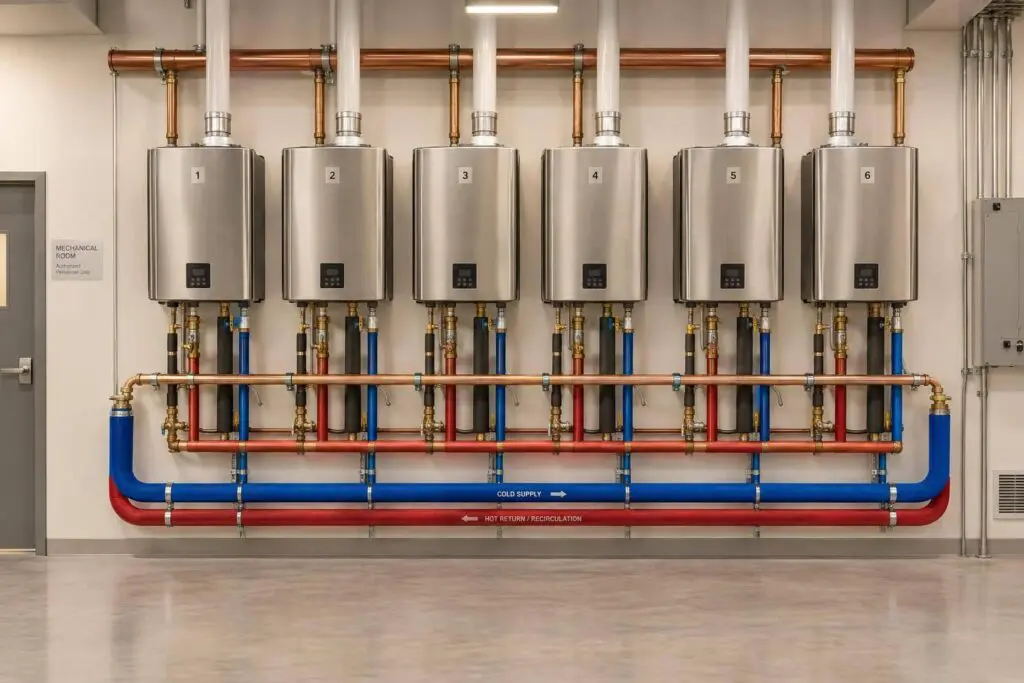
I’d size a commercial tankless system for winter peak demand – not its advertised maximum GPM. At a 60°F temperature rise, a 199,900 BTU/h heater running at 96% thermal efficiency supplies about 6.4 GPM. Your system should cover critical demand with one heater offline.
I compare six options for hotels, restaurants, apartments, and schools based on output, space, recirculation, installed cost, and service needs.
Quick Comparison
| Model | Recirculation setup | Main buying check |
|---|---|---|
| Navien NPE-240A2 | Built-in pump and 0.5-gallon buffer tank | Loop requirements; up to 32 cascaded units |
| Navien NPE-240S2 | External pump required | Added pump and control costs; up to 32 cascaded units |
| Rinnai CX199 Series | External pump required | Cabinet fit and approved cascade setup |
| Rinnai CXP199 Series | Built-in pump | Pump capacity and conflicting published dimensions |
| Noritz NCC199CDV | Confirm external-pump setup | 100°F–185°F setpoints and revision-specific vent limits |
| Rheem RTGH-CS11i / CSR11i | CSR11i includes recirculation | Exact model suffix, rack dimensions, and control limits |
My buying rule: compare <u>total installed cost</u>, not heater prices alone. Get an itemized quote covering gas supply, venting, controls, pumps, permits, and startup testing. Then check service access, water-quality needs, commercial warranty terms, and local repair support – including Chicagoland service options.
1. Navien NPE-240A2
Hot-Water Output
The Navien NPE-240A2 delivers 199,900 BTU/h, with rated flow rates of 11.2 GPM at a 35°F temperature rise, 8.7 GPM at 45°F, and 5.6 GPM at 67°F.
ComfortFlow pairs an internal recirculation pump with a 0.5-gallon buffer tank. It reduces cold-water sandwiching and improves response at low flow, but doesn’t add heating capacity. This setup suits compact mechanical rooms where capacity needs to scale.
Footprint and Cascade Options
For large sites, layout and venting often determine whether the system fits the job. The cabinet measures 17.3 inches wide × 27.4 inches high × 13.2 inches deep. Leave extra room for panel removal, connections, and condensate service.
Ready-Link supports up to 32 units, bringing another unit online at roughly 80% load. Navien also lists common venting for up to 12 units – a separate limit from cascade capacity. Before planning the layout, check the current installation manual for allowed vent lengths, materials, and clearances.
Equipment and Installed Cost
Treat these prices as benchmarks, not project quotes. Cascades add costs for gas, venting, condensate, permits, and commissioning.
One online listing puts equipment at about $1,949, excluding installation, accessories, tax, and freight. Published installed examples start around $6,148, while another estimate ranges from $6,300–$12,300.
Maintenance and Service
Set service intervals based on operating hours and water quality. Service should include heat-exchanger inspection, descaling, inlet-filter cleaning, combustion checks, condensate and neutralizer inspection, and recirculation-pump testing.
At startup, verify pump settings, return-loop operation, cascade communication, and hot-water temperature under load. Check the commercial warranty terms: improper installation or missed maintenance can void coverage.
The next models offer similar output, with different cabinet sizes and control approaches aimed at the same core capacity target.
sbb-itb-b5c10b1
2. Navien NPE-240S2
Hot-Water Output
The S2 delivers output similar to the A2 with a simpler hardware package. Maximum input is 199,900 BTU/h, with published flow rates of 11.2 GPM at a 35°F temperature rise, 8.7 GPM at 45°F, and 5.8 GPM at 67°F. Actual output depends on inlet temperature, target delivery temperature, the mix of fixtures in use, gas supply, and staging.
Unlike the A2, the S2 has no integrated recirculation pump or buffer tank. Buildings with central recirculation need compatible external pumps and controls, which affect layout and cost. That means the S2 isn’t a direct replacement for an A2 installation built around integrated hardware.
Footprint and Cascade Options
The S2 shares the A2’s 17.3-inch-wide × 27.4-inch-high × 13.2-inch-deep cabinet, but external recirculation components need their own space. The difference is in the service layout – not the cabinet size.
With the correct accessories, Navien supports up to 32 cascaded units and 12 common-vented units. Leave room for headers, isolation valves, and access to every heater. Use Navien’s current installation manual to specify communication wiring and common-vent accessories.
Equipment and Installed Cost
The lower equipment price matters most when compatible recirculation infrastructure is already in place. Published listings run roughly $1,650–$2,400 per unit, before installation.
One bundled installation price starts around $7,800. Compare full bids that include pumps, controls, gas upgrades, venting, and commissioning – not just the heater price.
Maintenance and Service
Service covers more than the heater itself: the heat exchanger, burner, condensate system, venting, gas connections, wiring, controls, pumps, and sensors all need attention. Group the work into cleaning and descaling, combustion and leak checks, and drainage and control testing. At large sites, the full recirculation system adds to the service workload.
Keep every cascaded unit accessible, and test staging with one heater offline to check available capacity. Follow Navien’s current installation and service documentation, tailoring maintenance to site water conditions, fuel type, usage, and local service guidance. Record startup readings, control settings, and maintenance intervals for future service.
Tankless Hybrid Water Heating Solutions for Commercial Applications
3. Rinnai CX199 Series
The CX199 Series offers large-site capacity in a smaller cabinet, with separate hardware for recirculation.
Hot-Water Output
The indoor natural-gas CX199iN delivers up to 199,000 BTU/h and about 11.0–11.1 GPM at a 30°F rise. Unlike the CXP199, the standard CX199 has no built-in recirculation pump. Central recirculation requires separate pumping and controls.
Footprint and Cascade Options
Rinnai lists the cabinet at 18.5 inches wide × 30.11 inches high × 11.4 inches deep, with a weight of 55 pounds. Use the current installation drawing to finalize the layout. Leave room for piping, condensate drainage, and at least 24 inches of front service clearance. Check the current manual to confirm clearance requirements.
The platform supports up to 24 cascaded heaters with compatible models and approved communication components. But cascade capacity and vent limits are separate: some eight-unit configurations allow vent runs up to 150 feet. Before designing the bank, confirm vent diameter, materials, fittings, and termination limits.
Equipment and Installed Cost
At large sites, the price difference matters most as the unit count grows – or when separate equipment already handles recirculation.
U.S. equipment pricing is about $1,600–$2,200 per unit, depending on configuration and quantity. The installed quote should include gas capacity, venting, condensate disposal, permits, piping, recirculation equipment, and commissioning. Quote the CX199 configuration directly rather than carrying over CXP pump features or pricing.
Maintenance and Service
Schedule professional inspections of the burner, flame sensor, intake, exhaust, water filter, and condensate path, along with flushing per Rinnai’s instructions. Hard water, high temperatures, and heavy recirculation increase scale-related service needs. Keep front access clear, and set the flushing interval based on the building’s water conditions and load.
4. Rinnai CXP199 Series
The CXP199 is Rinnai’s pump-equipped option for sites that want built-in recirculation.
Hot-Water Output
The CXP199 adds integrated recirculation hardware to the CX199 design. The Rinnai Sensei CXP199iN, the indoor natural-gas configuration, is rated at 199,000 BTU/h with a rated flow of about 11.0 GPM. Flow drops to 6.4 GPM at a 60°F temperature rise and 5.4 GPM at a 70°F temperature rise.
Its integrated four-speed DC recirculation pump cuts hot-water wait times and supports dedicated return-line or crossover layouts. Check the exact U.S. part number before specifying accessories.
Footprint and Cascade Options
The manufacturer’s specification sheet lists the cabinet at approximately 18.5 inches wide × 25.8 inches high × 11.4 inches deep. Some retail and distributor listings, however, show a height of about 30.1–30.2 inches. Use the current installation drawing when planning wall support, piping, and service access.
The wall-mounted design and built-in pump can save space otherwise needed for separate equipment. Long loops may still require separate balancing and circulation hardware, though. Those space savings only help if the full recirculation layout fits your budget.
Equipment and Installed Cost
Representative U.S. equipment prices run $2,200–$2,400 per heater. That excludes freight, tax, venting, racks, controls, recirculation piping, water treatment, and installation.
Request an itemized commercial quote. Installed cost depends on the venting, controls, piping, and recirculation hardware – including whether the integrated pump can serve the loop.
Maintenance and Service
Plan for annual professional service, with shorter intervals for hard water, heavy use, or high outlet temperatures. Focus on cleaning the inlet-water filter, testing the recirculation pump, and periodic descaling or flushing through installed service valves.
Keep the pump, isolation valves, flushing ports, and front panel accessible. For a cascade, confirm that each heater can be isolated and that the remaining units can meet demand while one is being serviced.
5. Noritz NCC199CDV
Hot-Water Output
For large sites, start by checking whether the NCC199CDV’s output and venting requirements fit the mechanical room.
The heater has a maximum input of 199,900 BTU/h, delivers up to 11.1 GPM, and carries a listed 0.98 UEF. That flow rate is a rated maximum – not a sizing guarantee. Use Noritz’s performance tables to match the building’s cold-water temperature and required outlet temperature. Setpoints range from 100°F to 185°F.
Footprint and Cascade Options
The cabinet measures 26.1 inches high × 18.1 inches wide × 11.8 inches deep and weighs about 62 pounds. Leave 24 inches in front and follow the manual’s front, top, and vent clearances. You’ll also need room for manifolds, valves, condensate piping, and service access.
Current listings allow up to 12 common-vented units, while cascade references list up to 24 units with approved controls. Check the exact heater revision, controller, and vent kit against current Noritz documentation, including approved vent components and configuration requirements. The 200-foot equivalent-run allowance applies only to qualifying common-vent designs.
Equipment and Installed Cost
Published listings put equipment costs at roughly $2,800–$3,000 per unit. Gas-service upgrades can push multi-unit system costs much higher.
For an installed price you can rely on, get a site-specific quote that separates controls, vent kits, manifolds, pumps, condensate neutralization, permits, labor, and commissioning. Six units have a combined maximum input of 1,199,400 BTU/h.
Maintenance and Service
The NCC199CDV uses dual 316L stainless-steel heat exchangers. These help resist condensate and chloride-related corrosion, but they don’t remove concerns about scale or water quality.
Schedule an annual professional inspection to clean filters, check combustion and gas pressure, and inspect venting and condensate parts. Descale as needed, with more frequent service for hard water or heavy use. Have controls, safety devices, and cascade communication tested, too.
Keep each unit’s isolation valves and service clearances accessible, along with its model number, serial number, and maintenance records.
Next, compare Rheem’s commercial condensing models, where footprint and service access change the cost-and-value comparison.
6. Rheem RTGH Commercial Condensing Models
Rheem’s commercial RTGH models compete on upfront equipment cost and rack layout. The choice also depends on whether built-in recirculation is worth the added cost of the CSR model.
Hot-Water Output
Use the commercial Rheem IKONIC RTGH-CS11i or RTGH-CSR11i models. A distributor lists the RTGH-CS11i at 199,900 BTU/h and 11.2 GPM, but doesn’t state the temperature rise. Before specifying it, confirm the current commercial submittal, fuel type, and full model suffix with Rheem. Size the system for the site’s required temperature rise – not the advertised maximum flow rate. On large sites, layout often matters as much as output.
Footprint and Cascade Options
A commercial listing gives approximate dimensions of 29 inches high × 18 inches wide × 14 inches deep and a weight of about 78 pounds. Treat these as preliminary until you check the current installation manual.
The listing also references modular racks with pre-sized water and gas manifolds. Before reserving space, confirm rack dimensions, service clearances, cascade count, and vent limits in the current Rheem submittal.
Equipment and Installed Cost
Published distributor examples price the RTGH-CS11i at $1,695–$1,850 and the recirculating RTGH-CSR11i at around $2,200, for equipment only. Installed cost also depends on racks, controls, venting, gas upgrades, condensate treatment, freight, and commissioning.
For long distribution runs, check the CSR11i’s pump controls and return-piping requirements before paying extra for built-in recirculation. Compare that price difference alongside the work needed to install and service the system.
Maintenance and Service
Inspect and clean the heat exchanger, inlet filter, burner, venting, and condensate path. Test gas pressure, controls, and the CSR11i’s recirculation components.
Document commissioning, leak checks, and owner training. To support uptime, keep rack service clearances, isolation valves, drains, and electrical connections accessible – especially around filters, vents, condensate components, and recirculation hardware.
Hot-Water Capacity and Installation Space
Commercial Tankless Capacity: Winter Demand and Backup
The verified numbers matter in two places: hot-water output at the same temperature rise, and the space and venting each system needs. For hotels, apartments, and restaurants, the key test is whether a bank of heaters can meet peak demand with cold winter inlet water.
Hot-Water Output at a Shared Temperature Rise
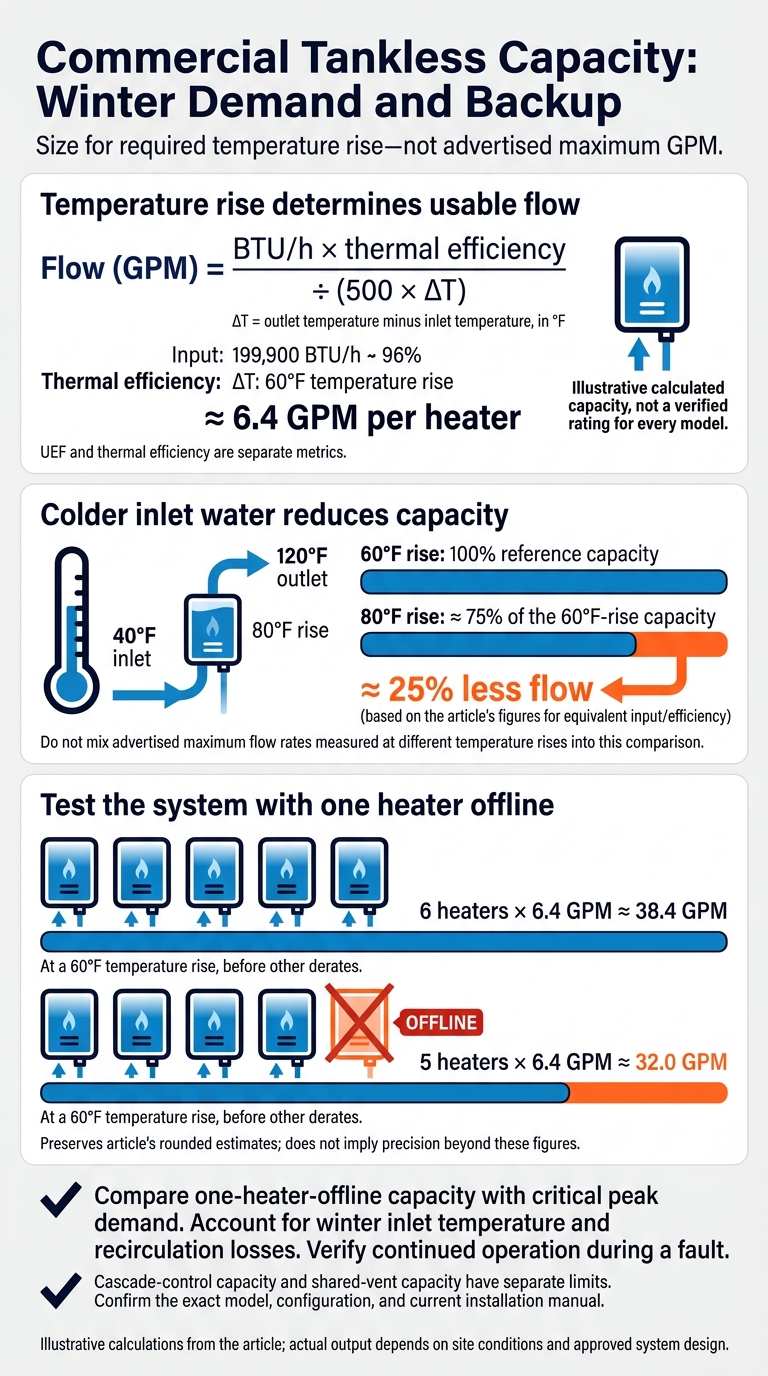
For this comparison, the estimates use 96% thermal efficiency and a 60°F temperature rise. The calculation is: Flow = BTU/h × thermal efficiency ÷ (500 × ΔT).
| Model | Input, BTU/h | GPM at 60°F rise | UEF | Thermal efficiency | Setpoint range | Recirculation |
|---|---|---|---|---|---|---|
| Noritz NCC199CDV | 12,800–199,900 | 6.4 calculated at 96% thermal efficiency | 0.98 | 96% | 100°F to 185°F, with stepped setpoints | – |
Source note: Rinnai and Noritz data support the verified entries. Fields marked – were not confirmed in the supplied documentation. UEF and thermal efficiency are separate metrics.
Rinnai commercial literature reports 10.8 GPM at a 70°F rise for two CX199 units, or about 5.4 GPM per unit. Published maximum flow is not the same as output at a 60°F rise. With 40°F inlet water, reaching 120°F requires an 80°F rise. That cuts output to about 75% of the 60°F-rise figure.
The heater setpoint is not the temperature delivered at the fixture. Higher storage or loop temperatures may help with long runs, but they also increase scald risk and code requirements. Use listed mixing valves, high-limit protection, relief protection, and point-of-use scald control. Set temperatures with the engineer and follow code and health department requirements.
That capacity also needs a mechanical room and vent path that can support it.
Dimensions, Cascade Controls, and Vent Limits
Once output is covered, check physical fit. Control-network capacity and shared-vent capacity have separate limits. This table is not an installation approval. Get the exact manual revision before reserving space or ordering components.
| Model | Cabinet dimensions, H × W × D | Service-space check | Controls / pumps | Cascade limit | Shared-vent limit |
|---|---|---|---|---|---|
| Navien NPE-240A2 | – | Check front clearance and pump access | Confirm cascade accessories and recirculation setup | Up to 32; subject to applicable manual | Up to 12; approved components |
| Navien NPE-240S2 | – | Check clearance around external piping | Confirm cascade accessories and external-pump controls | Up to 32; subject to applicable manual | Up to 12; approved components |
| Rinnai CX199 | – | Check rack layout and vent access | Approved cascade cables; confirm pump controls | Up to 24 in commercial literature | Up to 12; approved PP vent system |
| Rinnai CXP199 | – | Check rack layout and pump access | Confirm configuration-specific cascade and pump provisions | Up to 24; confirm applicability | Up to 12; approved PP vent system |
| Noritz NCC199CDV | 26.1 × 18.1 × 11.8 inches; 62 pounds | Wall mount; confirm service clearances | Confirm controller and external-pump arrangement | – | Vent limit varies by revision; published documents conflict on 6 versus 12 |
| Rheem RTGH-CS11i / CSR11i | – | Check full rack envelope and service access | Confirm suffix-specific controls and pump provisions | – | – |
Source note: Fields marked – were not verified in the supplied source set. Confirm configuration-specific limits and approved components in the current manuals.
Reserve room for piping, condensate, electrical connections, venting, and service access. Vent diameter, material, equivalent length, termination, and backflow protection must match the approved arrangement. During commissioning, set up and check lead-lag staging, runtime rotation, fault isolation, and balanced branch flow.
At 60°F rise, six heaters at 6.4 GPM each deliver about 38.4 GPM; one out leaves about 32.0 GPM before other derates.
Compare that reduced output with critical demand. Also verify that the remaining heaters keep operating during a fault.
Next comes the cost and maintenance tradeoff that determines which systems are practical for a large site.
Costs, Maintenance, and Installation
Once you’ve settled output and fit, compare total installed cost, maintenance needs, and service access. For large sites, all three affect hot-water uptime.
Equipment Prices and Installed Costs
All six models require site-specific quotes. Available sources don’t provide reliable U.S. package pricing. Request dated, itemized bids in U.S. dollars that specify the model, fuel type, quantity, configuration, peak demand, temperature rise, and redundancy requirements.
For large sites, the full system price matters more than the heater price alone.
| Cost category | Price status | Require in the quote |
|---|---|---|
| Individual heaters | Itemized bid | Exact model numbers and quantities |
| Rack or cascade package | Itemized bid | Rack, headers, and connection hardware |
| System adders | Itemized bid | Controls, sensors, wiring, vents, pumps, valves, neutralizers, tanks, and any other non-heater components |
| Installation | Project quote | Labor and defined site work |
| Commissioning | Separate line item | Startup, testing, programming, and records |
| Permits and inspections | Project quote | Fees and approval responsibility |
| Recurring maintenance | Per-visit or agreement | Tasks, frequency, consumables, and repair exclusions |
Heater price is not installed cost. Have each bid state whether it includes gas upgrades, electrical work, venting, condensate drainage, water treatment, recirculation piping, structural support, demolition, hazardous-material remediation, lifting, wall repair, and after-hours work.
Maintenance Tasks and Service Access
Set service intervals using the manufacturer’s manual, water hardness, inlet quality, recirculation temperature, and load. Price scheduled service, consumables, and emergency repairs separately.
For pump-equipped units, define pump access and who handles service. For other units, specify the external-pump layout. Use qualified professionals, as Navien requires in its installation and service documentation.
Plan isolation so individual units can be serviced while hotels, restaurants, apartment buildings, and schools retain hot-water capacity.
| Task | Scheduling basis | Access and downtime requirement |
|---|---|---|
| Descaling and flushing | Manual, hardness, and load | Individual isolation valves and flush ports |
| Inlet-filter cleaning | Manual and debris levels | Filter removal without header disassembly |
| Combustion, gas-pressure, and burner checks | Manual and operating conditions | Instrument and inspection clearance |
| Condensate and vent inspection | Manual and site conditions | Trap, neutralizer, drain, and vent access |
| Integrated or external pump service | Pump instructions and recirculation duty | Pump isolation without whole-loop shutdown where feasible |
| Control diagnostics and leak checks | Service schedule and fault history | Labeled boards, sensors, and connections |
| Parts replacement | Condition and faults | Local stock and documented lead times |
Installation and Commissioning Checklist
After pricing, focus on startup quality. Poor commissioning can hurt reliability. Require a signed commissioning record with the installer’s name, model and serial numbers, configuration, readings, control settings, and owner training. Check commercial warranty terms, too.
- [ ] Verify commercial-use approval, permits, inspections, and code compliance.
- [ ] Check gas pressure under simultaneous load, utility capacity, electrical supply, and combustion air.
- [ ] Confirm approved venting and condensate drainage.
- [ ] Check isolation valves, strainers, water treatment, and recirculation sizing and balancing.
- [ ] Test temperature controls and safety devices.
- [ ] Document startup readings and cascade operation at design demand, including one-heater-offline testing.
Chicagoland Installation and Service
For Chicagoland projects, Eco Temp HVAC provides commercial tankless installation, repair, and maintenance. Eco Temp HVAC says it holds Navien Service Specialist certification and offers 24/7 availability. Before contracting, confirm support for the selected model and cascade setup, commissioning scope, maintenance responsibilities, parts sourcing, and emergency response arrangements.
Model Selection by Property Type
Use the output, footprint, and service data above to match each model to the property’s demand pattern and tolerance for downtime. Check peak demand, recirculation needs, and outage risk before choosing.
| Property | Recommended when | Reconsider when |
|---|---|---|
| Hotels | Navien NPE-240A2 fits hotels that need integrated recirculation. Specify a redundant cascade to maintain service. | The design cannot meet peak demand with one unit offline. |
| Restaurants | Choose Noritz NCC199CDV when a broad temperature adjustment range matters. Use Rinnai CX199/CXP199 only when the model’s temperature and cascade limits match kitchen demand. | Dishwasher booster needs, mixing protection, or simultaneous flow exceed what the proposed design can handle. |
| Apartments | Navien cascade controls stage units to match demand. Size recirculation and pumps for the building’s load. | Winter inlet temperatures, loop losses, or low overnight demand make capacity or staging unsuitable. |
| Schools | Navien cascades suit larger shared loads. Consider Noritz NCC199CDV when its commercial setup matches campus demand. Verify scheduling controls, temperature safeguards, and service access. | The system cannot meet scheduling or alarm requirements, or maintenance would interrupt the entire campus supply. |
Before ordering, verify winter inlet temperature, recirculation losses, capacity with one unit offline, and installed cost.
FAQs
How do I estimate my building’s peak hot-water demand?
Don’t size a unit by its advertised maximum GPM rating. List the fixtures and processes that will run at the same time during your busiest periods. Then add their flow rates in gallons per minute (GPM).
Next, calculate the required temperature rise: subtract the coldest expected winter groundwater temperature from your target output temperature. Use that temperature difference and your peak flow rate to determine the required BTU output. Colder incoming water reduces how much hot water a unit can deliver per minute.
When should I add a storage tank to a tankless system?
Add a storage tank if your facility has short, intense spikes in hot water demand that exceed your tankless units’ output. Cascaded tankless systems handle steady, high-volume flow well. A storage tank adds a buffer for sudden, heavy use, so you don’t need to oversize the multi-unit setup. It also helps keep water temperatures consistent and reduces strain during peak demand.
Can I reuse existing gas lines and vents?
Reusing gas lines and vents depends on your new equipment’s requirements and their current condition. High-capacity tankless systems often need a 3/4-inch gas line. If yours is 1/2 inch, it typically needs an upgrade.
The vent’s path, length, and materials must meet manufacturer specifications and local building codes. Some systems can use the existing vent path, while others need specific materials or a dedicated vent run.