
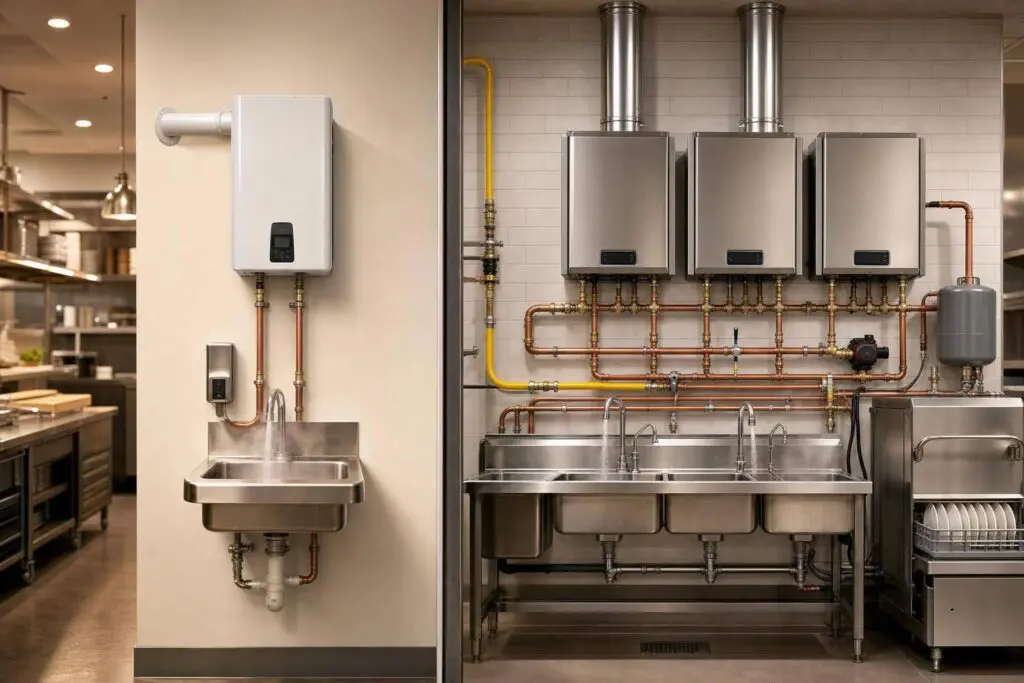
If I’m choosing a tankless water heater for a restaurant, I usually need a commercial unit, not a residential one. Restaurant hot water demand is higher, lasts longer, and often hits several fixtures at once. In cold areas like Chicagoland, winter inlet water in the upper 30s°F to low 40s°F can also cut tankless output, so sizing has to match both peak flow and temperature rise.
Here’s the short version:
- Residential tankless units are built for stop-and-start home use
- Commercial units are built for steady, heavy use
- Restaurants often need 8–15 GPM at peak, while many residential models top out below that in cold-weather conditions
- Restaurants may need water from 100°F at hand sinks up to 165–180°F for dish and sanitizing steps
- Warranty terms often shrink when a residential unit is used in a business
- Venting, recirculation, cascade controls, and permit rules are often stricter in restaurant installs
If I pick the wrong class of unit, the result can be temperature swings, service lockouts, failed inspections, and early replacement costs.
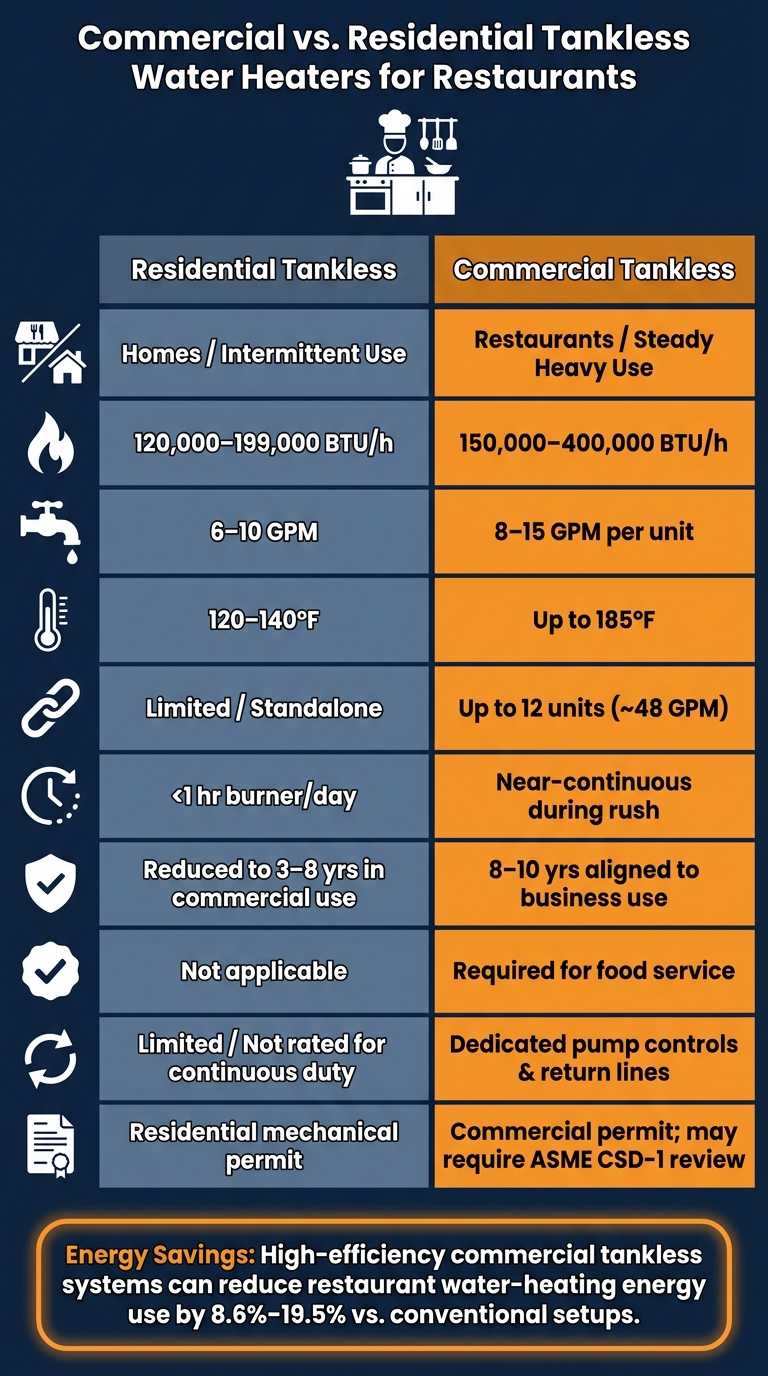
Commercial vs Residential Tankless Water Heaters for Restaurants
Commercial Navien Install at Echo and Rig in Summerlin, NV
sbb-itb-b5c10b1
Quick Comparison
| Criteria | Residential Tankless | Commercial Tankless |
|---|---|---|
| Main use | Homes | Restaurants and other business use |
| Hot water pattern | Short bursts | Long, steady demand |
| Peak output | Lower | Higher |
| Temp range | Often around 120–140°F | Can reach up to 185°F |
| Multi-unit cascade | Limited | Common |
| Recirculation duty | Often limited | Built for this setup |
| Warranty in restaurant use | Often reduced | Aligned with business use |
| Code fit for food service | Often not a match | Usually the right path |
So if I’m sizing for a restaurant, I’m not just comparing price or brand. I’m looking at flow rate, winter temperature rise, duty cycle, venting, controls, and code first.
Commercial vs. Residential Tankless: Output, Temperature, and Sizing
For restaurant use, the main differences come down to output, top-end temperature, and cascade capacity. Once you know the hot-water load, the next step is simple: pick a unit class that can handle it without losing temperature when the kitchen gets slammed.
| Feature | Residential Tankless | Commercial Tankless |
|---|---|---|
| BTU/h Input | ~120,000–199,000 BTU/h | ~150,000–400,000 BTU/h |
| GPM at a 60–70°F Rise | ~6–10 GPM | ~8–15 GPM per unit at a 70°F rise |
| Max Temperature Setting | Usually 120–140°F | Up to 185°F |
| Cascade/Manifold Support | Limited; typically standalone units | Yes; up to 12 units combined |
Flow Rate and BTU Capacity for Rush-Hour Sink, Dish, and Prep Demand
Commercial units are made for cascade setups, so multiple heaters can work together when kitchen demand goes past what one unit can handle. Manufacturers support setups with up to 12 units tied together, reaching roughly 48 GPM at a 100°F temperature rise for large facilities. That matters during rush periods, when a dish machine, prep sink, and hand sinks may all be pulling hot water at the same time.
Residential units, by contrast, are usually built as standalone systems. They may work fine in a house, but they aren’t set up to hold steady under heavy simultaneous demand across a full restaurant kitchen.
Capacity, though, is only part of the story. Restaurants also need hotter water for cleaning and sanitation.
Temperature Range for Cleaning and Sanitation
Most residential tankless units default to 120°F and top out around 140°F, which works for showers but falls short for a commercial dish line. Commercial dish machines need wash water at 150–165°F and sanitizing rinses at 165–180°F.
Many commercial tankless units sold for food-service use can be set as high as 185°F and keep those temperatures during steady multi-fixture demand. Push a residential unit near its limit, and it will often have trouble holding that temperature once the dish machine, prep sink, and hand sink are all running at once.
That’s why restaurant sizing starts with peak demand and required temperature rise, not square footage.
How Restaurant Sizing Differs From Home Sizing
Home sizing usually looks at fixture count and normal household use. Restaurant sizing is a different animal. It’s based on fixture counts, peak-hour simultaneity, needed temperature rise, and recirculation losses.
In plain English, restaurant sizing has to account for peak fixture load, required temperature rise, and recovery during steady use. Household sizing rules tend to understate restaurant demand, and that’s where systems start to fall apart during peak service.
Duty Cycle, Warranty Limits, and Where Residential Units Fall Short
Once output and temperature look fine on paper, duty cycle is often where things start to break down. A unit can seem properly sized and still fail in a restaurant if it was made for light household use instead of long daily run times.
Continuous Use vs. Intermittent Household Use
Residential units are built for intermittent household use. In many homes, that adds up to less than an hour of burner operation per day. A restaurant is a different story. During rush periods, the burner may run nearly nonstop.
That gap matters. Residential heat exchangers, burners, and control boards are not built for nonstop commercial cycling. Long run times and rapid on-off cycling wear parts out faster, encourage mineral scale buildup – especially in hard-water areas found across parts of Chicagoland – and can trigger error codes.
When that happens, the problems show up fast:
- Temperature swings
- Mid-service lockouts
- Parts failing years earlier than expected
Commercial-rated units are built and certified for the much higher number of firing cycles a business creates in a day.
Warranty Restrictions in Commercial Settings
Warranty terms can shrink fast once a residential unit is used in a commercial setting. Many manufacturers sharply reduce coverage the moment that happens. Some also connect warranty eligibility to daily activation counts, and one example excludes coverage above 300 activations per day.
So the fine print matters just as much as the spec sheet. Heavy daily use can cut coverage fast, which means the warranty has to line up with actual restaurant demand.
| Example | Warranty takeaway |
|---|---|
| Navien NPE-2 | Residential use can include a 15-year heat exchanger warranty, but commercial use can reduce coverage to 8 years on the heat exchanger, 5 years on parts, and 1 year on labor. |
| Noritz residential unit in commercial service | Heat exchanger: 3 years; parts: 3 years; labor: 1 year. |
| Noritz NCC199CDV commercial model | Heat exchanger: 10 years. |
| Rheem commercial Ikonic tankless | Heat exchanger: 8 years; parts: 5 years; labor: 1 year. |
Common Operating Problems in Restaurant Kitchens
In a busy kitchen, the day-to-day problems from using an undersized or light-duty unit are pretty predictable – and expensive. Temperature drops at sinks lead to uneven hot water delivery, which slows prep work and can create sanitation issues.
Dishwashing can take a hit too. If the unit cannot hold 150 to 165°F wash temperatures or 165 to 180°F rinse temperatures, mechanical warewashing performance suffers. On top of that, service resets are common when electronics trip from overheating or short cycling.
Then there’s the part owners feel in their budget: early replacement. When a unit runs far beyond its intended duty cycle, it often wears out long before anyone expected. In a busy restaurant, that can mean failure within just a few years, even if the warranty looked decent at the time of purchase. Any upfront savings usually disappear once you factor in shutdowns, repair calls, and early replacement. That is why venting, controls, and code compliance matter next.
Venting, Controls, and Code Requirements for Restaurant Tankless Systems
Once output and duty cycle are nailed down, venting and controls usually become the next sticking points.
Venting and Installation Complexity in Commercial Spaces
Restaurant tankless venting is tougher than it looks. Vent runs are often longer, the material rules are stricter, and the path often has to go through a roof, ceiling chase, or mechanical room. Condensing units need corrosion-resistant vent materials, while non-condensing units usually need stainless steel venting.
That gets tricky fast in a restaurant. A line might have to snake through back-of-house areas before it ever reaches the outside. Because of that, designers need to check the maximum equivalent vent length with care and keep the right horizontal slope so condensate drains the way it should.
Combustion air can trip people up too. If a unit pulls room air instead of outside air through a direct-vent setup, local code calls for minimum room volume and makeup air under ANSI Z223.1/NFPA 54.
Controls, Cascading, and Recirculation for Multi-Fixture Use
Venting is only part of the job. Restaurants also need controls that can keep hot water steady when the rush hits.
A restaurant may have dishwashing, prep sinks, hand sinks, and a mop sink all drawing hot water at the same time. That kind of demand calls for more than a basic home-style control setup. Commercial HVAC systems usually include digital setpoint controls, lockable temperature settings, remote controllers, and staged operation. Those features help keep water delivery steady even when demand changes from one part of service to the next.
Cascading is one of the big dividing lines between home and restaurant setups. Commercial systems can manifold multiple units and manage sequenced operation, fault reporting, and shared setpoints. A typical residential model usually doesn’t offer that kind of coordination.
Recirculation also matters, especially in bigger spaces where hot water has a long trip before it reaches the fixture. Commercial recirculation systems use dedicated return lines, pump controls, and check valves to keep hot water available at sinks that are far from the heater. Not every residential unit is rated for continuous recirculation duty.
Health, Safety, and Local Code Compliance
Code sets the final limit on what can and can’t go into a restaurant.
Food-service equipment has to meet code-driven handwashing, warewashing, and sanitizing temperatures. Commercial water heaters used in food service are expected to comply with NSF/ANSI 5, which covers food-service sanitation rules for materials, design, construction, and performance.
In the U.S., gas tankless equipment over 200,000 BTU/h input, or equipment installed in a commercial kitchen, can trigger a different permit and inspection path than a residential install. In some cases, that also brings added safety rules such as ASME CSD-1.
| Feature | Residential Tankless | Commercial Restaurant Tankless |
|---|---|---|
| Vent material | Varies by model (condensing vs. non-condensing) | PVC/CPVC/PP or stainless steel; Category IV or I/III rated |
| Shared venting | Rarely supported | Supported for multiple units on shared exhaust |
| Combustion air | Basic room-air or direct-vent requirements | Direct-vent or room-air with required makeup air per ANSI Z223.1/NFPA 54 |
| Cascade control | Not available | Built-in sequenced operation, fault reporting, shared setpoints |
| Recirculation support | Limited or not rated for continuous duty | Dedicated recirculation compatibility with pump controls |
| NSF/ANSI 5 listing | Not applicable | Required for food service approval |
| Permit/code path | Residential mechanical permit | Commercial mechanical permit; may require additional safety review |
Before equipment is selected, the local authority having jurisdiction (AHJ) should confirm what applies to the space, occupancy type, and install setup. Rules can change from one city or county to the next, so it’s smart to verify them before the design is locked in.
Conclusion: Why Commercial Tankless Is Usually the Right Call for Restaurants
Output, duty cycle, warranty, venting, and controls all lead to the same place: restaurants usually need commercial tankless systems. They’re built for steady, high-demand hot water across many fixtures at once. That’s a big deal in a restaurant, where the kitchen, hand sinks, bar, and dish area may all call for hot water at the same time.
Residential units aren’t made for that kind of workload. In a restaurant setting, they can bring more risk of temperature swings, lockouts, and inspection failures. Commercial units are a better fit for restaurant demand and tend to deliver hot water with more consistency.
There’s also an energy angle. High-efficiency tankless systems can cut restaurant water-heating energy use by 8.6%–19.5% compared with conventional setups.
In Chicagoland, this matters even more. Colder inlet water in winter means higher BTU demand, so sizing can’t be a guess. Winter performance and code compliance both need to be part of the plan.
If you’re planning an upgrade, the unit itself is only part of the job. Proper sizing and installation matter just as much. Eco Temp HVAC provides commercial tankless sizing, installation, and maintenance across Chicagoland. An on-site assessment is the fastest way to size the right system for your kitchen.
FAQs
How do I know what GPM my restaurant needs?
Calculate your peak simultaneous hot-water demand by listing every fixture or process that runs at the same time during your busiest period. Then add up their flow rates in GPM to get your target.
You’ll also want to factor in temperature rise. That’s the difference between your incoming water temperature and the outlet temperature you need. If the inlet water is colder, your unit will deliver less usable GPM. And if your total demand is more than one unit can handle, you may need a cascaded setup.
Can one commercial tankless unit handle my whole restaurant?
It comes down to how much hot water your restaurant uses at once and how many fixtures are pulling from the system.
For a smaller restaurant with lighter demand, one high-capacity commercial tankless unit may be enough.
But in most full-service restaurants, that’s usually not the case. Dishwashers, prep sinks, and hand sinks often run at the same time, and that combined demand can push past what a single unit can handle. When that happens, a cascaded system with multiple units is usually the better fit. It helps cover flow needs, adds backup if one unit goes down, and supports sanitization temperatures.
What codes apply to restaurant tankless installations?
Restaurant tankless installations need to meet both national and local code rules. For gas units, that usually means following IFGC and NFPA 54. For electric units, the key standard is NFPA 70. Plumbing and drainage work must meet the IPC.
Local rules can change from one city or county to the next, so it’s smart to check with your local Authority Having Jurisdiction. This matters most for venting materials, condensate disposal, and mechanical permits. To stay within code and keep the manufacturer warranty in place, the system should be installed by a licensed, certified professional.