
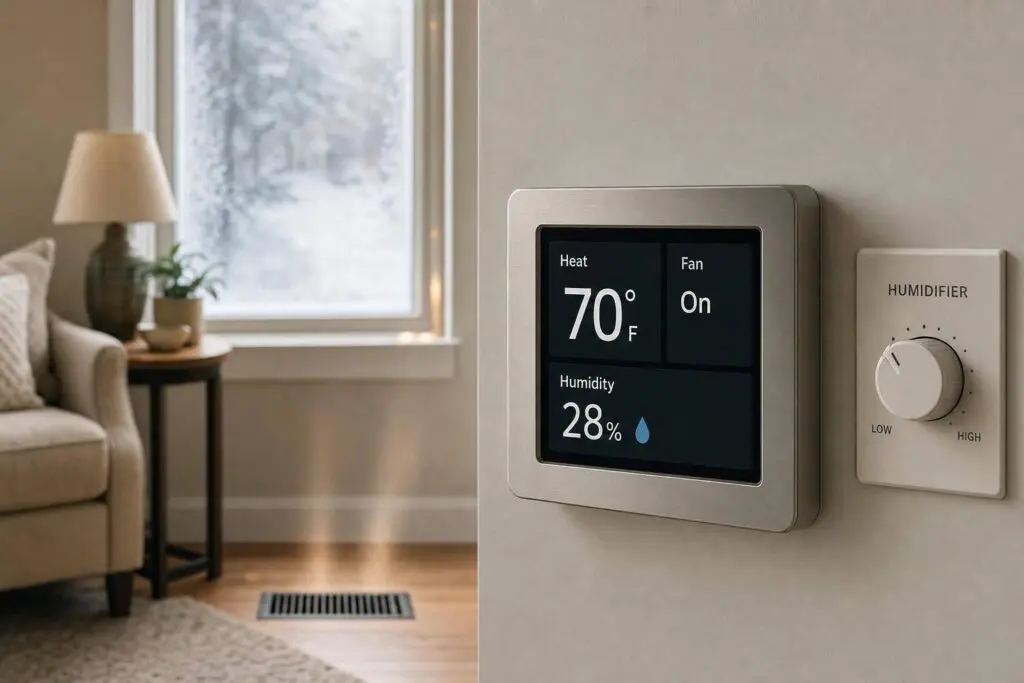
Your furnace does not remove moisture from indoor air. What you feel in winter is usually this: cold outside air leaks in, the furnace warms it to about 68°F to 72°F, and the relative humidity drops. That’s why homes often feel dry even when the heating system is working as it should.
If I had to sum it up fast, it would be this:
- Low winter humidity is usually caused by air leaks, ventilation, or humidifier settings
- Indoor RH is best kept around 30%–50%, with 30%–40% often working better in Chicagoland winter weather
- A fan set to “On” can make dry air feel worse because moving air speeds moisture loss from skin
- Exhaust fans, dryers, fireplaces, and duct leaks can pull in more cold, dry outdoor air
- A hygrometer is the simplest way to check what’s going on before changing thermostat or humidifier settings
- If windows show condensation, indoor humidity is too high for current outdoor conditions
Here’s the simple takeaway: if your air feels dry, I would first check RH readings, fan mode, drafts, duct leaks, and humidifier setup before blaming the furnace itself. This article explains how those parts work together and what to do next.
HVAC by Design: Winter Humidification
sbb-itb-b5c10b1
How furnace operation makes dryness more noticeable
When your furnace runs longer, dry air moves through the house more often. That can make the whole issue feel worse. The furnace itself isn’t removing moisture from the air, but long runtime and steady airflow can make low humidity a lot more noticeable.
Long heating cycles and continuous fan use
During a cold Chicagoland winter, the furnace may run for long stretches just to hold the thermostat setting. Each cycle pulls air through the return ducts, heats it, and sends it back through the supply registers. The longer it runs, the longer that dry air keeps circulating through the building.
That steady airflow can feel rough on your skin, eyes, nose, and throat. It’s a bit like standing in a breezy room after washing your hands. Even if the temperature is fine, moving air can make things feel drier than they already are. Rooms near supply registers, or spots where airflow is stronger, often feel this the most. And when the thermostat calls for more heat, that effect can get stronger.
Thermostat settings that can worsen dry-air discomfort
Dry air often feels colder than it is. So people bump up the thermostat when what they may need is more humidity, not more heat. That can backfire. Frequent thermostat changes can make the problem feel worse because they push the furnace into longer recovery cycles. A steadier approach usually works better: pick a comfortable setting and avoid constant temperature swings.
It’s also smart to check the fan setting. If the blower is set to "On" instead of "Auto," it keeps running even when the furnace isn’t heating. That means air keeps moving through the ducts all the time, which can make low humidity feel worse because moving air speeds up evaporation from your skin. Set the fan to "Auto" so it runs only during heating calls.
If the air still feels dry after you adjust runtime and fan settings, leaks and ventilation are the next places to check.
How air leaks and ventilation lower indoor humidity faster
If the thermostat and fan settings check out, the next place to look is air leaks and ventilation. In many cases, low RH has less to do with the heating system itself and more to do with outside air slipping indoors. When cold outdoor air comes in and then warms up inside, its relative humidity drops fast. That’s why a drafty room can feel dry in a hurry – the more outside air that leaks in, the more moisture levels fall.
Where dry outdoor air enters a home or small business
Dry outdoor air usually gets in through small openings that are easy to miss. Common trouble spots include gaps around window and door frames, worn weatherstripping, poorly sealed thresholds, rim joists, attic hatches, recessed light fixtures, and ceiling openings around plumbing or electrical wiring.
Basements and crawl spaces need a close look too. Cracks along foundation walls, sill plates, crawl-space access doors, and basement windows can let in a steady flow of cold, dry air. And when exhaust equipment is running, those gaps can pull in even more outside air.
How exhaust devices and duct leakage increase dryness
Bathroom fans, kitchen hoods, dryers, and fireplaces all push indoor air out of the building. That air has to be replaced somehow, so outside air gets pulled in through cracks and leaks – especially when more than one device is running at the same time.
Leaky ducts can make things worse. If ducts run through attics, crawl spaces, or basements, they can lose heated air before it reaches the living space. They can also pull cold air and dust into the system. A good first step is to seal open duct joints with mastic or metal-backed tape, then insulate ducts located in unconditioned spaces.
If the space still feels dry after those basic checks, it may be time to bring in a pro. Eco Temp HVAC can inspect duct leakage, airflow, and ventilation conditions to help find the source.
Solutions: humidifiers, humidity monitoring, and system settings
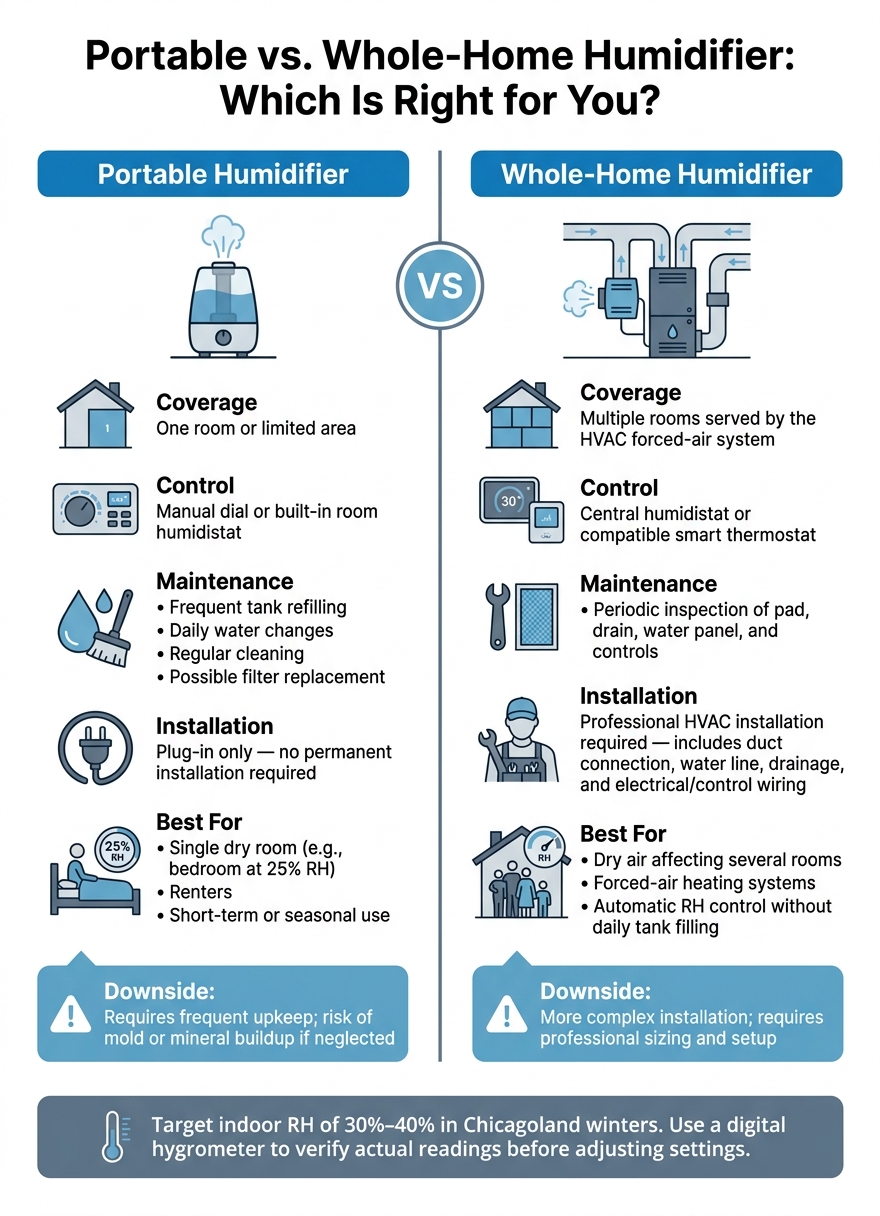
Portable vs. Whole-Home Humidifier: Which Is Right for You?
If indoor RH is still low after you’ve sealed leaks and fixed duct issues, it’s time to add moisture control. The best fix depends on how much of the building feels dry, what kind of property you have, and how hands-on you want to be.
Portable vs. whole-home humidifiers
A portable humidifier is a good fit when the problem is limited to one room. Think of a bedroom sitting at 25% RH or a single office that always feels dry. It also makes sense for renters or anyone who wants a short-term or seasonal fix. The downside is upkeep. You’ll need to refill the tank often, clean the unit on schedule, and keep the area around it dry so you don’t end up with mold or mineral buildup.
A whole-home humidifier is usually the better pick when dry air affects several rooms, the building uses forced-air heat, or you want automatic RH control without filling tanks every day. This type sends moisture through the HVAC system itself. That said, installation is more involved. It needs a water line, a drain connection, and proper duct integration, which is why correct sizing and professional furnace installation matter.
| Factor | Portable humidifier | Whole-home humidifier |
|---|---|---|
| Coverage | One room or a limited area | Multiple rooms served by the HVAC system |
| Control | Manual or built-in room humidistat | Central humidistat or compatible smart thermostat |
| Maintenance | Frequent tank filling, water changes, cleaning, and possible filter replacement | Periodic pad, drain, water-panel, and control inspection |
| Installation | Plug-in setup with little or no permanent installation | HVAC installation, duct connection, water line, drainage, and electrical or control wiring may be required |
How to set humidity without causing condensation
Once you’ve picked the unit, set it based on room readings, not just the dial. A digital hygrometer gives you the actual RH in the spaces that matter most, like bedrooms, living rooms, offices, and rooms near exterior windows. Check those readings at different times of day, especially in the morning, in the evening, and during a furnace cycle, since RH can shift more than people expect.
A good winter target is usually 30%–50% RH, and the EPA says indoor RH should stay below 60% to help cut condensation and mold risk. In a Chicagoland winter, starting around 30%–40% RH is often the safer move. Here’s why: when outdoor temperatures fall, windows can handle less indoor moisture before condensation shows up. Based on ASHRAE data, at 20°F outside, the approximate condensation-free limit is 43% RH for double glazing and 21% RH for single glazing.
If you notice moisture on windows or other cold surfaces, don’t ignore it. Lower the humidifier setting, bring in more ventilation, and dry the surface right away.
Using smart thermostats and humidistats together
Heat control and humidity control do two different jobs. Used together, the thermostat handles temperature while the humidistat shuts off humidification once the target RH is reached. That setup helps avoid adding too much moisture and cuts down on constant manual tweaking.
Set your humidity target from actual hygrometer readings, not only from what the thermostat screen says. In a larger home, using more than one sensor helps because one room shouldn’t speak for the whole building. The same idea applies in multi-zone homes and small commercial spaces. A single sensor may miss what’s happening in colder rooms, along exterior walls, or in spots that already have moisture issues, so extra hygrometers can give you a clearer read on the space.
A practical winter humidity plan for Chicagoland properties
What to check first when indoor RH is too low
After you check thermostat settings, leaks, and ventilation, use a hygrometer to see what’s actually happening in the air. Start with a digital hygrometer and place it away from registers, windows, and moisture sources. Then compare readings in a few rooms at about the same time.
For example, a central living room might read 35% RH while a bedroom near a drafty window sits at 25%. That kind of gap usually points to infiltration or airflow trouble, not just a humidifier setting problem.
Next, check the basics:
- Furnace filter
- Humidifier power
- Water supply
- Humidistat setting
- Drafts and duct leaks
A disconnected return duct can look like a humidifier failure because it pulls in cold, dry air.
Key takeaways for healthier winter indoor air
Once you know the actual RH, use the chart below to choose the next step.
| RH reading | What to do | Risk |
|---|---|---|
| Below 30% | Check filter, humidifier, and ducts | Dry skin, irritated airways, static |
| 30%–40% | Hold steady; watch for condensation | Practical winter comfort range for Chicagoland |
| 40%–50% | Monitor cold surfaces closely | Condensation risk rises on cold days |
| Above 50% or condensation visible | Reduce humidification; investigate sources | Window condensation, damp materials, mold risk |
Let measured RH guide your adjustments. Keep winter humidity near 30%–40%, lower it if condensation shows up, and turn humidification off if RH goes above 50%.
If those checks don’t fix the issue, the problem is likely mechanical. Call a professional when RH stays below 30% even though the humidifier is working, or when room-to-room readings differ by a lot. Eco Temp HVAC serves Chicagoland homeowners and small businesses across Chicago, St. Charles, Bartlett, Lemont, Downers Grove, Palatine, and nearby suburbs, with furnace maintenance, duct services, humidification support, and indoor air quality assessments.
FAQs
Why does my home feel dry even when the furnace is working normally?
Even if your furnace is doing its job, your home can still feel dry in winter. That’s because heating cold outdoor air lowers its relative humidity. Once that air warms up, it can hold more moisture, so the humidity level inside your home drops.
Comfort issues can also come from short cycling or ductwork that’s leaky or too small. Both can throw off airflow and make rooms feel uneven. Keeping indoor humidity around 30% to 40% with a whole-home humidifier can help.
Should I set my furnace fan to On or Auto in winter?
It depends on your system and what you want from it.
Keeping the fan set to On means air moves all the time. That can help smooth out hot and cold spots from room to room, and it can also push more air through the filter.
If you have a high-efficiency system with a variable-speed ECM blower, Auto may use less energy. These systems are built to run at lower, steadier speeds, which can help keep temperatures more even and humidity more controlled.
What humidity level is best for a house in winter?
A good winter indoor humidity range is 25% to 50%. But in very cold Chicago weather, 30% to 40% is often the sweet spot because it’s easier to maintain without running into moisture problems.
Keeping humidity in that range can make your home feel more comfortable. It can also help with dry skin and irritated sinuses, protect woodwork and furniture, and reduce the risk of condensation and mold growth.