
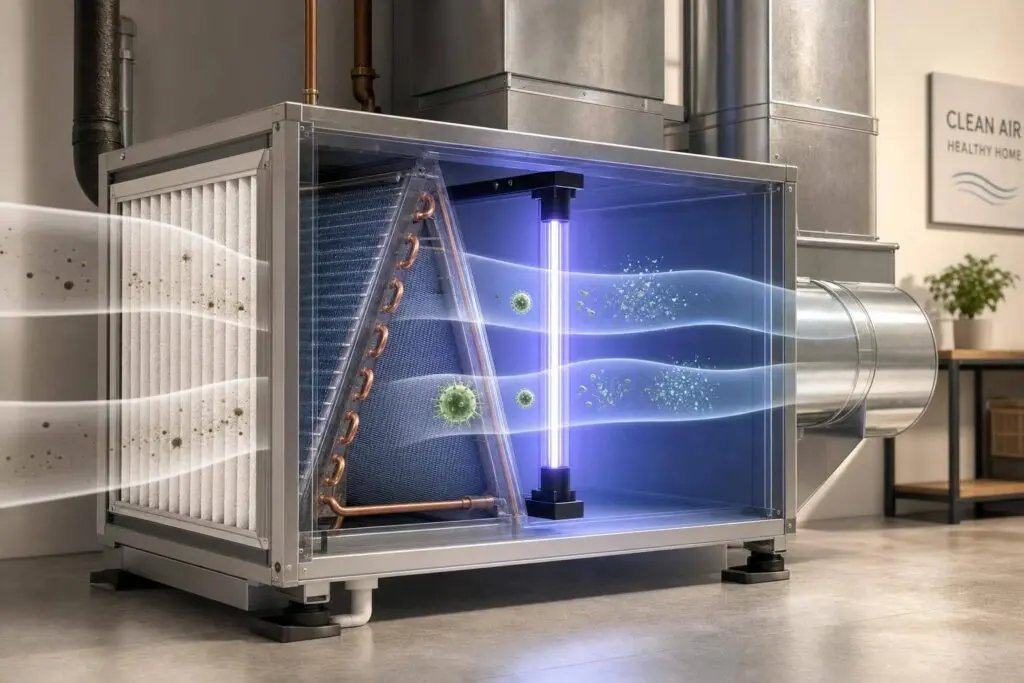
UV-C in an HVAC system can help control mold, bacteria, and some viruses – but it does not clean dust, pollen, smoke, or VOCs. In most systems, it uses 254 nm light inside the equipment to treat damp parts like coils and drain pans, or to expose moving air as it passes by.
If I were to boil this down for you, it’s this:
- UV-C is for germs, not particles
- It works only when air or surfaces get enough light
- Lamp placement, airflow, and runtime shape results
- It does not replace filters or ventilation
- Most lamps need replacement every 12–24 months
That last point matters. A lamp can still look “on” and still put out less germ-killing output than it should.
Here’s the simple version: if your main problem is musty buildup on coils, UV-C may help keep those parts cleaner. If your goal is air treatment, the setup has to match your airflow. And if you want help with allergies from dust or dander, UV-C alone won’t do that.
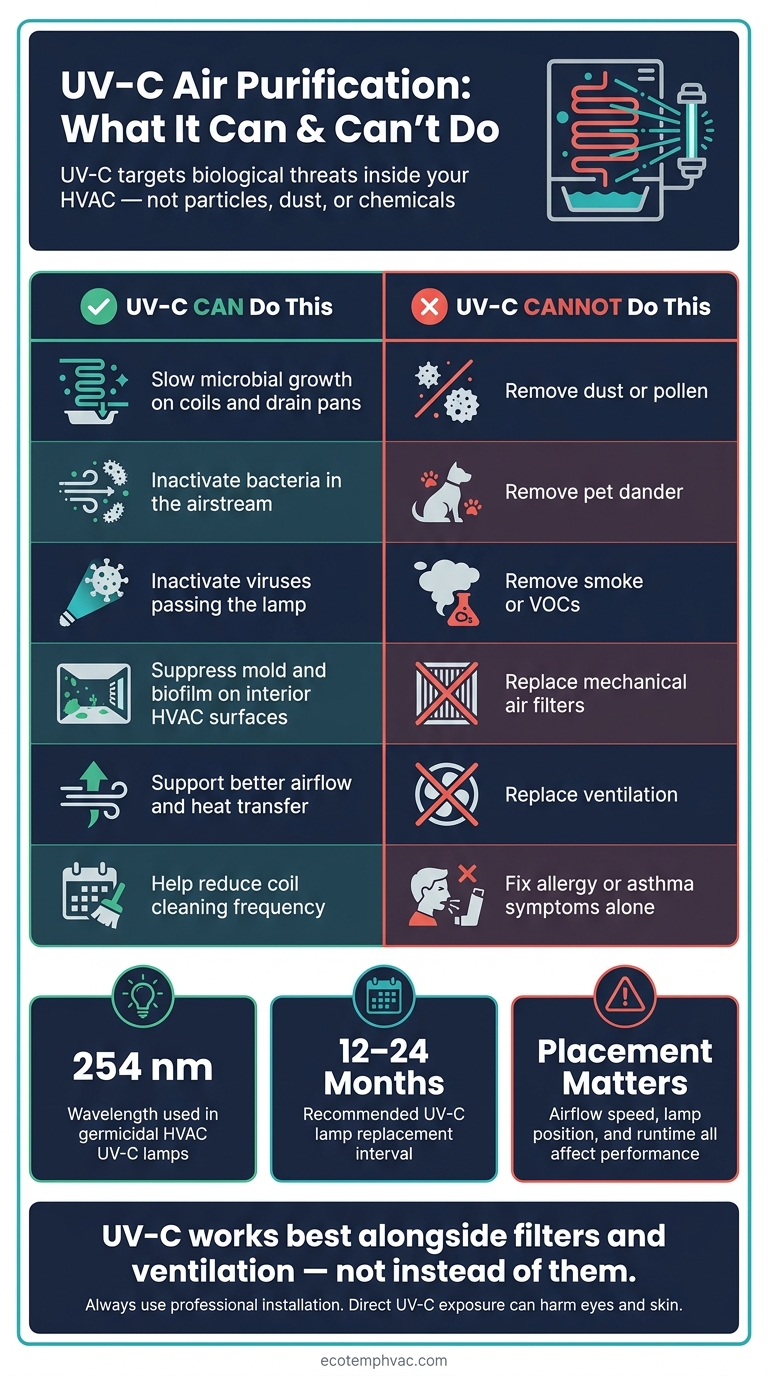
| What UV-C can do | What UV-C can’t do |
|---|---|
| Slow microbial growth on coils and drain pans | Remove dust or pollen |
| Inactivate some germs that pass the lamp | Remove pet dander |
| Help cut biofilm inside HVAC equipment | Remove smoke or VOCs |
In short, I’d look at UV-C as an add-on inside the HVAC system – not a stand-alone fix for indoor air quality problems.
UV-C Air Purification: What It Can and Can’t Do in Your HVAC System
HVAC Tip on UV Lights! (Location Matters!)
sbb-itb-b5c10b1
How UV-C Light Works on Airborne Germs
UV-C is the short-wave part of ultraviolet light. In HVAC systems, it is usually used at 254 nm. That wavelength sits close to the point where microbial DNA and RNA absorb UV energy most strongly. That’s why low-pressure mercury vapor lamps with that output have been a standard choice in germicidal HVAC use for decades.
Here’s the big idea: UV-C only works if the moving air gets enough exposure.
When a germ absorbs enough UV-C, its DNA or RNA is damaged, so it can’t reproduce. Once that happens, the microorganism is inactivated and can no longer infect.
What Happens as Air Moves Past a UV-C Lamp
Air comes in through the return ducts, moves through the part of the air handler or ductwork where the UV-C lamp is installed, gets exposed to UV-C, and then travels through the supply vents back into the building.
How much exposure the air gets depends on a few things:
- Lamp intensity
- Airflow speed
- Lamp placement
- Runtime
If the air moves too fast, exposure time drops. If the lamp is placed poorly, less of the airstream gets treated. In both cases, performance goes down.
What UV-C Can and Cannot Do
UV-C works on the biological side of air quality. That includes bacteria, viruses, and mold growth on coils and drain pans.
What it does not do is remove dust, pollen, pet dander, smoke, or chemical gases like volatile organic compounds (VOCs). Those need mechanical filtration or activated carbon media.
There’s one more point that matters. Even when UV-C inactivates mold spores, the spores still stay in the air as particles. They can still carry allergens. So UV-C by itself is not a dependable fix for allergy or asthma symptoms.
Its effect also depends on how much air passes close enough to the lamp. That’s why lamp placement inside the HVAC system matters so much.
| UV-C Helps | UV-C Does Not Help |
|---|---|
| Bacteria in the airstream | Dust and pollen particles |
| Viruses passing the lamp | Pet dander |
| Mold growth on coils and drain pans | Smoke and chemical gases (VOCs) |
| Biofilm on interior HVAC surfaces | General particle load in the air |
Where UV-C Lamps Are Installed in HVAC Systems
UV-C lamps are installed inside the HVAC cabinet or ductwork. Where they go matters, because placement decides whether the UV-C treats coil surfaces, moving air, or both.
Typical UV-C Lamp Locations in a Home Air Handler or Furnace
In homes, technicians usually go with one of two placement approaches.
The first is coil-and-pan placement. This setup targets cool, damp areas where mold and biofilm – slime-like microbial growth – often build up on metal fins, drain pans, and nearby surfaces.
For airstream treatment, the lamp goes in a straight duct run. That’s often in the supply plenum right after the coil or in a main trunk line. The goal is simple: put the lamp where air is well mixed, so it gets steady exposure as it moves past.
Common UV-C Lamp Placements in Small Commercial Units
Small commercial systems follow the same basic idea, just with larger equipment and more lamps. Bigger commercial coils often need multiple lamps or lamp arrays to cover the full coil face. That helps UV-C energy reach the whole cross-section instead of missing shaded areas. Installers may also add interlock switches that cut power when a service door opens.
| Location | Primary Purpose | Common In |
|---|---|---|
| Near evaporator coil and drain pan | Surface treatment – mold and biofilm control | Homes and small commercial units |
| Supply plenum or return duct | Airstream treatment – disinfecting moving air | Homes and small commercial units |
| Multi-lamp array across coil or duct | Wider coverage in larger systems | Small commercial RTUs and air handlers |
Once placement is clear, the next question is whether UV-C fits the system and HVAC installation or maintenance plan.
How to Decide If UV-C Is Right for Your Building
Not every HVAC system needs UV-C, and not every UV-C setup fixes the same issue. Before you install anything, look at three things: your goal, your system fit, and the service work the setup will need.
Step 1: Match UV-C to Your Main Goal
Once you know where UV-C can go, the next step is simple: match the setup to the problem you want to solve.
Most UV-C installs fall into one of three buckets, and each one calls for a different approach.
Coil and drain-pan treatment: Pick this if your main issue is musty smells or visible buildup on damp HVAC parts. A lamp mounted near the coil runs all the time and helps hold down biofilm and mold before they pile up. In many cases, this is the simplest and lowest-cost option.
Airstream disinfection: Pick this if your main goal is to cut down airborne germs in moving air, such as in offices, daycare centers, dental practices, or homes with people who are more sensitive to health issues. This setup places a lamp in the airstream and sizes it to deliver enough UV dose at your system’s airflow speed.
Broader indoor air quality support: If your concerns go beyond biological growth, UV-C is just one piece of the puzzle. A contractor can help line up UV-C, filtration, and ventilation with your building’s needs.
Step 2: Check System Space, Safety, and Maintenance Needs
After you define the goal, the next step is making sure the system can support the lamp safely.
The system needs enough straight, reachable space for proper lamp placement. For coil-surface setups, the lamp also needs a clear line of sight to the coil face, without filters, dampers, or other parts blocking it.
Safety comes first. Direct UV-C exposure can harm eyes and skin, so each lamp needs to run behind sealed, opaque access panels with proper gaskets. Service doors should have interlocks that shut the lamp off when the door opens. UV-C can also wear down nearby plastics, rubber, and wire insulation, so those parts may need shielding or a new position.
On the service side, plan for lamp replacement every 12–24 months. Even if the lamp still lights up, replace it on schedule.
Step 3: Have a qualified HVAC contractor Review the System
Lamp sizing, placement, wiring, and shielding should be handled by a qualified contractor. If a lamp is too small, it may not hit the dose target. If it’s placed poorly, it can damage parts inside the unit or create safety risks.
The system should also meet local mechanical and electrical code rules, including NEC wiring rules and permits where required.
A qualified contractor can tell you whether the system is a good fit before installation starts.
Benefits, Limits, and Key Takeaways
UV-C Benefits and Limitations Side by Side
Once you see where UV-C fits, the next step is pretty simple: look at the tradeoff. The table below puts the main upsides and limits next to each other.
| Benefit | Limitation |
|---|---|
| Keeps coils cleaner and suppresses biofilm and mold growth | Does not remove particles from the air |
| Supports better airflow and heat transfer | Performance depends on dose, airflow, lamp age, and placement |
| May reduce coil cleaning frequency over time | Requires regular lamp replacement |
| Helps reduce microbes in air and on surfaces | Does not replace filtration or ventilation |
| Can help maintain airflow and efficiency in fouled equipment | Requires proper containment and professional installation |
Conclusion: What Homeowners and Small Business Owners Should Remember
With those tradeoffs in mind, the big takeaway is straightforward. UV-C does its best work by keeping coils and internal surfaces cleaner. It is not an air filter.
That matters because a lot of people expect UV-C to do jobs it was never meant to do. It works best when the lamp has a clear line of sight, enough exposure time, and support from the rest of the system. In plain English, UV-C should sit alongside good filters, proper ventilation, and routine HVAC service, not stand in for them.
Safe setup matters too. The lamp should stay sealed inside the equipment, which is why professional installation is not optional.
For Chicagoland homes and small businesses, Eco Temp HVAC can review whether UV-C fits your system.
FAQs
How is UV-C different from an air filter?
UV-C light and air filters do different jobs in your HVAC system.
An air filter physically traps particles like dust, pollen, pet dander, and lint as air moves through it.
UV-C goes after microorganisms like mold, bacteria, and viruses by disrupting their DNA, which makes them inactive. But UV-C doesn’t catch debris, so you still need an air filter.
Will UV-C help with allergies or dust?
UV-C light doesn’t remove dust, pollen, or pet dander from the air. Those are physical particles, and your HVAC air filter or a dedicated air cleaner handles them.
What UV-C does is target biological contaminants like mold, bacteria, and viruses. It works by disrupting their DNA, which helps stop them from reproducing.
If your goal is better allergy relief, UV-C works best alongside high-efficiency filtration. Think of it this way: the filter traps the particles, and UV-C deals with the biological stuff.
How do I know if my HVAC system is a good fit?
Schedule a professional assessment with a qualified technician. UV-C lamps need to sit in the right spot, usually near the evaporator coil or inside the ductwork, so your HVAC system should be checked to make sure the setup will work as intended.
Eco Temp HVAC can assess your home’s needs and recommend the right UV light system while helping your equipment keep running reliably.