
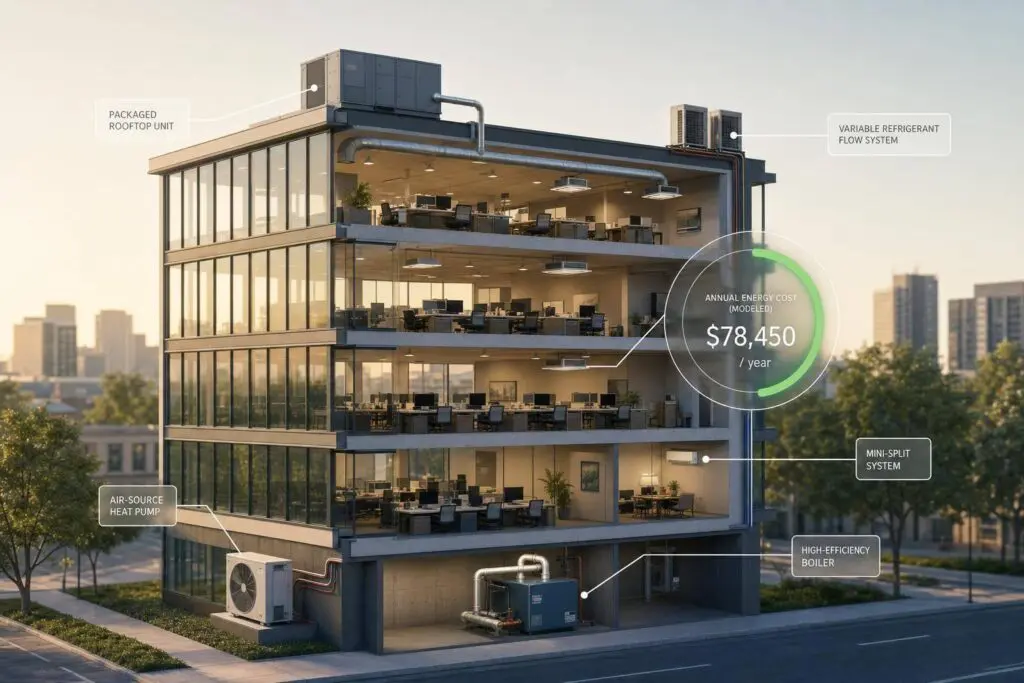
The short answer: LEED does not reward the HVAC system with the best label rating. It rewards the system that shows the lowest modeled annual energy cost against the Appendix G baseline.
If I had to boil this down fast, here’s what matters most:
- LEED points come from modeled cost savings, not equipment marketing specs
- The model runs 8,760 hours and tracks kWh, therms, peak kW, and utility cost
- RTUs often sit close to baseline, so savings can be modest unless controls are upgraded
- Boiler systems can lower electric demand, but they often add gas use and depend heavily on pump and water-reset inputs
- Heat pumps can cut heating cost in many cases, but cold-weather performance and backup heat settings matter a lot
- VRF often posts some of the lowest modeled energy use, especially in multi-zone buildings with uneven loads
- Mini-splits can do well in small-zone spaces by cutting duct losses, but they are less suited to large floor plates
- In many projects, climate, zoning, and commissioning shape the result as much as the equipment type
Put another way: the “best” LEED HVAC choice changes by building size, climate zone, utility rates, and zone layout. A gas system may win in one city and lose in another. A heat pump may look strong on paper, then slip if backup resistance heat runs too often. A VRF system may model well, but only if ventilation and controls match the design.
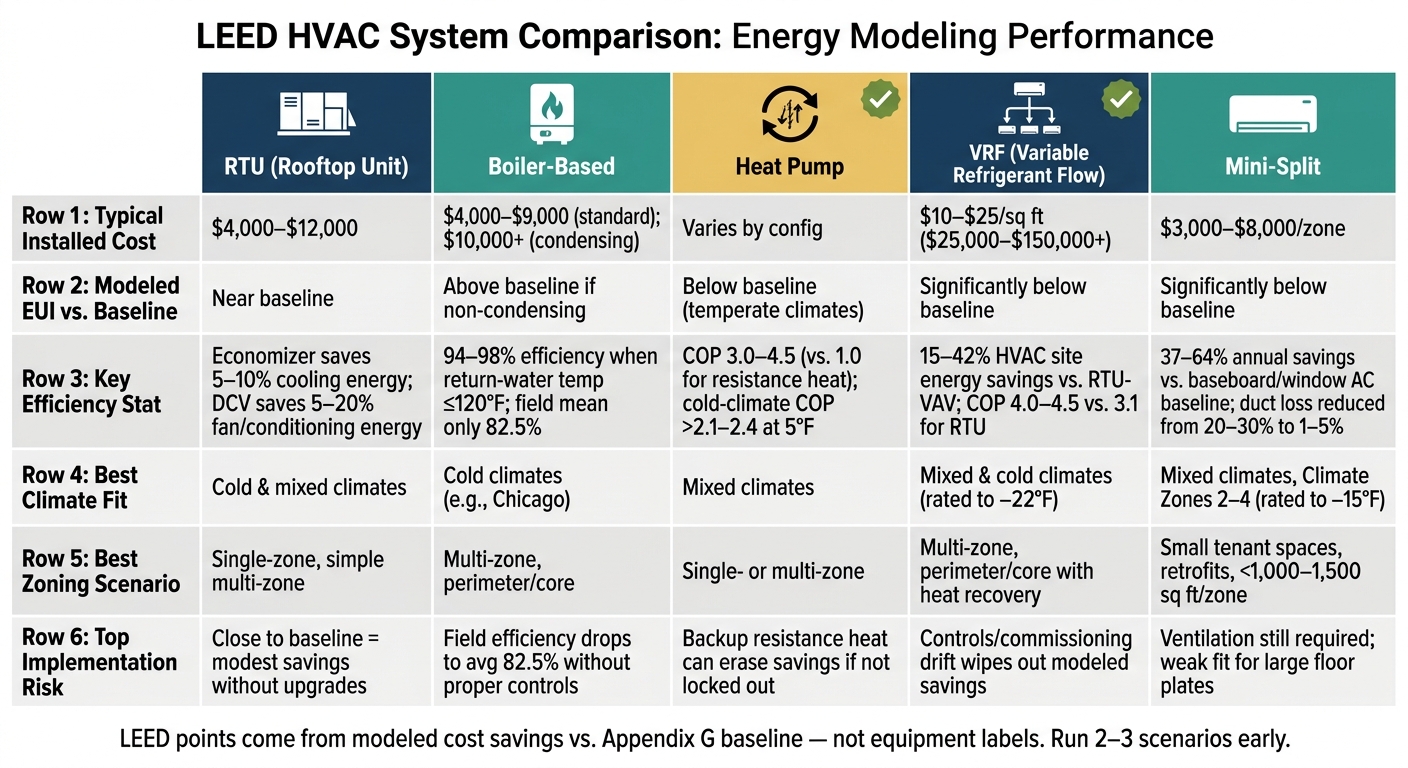
LEED HVAC System Comparison: Energy Modeling Performance by Type
Ep 161 LEED v5 Series: EAc3 – Enhanced Energy Efficiency

sbb-itb-b5c10b1
Quick comparison
| System | Where it often fits | Main modeling edge | Main risk in the model |
|---|---|---|---|
| RTU | Small open-plan retail or office | Economizer, DCV, fan control | Close to baseline, so savings can be small |
| Boiler-based | Cold-climate multi-zone spaces | Lower electric peak, lower heating cost in some cases | Pump energy, piping losses, weak condensing performance |
| Heat pump | Mixed climates, electrified buildings | Lower heating cost and no on-site combustion | Defrost, low-temp COP, and backup heat considerations |
| VRF | Multi-zone offices, clinics, tenant spaces | Part-load efficiency, heat recovery, zoning | Controls, ventilation tie-in, installation drift |
| Mini-split | Small suites, retrofits, room-by-room use | Low duct loss, zone shutoff | Supplemental heat, many indoor units, ventilation needs |
My main takeaway: if you want more LEED points, I’d test 2–3 HVAC scenarios early and compare modeled cost, first cost, and how likely the installed system is to match the model.
That frame makes the rest of the article much easier to read.
1. Packaged Rooftop Units (RTUs)
Packaged rooftop units are one of the most common HVAC picks for small commercial buildings in the U.S. In Appendix G, low-rise office and retail jobs often begin with an RTU baseline. That means if your proposed design also uses RTUs, it usually has to do more than just meet code to show strong savings.
LEED Baseline Alignment
Standard gas/electric RTUs often line up pretty closely with the baseline system. So if the design is baseline-compliant and nothing more, the modeled savings are usually modest.
The main ways to push the model in a better direction are pretty clear:
- High-efficiency units
- Variable-speed fans
- DCV
- Economizers
Those features matter because they affect both annual energy use and peak demand. That second part is easy to overlook, but it can make a big difference in the final result.
Modeled Energy and Demand
RTUs often land in the middle on annual energy use, but they can hit hard on peak electric demand. During peak cooling hours, compressor use, fan power, and reheat can all stack up at once. In the model, that demand spike usually stands out.
A few control moves can help trim both runtime energy and peak demand. Setbacks, economizer control, DCV, and staggered starts are the usual tools. Economizer operation alone can save 5–10% of annual cooling energy in many U.S. climates, and DCV can cut fan and conditioning energy by another 5–20%, depending on occupancy patterns.
How much improvement you get depends a lot on climate and zoning. Same RTU, different building, very different story.
Climate and Zoning Fit
RTUs tend to model best in open-plan, low-rise buildings with fairly even loads. They also do well in moderate and dry climates, where economizers can run often.
In hot-humid climates, things get tougher. RTUs can have a hard time with latent load control, may cycle in a less efficient way, or may lean on reheat to manage humidity. All of that pushes energy use up.
In cold climates, gas-fired RTUs can still pencil out well when gas prices are low. But in some models, cold-climate heat pumps and VRF come out ahead.
Buildings with many small zones, mixed uses, or different schedules are another weak spot. RTUs don’t offer fine-grained zoning, so adjacent spaces can end up heating and cooling at the same time. In LEED modeling, that penalty tends to show up fast.
Cost and Implementation Tradeoffs
After the model looks better, the next step is simple: does the extra cost make sense? Typical installed costs run from about $7,000 for small units to $60,000 for 10–25 ton systems.
High-efficiency RTUs with better controls often show a 3–7 year simple payback, especially when utility incentives are on the table. One field example is worth noting. A Publix review of a high-efficiency Trane Rebel RTU found a 3.8-year payback on about a $6,000 incremental cost. The unit showed 31% higher seasonal EER than the standard unit it replaced and avoided roughly 16,000 kWh per year.
For LEED modeling, the key point is simple: use NPV with local utility tariffs, not equipment ratings alone.
2. Boiler-Based HVAC Systems
Boiler-based systems are often modeled as the proposed design against an RTU baseline. So the LEED question changes a bit. It becomes less about heating efficiency by itself and more about heating cost, pump control, and distribution losses. A boiler only looks good if it cuts modeled cost. That’s why boilers make a useful contrast with RTUs: they often lower electric demand, but they do it by using more gas.
LEED Baseline Alignment
If the baseline is an RTU, boilers need to come out ahead through lower annual heating cost, tighter control, and lower distribution loss. Condensing gas boilers are the usual starting point. They often run at about 94% to 98% efficiency when return-water temperatures stay low, around 120°F or below.
ASHRAE 90.1 Appendix G puts baseline commercial gas boiler minimums at about 80% to 82% efficiency. That gives a well-specified condensing boiler a solid gap to model against.
Modeled Energy and Demand
Boilers move load from electricity to gas. In practice, that means they often cut electric peak demand more than annual site energy. But the model has to reflect the whole picture. If pump power, piping losses, and control sequences aren’t entered directly, the savings can disappear on paper.
Two inputs matter a lot here:
- Variable-speed pumps
- Outdoor air temperature reset on the hot water supply
Both can improve modeled results in a meaningful way. These tradeoffs show up most in cold and mixed climates, where heating hours last long enough for the boiler system to earn its keep.
Climate and Zoning Fit
Boiler systems tend to model best in cold and mixed climates, such as Chicago boilers, where heating hours are high and condensing operation can be maintained for much of the season. In that setup, a well-designed hydronic system with low return-water temperatures can stay in condensing mode on a steady basis and keep efficiency high.
They also fit well in multi-zone offices and clinics. Separate zone control paired with shared heating distribution can work well in those buildings. In hot climates with very little heating demand, though, the modeled savings usually don’t cover the added cost and system complexity.
Cost and Implementation Tradeoffs
Boiler replacement costs vary a lot, but condensing equipment and piping retrofits usually cost more up front than basic RTUs. The main problem isn’t the rated performance. It’s the gap between the model and what happens after startup.
Monitoring of in-service condensing boilers has found annual heat efficiencies from 68.6% to 89.7%, with a mean of only 82.5% – well below rated efficiency – when systems run at high temperatures or don’t have proper controls. That’s a big deal. A strong model can fall apart in the field if reset schedules, pump controls, and setback sequences aren’t commissioned the right way.
Next, compare that gas-heavy profile with all-electric heat pumps, which push the model in the other direction.
3. Electric Heat Pump Systems
Electric heat pumps move heat instead of making it. That simple difference matters a lot. In good conditions, they can deliver COPs of 3.0–4.5, compared with about 1.0 for resistance backup heat. But in LEED models, that edge only shows up when part-load behavior and backup heat are entered the right way.
LEED Baseline Alignment
In ASHRAE 90.1 Appendix G climate zones 3B through 8, the baseline uses fossil-fuel heating. So if the proposed design uses a heat pump, the model compares it against a gas-heated system. When the system is specified well, the result can be 8–20% lower energy cost, depending on climate and how the building loads swing through the year.
Modeled Energy and Demand
Modeled heat pump performance depends on a few inputs that are easy to gloss over but hard to ignore later:
- part-load curves
- defrost cycles
- backup heat
- fan power
Defrost cycles cut heating output for short periods, so the model needs to reflect that. Backup electric resistance heat can also become a problem fast. If it turns on too often, or if there’s no lockout temperature to hold it back, winter kWh and peak demand can climb enough to wipe out the savings the heat pump was meant to deliver.
Controls help tighten things up. Lockout temperatures for backup heat, demand-limiting, and supply-air temperature reset can add another 2–5% in modeled energy cost savings beyond equipment efficiency alone. In practice, these inputs are usually built in tools like EnergyPlus or eQUEST with manufacturer performance tables, not generic defaults.
Climate and Zoning Fit
Cold weather is where heat pump modeling stops being simple. Conventional air-source units can lose up to 60% of capacity and 50% of COP at −13°F compared with milder conditions. In Climate Zones 5–7, that’s a big deal.
That said, cold-climate heat pumps are a different story. Units with vapor injection and inverter-driven compressors have shown COPs above 2.1–2.4 at 5°F in DOE field studies. That’s more than double the efficiency of resistance heating at the same temperature. DOE‘s Cold Climate Heat Pump designation requires a COP of at least 1.75 at 5°F and at least 70% of rated heating capacity at 5°F compared to 47°F.
Zoning can make or break the model, especially in small commercial spaces. Perimeter offices, conference rooms, and core areas don’t behave the same way. They carry different load profiles, and heat pumps tend to model better when zoning matches that actual load diversity. Lump the whole floor into one zone, and the model will often miss part of the savings.
Cost and Implementation Tradeoffs
Lifecycle analyses in LEED documentation often show lower total cost of ownership over 15–20 years, especially in places where heat pump efficiency stays high for much of the year and electric rates stay moderate.
The main hurdles are electrical service capacity and commissioning. Cold-climate units and multi-zone layouts can call for panel or transformer upgrades. In Chicagoland, good sizing and careful commissioning help keep installed performance close to what the LEED model predicts.
If a project needs tighter zoning control, the next step is to compare VRF systems.
4. Variable Refrigerant Flow (VRF) Systems
VRF systems use inverter-driven compressors and modulating refrigerant flow to match output to the load in each zone. That zoning control is a big reason VRF stands apart from simpler heat-pump setups.
LEED Baseline Alignment
Under ASHRAE 90.1 Appendix G, VRF is modeled as the proposed design and compared against a conventional baseline system. In most cases, that baseline is packaged rooftop units with VAV or a boiler/chiller setup, based on the building type and climate. For LEED modeling, map the VRF design to the right Appendix G baseline system and clearly document the basis for ventilation, fan power, and heat-recovery assumptions.
Modeled Energy and Demand
A DOE simulation of a medium office prototype found that VRF systems cut HVAC site energy by 15% to 42% and HVAC source energy by 18% to 33% compared with RTU-VAV systems across 16 U.S. climate zones.
The part-load story is where VRF often pulls ahead. VRF cooling COP is about 4.0 to 4.5, versus about 3.1 for a standard rooftop unit at full load, and that gap gets larger as loads fall. In plain terms, VRF tends to do better when the building isn’t running flat out all day, which is most of the time.
Heat recovery is another big plus. If one zone needs cooling while another needs heat, a heat-recovery VRF system can move energy between those zones instead of dumping it outdoors. NREL‘s national ComStock analysis found that VRF with heat recovery and a Dedicated Outdoor Air System (DOAS) delivers about 16% total site energy savings, including 53% heating natural gas savings and 30% fan electricity savings across the U.S. commercial building stock. That edge is strongest in buildings where heating and cooling happen at the same time in different areas.
Climate and Zoning Fit
Modern cold-climate VRF units are rated to operate down to −22°F, which gives them a much broader range of use than many people assume. They’re no longer just a mild-climate option.
That said, the LEED modeling edge is usually strongest in mixed-humid, marine, and warm-humid regions, where simultaneous heating and cooling loads make heat recovery pay off the most. In colder regions, the model can still show net energy savings, but teams should plan for supplemental heat below the unit’s rated minimum operating temperature.
Cost and Implementation Tradeoffs
VRF usually comes with a higher first cost than a standard rooftop unit. Installed cost often falls between $15 and $25 per sq ft, while more complex heat-recovery layouts in multi-story buildings can reach $24 to $38 per sq ft.
And this is where projects can go sideways: the model only holds up if the installed system matches it. Layout, refrigerant charge, ventilation, and controls all need to line up with the design assumptions. If they don’t, the projected savings can fade fast.
Comparing ductless mini-splits vs. traditional central HVAC shows they use similar inverter control, but mini-splits offer less zoning depth and less heat-recovery potential.
5. Ductless Mini-Split Systems
Mini-splits use the same inverter-driven approach as VRF, but in a simpler setup. They pair inverter-driven heat pumps with individual zone control and no ductwork, which makes them a strong option for small commercial spaces that aren’t used all day.
LEED Baseline Alignment
For small nonresidential buildings under 25,000 sq ft and three stories, Appendix G usually sets a single-zone packaged system as the baseline. In the model, the mini-split goes on the proposed side. Baseline efficiencies, economizers, and fan rules stay the same.
That means the edge in the model usually comes from two things: less duct loss and better zone control.
Modeled Energy and Demand
The biggest modeling win is getting rid of ducts. The U.S. DOE has estimated that ducted commercial systems can lose 20% to 30% of heating and cooling energy through duct leakage and thermal losses. Ductless systems bring that down to about 1% to 5%.
That difference can add up fast. In a DOE/EERE study of six prototype buildings across three Northwest climate zones, ductless mini-splits were the most efficient option, with 37% to 64% annual savings versus an electric baseboard and window air-conditioner baseline.
There is a catch, though. In multi-zone commercial buildings, VRF usually models better than a basic mini-split layout. One office building study found VRF using about 74.6% of the mini-split system’s energy. So mini-splits tend to work best when the building has small, clearly defined zones with different schedules.
Climate and Zoning Fit
Mini-splits are a strong fit for Climate Zones 2–4 and mixed climates, where cooling plays a bigger role and duct loss removal has more impact. Modern cold-climate units can run down to −15°F, but output drops as outdoor temperatures fall. Because of that, the energy model should use manufacturer low-ambient performance data, not generic heat pump curves.
In upper Climate Zones 6–8, teams should expect some supplemental heat and make sure the selected equipment’s cold-weather performance is shown correctly in the model.
The best fits are spaces like:
- Small offices
- Retail bays
- Server closets
- Tenant suites
- Classroom spaces
In plain terms, mini-splits make the most sense in spaces under about 1,000–1,500 sq ft per zone with a clear occupancy schedule. They’re also a good match for renovations and tenant improvements because they avoid the mess and wall or roof penetrations that often come with new ductwork.
Cost and Implementation Tradeoffs
Installed cost usually falls between $3,000 and $8,000 per zone for small commercial applications. Multi-zone systems often land around $6,500 to $15,000+, depending on the layout and equipment mix.
The tradeoff is simple: mini-splits need more indoor units. So the math works best when a project can skip a lot of ductwork or fully shut off unused zones.
Installation quality matters more than many teams expect. Refrigerant charge, controls, and indoor-unit placement all need to match the model. If they don’t, savings can slip. So while mini-splits can look strong in the energy model, cost and install quality still determine how much of that shows up in day-to-day use.
Modeled Performance Tradeoffs by Evaluation Area
The tables below boil the earlier system-by-system review down to four LEED decision points. Instead of looking at each HVAC type in isolation, this section turns those details into practical selection criteria.
LEED Baseline Alignment
RTUs line up most closely with the baseline. That means their modeled savings usually come from better unit efficiency, stronger economizer performance, and tighter controls. Boiler systems drift farther from the baseline, so their results depend more on heating cost, pump energy, and losses through the distribution system. Electric heat pumps are a partial match to PSZ-HP baseline rules, but variable-speed compressors, defrost inputs, and backup heat choices still need close review.
VRF and ductless mini-splits sit farthest from the baseline. In the proposed design, they often use refrigerant-based zonal equipment paired with a DOAS, which creates separation in fan energy, reheat, and simultaneous heating/cooling behavior in the model.
| System | Baseline System Type | Main source of modeled advantage |
|---|---|---|
| RTU | Packaged single-zone DX baseline | Higher efficiency, better economizer, controls |
| Boiler-based | Packaged baseline; may shift to VAV or plant-based systems depending on building type | Fuel mix, part-load behavior, pump energy |
| Heat pump | PSZ-HP baseline (partial match) | Variable-speed operation, defrost, backup heat assumptions |
| VRF | Packaged or VAV baseline (significant divergence) | Fan energy, heat recovery, simultaneous heating/cooling |
| Mini-split | Packaged or VAV baseline (significant divergence) | Lower duct losses, zonal control, fan energy |
Modeled Energy and Demand
In LEED modeling, annual energy cost comes first. After that, peak kW and fuel mix start to shape the picture.
RTUs usually land close to baseline on annual energy use, but they can push peak kW up during cooling hours. Boiler-based systems move more load to gas therms, and total EUI can rise when boilers are non-condensing or controls are weak. In one office building study, a boiler/tower water-loop heat pump system reached a site EUI of 43 kBtu/ft²·year, while a VRF system in that same study came in at 31.4 kBtu/ft²·year.
Electric heat pumps can cut or remove therm use, which helps site EUI in temperate climates. Their variable-speed compressors also smooth out demand better than on/off RTUs. VRF and mini-splits tend to post the lowest modeled EUI, mostly because of strong part-load performance and less reheat.
| System | Main energy type | Typical EUI Direction vs. Baseline | Peak kW Driver |
|---|---|---|---|
| RTU | Electric + gas therms | Near baseline | Cooling load + constant-volume fans |
| Boiler-based | Gas therms dominant | Above baseline if non-condensing | Lower electric peak; gas demand rises |
| Heat pump | Electric | Below baseline in temperate climates | Cold-weather backup heat |
| VRF | Electric | Significantly below baseline | Modulated compressor; lower peak |
| Mini-split | Electric | Significantly below baseline | Distributed small fans; very low peak |
Climate and Zoning Fit
Climate can change the ranking more than system type by itself. Zoning fit matters almost as much.
In cold-humid Climate Zone 5A, RTUs handle winter conditions well with gas heat, but their limited modulation can push shoulder-season energy use higher. Boilers with condensing operation and low return-water temperatures can post strong seasonal performance, but that edge disappears fast with non-condensing units. Heat pumps need accurate low-temperature COP curves. Without manufacturer-specific data, the model can miss winter kWh by a wide margin in either direction. VRF systems with inverter-driven compressors often beat standard heat pumps in cold climates when modeled the right way, but defrost cycles and auxiliary heat have to be shown clearly.
Zoning adds another layer. RTUs fit best in single-zone or simple multi-zone layouts. Boiler-based VAV systems work well in larger multi-zone or perimeter/core buildings. Heat pumps can serve either single-tenant or multi-tenant layouts. VRF stands out in perimeter/core and multi-zone projects, where heat recovery between zones can pay off in the model. Mini-splits fit tenant spaces and retrofit work especially well, since adding new ductwork may be a headache or just not worth it.
| System | Best Climate Fit | Best Zoning Scenario | Cold-Climate Modeling Note |
|---|---|---|---|
| RTU | Cold and mixed climates | Single-zone, simple multi-zone | Reliable; limited modulation in shoulder seasons |
| Boiler-based | Cold climates | Multi-zone, perimeter/core | Condensing efficiency depends on return-water temperature |
| Heat pump | Mixed climates | Single- or multi-zone | Requires manufacturer low-ambient COP curves |
| VRF | Mixed and cold climates | Multi-zone, perimeter/core | Defrost and aux heat must be modeled explicitly |
| Mini-split | Mixed climates | Tenant spaces, small zones | Low-ambient data critical; may need supplemental heat in colder climates |
Cost and Implementation Tradeoffs
Upfront cost matters, but commissioning often decides whether modeled savings show up in the building once people move in.
RTUs usually have the lowest entry cost, at $4,000–$12,000 installed for small commercial jobs under 5,000 sq ft. Boiler systems often run $4,000–$9,000 for standard units and $10,000+ for high-efficiency condensing models. VRF and multi-split systems come with the highest first cost, usually around $10–$25 per sq ft, with bigger or more complex jobs reaching $25,000–$150,000 depending on zone count and controls.
This is where models can look great on paper and then fall flat in use. Weak controls or poor commissioning are common trouble spots, especially for VRF and mini-split systems. If the controls sequence, ventilation tie-in, or zoning setup drift from the model, the savings can disappear fast.
| System | Typical Installed Cost | Controls / Implementation Notes |
|---|---|---|
| RTU | $4,000–$12,000 | Lowest first cost; savings usually come from efficiency upgrades and controls |
| Boiler-based | $4,000–$9,000 standard; $10,000+ | Distribution, pumping, and water-temperature reset affect modeled performance |
| Heat pump | Varies by configuration | Low-temperature performance and backup heat assumptions need close modeling |
| VRF | $10–$25 per sq ft; $25,000–$150,000 for larger systems | Strong modeled savings, but controls and commissioning are critical |
| Mini-split | Pricing varies with layout and zone count | Good fit for small spaces and retrofits; no duct losses and strong zoning |
Use these tradeoffs to set project-fit recommendations in the next section.
Pros, Cons, and Best-Fit Recommendations
The tradeoffs above make more sense when you tie them to three simple things: project goals, budget, and execution risk. That’s where system choice gets practical. The tables below turn those modeled differences into day-to-day selection criteria for small commercial work.
Pros and cons by system type
The table below sums up the main decision factors for small commercial projects.
| System | Key Pros | Key Cons |
|---|---|---|
| RTU | Low first cost; often aligns with LEED baseline assumptions; familiar to most U.S. contractors | Limited modulation; lower seasonal efficiency than heat pumps or VRF; duct losses can add up |
| Boiler-based | Reliable in extreme cold; long equipment life; strong comfort with hydronic distribution | Higher gas use can weaken LEED cost and carbon outcomes; distribution losses increase if controls are weak |
| Heat pump | Zero on-site combustion; strong fit for electrification goals; efficient across heating and cooling seasons | Capacity can drop in extreme cold unless the unit is cold-climate rated; backup heat must be modeled carefully |
| VRF | High part-load efficiency; strong zoning; low duct losses; high savings potential | Highest first cost; requires specialized design and commissioning; refrigerant leak risk and controls complexity |
| Mini-split | Minimal installation disruption; ideal for retrofits and small zones; no duct losses | Visible indoor units; weak fit for large floor plates; separate ventilation still required |
On paper, every system has a case for it. In practice, the best option is usually the one that fits the building type, local weather, and budget without making installation harder than it needs to be.
Best fit by project scenario
| Project Scenario | Recommended System | Primary Reason |
|---|---|---|
| New construction, small owner-occupied office, cold climate (e.g., Chicagoland) | Cold-climate heat pump or VRF | Best for small offices with private zones and independent schedules |
| Retrofit of existing strip retail with an existing RTU curb and limited budget | High-efficiency RTU with economizer and DCV | Best when existing curb and budget limit major changes |
| Small medical clinic or professional services space with varied occupancy | VRF or ductless mini-splits with per-zone controls | Best for spaces with unoccupied rooms and variable schedules |
| Older building with existing hydronic infrastructure | High-efficiency condensing boiler with upgraded controls | Best when full system replacement is not feasible |
| LEED Gold or Platinum project | VRF or integrated heat pump with energy monitoring | Best combination of modeled savings, zoning flexibility, and carbon performance |
Chicagoland narrows the field a bit more. In this market, VRF and cold-climate heat pumps often make sense for small commercial buildings under 50,000 sq ft. Cold-climate heat pumps now perform well in sub-zero weather, which gives owners more all-electric options than they had even a few years ago.
When installation quality matters as much as the model
A polished energy model is one thing. What gets installed in the building is another. If those two drift apart, the savings on paper can disappear fast.
That’s a big deal for VRF and heat pumps, where commissioning can recover 5–15% in energy savings by finding installation issues and making sure control sequences run the way they were designed to run.
For these systems, field quality can matter just as much as rated efficiency. The gap gets biggest when the installed equipment, controls, or setup do not match the model assumptions. Eco Temp HVAC‘s Mitsubishi Diamond Elite Contractor, Navien Service Specialist, and American Standard Customer Care Dealer credentials support that level of installation and commissioning. That matters most for VRF, heat pumps, boilers, and mini-splits, where controls and commissioning have a major effect on how the system performs day to day.
Conclusion
Across RTUs, boilers, heat pumps, VRF, and mini-splits, the model rewards fit more than labels. LEED HVAC modeling compares each system against the code baseline, annual operating cost, and the on-site risk tied to installation and commissioning.
Key takeaways
The winner depends on baseline fit, annual energy and demand, climate, zoning, and installation quality. No system wins on name alone. The model rewards fit, controls, and solid execution. Poorly integrated ventilation can wipe out the efficiency edge of VRF or mini-split systems.
That’s why this choice should move into scenario testing early, not wait for a late-stage comparison.
Next step for owners and designers
Run two or three HVAC scenarios early, before schematic design locks in major decisions. Use the preliminary model to compare LEED score impact, operating cost, first cost, and constructability.
The right system is the one that performs best against the baseline, fits the climate and zoning plan, works with local utility rates, and can actually be built well. Early scenario testing turns that choice into a data-driven decision.
FAQs
How does LEED score HVAC systems?
LEED looks at HVAC systems mostly through the lens of energy use and whether the system meets rules such as ASHRAE 90.1 and the IECC. The exact score depends on the building type, how people use the space, and how much ventilation the building needs.
Projects can earn credits by going beyond ASHRAE fresh air targets and using smarter system design. That can include advanced zoning, variable-speed equipment, and high-efficiency layouts that cut energy use.
Which HVAC system usually models best for LEED?
For LEED-focused energy modeling in small commercial spaces, ductless VRF and mini-split systems often perform best in the model. The reason is pretty simple: they tend to deliver strong part-load efficiency, and they sidestep the energy loss that comes with duct leakage.
When a space needs fresh air, hybrid setups paired with ERVs can lead to the best energy performance. Eco Temp HVAC specializes in these advanced installations, including Mitsubishi VRF solutions.
Why can installed performance miss the model?
Installed HVAC performance can fall short of energy model projections for reasons that go well beyond the equipment rating itself. One of the biggest issues is improper installation. Poorly sealed ducts can reduce efficiency by as much as 30 percent, and incorrect sizing or poor placement can cause humidity problems and wasted energy.
Performance can also slip because of thermal losses in unconditioned spaces, weak commissioning that fails to hit design airflows, or skipped maintenance tasks like filter changes and burner cleanings.