
If you want the short answer: MERV 8 is the safe basic pick, MERV 11 is the middle-ground choice for many homes, and MERV 13 filters the most but can restrict airflow the most.
I’d choose based on two things:
- What you want to filter out: dust, pollen, pet dander, smoke, and fine particles
- What your HVAC system can handle: especially static pressure and filter depth when installing new furnaces
A higher MERV rating can help with smaller particles, but it can also cut airflow by 15% to 25% in some setups and may add 5% to 15% to energy use if the filter is too restrictive or clogged. That’s why the “best” filter is not always the one with the highest number.
What this comparison covers:
- MERV 8: lower resistance, basic home use
- MERV 11: more help with pets, allergies, and finer dust
- MERV 13: more filtration for smoke and fine particles, but more strain on the system
- Main trade-offs: particle size, airflow, filter life, and cost
- System fit: why 1-inch filters and 4-inch to 5-inch media cabinets can perform very differently
How to Choose the BEST Furnace Air Filter (MERV Ratings & More Explained)
Once you’ve chosen the right MERV rating, use our HVAC filter replacement planner to stay on top of your maintenance schedule.
sbb-itb-b5c10b1
Quick Comparison
| Filter | Best for | Particle range | Airflow impact | Common change interval | Typical cost |
|---|---|---|---|---|---|
| MERV 8 | Basic filtration | 3.0-10.0 microns | Low | 60-90 days | $5-$20 |
| MERV 11 | Pets, mild allergies, fine dust | 1.0-10.0 microns | Medium | 45-90 days | $10-$30 |
| MERV 13 | Smoke, smog, finer particles, sensitive occupants | 0.3-10.0 microns | High | 45-60 days | $15-$50+ |
My takeaway: if your system is standard and you just want solid day-to-day filtration, MERV 11 is often the sweet spot. If your system has tight airflow limits, MERV 8 may be the safer choice. If you need more particle removal, MERV 13 can make sense only if your equipment can support it.
Once you choose the right rating, you’ll need to change your HVAC filter correctly to maintain performance. Here’s the side-by-side breakdown.
How MERV Ratings Work in HVAC Systems
For homes and small commercial buildings, MERV 5 through MERV 13 covers most day-to-day needs.
The rating shows how well a filter traps particles across different size ranges. As the rating goes up, the filter can catch smaller stuff, from pollen and dust to smoke and other fine particulates. But there’s a catch: to trap more, the filter media has to be denser. And denser media slows airflow.
Particle Size, Filtration, and Airflow Trade-Offs
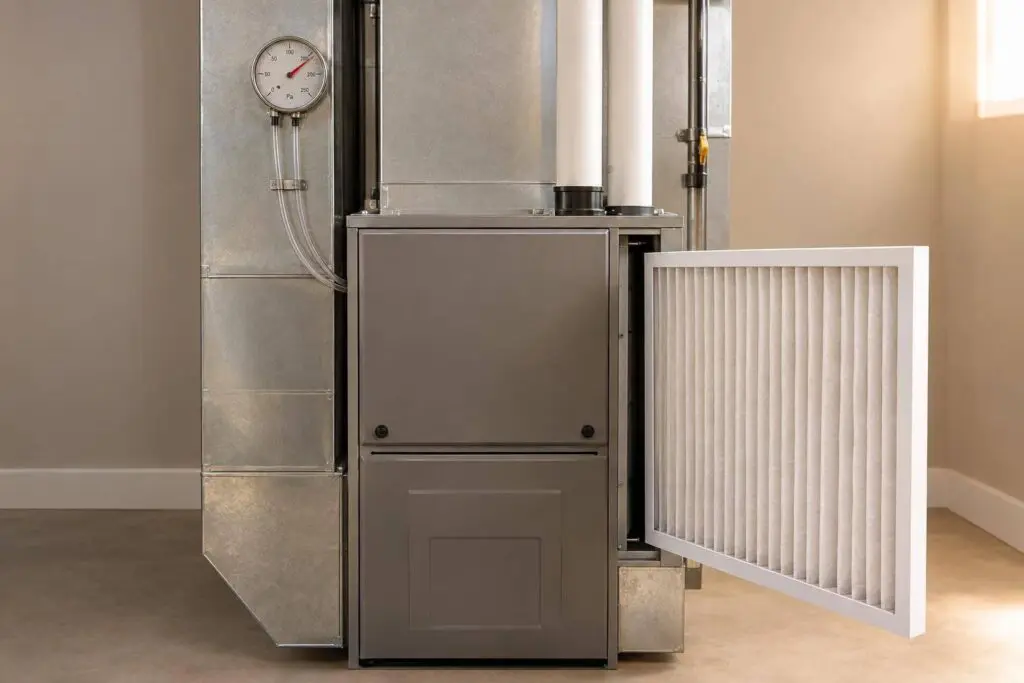
The big trade-off is airflow. Static pressure is the resistance your blower has to push against. Most residential forced-air systems are built to stay below 0.50 inches of water column (in. w.c.) of total external static pressure. A new 1-inch MERV 13 filter can eat up a big chunk of that pressure budget on day one.
When a filter adds too much resistance, the problem isn’t just a higher power bill. Restricted airflow can freeze the evaporator coil in summer or overheat the heat exchanger in winter. Older fixed-speed motors – common in systems installed before 2012 – usually can’t make up for that extra resistance. Newer variable-speed blowers can ramp up to hold airflow steady, but that added effort means more energy use and more wear on moving parts.
Filter depth also plays a big role. A 4-inch deep media filter usually has about 30–40 sq ft of surface area, while a standard 1-inch pleated filter has only 3–5 sq ft. More depth changes how much resistance a given MERV rating creates. In plain English, deeper media cabinets lower resistance and make higher-MERV filters easier for a system to handle.
These trade-offs stand out even more in a side-by-side look. With those airflow limits in mind, the next section compares MERV 8, MERV 11, and MERV 13 directly.
MERV 8 vs MERV 11 vs MERV 13: Side-by-Side Comparison
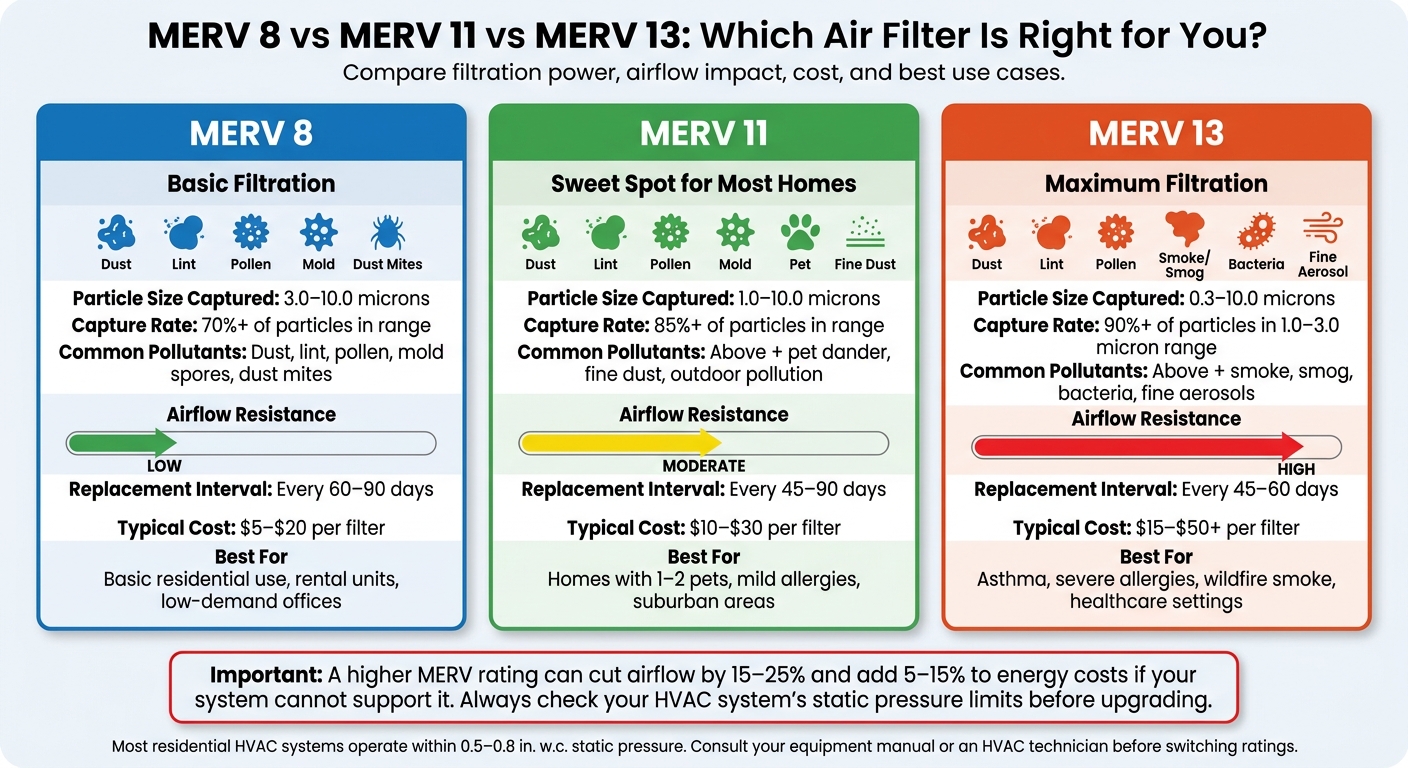
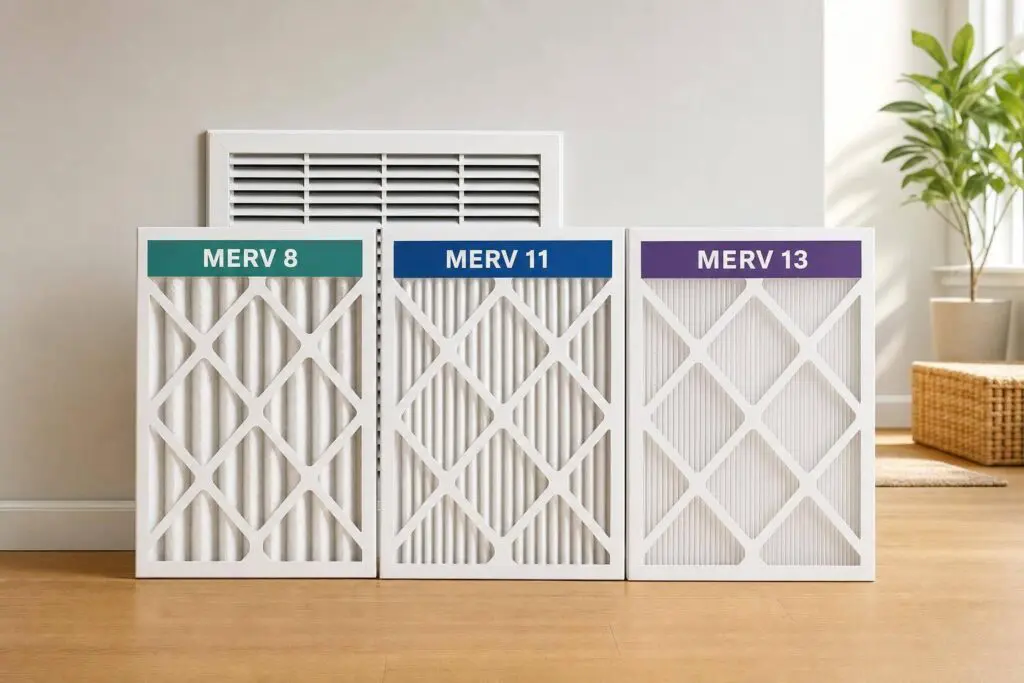
MERV 8 vs MERV 11 vs MERV 13 Filter Comparison Chart
These three ratings cover what most U.S. homes and small businesses need. As you move up from MERV 8 to MERV 13, the filter catches smaller particles, but it also puts more resistance on your HVAC system. That trade-off matters.
MERV 8: Basic Filtration With Low Airflow Resistance
MERV 8 is a common starting point for residential and light commercial systems. It captures at least 70% of particles in the 3.0–10.0 micron range.
Its big selling point is low airflow resistance. If your home has average dust levels, a 1-inch MERV 8 filter will often last 60–90 days before it needs to be replaced or you require AC repair. If you have pets or live in a high-pollen area, it makes sense to check it every month and plan on changing it every 30–45 days.
MERV 11: Better Filtration for Pets, Allergies, and Finer Dust
MERV 11 sits in the middle. It captures at least 85% of particles in the 3.0–10.0 micron range and also offers moderate efficiency for particles in the 1.0–3.0 micron range.
That extra step matters in day-to-day life. It helps with pet dander and fine dust, which is why many homes with pets or mild seasonal allergies land here. MERV 11 tends to give you a solid balance between cleaner air and acceptable airflow. Most 1-inch filters in this range need replacement every 45–90 days, based on how much dust, pollen, or pet dander is floating around.
MERV 13: Higher Filtration for Smoke, Fine Allergens, and Sensitive Occupants
MERV 13 is the strongest option in this group. It delivers 90%+ capture in the 1.0–3.0 micron range and can trap sub-micron particles as small as 0.3 microns.
That makes it a better fit for smoke, smog, and other fine airborne particles. It can also make sense for sensitive occupants or spaces with stricter indoor air needs. This is particularly relevant for maintaining safety during health crises like COVID-19. The downside is higher resistance. Compared with MERV 8, MERV 13 can cut airflow by 15% to 25%. In older systems, that added restriction can be a problem. If your HVAC equipment isn’t built to handle the extra static pressure, moving to MERV 13 may put too much strain on the system.
| MERV 8 | MERV 11 | MERV 13 | |
|---|---|---|---|
| Best-captured particle sizes | 3.0–10.0 microns | 1.0–10.0 microns | 0.3–10.0 microns |
| Common pollutants captured | Dust, lint, pollen, mold spores, dust mites | Above + pet dander, fine dust, outdoor pollution | Above + smoke, smog, bacteria, fine aerosols |
| Airflow impact | Low resistance | Moderate resistance | High resistance |
| Replacement interval | 60–90 days | 45–90 days | 45–60 days |
| Typical 1-inch filter cost | $5–$20 | $10–$30 | $15–$50+ |
Next, match the rating to your HVAC system’s static pressure limits and your indoor air needs.
How to Choose the Right Filter for Your Home or Small Business
The right MERV rating comes down to two things: what kind of air you want and what your HVAC system can handle.
Check Your HVAC System’s Static Pressure Limits Before Upgrading
Once you know what each MERV rating does, the next step is simple: make sure your system can move air through that filter without getting bogged down.
Start with the equipment manual or the air handler label. That should show the highest filter rating approved for the system. Most residential HVAC systems run within a static pressure range of 0.5 to 0.8 in. w.c., and going past that range can cut heating and cooling capacity by up to 15%.
Not sure where your system stands? A technician can provide professional HVAC services to check external static pressure with a manometer. If the reading is above 0.8 in. w.c., that usually points to too much restriction.
When a filter is too restrictive, airflow drops. Then run times get longer, and comfort starts to slip. This is why a 1-inch MERV 13 filter is often too restrictive for standard systems. A 4-inch or 5-inch media cabinet can help lower resistance.
Match Your Filter to Allergies, Pets, Smoke, and Daily Use
After you know the filter won’t put extra strain on the system, pick the rating that fits the space and the people in it.
MERV 8 works well for basic residential use, rental units, and low-demand offices.
MERV 11 is a solid step up for homes with 1–2 pets, people with mild allergies, or properties in high-traffic suburban areas.
MERV 13 makes more sense for occupants with asthma, severe allergies, or exposure to wildfire smoke and urban pollution. It’s also a fit for high-occupancy commercial and healthcare settings.
| Situation | Recommended Rating |
|---|---|
| Basic residential use, rental units, low-demand offices | MERV 8 |
| Homes with 1–2 pets or mild allergies | MERV 11 |
| Asthma, severe allergies, wildfire smoke, or urban pollution | MERV 13 |
| High-occupancy commercial or healthcare spaces | MERV 13 |
Conclusion: Which MERV Rating Is Right for You
Once you compare filtration with airflow, the best filter comes down to two things: what your HVAC system can handle and what your indoor air needs look like.
MERV 8 works well for basic filtration. MERV 11 is a good fit for many homes, especially if you have pets or mild allergies. MERV 13 gives you stronger filtration, but it only makes sense if your system can support it without airflow problems.
One thing people often miss: a higher MERV rating doesn’t just trap more particles. It can also clog faster. That’s why it’s smart to check MERV 11 and MERV 13 filters every 30–45 days.
When to Call Eco Temp HVAC

If you need a filter check or want to see whether your system has enough airflow for a higher-rated filter, Eco Temp HVAC can help. If you’re not sure which MERV rating makes sense for your setup, Eco Temp HVAC serves Chicagoland homes and businesses with HVAC and indoor air quality solutions.
FAQs
How do I know if my HVAC system can handle MERV 13?
Check whether your HVAC system can handle the added airflow resistance of a MERV 13 filter without extra strain. Start with your furnace manual and look for the maximum rated static pressure. For many residential units, that number is often 0.5 inches of water column.
Some systems have a harder time with this than others. Units that are about 10 to 15 years old, or systems with small return ductwork, may struggle to move enough air.
After you install the filter, pay attention to signs that something’s off, such as:
- Weaker airflow
- Longer run times
- Unusual noises
If you’re not sure whether your system is a good match, have a technician check compatibility.
Is MERV 11 the best choice for most homes?
Often, yes. A MERV 11 filter hits a solid middle ground for many homes. It does a better job than MERV 8 at filtering pet dander, mold spores, and pollen, without the higher airflow resistance often tied to MERV 13.
That makes it a good fit for homes with pets or mild allergies. Still, the best pick comes down to one thing: whether your HVAC system can keep proper airflow with that filter in place.
Does a higher MERV rating raise energy bills?
Yes, it can. Higher MERV filters are denser, so they can restrict airflow and make your HVAC system work harder.
That extra strain can lead to:
- Longer run times
- Lower efficiency
- Higher energy use
For the best balance between air quality and HVAC performance, choose a filter your system is built to handle. Eco Temp HVAC can help you pick the right one.