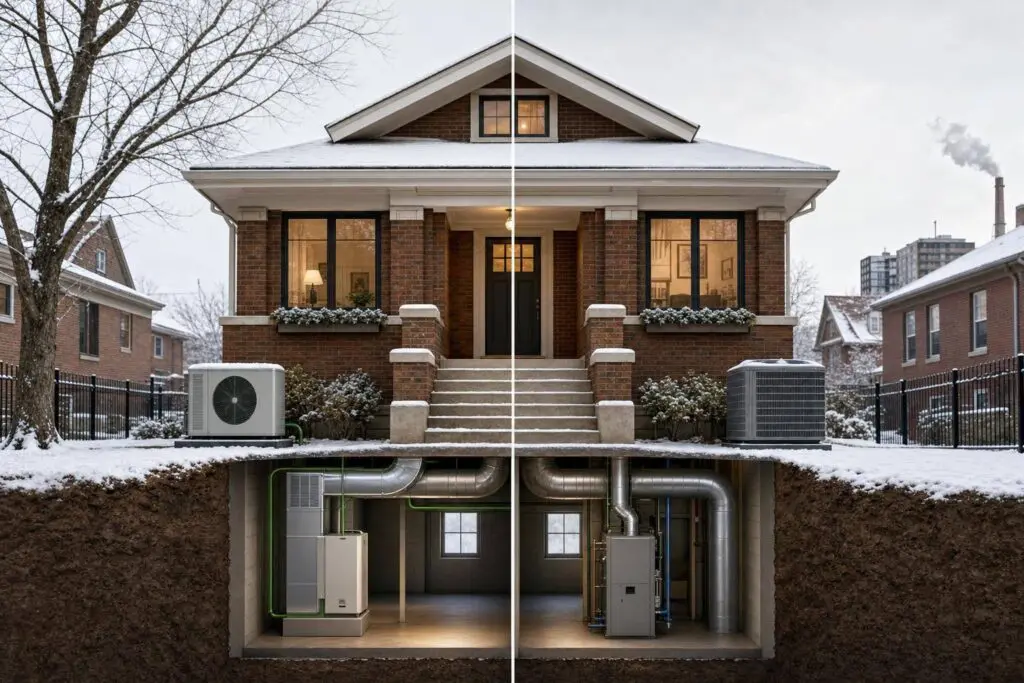

Air conditioning systems often waste energy due to leaks, poor insulation, and inefficient operation. These issues not only increase your energy bills but also wear down your AC faster. Here’s how you can cut energy loss, save money, and keep your home comfortable:
- Set Thermostat Smartly: Use energy-efficient settings (78°F when home, 82–85°F when away) and consider smart thermostats to save up to 10% annually.
- Upgrade Insulation: Proper insulation reduces AC workload, with attic upgrades saving $200–$400 yearly.
- Seal Air Leaks: Caulk, weatherstripping, and foam gaskets can cut 10–15% of energy waste.
- Fix Duct Leaks: Sealing and insulating ducts can prevent 25–40% of cooling energy loss.
- Maintain Your AC: Regular tune-ups and filter changes save up to 15% on cooling costs.
- Block Solar Heat: Use shades, awnings, or window films to reduce heat gain by up to 60%.
- Use Fans Wisely: Ceiling fans let you raise the thermostat by 4°F, cutting energy use by 20–28%.
- Reduce Internal Heat: Switch to LED bulbs, unplug unused devices, and limit appliance use during the day.
- Upgrade Your AC: Modern high-efficiency systems can save 20–30% more energy.
- Add Zoning Systems: Cool only the rooms you use, reducing energy costs by up to 30%.
Quick Tip: Regular maintenance is key – simple steps like changing filters and sealing leaks prevent up to 5% efficiency loss each year. These strategies, when combined, can significantly lower your cooling bills while extending the life of your AC system.
Slash Your Heating / Energy Bill By Doing These Tricks
sbb-itb-b5c10b1
1. Optimize Thermostat Settings and Use Smart Controls
Adjusting your thermostat settings is one of the simplest ways to cut back on wasted AC energy. The U.S. Department of Energy suggests setting your AC to 78°F when you’re home and bumping it up to 82–85°F when you’re away. These small changes can save you up to 10% annually on cooling costs. And here’s a helpful tip: every degree above 72°F can lower your cooling bill by 3–5%. For example, moving from a constant 72°F to 78°F could slash cooling energy use by 18–30%, depending on factors like insulation and climate.
One common myth is that setting the thermostat lower cools your home faster. It doesn’t. Your AC works at the same pace no matter the temperature setting. Lowering it unnecessarily just makes the system run longer, wasting energy.
"A 7–10°F setback for about 8 hours a day can save around 10% annually on heating and cooling." – U.S. Department of Energy
Make Use of Smart Thermostats
Smart thermostats can make temperature management easier and more efficient. Models like the Nest Learning Thermostat (4th gen, ~$230) and the Ecobee Smart Thermostat Premium (~$250) use features like learning algorithms, geofencing, and occupancy sensors to automatically adjust temperatures based on your habits. They also have Smart Recovery, which pre-cools your home so it reaches the desired temperature on schedule, avoiding energy spikes from sudden cooling. For many households, these systems can save between $80 and $130 annually.
To ensure accurate temperature readings, place your thermostat away from direct sunlight, heat sources, or drafts. Most smart thermostats also require a C-wire (common wire) to maintain a stable 24V power supply. Without it, Wi-Fi connectivity may be unreliable. If you’re uncertain about your setup, a professional HVAC technician, like those at Eco Temp HVAC, can help with installation and compatibility checks.
Quick Reference Guide for Thermostat Settings
| Scenario | Recommended Setting | Energy Impact |
|---|---|---|
| Home & Awake | 78°F | Baseline efficiency |
| Away (8+ hours) | 82–85°F | ~10% annual savings |
| Sleeping (with fans) | 76–78°F | Balanced comfort and cost |
| Peak Utility Hours (TOU plan) | 82°F+ | Avoids high-rate charges |
2. Improve Home and Building Insulation
Insulation is a key player in cutting down on AC energy loss. Without proper insulation, your AC has to work overtime as heat seeps in through walls, ceilings, and floors. Often, just keeping the cool air inside can make a big difference.
The EPA states that air sealing and insulation together can lower heating and cooling costs by 15% on average. For older homes or those in extreme climates, the savings can jump to 30% to 45%. And the best part? These savings don’t require any changes to your AC system.
Here’s the golden rule: seal before you insulate. If you insulate without addressing gaps, air leaks will still let energy escape. Air leaks alone are responsible for 25% to 40% of a typical home’s heating and cooling energy use. Sealing gaps around pipes, wires, and attic hatches ensures that every dollar spent on insulation pulls its weight.
Focus on the Attic
The attic is the top priority for insulation upgrades. It absorbs the most solar heat, making it the best place to start for quick returns. For Illinois, which is in Climate Zone 5, the Department of Energy recommends an attic R-value between R-38 and R-60. Upgrading attic insulation from R-19 to R-49 can save homeowners $200–$400 per year, with a payback period of just 2–4 years for a DIY project costing $500–$1,200.
Comparing Insulation Options
Here’s a quick breakdown of common insulation materials:
| Material | R-Value Per Inch | Best Used For | Typical Cost |
|---|---|---|---|
| Fiberglass batts | R-3.0 to R-4.3 | Attics, walls, floors | $0.40–$0.70/sq ft |
| Blown-in cellulose | R-3.2 to R-3.8 | Attics, enclosed walls | $0.60–$1.00/sq ft |
| Rigid foam (XPS) | R-5.0 | Basements, exterior walls | $0.75–$1.50/sq ft |
| Closed-cell spray foam | R-6.0 to R-6.5 | Rim joists, crawlspaces | $1.50–$4.50/sq ft |
Closed-cell spray foam stands out because it doubles as an air and vapor barrier, reducing HVAC energy use by an additional 10–15%. For those on a tighter budget, blown-in cellulose is an affordable option that works well in attics and irregular spaces.
Looking ahead, the Home Efficiency Rebates (HOMES) program, launching in 2026, could help offset insulation costs. Depending on your income and the energy savings achieved, rebates could range from $4,000 to $8,000.
3. Seal Air Leaks in the Building Envelope
Insulation is key to keeping cool air inside, but sealing air leaks is just as important for preventing energy loss. Even with great insulation, cooled air can escape through unnoticed gaps, making your AC work harder than necessary. These leaks can occur around window frames, door thresholds, electrical outlets, and baseboards – essentially, anywhere there’s a crack or gap. Without addressing these, your system ends up running longer and consuming more energy.
Even small leaks can lead to inefficient operation. Sealing these gaps reduces the strain on your AC, which means shorter run times, less wear on the compressor, and, ultimately, lower energy bills.
"Caulking and weatherstripping are two simple and effective air-sealing techniques that offer quick returns on investment, often one year or less." – Department of Energy
If you’re tackling this as a DIY project, materials like caulk and weatherstripping typically cost between $50 and $100. For professional sealing, expect to spend around $1,000–$2,500, but the payback period is relatively short.
To get the most out of your efforts, it’s essential to use the right materials for each type of leak. Here’s a quick guide:
| Leak Location | Recommended Sealing Material |
|---|---|
| Window and door frames | Caulk |
| Operable windows and doors | Weatherstripping |
| Electrical outlets and switch plates | Foam gaskets |
| Large gaps around baseboards or plumbing | Low-expansion spray foam |
| Ductwork seams and joints | Mastic sealant or UL-181 foil tape |
| Chimney and flue areas | Fire-resistant caulk or sheet metal |
For example, foam gaskets are ideal for sealing electrical outlets on exterior walls, where air can travel through wall cavities. And don’t forget your fireplace – keeping the damper tightly closed when not in use prevents cooled air from escaping through the flue.
If you’re testing for leaks on your own, safety is crucial. A DIY depressurization test, like running exhaust fans with all windows closed, can help you identify problem areas. However, make sure to turn off fuel-fired appliances like water heaters or space heaters during the test to avoid backdrafting combustion gases.
For professional sealing services and efficiency upgrades in the Chicagoland area, check out Eco Temp HVAC.
4. Seal and Insulate Ductwork
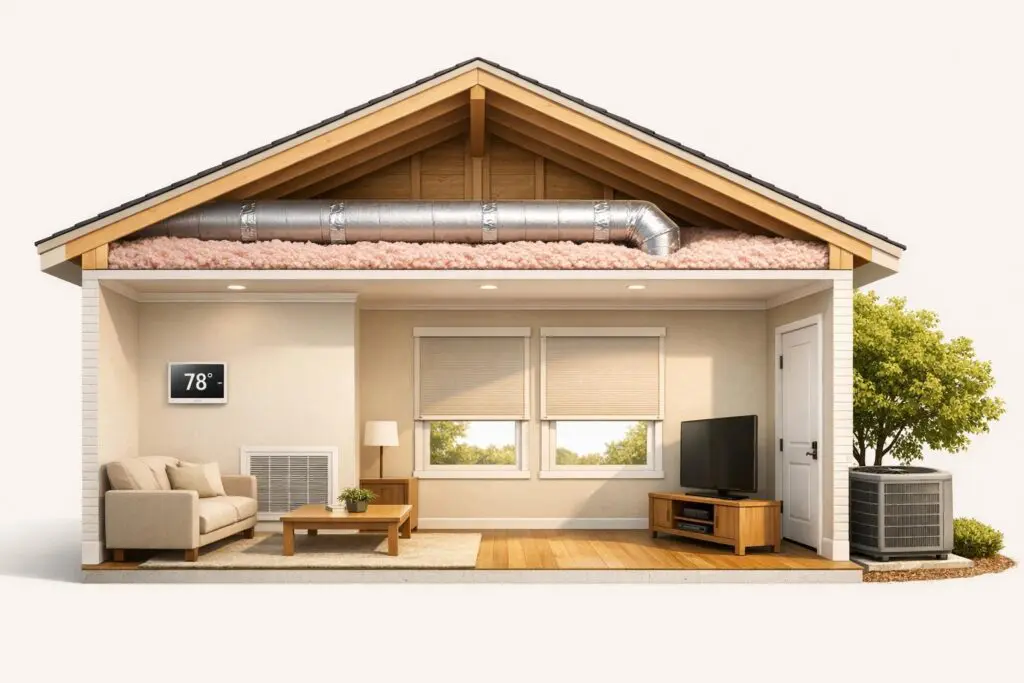
Fixing duct leaks is a key step in improving your AC’s efficiency. Even if your AC is running perfectly, duct leaks can waste 25–40% of cooling energy. That’s a big chunk of your cooling budget literally slipping away.
Duct leaks don’t just waste cool air – they pull in hot, humid air from outside. This is especially true for return duct leaks, which often draw unconditioned air from places like attics, crawlspaces, or garages. The result? Your AC has to work harder to keep things cool.
"Duct leakage is a double hit on the utility bill: 1) duct leaks are an uncontrolled loss of conditioned air to the outdoors and 2) duct leakage drives building infiltration." – Building America Solution Center
To properly seal ducts, it’s important to use the right materials. Forget traditional duct tape – it’s not up to the job. Instead, go for UL-181 rated mastic sealant or foil-backed acrylic tape. For metal joints, start with fiberglass mesh tape, then apply a layer of mastic. Once sealed, insulate ducts in unconditioned spaces like attics or crawlspaces. Aim for at least R-8 insulation for supply ducts and R-6 for return ducts. Always seal leaks before insulating to avoid covering up hidden problems.
Not sure if you have duct issues? Look for clues like warm rooms even when the AC runs, dusty air near vents, or whistling sounds from your system. For a precise diagnosis, a professional duct blaster test can locate hidden leaks. Ideally, your duct system should have a leakage rate of 10% or less. Professional duct sealing services typically cost about $0.40 per square foot of floor space, and many utility companies offer rebates to help with the cost.
For expert duct sealing and insulation in the Chicagoland area, reach out to Eco Temp HVAC. Tackling ductwork issues not only reduces energy loss but also enhances the effectiveness of other energy-saving measures.
5. Keep Up With Regular AC Maintenance
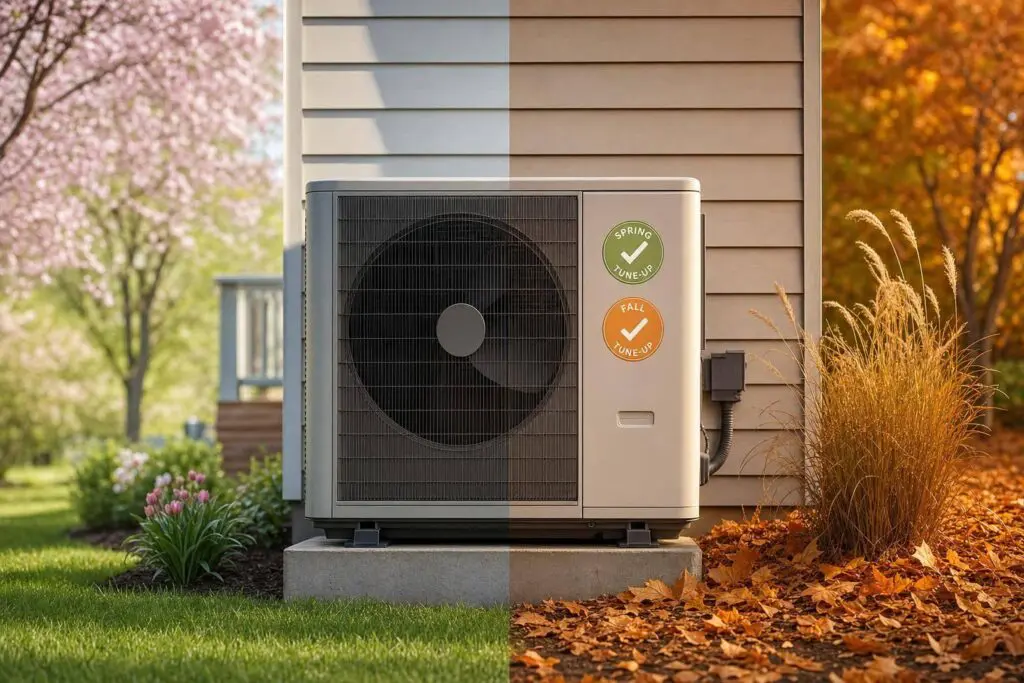
Think of an AC tune-up like an oil change for your car – it keeps everything running smoothly and prevents minor issues from turning into expensive repairs. As Eco Temp HVAC explains, "A furnace or AC tune-up is basically the ‘oil change’ your system needs to run efficiently". Without routine maintenance, your AC could lose up to 5% of its efficiency each year, which means higher energy bills over time.
Start with the basics: check your air filter every 30 days. Swapping out clogged filters can cut energy use by 5–15%. For most homes, a 1-inch filter replaced every 1–3 months works well. However, if you have pets or deal with a lot of dust, you may need to change them more often. Filters with a MERV rating of 8–11 are a good choice because they balance airflow and filtration quality.
Dirty coils are another efficiency killer. When coils get clogged with dirt, they can’t transfer heat properly, forcing your system to work harder. While you can rinse outdoor coils with a garden hose to clear surface debris, a professional cleaning during an annual tune-up is more thorough. Similarly, pouring a cup of white vinegar down the condensate drain line once a month can help prevent algae buildup and clogs. These simple DIY tasks keep your system running better, but professional maintenance ensures every part is checked and optimized.
A professional AC tune-up, typically costing $79–$200, includes checking refrigerant levels, tightening electrical connections, lubricating moving parts, and calibrating the thermostat. Scheduling this service in early spring – before the summer rush – ensures your system is ready when temperatures rise. Plus, many manufacturers require annual maintenance to keep warranties valid.
If you’re in Chicagoland, Eco Temp HVAC offers maintenance plans starting at $19.95 per month (billed annually). These plans come with perks like priority scheduling, discounted diagnostic fees, and 10% off repairs. Regular maintenance doesn’t just prolong your system’s lifespan – it can also save up to 15% on monthly cooling costs. It’s a practical way to keep your home comfortable while cutting down on energy expenses.
6. Block Solar Heat Gain Through Windows
Windows can be a major culprit when it comes to air conditioning energy loss. According to the U.S. Department of Energy, around 76% of sunlight hitting standard double-pane windows turns into heat inside your home. This solar heat gain contributes to 25–30% of heating and cooling energy use in buildings, making windows a prime target for reducing your AC’s workload.
Reducing solar heat gain is just as important as sealing leaks or insulating ducts when it comes to improving energy efficiency. The key is to stop the heat before it enters your home. Exterior options like awnings, solar screens, and shutters are the most effective at blocking heat. Interior solutions, such as cellular shades, can cut heat gain by up to 60%. As h2x Engineering explains:
"By the time the solar radiation has passed through the glass, most of the heat is already inside the building. External shading is always more effective [than internal blinds]."
If external shading isn’t feasible, interior treatments still offer significant benefits. Draperies with white backings, for instance, can reduce heat gain by about 33%. For those who want to maintain their view, solar control window films are a great option, particularly for east- and west-facing windows that receive the most intense sunlight during the day. Installation costs for these films typically range from $8 to $15 per square foot, with energy savings paying off the investment in 3–6 years.
Pay special attention to west-facing windows. These windows bear the brunt of the afternoon sun and can generate 2–3 times more heat gain than their north-facing counterparts. Adding window awnings to west-facing windows can slash solar heat gain by as much as 77%. When choosing any window treatment, look for products with the AERC (Attachments Energy Rating Council) "Warm Climate" rating – a dependable measure of a product’s ability to limit heat gain.
Using high-efficiency shades effectively can lead to 15–25% savings on summer cooling costs across your home. That’s a noticeable reduction in energy bills – all without adjusting your HVAC system. However, if your unit is still struggling, professional air conditioning repair service may be necessary. Up next, we’ll explore how fans and ventilation can further boost your AC’s performance.
7. Use Fans and Ventilation to Support Your AC
Combining effective air circulation with targeted ventilation can help you cut down on the energy your AC consumes. Ceiling fans create a wind chill effect that enhances sweat evaporation, making a room feel cooler. This allows you to raise your thermostat setting by about 4°F without compromising comfort. Since each degree higher on the thermostat can reduce HVAC energy use by around 5–7%, a 4°F adjustment could lead to seasonal cooling savings of 20–28%.
A 2021 study from the Center for the Built Environment at UC Berkeley backs up these savings. Researchers tracked the use of 99 smart ceiling fans in affordable multifamily housing in California’s Central Valley. By pairing Haiku fans with smart thermostats that automatically increased AC setpoints when fans were running, the project achieved 39% overall compressor energy savings during the cooling season. One facility even saved more than $6,000 in a single summer. The study highlighted:
"Air movement, such as through ceiling fans, can cool a person indoors but uses only a tiny fraction of the energy required by HVAC systems."
One key detail often overlooked is fan blade direction. During summer, set your ceiling fan to spin counterclockwise so it pushes air downward. And don’t forget to turn fans off when you leave the room – since they cool people, not spaces, leaving them on unnecessarily wastes electricity. For optimal airflow, install fans at least 8 feet above the floor and choose blades that fit the room size (52 inches or larger for rooms over 225 sq. ft.).
Ventilation also plays a big role in reducing AC strain. According to the Department of Energy, it’s "the least expensive and most energy-efficient way to cool buildings". Use bathroom and kitchen exhaust fans to remove heat and humidity during showers and cooking, which lightens the AC’s workload. For whole-house ventilation, exhaust warm air through windows on the side opposite the prevailing wind and pull in cooler air from shaded areas. Be mindful of airflow within the home – closing bedroom doors without a return air path can restrict airflow by 30–50%, forcing the AC to work harder. Keeping doors open or trimming them by at least 1 inch at the bottom helps maintain proper circulation.
When combined with other energy-saving practices, these strategies can enhance your AC system’s efficiency and performance.
8. Cut Down on Internal Heat and Moisture Sources
Reducing internal heat sources is just as important as sealing leaks and insulating ducts when it comes to easing your AC’s workload. Appliances, electronics, and even people contribute roughly 16% to your home’s cooling load. This extra heat can significantly drive up energy costs.
Switch to energy-efficient lighting. Incandescent bulbs waste up to 90% of their energy as heat, while LEDs are a much cooler and more efficient alternative, using 75% less electricity overall. If you’ve got multiple fixtures in a room, this simple change can make a noticeable difference in the heat your AC has to counteract.
Shift high-heat appliance use to cooler times of the day. Running your dryer, dishwasher, or oven during the early morning or late evening helps keep your home cooler. Matthew Boatner, Field Supervisor at Comfort Solutions HVAC, explains it best:
"Cooking dinner at 5 PM in July basically turns your kitchen into a secondary climate zone."
Humidity adds to the strain on your AC. High indoor humidity makes the air feel warmer, often leading to unnecessary thermostat adjustments. For instance, a room at 78°F with 50% relative humidity can feel more comfortable than one at 75°F with 65% humidity. To manage humidity, always use your kitchen exhaust fan while cooking and your bathroom fan during and after showers to vent heat and moisture outside.
Unplugging unused electronics reduces waste heat. Devices like older DVRs can draw over 25 watts even when idle, and gaming consoles in rest mode consume 10–15 watts continuously. Fully powering down these devices – and unplugging chargers and small appliances – cuts down on phantom power costs, which average $100–$200 per year for households, while also reducing unnecessary heat.
Addressing these internal heat and moisture sources works hand-in-hand with other strategies to improve your AC’s efficiency and lower energy bills.
9. Upgrade to a High-Efficiency AC System
If your air conditioning unit is 12 to 15 years old, chances are it’s using 20–30% more energy compared to modern variable-speed models. These newer systems adjust their output to match your home’s cooling requirements, offering better humidity control and more consistent temperatures. For example, top-tier units like the American Standard Platinum 20, which is rated up to 24 SEER2, can potentially save you up to 55% on annual energy costs compared to older, less efficient systems. This upgrade complements earlier steps like sealing and maintenance to further minimize energy waste.
However, selecting an efficient model is only part of the equation – proper sizing is equally important. As Mike Johnson, a NATE-Certified HVAC Technician, emphasizes:
"A premium 20 SEER2 heat pump installed on leaky, undersized ducts in a poorly insulated attic will underperform a mid-tier 16 SEER2 unit installed properly in a tight envelope."
To get it right, a licensed technician should conduct a Manual J load calculation before installation. This process considers your home’s layout, insulation levels, and window quality, ensuring the unit isn’t oversized. Oversized systems tend to short-cycle, leading to wasted energy and uneven cooling.
The cost of upgrading varies. Standard 14.3 SEER2 systems typically range from $5,500 to $9,500 (including installation), while high-efficiency variable-speed systems (18+ SEER2) can cost between $12,000 and $20,000. Federal tax credits and local utility rebates – such as those offered by ComEd – can help offset these costs by $1,000 to $3,000. Most system replacements take about one day and come with a 10-year parts warranty.
When paired with proper maintenance and sufficient insulation, a high-efficiency AC upgrade can significantly boost energy efficiency while delivering long-term savings. For residents in the Chicagoland area, Eco Temp HVAC, an American Standard Customer Care Dealer, offers certified installation services to ensure your system is properly sized and installed, maximizing both energy savings and warranty benefits.
10. Use Zoning to Avoid Cooling Unused Spaces
In many homes, air conditioning systems cool every room equally, even when some spaces aren’t being used. This approach can waste energy and money. A zoning system solves this by using motorized dampers and individual thermostats to direct airflow only to the areas that need cooling. This targeted cooling approach can help reduce energy costs significantly.
In fact, zoning can cut energy expenses by up to 30%, and when paired with a programmable thermostat, savings can climb to 35%. Most homes with zoning systems have 2 to 4 zones, and retrofitting typically pays for itself within 4 to 7 years through the energy savings it delivers.
Brooke Greenwood, Director of Product Management at Carrier, highlights the benefits of zoning:
"Zoning is one of the most effective ways to improve efficiency in high-end residential cooling because it lets the system respond to how different spaces are used."
For the best results, pair zoning with a variable-speed compressor. These compressors can reduce their output to as low as 25% when only one zone is active, making them highly efficient. If you’re working with a single-stage system, you’ll need to include a "dump zone" – an open area without a damper – to handle excess airflow and prevent pressure buildup.
Costs and Installation
Retrofitting a zoning system comes with an upfront cost, but it’s an investment that pays off over time. Here’s a breakdown of typical expenses:
- 2-zone retrofit: $2,500–$4,500
- 3–4-zone retrofit: $4,000–$7,000
- New installation with zoning: $1,500–$3,000
Before installing a zoning system, it’s crucial to perform a Manual J load calculation. This ensures each zone is properly sized and that no single zone accounts for less than 25% of the total system airflow capacity. Falling below this threshold can damage the blower motor and compromise system performance.
For homeowners in the Chicagoland area, Eco Temp HVAC offers professional zoning installation and system evaluations. By combining zoning with other energy-saving strategies, you can maximize your air conditioning system’s efficiency and keep your energy bills in check.
Comparison Table
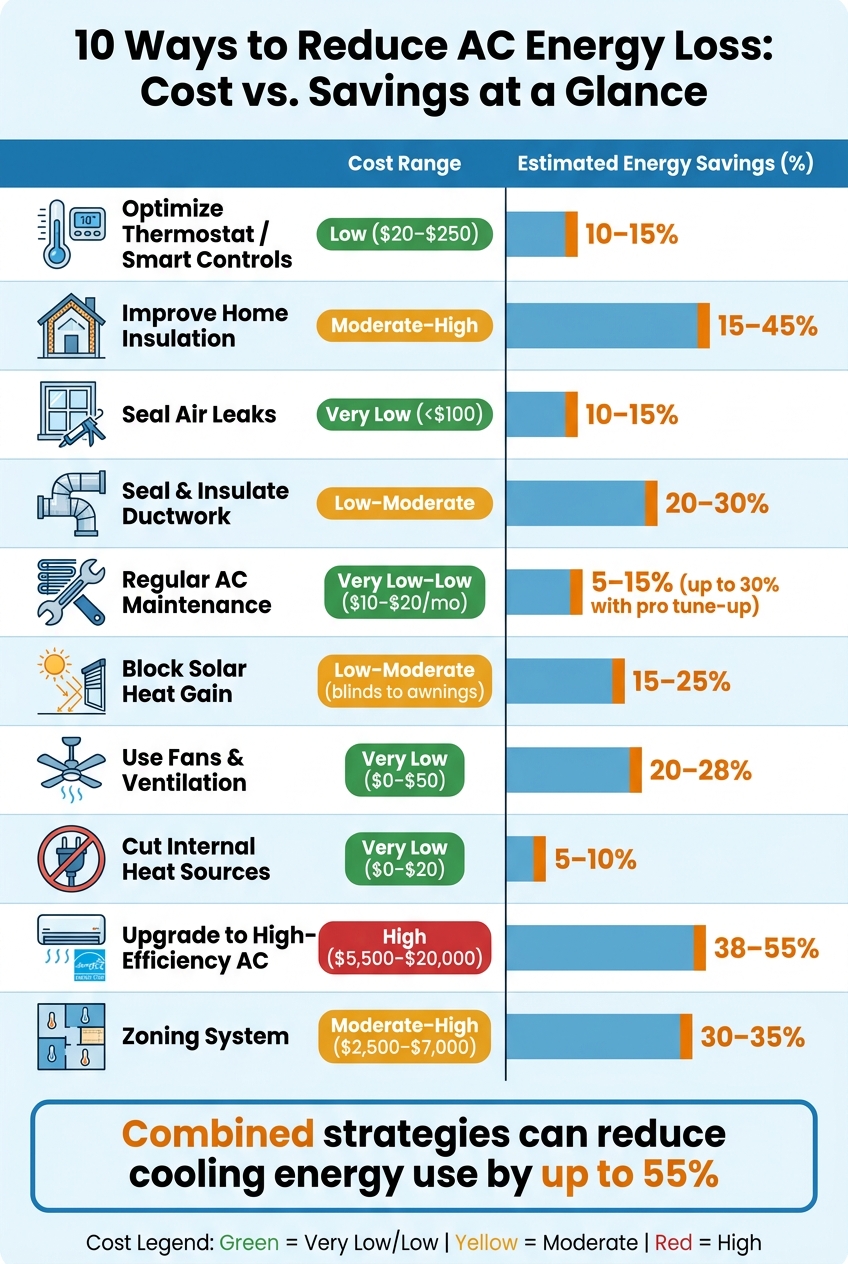
10 Ways to Reduce AC Energy Loss: Cost vs. Savings Comparison
Energy-saving strategies come with varying costs, energy savings, and installation challenges. Here’s a breakdown of each tip to help you decide what fits your needs and budget:
| Tip | Estimated Cost | Estimated Energy Savings | Installation Difficulty |
|---|---|---|---|
| Optimize Thermostat Settings / Smart Controls | Low (around $20–$250 for a smart thermostat) | 10–15% | Low to Moderate |
| Improve Home Insulation | Moderate to High | Significant (reduces AC workload) | Moderate to High |
| Seal Air Leaks | Very Low (under $100) | 10–15% | Low (DIY-friendly) |
| Seal and Insulate Ductwork | Low to Moderate | 20–30% energy loss reduction | Moderate to High |
| Regular AC Maintenance | Very Low to Low (filters cost $10–$20; professional plans around $20/month) | 5–15% for filters; up to 30% with professional tune-ups | Low to Professional |
| Block Solar Heat Gain | Low (blinds) to Moderate (awnings) | Significant (reduces cooling load) | Low |
| Use Fans and Ventilation | Very Low (around $0–$50) | Moderate (supports AC, reduces runtime) | Low (DIY-friendly) |
| Cut Internal Heat Sources | Very Low (around $0–$20 for smart power strips) | 5–10% | Low (DIY-friendly) |
| Upgrade to High-Efficiency AC | High (cost varies, often several thousand dollars) | 38–55% savings compared to older, low-SEER units | Professional |
| Zoning System | Moderate to High | Up to 30–35% | High (Professional installation required) |
Combining these strategies can significantly reduce energy use. Small, inexpensive steps like sealing air leaks, replacing filters, or tweaking thermostat settings can lower cooling energy by 10–15%. Meanwhile, larger investments, such as upgrading to a high-efficiency AC or installing a zoning system, can cut energy use by as much as 55%.
"A system running at peak efficiency uses 25 to 40 percent less energy than the same equipment running degraded." – Five Star HVAC Chicago
This guide provides a clear path to prioritize upgrades, helping you save energy while improving your home’s comfort.
Conclusion
Reducing AC energy loss involves combining practical strategies that work together for better efficiency. Simple, cost-effective steps like sealing air leaks, boosting insulation, blocking solar heat, using fans smartly, and cutting down internal heat sources can significantly lower cooling energy use. For those ready to invest more, upgrading to a high-efficiency system or adding zoning options can amplify savings even further. Together, these measures create a well-rounded plan to tackle energy loss.
Among all the strategies discussed, regular professional maintenance proves to be the most reliable. It prevents up to 5% efficiency loss annually and can cut monthly energy bills by as much as 15%, all while extending the lifespan of your system – especially in Chicago’s demanding climate.
"Maintenance improves energy efficiency by cleaning coils, correcting airflow, and checking refrigerant levels. A tuned system cools faster, runs less, and consumes less power." – Eco Temp HVAC
For those in the Chicagoland area looking for expert help, Eco Temp HVAC provides services like AC maintenance, installation, duct sealing, and smart thermostat setup. Their Eco Home Program, starting at $19.95/month (when paid annually), includes yearly tune-ups, filters, and a 10% discount on repairs. It’s an easy way to keep energy waste in check throughout the year.
FAQs
Which upgrades save the most if I’m on a tight budget?
If you’re watching your spending, there are plenty of low-cost or even free ways to reduce energy use fast. For example, adjusting your thermostat by 7–10°F for just 8 hours a day could lower your annual cooling costs by up to 10%. Pair this with simple habits like closing blinds during the hottest parts of the day and using ceiling fans to circulate air.
Another easy win? Swap out your air filters regularly – this can boost efficiency by 5–15%. For more lasting savings, consider an annual HVAC tune-up or sealing up any air leaks around your home. Small steps like these can make a big difference over time.
How do I know if my ducts are leaking?
Keep an eye out for signs that your ductwork might have leaks. Uneven room temperatures can be a red flag, as can unexpected spikes in your energy bills. If you notice excess dust accumulating near vents, it’s worth investigating further.
Pay attention to unusual noises when your system is running. Whistling or rattling sounds could indicate air escaping through gaps. You can also inspect accessible ducts for visible issues like gaps, disconnected sections, or peeling tape. If you’re unsure, try using your hand or an incense stick near ducts to feel or see if air is escaping. Another telltale sign? Dark dust streaks near registers, which often point to leaks.
If these problems persist or you’re unable to pinpoint the issue, it might be time to call in a professional for a thorough inspection.
Do I need a C-wire for a smart thermostat?
A C-wire supplies the 24-volt power that smart thermostats need to support features like Wi-Fi connectivity, displays, and advanced functionalities. While certain thermostat models can function without a C-wire, this often leads to inconsistent performance, such as dropped connections or battery problems.
If your setup lacks a C-wire, you have a few options: check for an unused wire in your existing system, use a C-wire adapter, or hire a professional to install one. Companies like Eco Temp HVAC specialize in professional installation to ensure your thermostat runs smoothly.