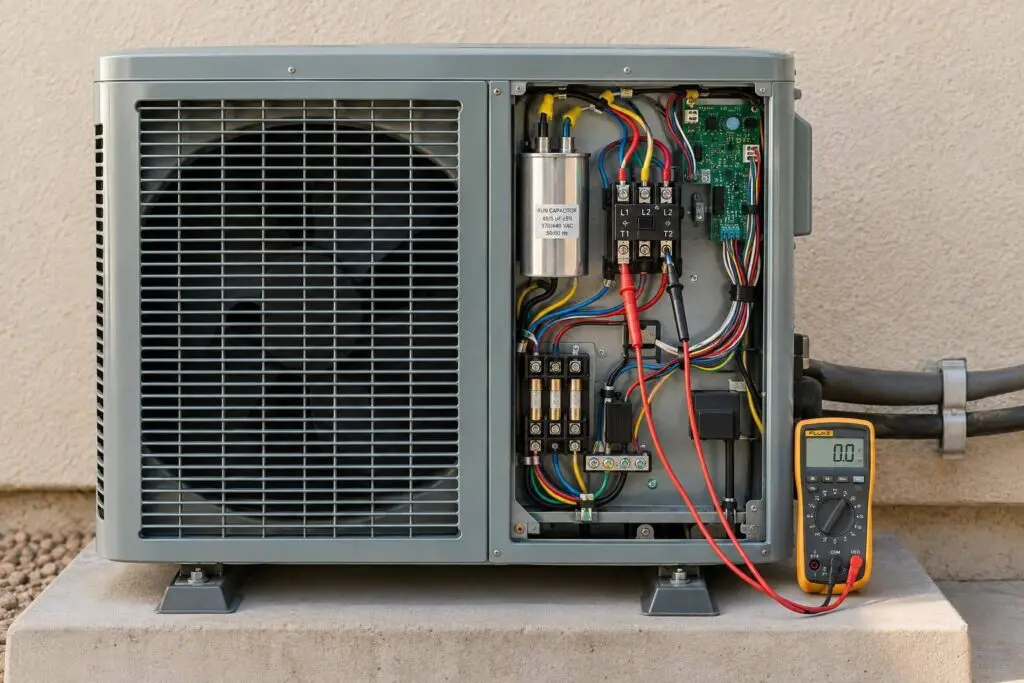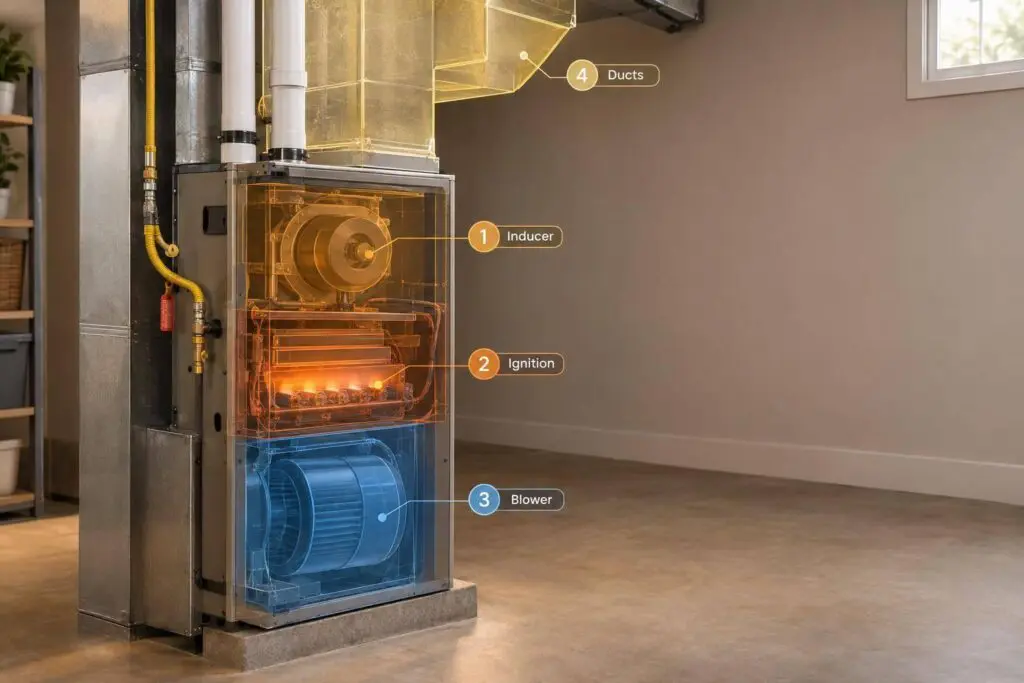

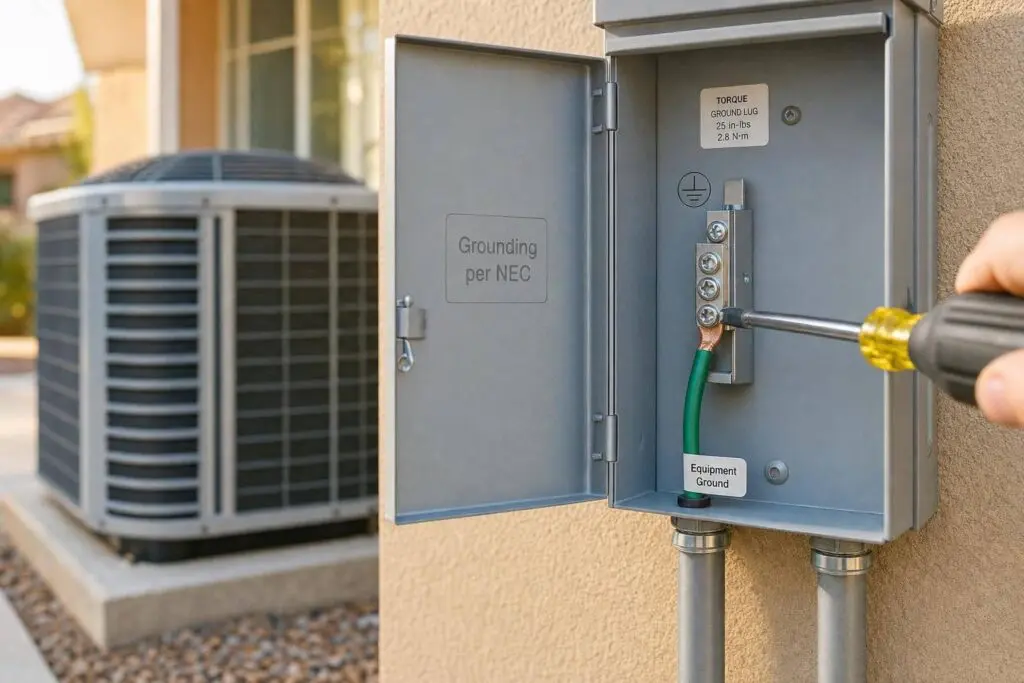
If an HVAC cabinet faults and the grounding path is wrong, the breaker may not trip fast enough. That is the whole issue in one line.
I’d boil this article down to a few jobsite rules:
- Run a proper equipment grounding conductor (EGC) with the branch circuit
- Do not drive a separate ground rod for a condenser or rooftop unit
- Do not bond neutral to ground downstream of the service
- Do not use line sets, ductwork, gas connectors, or communication wire as a ground path
- Torque ground lugs to manufacturer specs and land them on clean metal
- Check local Chicago-area code changes before the job starts
In plain terms, the article explains the split between grounding and bonding, how fault current gets back to the source, and what NEC Articles 250 and 440 mean in the field for condensers, furnaces, mini-splits, and rooftop units. It also points out common errors with LFNC, LFMC, disconnects, and indoor equipment, plus a simple startup check for continuity, lug terminations, and torque.
One point I’d keep front and center: the branch-circuit EGC clears faults; earth does not do that job by itself. That’s why a random rod at the unit is not the fix many people think it is.
For a fast field read, here’s the article’s core message:
| Topic | What to do | What not to do |
|---|---|---|
| Fault path | Run a continuous, code-sized EGC | Assume metal parts or earth will clear the fault |
| Outdoor units | Pull a green-insulated copper EGC in LFNC | Use LFNC alone as the grounding path |
| Neutral-ground bond | Keep it at the service only | Tie neutral and ground together at the unit or disconnect |
| Metal parts | Bond cabinets, enclosures, and raceways | Trust hubs, tubing, or ductwork by themselves |
| Mini-splits | Install the dedicated insulated ground wire called for by the system | Use comm wire or refrigerant lines as ground |
| Final check | Verify continuity and torque before startup | Skip lug torque and assume it’s fine |
Bottom line: if you keep the fault path continuous, size the EGC from NEC Table 250.122, and avoid bad shortcuts in whips and disconnects, you cut down shock risk, nuisance issues, and inspection problems.
That’s the short version of the full article below.
Grounding and Bonding AC Unit Feeders Explained
Core NEC Grounding Rules for HVAC Equipment
Those fault-path basics turn into direct NEC rules for installation, which are critical for any reliable HVAC service provider to follow. The code spells out how HVAC equipment must stay bonded and how the fault path has to stay unbroken.
Grounding Electrode System: Why HVAC Equipment Should Not Have Its Own Ground Rod
A separate ground rod at a condenser or rooftop unit is not part of the required building grounding system. The building grounding electrode system has to be bonded together as one system. Putting a separate rod at an HVAC unit doesn’t give you the low-impedance fault path needed to clear a fault.
That’s the key point: the building grounding electrode system is not the same thing as the branch-circuit equipment grounding conductor. For HVAC equipment, the right move is to connect to the building’s existing grounding system, not to drive a standalone rod at the unit.
Where the Neutral-Ground Bond Belongs and Why Downstream Connections Are a Violation
The main bonding jumper belongs at the service disconnect or at the source of a separately derived system. NEC 250.24(A) prohibits a neutral-to-ground bond on the load side of the service.
Put simply, once you’re downstream of the service, neutral and ground should not be tied together. If they are, fault current can take paths it shouldn’t, and that defeats the point of a controlled grounding path.
NEC Requirements for HVAC Disconnects, Raceways, and Metal Parts
NEC 250.110 requires exposed non-current-carrying metal parts – including cabinets, motor frames, and disconnect enclosures – to be connected to an equipment grounding conductor when they can become energized. Metal raceways also have to stay bonded as part of the grounding path. And outdoor HVAC units require a wire-type equipment grounding conductor (EGC) under NEC 440.9.
This is where jobsite details make or break the install. Bond the metal parts, use the required EGC, and keep the grounding connection tied back to the building system. That path only works if conductor size, routing, and termination are done right.
Equipment Grounding Conductors: Sizing, Routing, and Termination
Once the code-required fault path is in place, the next step is getting the EGC size and termination right in the field. If the EGC is undersized, poorly routed, or badly terminated, that fault path can fall apart when you need it most.
Accepted EGC Types and When a Wire-Type Ground Is Required
Use an EGC sized to the circuit breaker, and run it with the branch-circuit conductors from the disconnect to the unit. NEC Table 250.122 sets the minimum EGC size based on the rating of the overcurrent protective device protecting the circuit. If the ungrounded conductors are increased in size to make up for voltage drop, the EGC has to be increased too.
Termination Details That Affect Safety
Use listed lugs or connectors rated for the conductor, land them on clean bare metal, and torque them to the manufacturer’s spec.
That might sound like a small detail, but it’s often where jobs go sideways. Poor terminations are the first place grounding failures show up during HVAC installation and inspection.
Common Grounding Errors at Condensers, Furnaces, Mini-Splits, and Rooftop Units
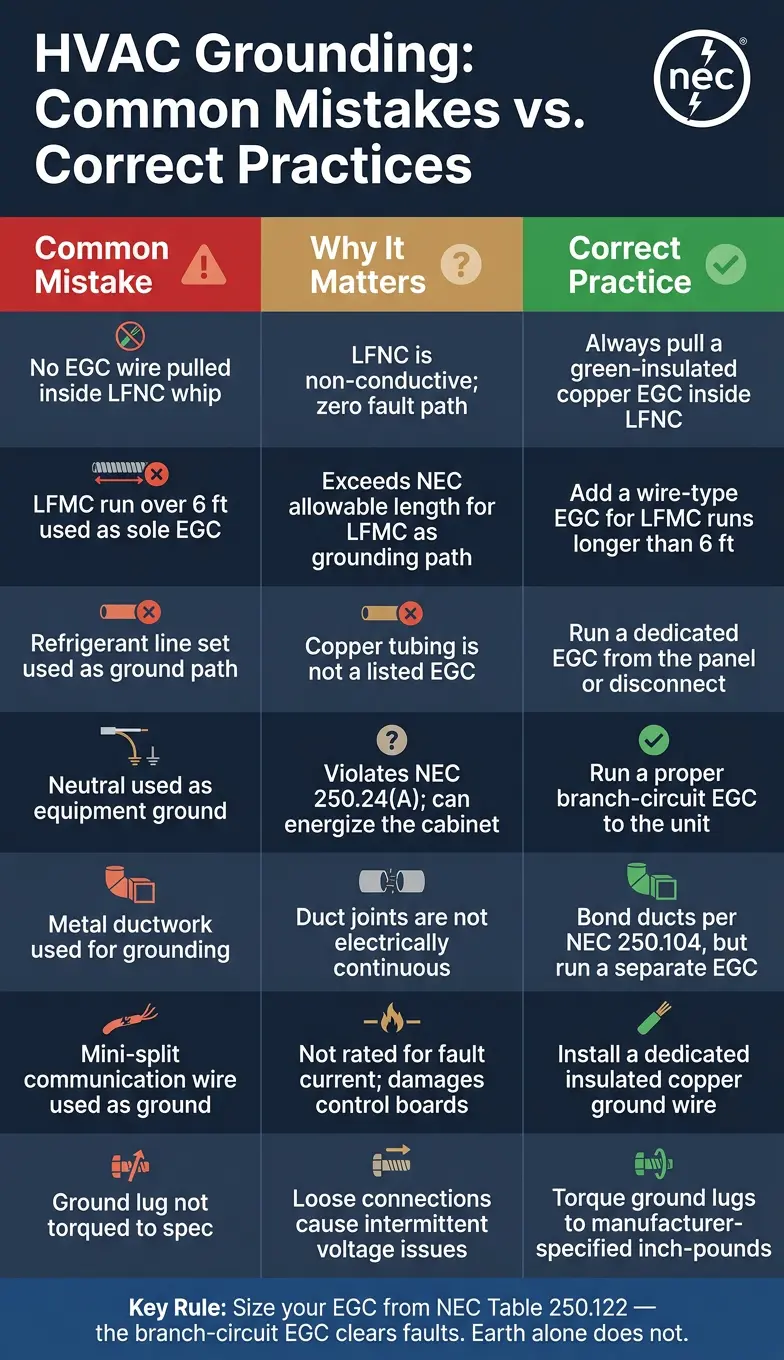
HVAC Grounding: Common Mistakes vs. Correct Practices (NEC Guide)
Even when the right parts are on site, grounding mistakes still show up in the field. In most cases, the issue comes down to a few shortcuts in the whip, enclosure, or unit bond.
Outdoor Unit Errors: Disconnects, Line Sets, and Liquid-Tight Misuse
One of the most common outdoor mistakes is running Liquid-tight Flexible Nonmetallic Conduit (LFNC) to a condenser and skipping the dedicated EGC. That doesn’t work. LFNC is non-conductive, so it cannot carry fault current. If you’re using LFNC, you need to pull a green-insulated copper EGC inside the whip.
Liquid-tight Flexible Metal Conduit (LFMC) can trip people up too. If the LFMC is not allowed by its listing and NEC rules to act as the grounding path, you need a separate wire-type EGC. Otherwise, you’ve broken the low-impedance fault path the unit and disconnect need.
Another field mistake is treating the refrigerant line set like a ground path. It isn’t one. Copper refrigerant tubing is not a listed EGC. It’s part of the system, not part of the fault-current path.
The outdoor disconnect needs attention too. The EGC must terminate on a listed ground lug. Don’t count on the hub by itself. Use a listed bonding bushing or ground lug.
Indoor Equipment Errors: Using the Neutral as a Ground or Using Ductwork as the Ground Path
Never bond neutral to ground downstream of the service disconnect. If a fault happens, that mistake can energize the cabinet.
Metal ductwork and flexible gas connectors don’t count as an EGC either. Duct joints are not electrically continuous, and flexible gas connectors are not listed for fault current. You can bond them to the grounding system, but that does not replace the branch-circuit EGC for the HVAC equipment.
Mini-splits have their own trouble spot. Many mini-split systems call for a dedicated insulated copper ground wire between the indoor and outdoor units, often 14 AWG or larger. Using the communication wire or the line set as an EGC is a common reason control boards fail, and it also violates NEC grounding rules.
Inspection, Testing, and Documentation During Installation
A visual inspection will catch most grounding mistakes before the system is energized. Check that each EGC lands on a listed lug, that enclosures are bonded, and that there are no neutral-ground connections downstream of the service disconnect.
Before startup, verify that every ground lug is torqued to spec. Then record torque values and any field changes on the install checklist. It may feel like small stuff, but loose grounding points can lead to weird voltage readings and hard-to-track callbacks.
Here are the most common field mistakes and the right fix:
| Common Mistake | Why It’s Wrong | Correct Practice |
|---|---|---|
| No EGC wire in LFNC whip | LFNC is non-conductive; conduit provides no fault path | Always pull a green-insulated copper EGC inside LFNC |
| LFMC run longer than 6 ft used as sole EGC | Exceeds the allowable length for LFMC as the only grounding path | Add a wire-type EGC for LFMC runs longer than 6 ft |
| Refrigerant line set used as ground | Copper tubing is not a listed EGC | Run a dedicated EGC from the panel or disconnect |
| Neutral used as equipment ground | Violates NEC 250.24(A); can energize the cabinet | Run a proper branch-circuit EGC to the unit |
| Metal ductwork used for grounding | Duct joints are not electrically continuous | Bond ducts per NEC 250.104, but run a separate EGC |
| Mini-split communication wire used as ground | Not rated for fault current; can damage control boards | Install a dedicated insulated copper ground wire |
| Ground lug not torqued to spec | Loose connections cause intermittent voltage readings | Torque ground lugs to the manufacturer’s specified inch-pounds |
Conclusion: Grounding Best Practices for Chicagoland HVAC Projects
Bonding keeps metal parts at the same electrical potential. Grounding gives fault current a clear path that helps trip the breaker. That distinction matters on HVAC jobs because every fault needs a direct route back to the source.
On every job, three rules stay the same:
- Keep the fault path continuous
- Size the EGC correctly
- Place the neutral-ground bond only at the service
Before you energize any unit, verify continuity, torque, and proper bonding.
Chicago and nearby AHJs may require stricter methods than the base NEC for cooling services. In Chicago and nearby areas, local amendments can be stricter than the base NEC.
FAQs
Why won’t a ground rod at the unit clear a fault?
A ground rod at the unit will not clear a fault. The reason is simple: it doesn’t give fault current the low-impedance path back to the electrical panel that the breaker needs in order to trip.
To clear a fault safely, the NEC requires a dedicated equipment grounding conductor that runs from the panel to the unit. That conductor sends fault current back to the power source so the breaker trips and removes hazardous voltage.
When does HVAC equipment need a separate wire ground?
HVAC equipment needs an equipment grounding conductor.
For furnaces, central air conditioners, heat pumps, and mini-splits, that means a dedicated ground wire – bare copper or green-insulated – runs with the circuit conductors from the electrical panel to the unit.
This grounding path helps carry stray current safely to earth, which lowers the risk of shock and fire. Check the manufacturer’s nameplate and installation manual for system-specific grounding requirements.
How can I verify the ground path is safe?
First, shut off power to the circuit at the main panel. Then use a multimeter to check continuity and confirm that the equipment is properly grounded to the home’s grounding system.
Before turning the power back on, make sure the equipment grounding conductor is firmly attached to both the unit’s ground lug and the disconnect box, following the manufacturer’s wiring diagram. Check that all connections are tight and meet the listed torque specs.