
Wiring your central AC unit correctly is non-negotiable for safety and efficiency. Here’s what you need to know:
- Key Factors: Use the unit’s Minimum Circuit Ampacity (MCA) and Maximum Overcurrent Protection (MOCP) values from the nameplate to determine the proper wire gauge and breaker size.
- Why It Matters: Undersized wires can overheat, damage components, or even cause electrical fires. Voltage drop over long distances can also reduce performance.
- General Guidelines: For a typical 240V system:
- 1.5–2 tons: 14 AWG wire, 15–20A breaker
- 2.5–3 tons: 12 AWG wire, 20–25A breaker
- 3.5–4 tons: 10 AWG wire, 30–35A breaker
- 5 tons: 8 AWG wire, 35–50A breaker
- Special Considerations: Long runs (over 75 feet), high temperatures, or conduit fill may require upsizing the wire gauge.
Always confirm local codes and consult a licensed electrician for 240V circuits or panel work.
Proper wire sizing for an A/C unit. Proper methods explained
Pre-Installation Checklist
Before starting any wiring work, it’s essential to have a few key items ready and ensure your electrical setup is prepared. Skipping these steps could result in circuits or panels that can’t handle the load properly. Make sure to check the equipment’s nameplate data, the capacity of your electrical panel, and the installation environment.
Confirm Manufacturer Data
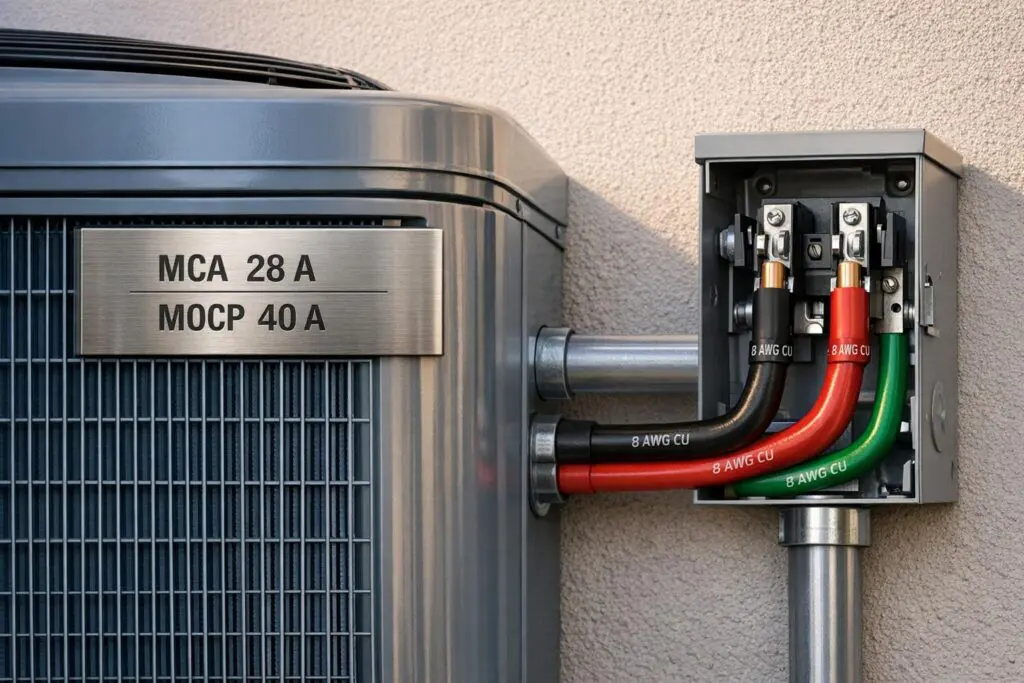
Start by reviewing the nameplate on the outdoor unit – it contains all the wiring details you’ll need. The two most important values here are the Minimum Circuit Ampacity (MCA) and the Maximum Overcurrent Protection (MOCP). These numbers have already been calculated by the manufacturer, so use them exactly as stated for your wiring decisions.
"The breaker size alone is not a reliable way to select wire for HVAC equipment." – MEP Academy Instructor
The nameplate might also include values like Rated Load Amps (RLA) for the compressor, Full Load Amps (FLA) for the fan motor, and Locked Rotor Amps (LRA), which is the surge current during startup. LRA can be 5 to 8 times higher than the normal running current. While these values aren’t used directly for wire selection, they help explain why the MOCP is often set higher. Additionally, if the nameplate specifies "Maximum Fuse", you must use a fuse instead of a circuit breaker to maintain the equipment’s warranty and listing.
Check Electrical Service Capacity
With the MCA in hand, verify that your main panel can handle the load. Look at the total amperage of your service – commonly 100 A, 150 A, or 200 A – and ensure there’s a dedicated double-pole breaker slot available. Central air conditioning units require their own circuits and shouldn’t share one with other high-draw appliances.
You’ll also need to confirm that the panel’s bus rating can accommodate the combined load of your existing circuits plus the new AC unit. If the panel is near capacity, it’s a good idea to have a licensed electrician evaluate whether an upgrade is needed. Typically, hiring an electrician to install a new 240 V dedicated circuit and a disconnect costs between $300 and $500, though complex issues may require professional air conditioning repair service.
Review Installation Conditions
Beyond checking MCA and MOCP, consider installation factors that might affect wire sizing, such as the run length, ambient temperature, and conduit fill.
The National Electrical Code (NEC) recommends a maximum voltage drop of 3% for branch circuits. If the wire run exceeds 75 feet, you’ll need to upsize the wire gauge to stay within this limit. Outdoor runs or high ambient temperatures may also require upsizing due to reduced ampacity and additional voltage drop concerns.
The wiring method matters, too. For indoor runs through framing, NM-B (Romex) is suitable. However, outdoor sections must use THHN/THWN-2 conductors within conduit, such as PVC or EMT. The final connection to the unit typically requires about 6 feet of liquid-tight flexible metallic conduit from the disconnect to the unit. If multiple conductors share a conduit, bundling adjustments may also necessitate a larger wire gauge.
Lastly, even if you’re using THHN wire rated for 90°C, the ampacity is limited by the lowest-rated termination in the circuit. Unless all breaker terminals, disconnect lugs, and equipment terminals are explicitly marked for 75°C operation, you’ll need to size the wire based on the more conservative 60°C ampacity column.
Wire Sizing Based on MCA and MOCP
Once you’ve got the nameplate data and installation conditions squared away, it’s time to turn those numbers into practical decisions about wire gauge and breaker size. The two key values you’ll rely on here are MCA (Minimum Circuit Ampacity) and MOCP (Maximum Overcurrent Protection).
How to Use Minimum Circuit Ampacity (MCA)
MCA is your starting point because it already includes the required 125% multiplier for safety. As noted:
"MCA already includes the 125 percent factor."
To select the correct wire gauge, find a wire with an ampacity that meets or exceeds the MCA. For most residential installations, you’ll use the 60°C column of NEC Table 310.16. This column applies unless every termination point in the circuit – like breaker terminals, disconnect lugs, and equipment lugs – is specifically rated for 75°C.
How Maximum Overcurrent Protection (MOCP) Works
After determining the MCA, check that the MOCP limits are respected. MOCP sets the maximum size for your breaker or fuse. It’s not a target to aim for but a ceiling you can’t exceed. Why is MOCP often much higher than MCA? It’s because air conditioning compressors draw a surge of current – 5 to 8 times their normal running current – when they start up. A larger breaker helps handle these surges without tripping unnecessarily.
However, MOCP doesn’t decide wire size. According to NEC Article 440, it’s perfectly acceptable for a breaker to exceed the wire’s standard ampacity rating, as long as the wire meets the MCA and the breaker stays within the MOCP.
"Installing a breaker larger than the listed MOCP is a code violation under NEC Article 440 regardless of what the homeowner was told or what the previous system had." – AB Electric
If you’re replacing an older AC unit with a newer, more efficient model, note that the MOCP on the new unit may be lower. In this case, any oversized breaker from the old system must be replaced to match the new nameplate. Don’t assume the old breaker is still appropriate.
Choosing the Right Wire Gauge
Once you’ve nailed down the MCA and MOCP, picking the right wire gauge is straightforward. Use the 60°C column of NEC Table 310.16 to find a wire with an ampacity that meets or exceeds the MCA. For example, if your unit has an MCA of 17.8A and an MOCP of 30A, you’ll need #12 copper wire (rated for 20A). A smaller wire like #14 (rated for 15A) wouldn’t suffice, even with a 30A breaker.
Here’s a quick reference for common residential AC sizes:
| AC Unit Size | Approx. MCA Range | Copper Wire (AWG) | Common Breaker (MOCP) |
|---|---|---|---|
| 1.5–2 Tons | 12–15A | 14 AWG | 15–20A |
| 2.5–3 Tons | 15–20A | 12 AWG | 20–25A |
| 3.5–4 Tons | 20–30A | 10 AWG | 30–35A |
| 5 Tons | 30–40A | 8 AWG | 35–50A |
Always cross-check these ranges with the specific unit’s nameplate. These are just general guidelines.
For longer wire runs, voltage drop becomes a concern. The NEC recommends keeping the branch-circuit voltage drop under 3%. If your run is over 50 feet, it’s a good idea to step up to the next wire gauge. This helps maintain efficiency and prevents the compressor from overworking.
Next, we’ll dive into common wire sizes by AC tonnage and how to account for factors like voltage drop.
Common Wire Sizes for Residential AC Units
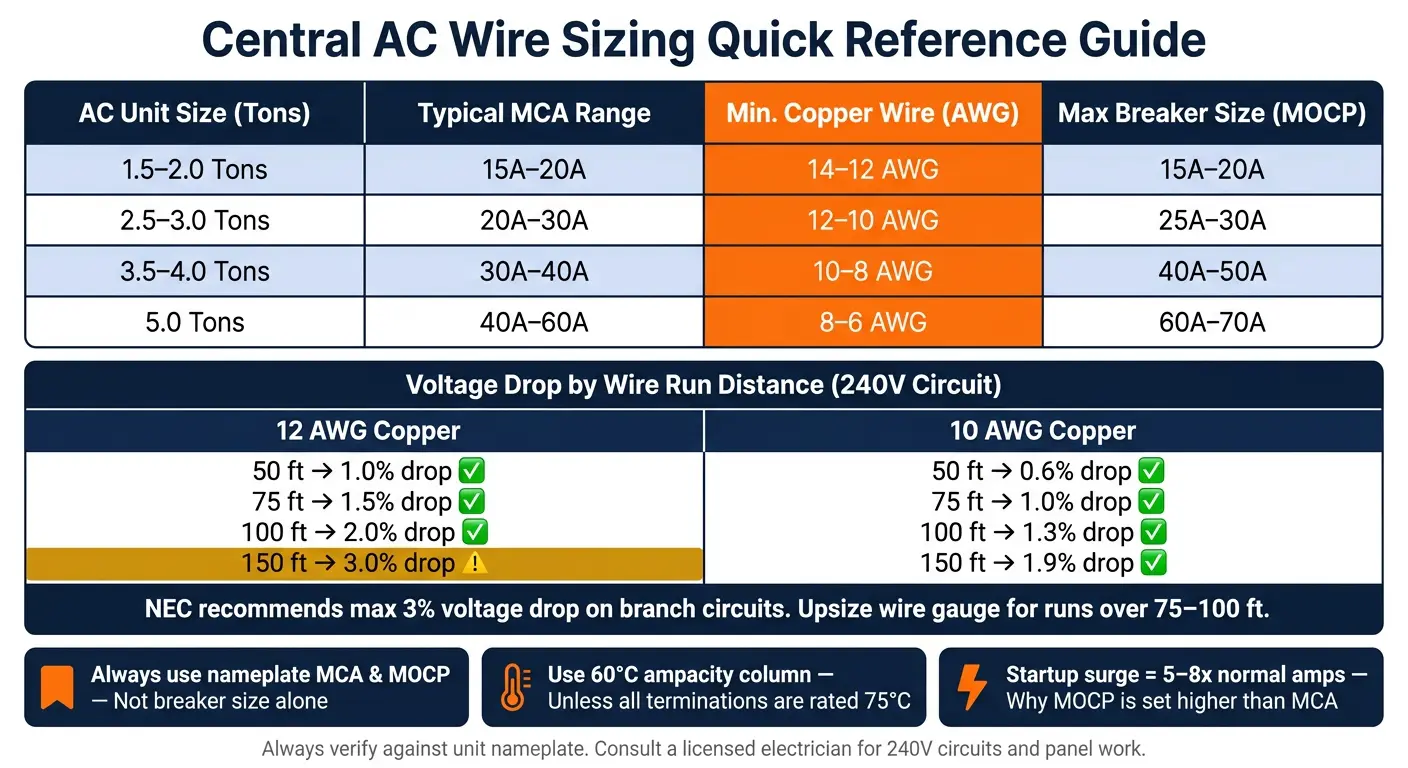
AC Wire Size Chart: AWG, Breaker & MCA by Tonnage
Wire Size by AC Tonnage
When it comes to wiring residential central AC units, understanding how MCA (Minimum Circuit Ampacity) and MOCP (Maximum Overcurrent Protection) translate to wire gauge is essential. Most residential units operate on 240V, using two hot wires and a ground, with no neutral required. Copper is the go-to material for these final connections due to its superior resistance to oxidation and lower electrical resistance compared to aluminum.
Here’s a quick guide to how wire size aligns with AC tonnage:
| AC Tonnage | Typical MCA Range | Min. Copper Wire (AWG) | Breaker (MOCP) |
|---|---|---|---|
| 1.5–2.0 Tons | 15A–20A | 12 AWG | 15A–20A |
| 2.5–3.0 Tons | 20A–30A | 10 AWG | 25A–30A |
| 3.5–4.0 Tons | 30A–40A | 8 AWG | 40A–50A |
| 5.0 Tons | 40A–60A | 6 AWG | 60A–70A |
Always verify these values against the unit’s nameplate, as specifications can vary by manufacturer and efficiency ratings.
For heat pumps with electric auxiliary heat strips, current demands can be significantly higher. In some cases, a 6 AWG wire on a 60A circuit may be necessary. Always double-check the nameplate ratings for these systems to ensure proper wiring.
Next, let’s explore how long wire runs can impact voltage and why adjustments may be needed.
Accounting for Voltage Drop
Selecting the right wire gauge isn’t just about handling the current; it’s also about managing voltage drop, especially over longer distances. The NEC recommends keeping branch-circuit voltage drop below 3%. If the distance between your panel and condenser exceeds 75–100 feet, it’s often necessary to use a thicker wire to maintain efficiency and safety.
Here’s how voltage drop looks for 12 AWG and 10 AWG copper wires over different distances in a 240V circuit:
| Distance | 12 AWG Copper | 10 AWG Copper |
|---|---|---|
| 50 ft | 1.0% drop | 0.6% drop |
| 75 ft | 1.5% drop | 1.0% drop |
| 100 ft | 2.0% drop | 1.3% drop |
| 150 ft | 3.0% drop | 1.9% drop |
If the voltage drop approaches 3%, it’s time to upsize the wire gauge for safety and to ensure the system runs efficiently.
Grounding and Bonding Requirements
Proper grounding is just as important as wire sizing. A dedicated equipment grounding conductor – either bare copper or green-insulated – must run alongside the circuit conductors from the panel to the unit. The size of this grounding conductor is based on the circuit breaker rating, as outlined in NEC Table 250.122.
Additionally, all metallic components, including the condenser cabinet, disconnect enclosure, and conduit, should be bonded together. This bonding ensures a uniform ground reference and prevents dangerous voltage differences between metal surfaces during a fault. This setup helps the breaker trip quickly, avoiding prolonged exposure to energized equipment.
"An oversized breaker beyond the MOP means the overcurrent protection won’t trip fast enough to protect the compressor windings during a locked rotor event." – WireRef
A properly sized and installed grounding system ensures a safe path for fault currents, reducing risks and enhancing overall safety. Before moving forward with safety inspections, always verify voltage drop and grounding connections – whether you’re tackling the job yourself or hiring a professional.
For expert advice on wire sizing and installation that meets local codes, consult a licensed electrician or contact Eco Temp HVAC for assistance in the Chicagoland area.
Safety and Professional Inspection
Checking Existing Installations
Start by de-energizing the circuit at the main panel. Once the power is off, carefully inspect the breaker size and compare it to the MOCP (Maximum Overcurrent Protection) listed on the unit’s nameplate. Next, trace the wiring to ensure the gauge meets or exceeds the MCA (Minimum Circuit Ampacity). Look for signs of trouble, such as brittle or discolored terminal insulation, or any melting – these are clear indicators of overheating. Pay attention to any burning or musty odors near the disconnect or panel, as these smells often signal underlying electrical issues that need immediate attention.
There’s a common misconception that a 50A breaker paired with 10 AWG wire automatically signals a problem. However, the NEC (National Electrical Code) allows breakers to exceed the wire’s standard ampacity in certain cases, like air conditioning units, to accommodate the compressor’s startup surge. This is referred to as the oversized breaker exception. The critical factor is ensuring the breaker does not exceed the MOCP specified on the nameplate. If you encounter any irregularities or uncertainties, it’s best to involve a professional.
When to Call a Professional
While you can verify basic wiring details on your own, any work involving the main panel or 240V circuits should be left to a licensed electrician.
"Electrical work can cause serious injury, death, fire, or property damage if performed incorrectly. Always hire a licensed electrician for electrical work, especially for service upgrades, panel work, and 240V circuits." – WireRef
A licensed technician will confirm that the MCA and MOCP align with the installed wiring and breaker, check that the disconnect is within sight of the outdoor unit (as required by NEC 440.14), and ensure the breaker is HACR-rated if specified by the manufacturer. Additionally, if the nameplate states "fuse only", using a circuit breaker would violate code – something a professional will catch right away.
If you’re in the Chicagoland area, Eco Temp HVAC offers comprehensive electrical and system inspections to ensure compliance with NEC standards and local regulations.
Once any necessary professional inspections are complete, you can proceed with the following safety checks before turning the system back on.
Pre-Operation Safety Checks
Before re-energizing the circuit, double-check everything. Ensure all connections at the disconnect, contactor, and panel are secure. Verify that the flexible conduit linking the disconnect to the unit is no longer than 6 feet and contains the correct wire gauge. Also, confirm that the equipment grounding conductor is properly connected, following the manufacturer’s wiring diagram.
When starting the system for the first time, pay close attention to its behavior. Listen for any unusual sounds like grinding, buzzing, or squealing, and check that the breaker doesn’t trip immediately. A smooth startup, quiet operation, and cool air within a few minutes are strong indicators that the wiring is correct and the system is ready to go.
Conclusion: Safe and Correct AC Wiring
When it comes to wiring a central AC unit, accuracy and adherence to guidelines are non-negotiable. The key steps? Refer to the unit’s nameplate, follow the NEC 440 code, and consult a professional when necessary. As Mike Holt, owner of Mike Holt Enterprises, wisely advises:
"For each motor, the manufacturer has worked out all of the details and supplied the correct protection, conductor sizing, and other information on the nameplate. So when wiring an air conditioner, trust the information on the nameplate, and don’t try to over-complicate the situation."
Two critical factors – MCA (Minimum Circuit Ampacity) and MOCP (Maximum Overcurrent Protection) – guide every wiring decision. MCA ensures the wire size meets the minimum requirement, while MOCP sets the upper limit for breaker size. For installations requiring longer wire runs, increasing the conductor gauge slightly helps maintain voltage drop within the recommended 3% limit.
Termination temperature ratings are another essential consideration. Even if your wire is rated for high temperatures, the ampacity will still be restricted by the lowest-rated termination point in the circuit, typically 60°C in residential systems. Always check the ratings of breakers, disconnect lugs, and equipment terminals to ensure your setup meets safety standards.
Finally, leave complex tasks like panel work and 240V circuits to licensed professionals. For those in the Chicagoland area, contacting Eco Temp HVAC ensures expert installation, compliance with codes, and peace of mind – an investment that can prevent costly equipment damage or potential fire hazards.
FAQs
Where can I find the MCA and MOCP on my AC unit?
The MCA and MOCP ratings can be found on the equipment nameplate, which is typically a metal plate or a durable sticker attached to your outdoor condenser unit. If you don’t see it on the side panel, you might need to remove a service panel to locate it. For indoor air handlers, the nameplate is usually positioned near the electrical connections or along the side of the unit. Check the label for these specific terms.
Do I need a neutral wire for a 240V central AC circuit?
Typically, a neutral wire isn’t needed for a standard 240V central air conditioning circuit. These systems usually rely on two hot conductors and a ground wire. That said, it’s always a good idea to check the nameplate and installation manual of your specific unit to confirm its electrical requirements. For expert installation and to keep your system running smoothly, Eco Temp HVAC offers professional services across the Chicagoland area.
When should I upsize the wire for a long run?
If the distance between your electrical panel and AC unit results in a voltage drop greater than the recommended 3% for branch circuits, you’ll need to use a thicker wire. While adhering to the National Electrical Code (NEC) is essential, longer distances often require upsizing the wire gauge. A good rule of thumb is to increase the wire size by one gauge for every 50–100 feet. If your calculations land between two sizes, always round up to the next larger gauge to protect your compressor and maintain efficiency.