
If your HVAC system is old, a retrofit can cut energy waste without a full replacement. In many Chicagoland buildings, the biggest losses come from old equipment, leaky ducts or piping, and poor controls. Fixing those areas can lower utility costs, improve comfort, and reduce service calls.
Here’s the short version:
- Older furnaces and boilers may run at only 70% to 80% AFUE, while newer models can reach 95% to 98%
- Duct leaks can waste about 25% to 40% of heating and cooling energy
- Thermostat setbacks of 7°F to 10°F for 8 hours a day can trim HVAC energy use by about 10% to 20%
- ECM motors and variable-speed pumps can cut fan or pump power by 30% to 80%
- Duct sealing and insulation can reduce leakage by 70% to 90%
In plain terms, I’d look at the system in this order:
- Fix controls so the system stops conditioning empty spaces
- Seal and insulate ducts or piping so heated or cooled air gets where it should
- Replace old or oversized equipment if it’s failing, unsafe, or wasting fuel
A retrofit sits between a tune-up and a full replacement. It targets the parts of the system that waste the most energy, so you can spend money where it matters most.
That’s the main idea of this article: find the waste first, then fix equipment, distribution, and controls in the right order.
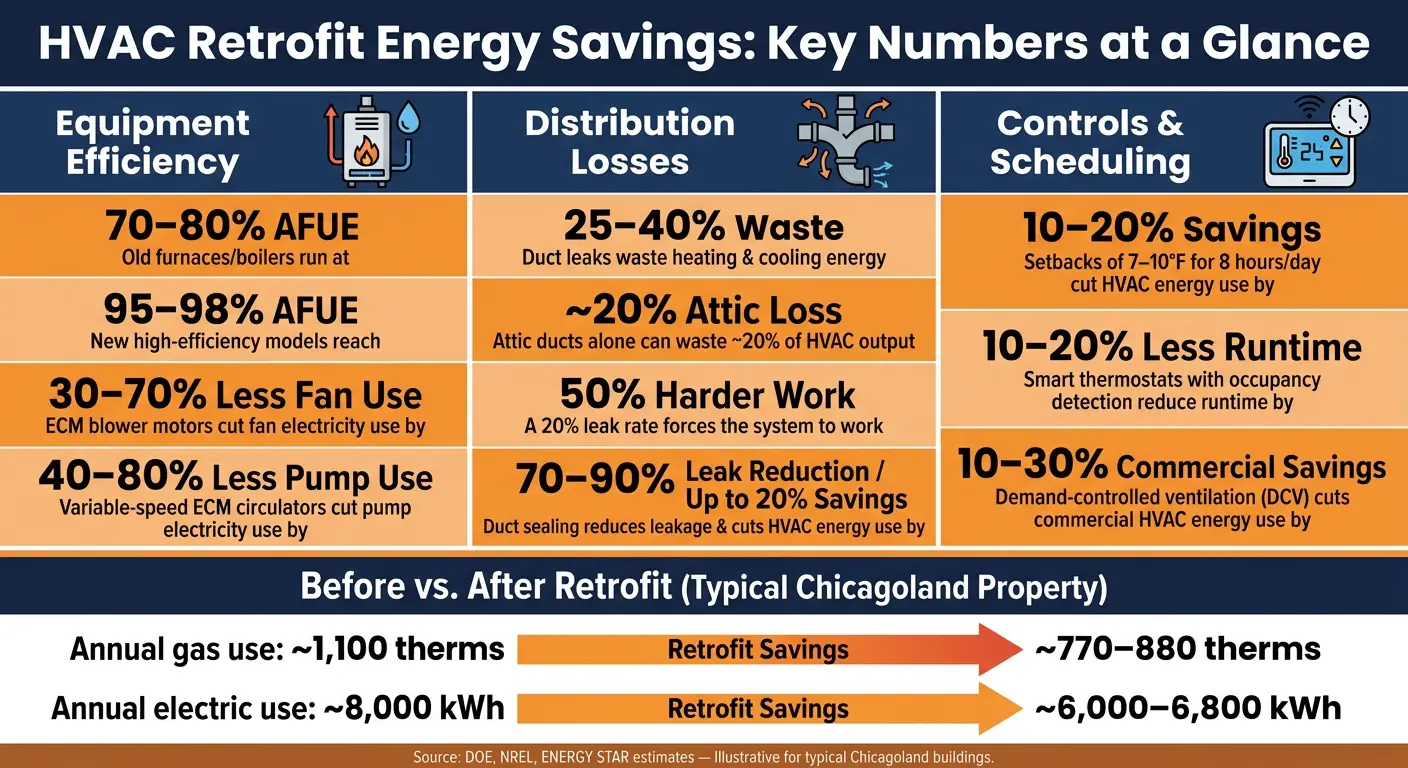
HVAC Retrofit Energy Savings: Key Numbers at a Glance
Smart HVAC Retrofits for Cost Saving using HAP
Common causes of energy waste in existing HVAC systems
Most energy waste in older HVAC systems comes from three trouble spots: equipment, distribution, and controls. That’s where a lot of retrofit savings come from too, which is why those areas usually deserve attention first.
Low-efficiency furnaces and boilers
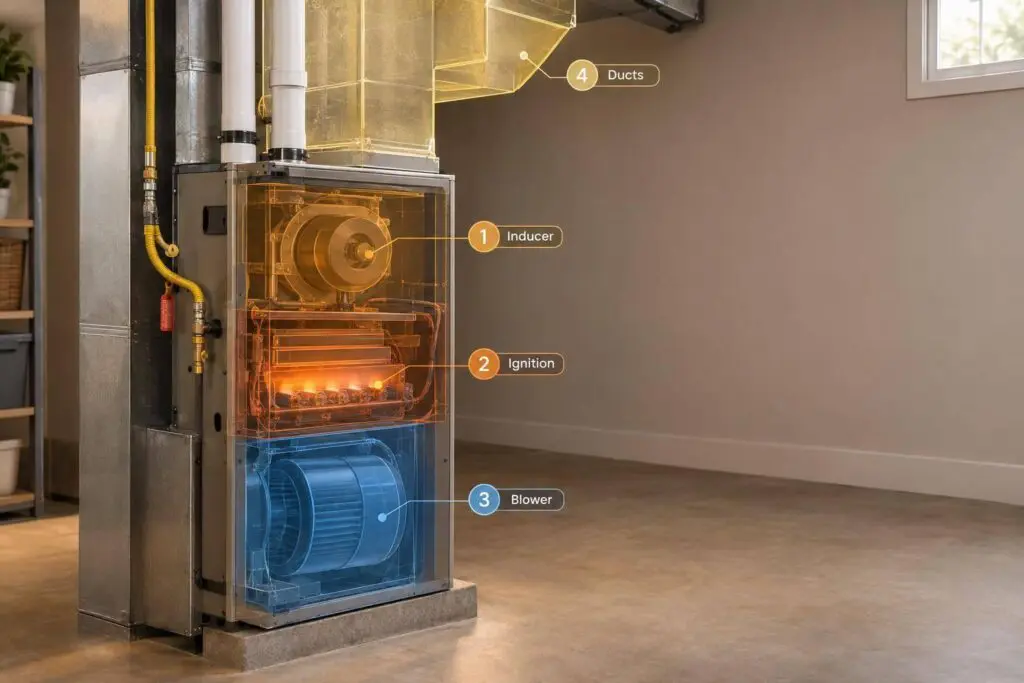
Older furnaces and boilers often operate in the 70% to 80% AFUE range, while newer high-efficiency models can reach 95–98% AFUE. In a place like Chicago, where the heating season drags on for months, that difference can hit hard.
Age also takes a toll. Burners wear down, heat exchangers lose performance, and controls stop working as cleanly as they once did. Then there’s short cycling, a common problem in older setups. It happens when equipment is too large for the space, so it heats the room too fast, shuts off, then kicks back on again a few minutes later. That constant stop-and-start adds wear to parts and wastes energy.
A lot of the time, oversizing happens because replacement equipment gets picked based on the old unit’s size instead of a proper load calculation. It sounds harmless, but it can lock in the same problem for years.
Duct, piping, and airflow losses
Duct leakage is one of the biggest sources of wasted energy in existing homes, and most people never see it. In a typical home, about 25–40% of heating and cooling energy can disappear through leaks, holes, and loose duct connections before that air ever reaches the rooms it’s meant to serve.
The worst losses usually show up in attics, basements, and crawlspaces. Research from the National Renewable Energy Laboratory found that ducts in unconditioned attics alone can waste about 20% of a furnace or air conditioner’s output. Even a leak rate of just 20% can force the system to work 50% harder to hold the thermostat setting. That’s a big penalty from something most owners can’t spot with a quick glance.
Those losses usually point to a short list of fixes:
- Duct sealing
- Duct insulation
- Airflow balancing
Hydronic systems have their own version of the same issue. Poorly insulated pipes in basements and mechanical rooms lose heat into unconditioned areas. The boiler then has to produce more heat to deliver the same comfort indoors, which means more fuel use and less even temperatures from room to room.
Outdated thermostats and poor system control
If a thermostat can’t follow a schedule, the system often runs at occupied settings all day long. For a small business owner, that can mean paying to heat empty offices, unused conference rooms, or spaces that are only partly occupied.
Even small setpoint changes can make a dent. Adjusting thermostat settings by 7–10°F for about 8 hours per day during unoccupied periods can cut HVAC energy use by around 10–20%, depending on the building and climate. Older single-stage systems add another layer to the problem because they run at full output every time they turn on.
| Warning Sign | Likely Cause | What It Means |
|---|---|---|
| Short cycling (frequent on/off) | Oversized equipment or failing controls | Higher energy spikes, faster component wear |
| Uneven room temperatures | Duct leaks or poor airflow distribution | System runs longer to compensate |
| High bills despite steady usage | Low AFUE equipment or duct losses | Energy escaping before it reaches occupied spaces |
| Weak airflow at registers | Duct leaks, restrictions, or pressure imbalance | Equipment works harder, comfort suffers |
| Conditioning empty spaces | No scheduling or occupancy-based controls | Energy spent with zero comfort benefit |
Retrofit solutions that improve HVAC energy efficiency
Once you know where energy is slipping away, the next move is simple: fix the biggest leaks, control problems, and equipment weak spots first.
Upgrade heating equipment and key components
If old equipment is the issue, the fix is a properly sized high-efficiency replacement.
Replacing an aging furnace or boiler with a high-efficiency condensing model is often the biggest retrofit win. Condensing gas furnaces can reach 95–98% AFUE, compared with the 70–80% range found in many older Chicagoland homes. Condensing boilers can reach 90–95% efficiency when return water stays cool.
Two other upgrades can trim fan and pump power in a big way, even though they don’t get much attention. Swapping a standard PSC blower motor for an ECM (electronically commutated motor) can cut fan electricity use by 30–70%, depending on how many hours the system runs. ECM motors also operate at lower, steadier speeds, which helps keep indoor temperatures more even through the day.
On the hydronic side, replacing old constant-speed circulator pumps with variable-speed ECM-based circulators can cut pump electricity use by 40–80%. Both upgrades can also help reduce short cycling because airflow and water flow track demand more closely.
A Manual J load calculation should drive equipment selection, not the size of the old unit. Bigger isn’t better here. Even high-efficiency equipment will waste energy if heated air or hot water can’t get to the rooms properly.
Seal ducts, insulate piping, and balance distribution
If the problem is delivery loss, the fix is sealing and balancing the system.
Duct sealing is one of the highest-impact steps you can take. Full sealing with mastic or approved tape can reduce leakage by 70–90% and cut HVAC energy use by up to 20%. Ducts in basements and attics should also be insulated to at least R-6 or R-8 so less heat is lost along the way.
For buildings with hot-water heat, pipe insulation on supply and return mains in unconditioned spaces can save fuel, especially in systems with long exposed runs. Add hydronic balancing by adjusting flow at each branch with balancing valves or thermostatic radiator valves (TRVs), and the boiler can run at lower setpoints. That helps condensing boilers stay in their high-efficiency range longer and cuts down on room-to-room overheating.
In forced-air systems, airflow balancing uses damper changes and pressure checks to shift supply air from over-served rooms to under-served ones. The result is more even comfort and fewer cycles to hit the thermostat setting.
Add smart controls and ventilation improvements
After equipment and distribution, controls are often the fastest way to cut runtime without giving up comfort.
If poor scheduling or uneven conditioning is the issue, smarter controls are usually the fix.
Smart thermostats add scheduling, occupancy sensing, and automatic setbacks. Models with occupancy detection and setback scheduling typically cut runtime by 10–20% compared with manual controls.
Zoning systems go a step further by controlling separate areas on their own through motorized dampers in forced-air systems or zone valves in hydronic systems. That means you don’t spend energy conditioning empty spaces.
For boilers, outdoor reset controls lower supply water temperature on milder days. That keeps condensing boilers in condensing mode more often, which is when they operate most efficiently. In Chicagoland, where outdoor conditions can swing a lot, fixed setpoints often waste energy on days that don’t need full output.
In commercial and mixed-use buildings, demand-controlled ventilation (DCV) adjusts outdoor air intake based on CO₂ sensors or occupancy data instead of running at a fixed maximum rate. Case studies show DCV can cut HVAC energy use by 10–30% in commercial spaces while also supporting better indoor air quality by increasing ventilation when occupancy goes up.
What owners gain from HVAC retrofits
Once the equipment, ducts, and controls are fixed, owners tend to notice three things pretty fast: lower utility bills, more even comfort, and fewer repair headaches.
Lower energy use and operating costs
Savings vary based on the age of the system, how much air leakage it had, and how much work was done. But in Chicagoland, older systems often burn through a lot more energy than retrofitted ones. Federal and local incentive programs can also cut upfront costs and help shorten the payback window.
Lower energy use is only part of the story. Comfort usually gets better too. In offices and retail spaces, where HVAC systems run for longer stretches, those savings can stack up faster.
Better comfort, quieter operation, and cleaner air
Variable-speed equipment helps smooth out temperature swings, does a better job with humidity, and avoids the hard on-off cycling common in older systems. Sealed ducts keep conditioned air where it should be and can cut down on dust and debris pulled in from unconditioned areas.
Noise is another plus that people often overlook. Modern variable-speed systems run with a steady hum, not the loud start-stop pattern many older units have. You can hear the difference in bedrooms, home offices, and conference rooms. And when a retrofit also includes better filtration and ventilation, the space often feels fresher and less dusty.
Here’s how those changes often look before and after a retrofit.
Before and after retrofit: side-by-side comparison
Illustrative comparison for a typical Chicagoland property.
| Condition | Before Retrofit | After Retrofit |
|---|---|---|
| Annual gas use (heating) | ~1,100 therms (illustrative) | ~770–880 therms (illustrative) |
| Annual electric use (cooling) | ~8,000 kWh (illustrative) | ~6,000–6,800 kWh (illustrative) |
| Comfort consistency | Hot/cold spots; frequent swings | More even temperatures; minor room-to-room variation |
| Emergency repairs | Multiple service calls/year; reactive repairs | Fewer emergency calls; scheduled tune-ups |
Newer equipment also tends to come with warranties and fewer breakdowns, which means less disruption during peak heating and cooling months. Scheduled upkeep replaces emergency service calls, and that matters a lot for small business owners who can’t afford to lose heating or cooling in the middle of the workday. The next step is figuring out which upgrades give the fastest return.
How to plan an HVAC retrofit project
Once you know where the biggest losses are, you can decide what to tackle first instead of guessing.
Start with an inspection or energy assessment
Look at 12 to 24 months of gas and electric bills before buying anything. That gives you a baseline. It also helps you see whether the main cost problem comes from heating, cooling, or year-round operation.
Next, bring in a licensed HVAC technician for a site inspection. They should check equipment age, airflow, duct and pipe leaks, thermostat setup, static pressure, and combustion safety. The point is simple: find out which of the three trouble spots – equipment, distribution, or controls – is driving the most waste before you decide what to fix.
Use what you learn from the assessment to rank upgrades by payback and urgency.
Prioritize upgrades by impact and budget
A smart way to rank upgrades is by safety, savings, and cost. In most cases, that means:
- Fix controls first
- Seal and insulate ducts or piping next
- Replace major equipment when it is unsafe, failing, or oversized
If ducts run outside conditioned space, insulate them to R-8. This step matters more than many owners expect. If you fix the distribution system before swapping out major equipment, you may be able to install a smaller system later. That can cut replacement cost and help make sure the new unit is sized for the building’s actual load, not for a leaky setup.
Conclusion: fix controls, distribution, and equipment together
Older HVAC systems in Chicagoland tend to waste energy in three main areas: inefficient equipment, leaky or poorly insulated distribution, and old controls. A well-planned retrofit deals with all three in the right order, so each upgrade supports the next. That can lower operating costs, keep indoor temperatures more steady, and improve indoor air.
FAQs
How do I know if my HVAC system needs a retrofit?
It often comes down to age and performance. If your system is more than 10 years old, it may run 20% to 30% less efficiently than newer units. That can show up fast in your monthly energy bills.
A retrofit makes sense when energy costs start creeping up, repair calls become more common, or the system has trouble keeping your home comfortable. Older systems usually have to work harder to heat or cool the same space.
Which retrofit upgrades usually save the most energy first?
The biggest savings often come down to the shape your current equipment is in.
If your HVAC system is more than 10 years old, swapping it out for a modern, high-efficiency unit can make the biggest difference. In many cases, that means energy savings of 15% to 25%.
If you want smaller wins that can happen faster, routine maintenance, smart thermostats, and sealing leaky ductwork can help too. Those fixes may sound minor, but they add up. Duct leaks alone can cut central system efficiency by 20% to 30%.
Can an HVAC retrofit help if my system still works?
Yes. Even if your system still runs, an older unit can fall short of current efficiency standards and use 20% to 30% more energy than a newer model.
A retrofit can help your system run better, cut energy waste, and address issues like uneven temperatures, poor humidity control, and higher utility bills without the cost of a full replacement.