
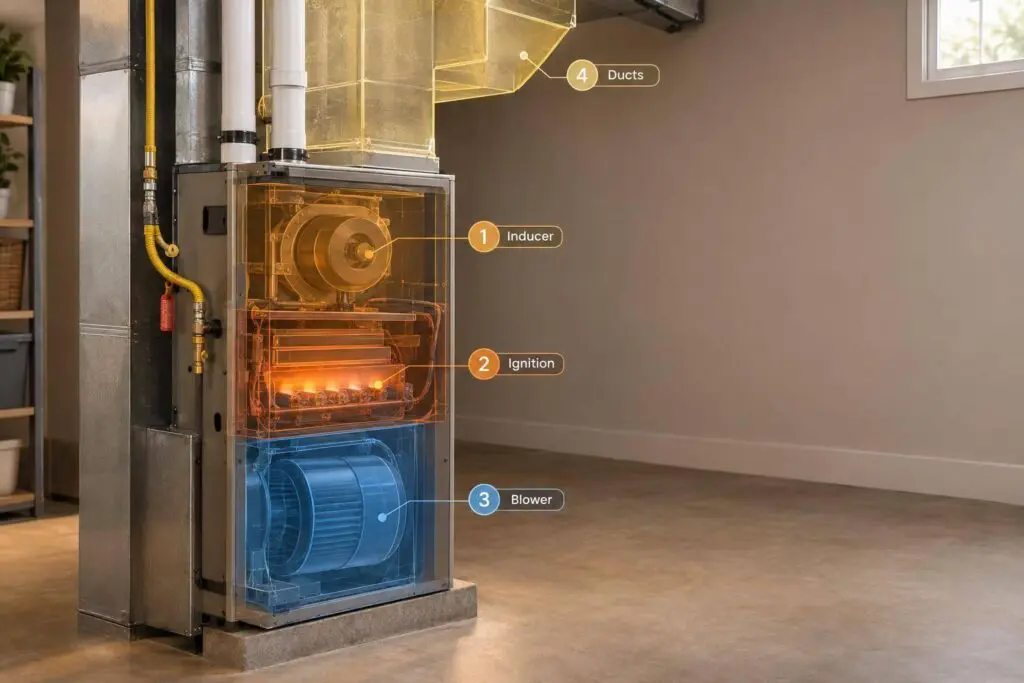
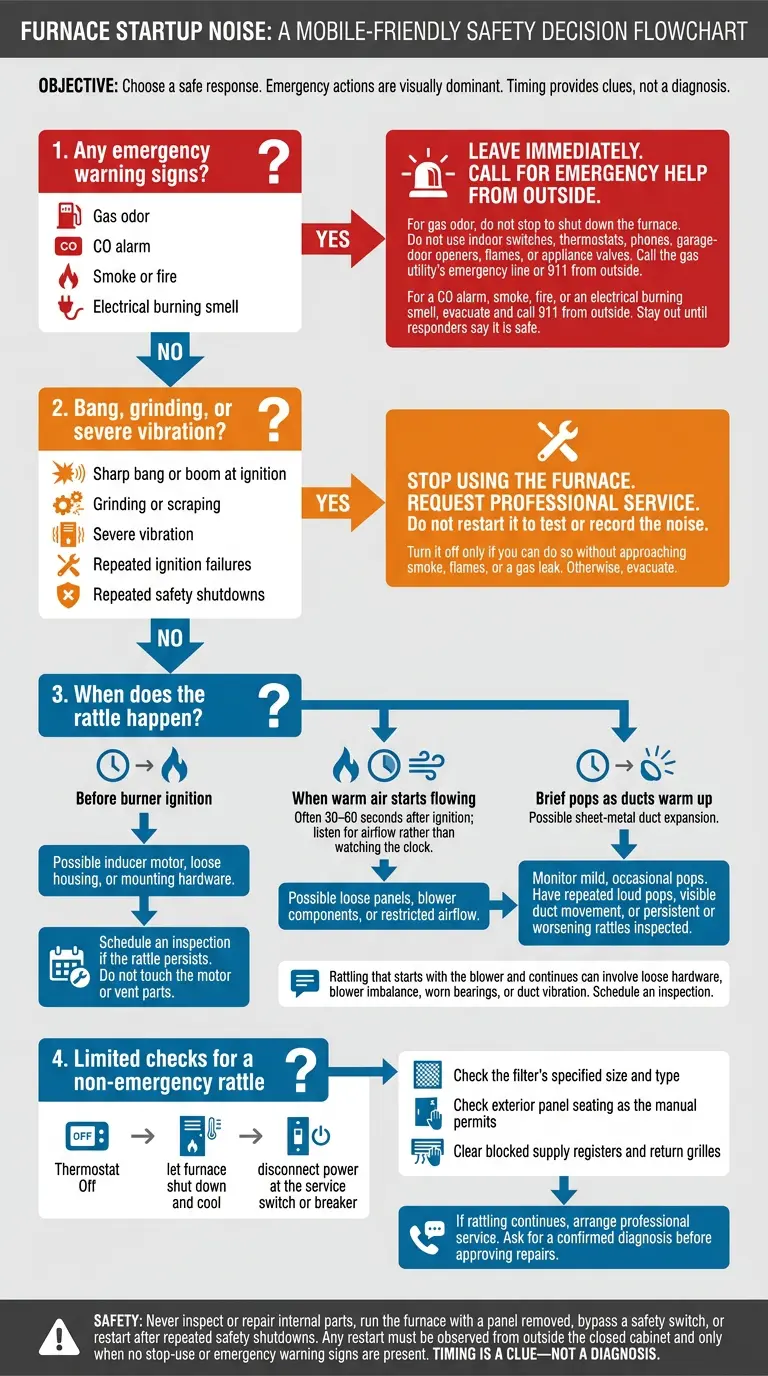
If your furnace rattles at startup, I’d first note when it happens – not assume a part needs replacing. Noise before ignition may involve the inducer. Rattling when warm air starts flowing – often 30–60 seconds after ignition – may come from the blower, loose panels, or ducts.
Here’s how I’d choose the next step:
- Mild, brief duct pops: Monitor them. Persistent or worsening rattles need inspection.
- Blower-start rattling: With power off and the furnace cool, check the filter, exterior panel seating, and blocked registers as the manual allows. Leave internal repairs to a technician.
- Grinding, severe vibration, repeated shutdowns, or an ignition bang: Stop using the furnace. Don’t restart it to test or record the noise.
- Gas odor, a CO alarm, smoke, or fire: <u>Leave immediately</u> and call for emergency help from outside. For gas odor, don’t use indoor switches or phones.
My rule: use timing as a clue, not a diagnosis. Ask for a confirmed cause before approving repairs.
Furnace Rattles at Startup: Safe Next Steps
Noisy Furnace? – Top 5 Fixes | Repair and Replace
When Does the Furnace Rattle?
When the rattle starts helps narrow down the cause. Listen for it before ignition, when the burners light, as the blower starts, or throughout the heating cycle. Use the table below to match the timing with possible sources and a safe first step.
| Sound timing | Possible sources | Recommended response |
|---|---|---|
| Before burner ignition | Inducer motor, loose housing, or mounting hardware | Schedule an inspection if the rattle persists. Do not touch the motor or vent parts. |
| At burner ignition | Delayed ignition or a combustion fault | If you hear a sharp bang or boom, stop the furnace and request professional service. Do not repeatedly restart it. |
| When the circulation blower starts | Loose panels, blower wheel, motor mounts, bearings, or restricted airflow | Turn the power off, then check the filter and visible vents. Arrange service if the rattling continues. |
| Starts with the blower and continues throughout operation | Loose hardware, blower imbalance, worn bearings, or duct vibration | Schedule an inspection. Stop running the furnace if you notice grinding, severe vibration, or repeated shutdowns. |
| Briefly during startup warmup | Sheet-metal duct expansion | Monitor mild, occasional pops. Have repeated loud pops or visible duct movement inspected. |
Burner Ignition vs. Blower Startup
Most gas furnaces light the burners before the circulation blower starts. Listen for airflow rather than watching the clock. A brief, soft whoosh at ignition is different from a metallic rattle that begins when air starts moving.
The inducer can also rattle before the circulation blower runs. A technician should check its bracket, wheel, and bearings – timing alone doesn’t prove that a part has failed. If the noise isn’t tied to ignition, listen for whether it follows warm-air flow or comes from the ducts.
Brief Duct Pops vs. Lasting Rattles
A ping from a wall, ceiling, or register as warm air arrives usually points to duct expansion, not the furnace cabinet. As the ducts heat up, the sheet metal expands. Mild, occasional pops fit that pattern. Repeated rattling, scraping, grinding, or visible movement does not.
Notice whether changes in airflow affect the noise or the heat output drops. These clues suggest a blower or airflow problem rather than normal duct expansion. Don’t dismiss worsening noise as normal expansion, especially if the furnace starts shutting down. If the sound comes from a mechanical issue, the next section covers the most likely parts and repairs.
Causes of Furnace Rattling and Repair Options
When the rattle happens can help narrow down the likely source and repair.
| Symptom or source | Safe owner check, with power off | Typical technician repair |
|---|---|---|
| Loose panel or exterior fastener | Refit accessible panels or check exterior hardware only as the manual permits | Secure or replace damaged panels and fasteners |
| Dirty or poorly fitted filter | Replace with the specified size and type | Repair the filter rack and check for other airflow restrictions |
| Persistent duct vibration | Clear blocked supply registers and return grilles | Repair joints, add supports, or correct contact with framing |
| Blower-start rattle | Check only the filter and exterior panel seating | Remove internal debris; align or replace the wheel, mounts, bearings, or motor |
| Rattle before ignition | Note the timing; do not open the cabinet | Inspect the inducer assembly and vent connector or termination |
| Bang at ignition | Stop use; do not restart for testing | Inspect ignition parts, burners, gas controls, venting, and heat exchanger |
Repair costs depend on the fault, access, labor, and parts. Ask for a confirmed diagnosis before approving work.
The sections below explain common causes and the repairs they usually need.
Loose Panels, Dirty Filters, and Duct Movement
Loose fasteners and poorly seated panels can make cabinet vibration louder. If the rattling persists or gets worse, schedule furnace repair.
A clogged or restrictive filter can reduce airflow and make the furnace noisy. Replace it with the manufacturer-specified size and type, and don’t force it into the rack.
Loose duct joints, missing supports, and sheet metal touching framing need professional repair. Don’t remove duct insulation or change supports yourself.
Blower Wheels, Motor Mounts, and Bearings
A loose shaft connection, damaged blower wheel, worn bearings, loose motor mounts, or trapped debris can cause mechanical rattling. A technician should inspect these parts, remove debris, check alignment, and replace anything damaged.
Don’t inspect, clean, or repair internal parts. Never run the furnace with a panel removed.
Ignition and Combustion Faults
Delayed ignition means gas ignites after an abnormal delay, which can produce a bang. But sound alone can’t confirm the cause.
A qualified technician may check the burners, ignition components, gas controls, venting, combustion air, and heat-exchanger condition. Don’t clean burners, open sealed combustion compartments, adjust gas controls, or repeatedly restart the furnace to test a suspected ignition problem.
Safe Checks Before Calling for Repair
For a non-emergency rattle, set the thermostat to “Off,” let the furnace shut down and cool, then disconnect power at the service switch or breaker. Follow the manual when making the checks listed above.
Watch any restart from outside the closed cabinet. Never bypass a safety switch or restart after repeated safety shutdowns.
If you smell gas, hear a bang at ignition, or get a CO alarm, stop using the furnace and get emergency help.
When to Stop the Furnace or Evacuate
Delayed Ignition and Burner-Area Bangs
If a startup rattle turns into a combustion-related bang or boom, stop troubleshooting. Follow the shutdown or evacuation guidance below.
A brief igniter warm-up is normal. But delayed ignition followed by a boom or hard whoosh, especially after repeated failed starts, means you should stop using the furnace. Turn it off at the thermostat or service switch ONLY if you can reach it without approaching smoke, flames, or a gas leak. Otherwise, evacuate. Leave the furnace off until it has been inspected.
Gas Odor, Carbon Monoxide Alarms, or Smoke
If you smell rotten eggs or raw gas, leave immediately. Don’t stop to shut down the furnace. While indoors, don’t use switches, thermostats, phones, garage-door openers, flames, or appliance valves. Once outside the building, call the gas utility’s emergency line or 911. Don’t search for the leak or go back for belongings.
For a CO alarm, smoke, fire, or an electrical burning smell, evacuate and call 911 from outside. CO has no odor. Symptoms can include headache, dizziness, nausea, or confusion. Don’t silence an alarm to keep the heat running, open the cabinet, or investigate before leaving. Stay out until responders say it’s safe to return. Don’t use the furnace again until qualified professionals confirm it’s safe.
Grinding, Severe Vibration, or Repeated Shutdowns
Even without an odor or alarm emergency, some mechanical problems mean it’s time to stop the furnace and call for service. These include grinding, scraping, severe vibration, repeated ignition failures, repeated safety shutdowns, a persistent burning odor, or suspected burner or heat exchanger damage.
When you call, explain whether the noise happened at ignition or blower startup, how long it lasted, and whether it occurred every cycle. Report any visible error code, weak airflow, or unusual odor. A recording made safely before shutdown may help, but don’t restart the furnace to make one.
Conclusion: Choose the Right Response to the Rattle
Timing helps guide your response – it doesn’t diagnose the problem. A rattle during burner ignition points to a different concern than vibration when the blower starts. A brief duct pop is usually less urgent, but a rattle that lasts or gets worse needs attention.
Keep homeowner checks outside the furnace: check for a dirty filter and blocked registers or vents. Leave internal parts and duct repairs to a professional. Shut off the furnace and schedule service for persistent rattles, blower-related grinding, severe vibration, or repeated shutdowns.
Stop troubleshooting if there’s any sign of danger. For a gas odor, smoke, a CO alarm, or an ignition bang, evacuate and call for emergency help from outside.
Chicagoland homeowners and businesses can contact Eco Temp HVAC for furnace diagnosis, repair, and ductwork evaluation. Before booking, share when the noise occurs, whether the furnace has shut down, and any odors you’ve noticed. Don’t restart the furnace to gather those details.
FAQs
Can my thermostat’s fan setting help pinpoint a rattle?
Yes. Set your thermostat’s fan to “On” or “Fan Only” instead of “Auto.” This runs the blower without turning on the burners. If you hear rattling, the blower assembly is the likely source – possibly a loose component or a failing motor part.
If it rattles only during heating, the noise is more likely tied to the burners, ignition, or duct expansion.
Why does my furnace rattle only on cold mornings?
Cold-morning rattles often happen when ductwork or furnace parts expand and contract as temperatures change. Cold weather can increase that movement, making loose screws or panels vibrate during startup.
But startup rattling can also point to a cracked heat exchanger, a serious safety concern. If you see soot, notice a chemical smell, or spot an orange or yellow burner flame, turn off the system immediately and contact a professional for an inspection.
Does a rattling furnace need repair or replacement?
The fix depends on what’s causing the rattle. Loose cabinet panels or screws may just need tightening. If the noise continues after you’ve checked for loose parts, have a professional inspect the furnace.
Rattling at startup may point to a cracked heat exchanger, which can leak carbon monoxide. This is a serious safety issue that needs immediate professional attention. A cracked heat exchanger can’t be repaired, so it generally means replacing the furnace.