

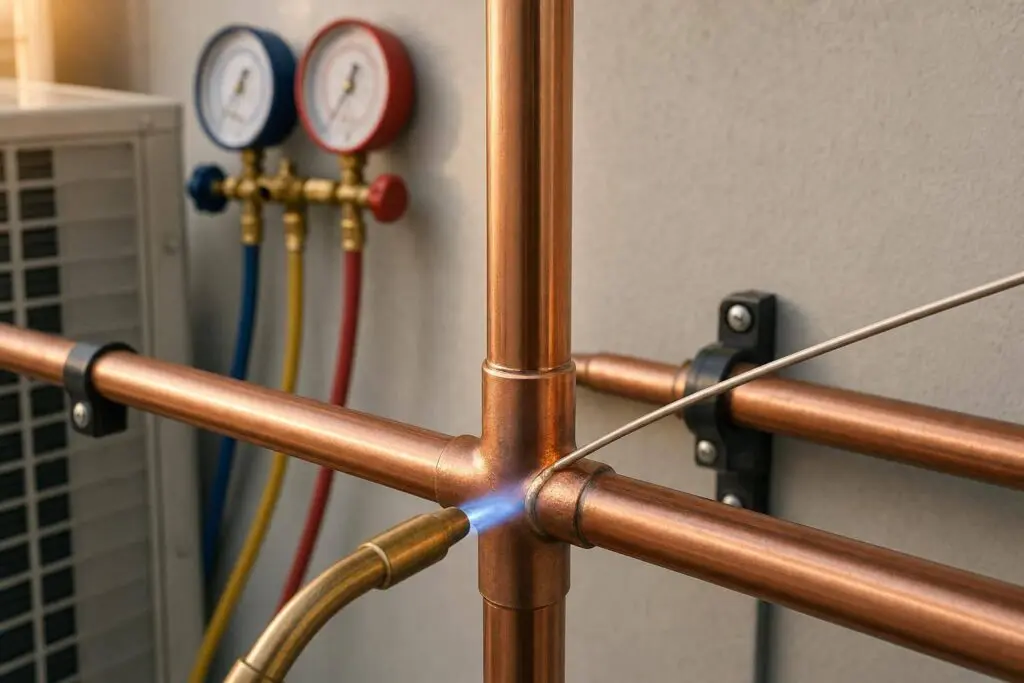
If a copper line carries refrigerant, I would braze it, not solder it. Brazing uses filler metal above 840°F, often around 1,292°F to 1,472°F, which gives the joint more strength for high pressure, vibration, and temperature swings. Soldering runs much cooler, often around 420°F to 450°F, and is better for water lines and condensate piping, not refrigerant circuits.
Here’s the short version:
- Brazing is the HVAC standard for refrigerant copper lines
- Soldering is for lower-pressure piping
- Brazed joints handle systems that run above 200 psi
- Brazing alloys can provide up to 50% more tensile strength than soldered joints
- For copper refrigerant piping, code and manufacturer rules often favor brazing
- A clean joint and nitrogen purge help stop internal scale and leaks
If you just want the answer, it’s simple: for residential and light commercial HVAC refrigerant lines, brazing is the right choice.
HVAC Silver Soldering vs Brazing vs Brazing While Flowing Nitrogen!
Quick Comparison
| Feature | Soldering | Brazing |
|---|---|---|
| Filler metal temp | 420°F–450°F | 1,292°F–1,472°F |
| Joint strength | Lower | Higher |
| Pressure use | Low to moderate | High-pressure refrigerant lines |
| Vibration handling | Lower | Better |
| Common HVAC use | Water lines, condensate drains | Refrigerant lines, coils, heat pumps |
| Flux | Always needed | Not always needed on copper-to-copper |
| Typical fit for refrigerant piping | Usually no | Yes |
I’ll keep the rest simple: when pressure, motion, and code matter, brazing wins.
Brazing for HVAC Refrigerant Copper Lines
Brazing is the standard for copper refrigerant lines in residential and light commercial HVAC installation. And for good reason. Refrigerant joints need to stay tight under pressure, vibration, and constant system cycling. It also matches common HVAC code and manufacturer rules for refrigerant piping.
Heat Range, Alloys, and Joint Performance
Brazing filler metals for HVAC work usually melt between 1,292°F and 1,472°F.
Common HVAC brazing materials include BCuP-3, a 5% silver alloy, along with other copper-phosphorus alloys that contain 0.2% to 0.8% phosphorus. On copper-to-copper joints, these alloys are self-fluxing, so you don’t need separate flux. But for copper-to-brass connections, you should use a silver-bearing alloy with flux.
Silver-bearing brazing alloys can deliver up to 50% higher tensile strength than soldered joints. Brazed joints also hold up well across a temperature range of -40°F to 392°F.
That helps explain why brazing is the go-to choice for refrigerant piping. It’s not just about making a stronger metal-to-metal joint. It’s about getting a joint that can handle the job day after day.
Pressure Handling and Vibration Resistance
Many refrigeration systems run above 200 psi. Brazed joints handle that pressure well, and they also resist creep, the slow shape change that happens under steady heat and stress.
Compressor discharge lines and evaporator coil connections deal with high pressure and steady vibration from the compressor. Those are high-stress spots, which is exactly where brazed joints make sense.
That sets the bar for the next section’s comparison with soldering.
Best Practices for Clean, Reliable Refrigerant Piping
A good brazed joint starts long before the torch comes out. Clean the tube ends with a wire brush or solvent to remove oxides and surface contamination.
Heat control matters just as much. If you overheat the base metal, you can cause oxidation inside the pipe. That leaves scale behind, and that scale can move through the system. The standard fix is nitrogen purging: flow dry nitrogen through the line while brazing to push out oxygen and stop internal scale from forming.
Clean joint + controlled heat + nitrogen purge = a leak-resistant refrigerant line.
Soldering for Copper Lines: Where It Fits and Where It Does Not
Brazing belongs on refrigerant lines. Soldering belongs on lower-pressure copper piping.
Lower Heat, Weaker Joints
Soft soldering uses filler metals that melt well below 840°F, usually around 400°F to 500°F. That lower temperature is the main problem. It doesn’t create the same joint strength as brazing.
And that matters.
A soldered joint is more likely to creep, which means it can slowly deform when it’s under steady stress for a long time. That’s a bad fit for high-pressure refrigerant suction and liquid lines.
Soldering also always needs flux, unlike some brazing alloys. If the wrong flux is used, or if residue is left behind, that leftover material can corrode the system over time. That’s one big reason brazing is the better match for refrigerant piping.
Where Soldering Still Has a Place in HVAC Work
Soldering still has a role in HVAC work. It’s best used for domestic water lines and low-pressure condensate piping in residential and light commercial systems, often serviced by cooling specialists, where pressures are lower than in refrigerant circuits.
Use it only when local code and the manufacturer allow it.
For refrigerant piping, code and manufacturer rules usually take soldering off the table.
Brazing vs Soldering: Direct Comparison for Residential and Light Commercial HVAC
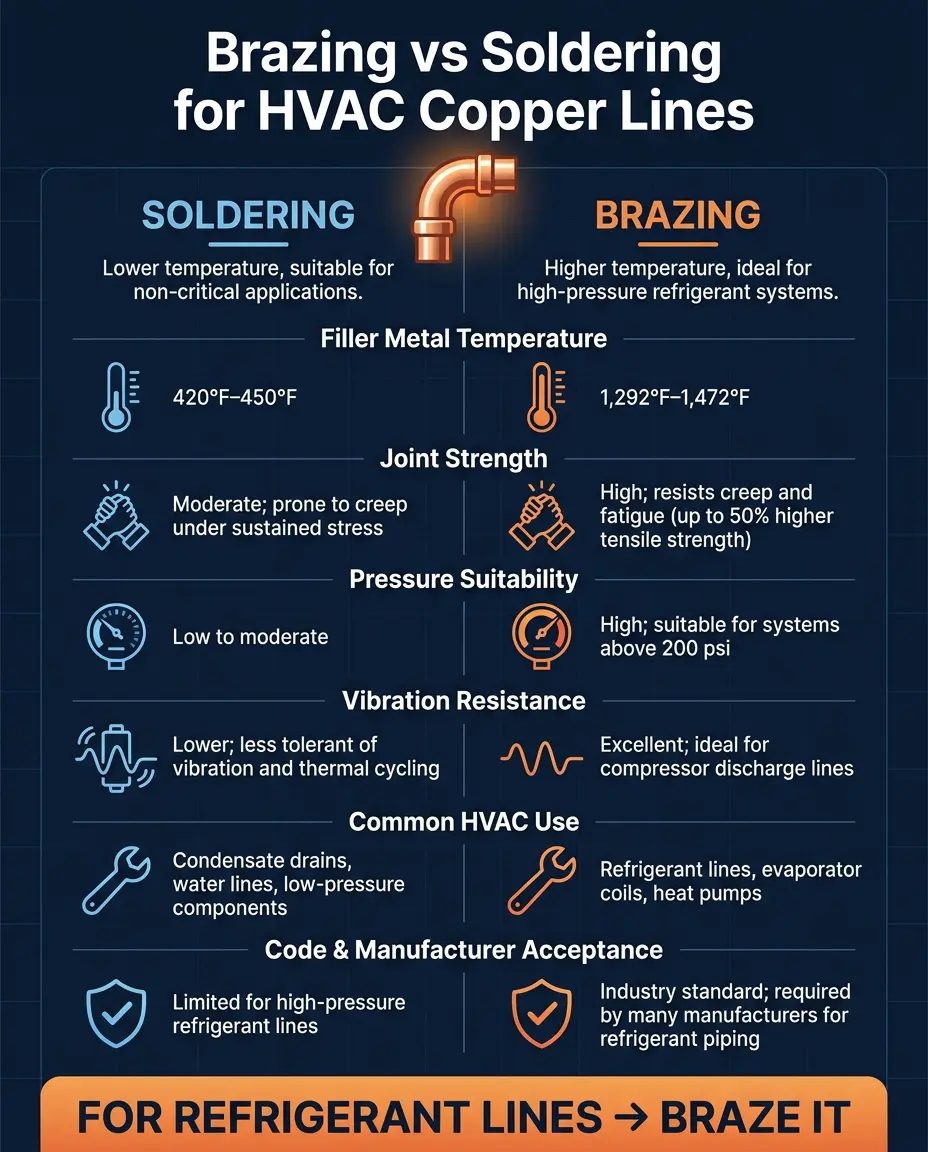
Brazing vs Soldering for HVAC Copper Lines: Key Differences
Comparison Table: Heat, Strength, Pressure, and Code Use
Here’s the side-by-side difference that matters for refrigerant lines.
Brazing and soldering aren’t the same where it counts most for refrigerant piping. Heat range, joint strength, pressure handling, and code acceptance all play a big part.
| Feature | Soldering | Brazing |
|---|---|---|
| Filler Metal Temp Range | 420°F–450°F | 1,292°F–1,472°F |
| Joint Strength | Moderate; prone to creep under sustained stress | High; resists creep and fatigue |
| Pressure Suitability | Low to moderate | High; suitable for refrigerant circuits |
| Vibration Resistance | Lower; less tolerant of vibration and thermal cycling | Excellent; ideal for compressor discharge lines |
| Common HVAC Use | Condensate drains, water lines, some low-pressure components | Refrigerant lines, evaporator coils, heat pumps |
| Code/Manufacturer Acceptance | Limited for high-pressure refrigerant lines | Industry standard for refrigerant piping; required by many manufacturers for refrigerant piping |
That table makes the main point pretty clear: brazing is the standard for refrigerant lines. In HVAC, refrigerant piping has to deal with pressure, vibration, and code rules. That’s where brazing has the edge.
What This Means for Homeowners and Small Business Owners
For homeowners and small business owners, this choice usually comes up during the install of a condenser, heat pump, or ductless mini-split lineset. These systems use high-pressure refrigerants like R-410A, so brazed joints are preferred because they hold up better under pressure, vibration, and constant temperature swings.
Creep resistance also matters more than most people think. When a system keeps cycling through pressure and temperature changes, a weaker joint can become a problem over time.
Using manufacturer-approved brazing methods can also help protect warranty coverage on qualifying systems.
For heat pumps and ductless mini-splits, brazed joints help support long-term performance as operating pressure and temperature shift during normal use. In residential and light commercial HVAC, that difference often decides whether a joint is right for the job.
Conclusion: Which Method to Use for HVAC Copper Refrigerant Lines
Once you stack up heat, strength, pressure handling, and code use, the answer is pretty straightforward: for residential and light commercial refrigerant lines, brazing is the standard.
Soldering still has a place in low-pressure HVAC piping. But refrigerant lines are a different story, and that’s where soldering falls short.
If a copper line carries refrigerant, braze it. It helps protect system performance, reliability, and code compliance.
Eco Temp HVAC provides HVAC installation and service in Chicagoland.
FAQs
Can soldering be used on refrigerant lines?
Yes. You can use soldering on refrigerant lines if the filler material meets industry standards, such as silver-bearing alloys or lead-free options like tin-silver-copper.
That said, brazing is often the go-to choice because it gives you a stronger joint. Still, soldering is accepted for leak-proof copper connections when you use a refrigeration-specific, non-corrosive flux.
The big thing is this: follow the manufacturer’s instructions and your local building code for the system you’re installing and the refrigerant it uses.
Why is nitrogen purging needed during brazing?
Flowing dry nitrogen through copper lines during brazing helps stop copper oxide scale from forming inside the tubing.
Here’s why that matters: brazing uses high heat, and that heat can oxidize the inside of the copper if there’s no nitrogen moving through the line. When that happens, flakes of scale can break loose, travel through the system, and contaminate it.
That debris can also damage key parts, including the compressor valves.
Does brazing affect HVAC warranty or code compliance?
Yes. Brazing can affect both code compliance and warranty coverage.
For code, brazing needs to be done while dry nitrogen flows through the lines. That step helps stop copper oxide scale from forming inside the tubing. If that scale builds up, it can damage compressor valves and, in some cases, lead to system failure.
Warranty coverage can also be affected. If the installer doesn’t follow professional installation standards, the manufacturer may void the warranty. On top of that, brazed connections need to be pressure-tested and inspected to meet International Mechanical Code and ASHRAE safety requirements.