
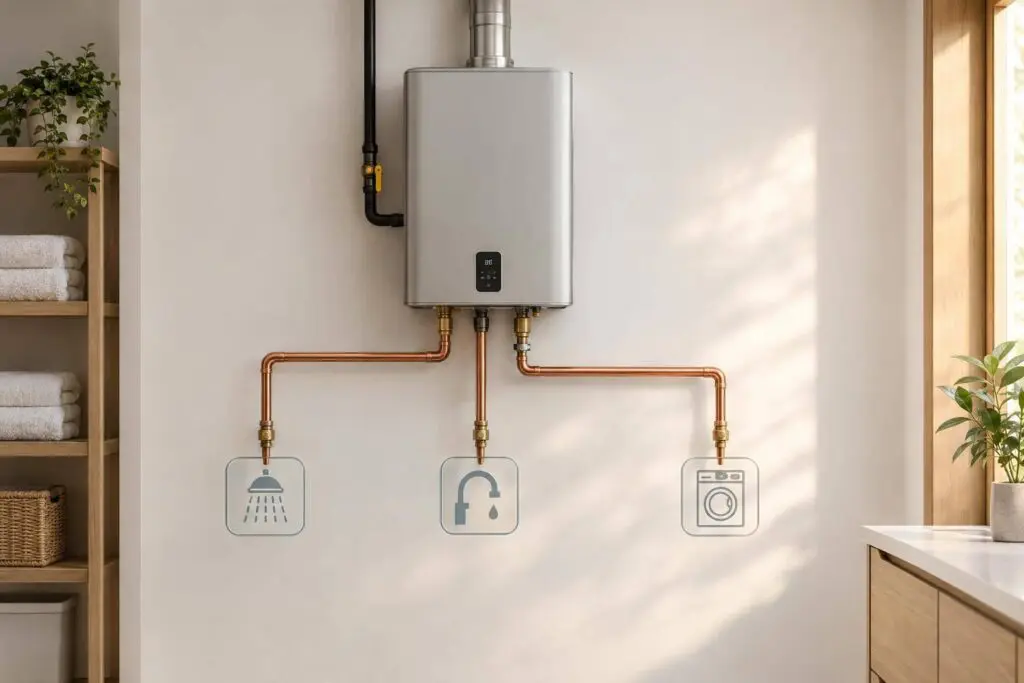
A tankless water heater won’t always pay for itself. I’d start by dividing the extra installed cost, after confirmed rebates, by yearly energy and maintenance savings. ENERGY STAR’s roughly $95-a-year gas savings benchmark shows why a large installation premium can take years to recover.
Here’s how I’d compare household use:
- Low use: Small yearly savings often mean payback takes longer than the heater lasts.
- Moderate use: Regular, longer hot-water draws can improve savings if retrofit costs stay low.
- High use: More gallons can mean more dollars saved – but piping upgrades or multiple units can offset those savings.
My rule: compare tankless with comparable new storage heaters, not your old tank. Use local utility rates, itemized quotes, and maintenance costs. <u>If yearly net savings are zero or negative, there’s no operating-cost payback.</u>
For a Chicagoland home, I’d also check winter capacity: heating 40°F inlet water to 120°F requires an 80°F temperature rise. Total gallons affect savings; simultaneous showers and appliances determine the capacity you need.
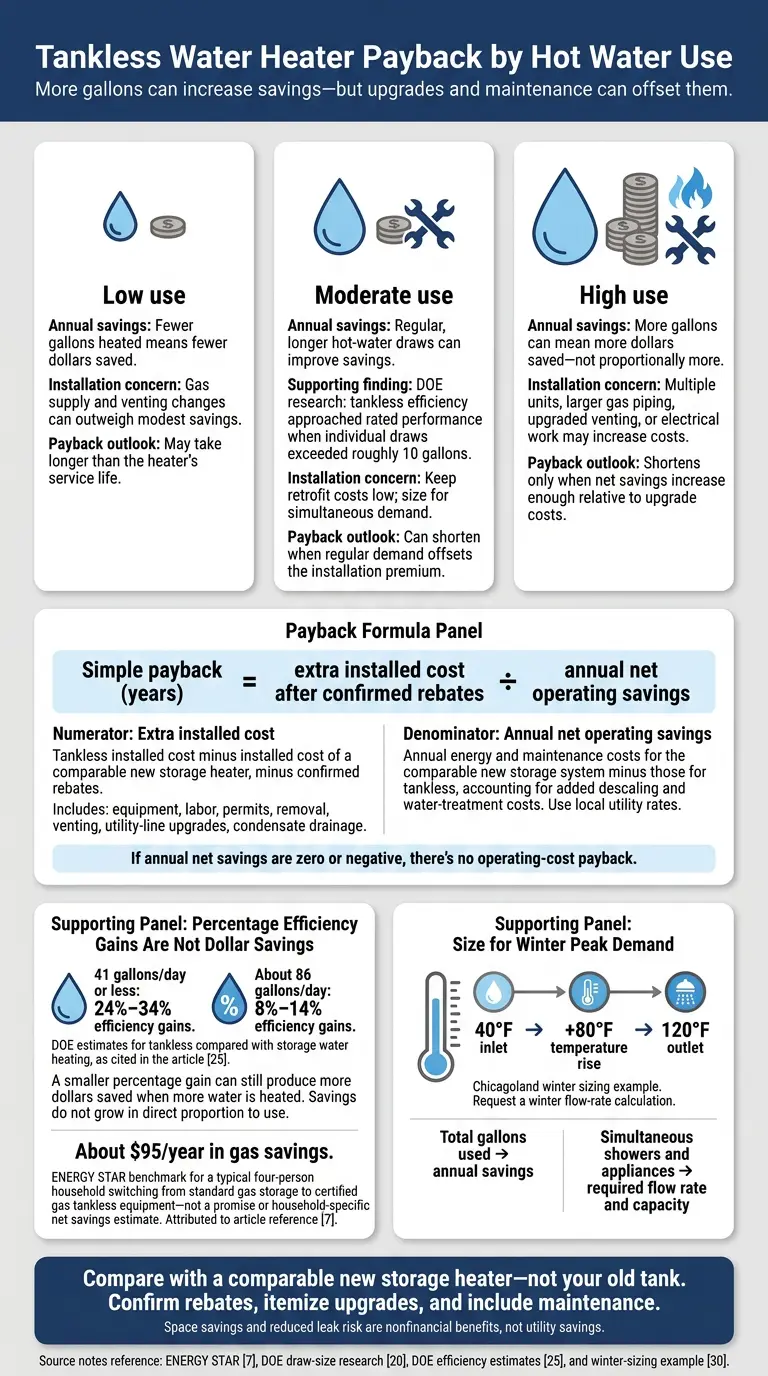
Tankless Water Heater Payback by Hot Water Use
1. Low Hot Water Use
Low-Use Patterns
Low hot-water use means lower annual savings, even when the heater sits idle for long periods. Savings from avoided standby heat loss rarely cover the extra installation cost because fewer gallons heated means fewer dollars saved.
Annual Net Operating Savings
Estimate savings using your actual annual hot-water use. Low-use homes generally save less than ENERGY STAR’s benchmark of approximately $95 per year for a typical four-person household switching from a standard gas storage model to a certified gas tankless heater. Subtract any added descaling, maintenance, or water-treatment costs to find your net savings.
Extra Installation Cost
Compare complete installed quotes that include permits, removal, venting, utility-line upgrades, and condensate drainage. Conversion costs can outweigh modest energy savings, especially if the existing gas supply or venting needs changes.
Simple Payback
Divide the extra installed cost, after rebates, by annual net operating savings. In low-use homes, payback can take longer than the heater’s service life. If net savings are zero or negative, there’s no operating-cost payback. Moderate and high hot-water use improve payback by increasing annual savings.
2. Moderate Hot Water Use
Draw Volume and Timing
With moderate use, payback depends on more than standby heat loss. How often the heater runs matters, too. Regular showers, laundry, and dishwashing create repeat demand, so track shower minutes, fixture flow rates, and appliance cycles – not just household size. Simultaneous showers and appliances determine the required flow rate; total hot-water volume drives annual savings. More frequent use starts to improve those savings.
Annual Net Operating Savings
Use local utility rates to compare annual energy and maintenance costs for both systems. Moderate use gives a tankless heater enough runtime for its efficiency to matter more than it does in low-use homes. DOE research found that tankless efficiency approached its rated performance when individual draws exceeded roughly 10 gallons. Short, scattered draws may produce smaller savings.
Extra Installation Cost
In Chicagoland, Eco Temp HVAC should size the unit for peak flow and the required water temperature increase before quoting equipment. The heater needs to support simultaneous showers and appliances – not just average daily use.
Simple Payback
Moderate use can shorten payback when regular demand offsets the higher upfront cost, but the installation premium needs to stay in check. The strongest case is an aging heater that already needs replacement and requires little retrofit work.
3. High Hot Water Use
Draw Volume and Timing
High daily use isn’t the same as high peak demand. Spreading showers, laundry, and dishwashing throughout the day can reduce the capacity you need without changing total gallons used. Continuous hot water still depends on the unit’s flow rate and temperature rise. Limiting peak demand can help higher total use lead to faster cost recovery.
Annual Net Operating Savings
With high use, the question isn’t whether standby losses matter – it’s how much they contribute to total energy use. DOE estimates tankless efficiency gains of 8%–14% at about 86 gallons per day, compared with 24%–34% at 41 gallons or less. Using more gallons can increase dollar savings, but savings don’t grow in direct proportion to use. Efficiency gains shrink as standby losses account for less of the total fuel used.
Extra Installation Cost
Running several hot-water fixtures or appliances at once may require multiple units, larger gas piping, upgraded venting, or electrical work. Ask for each cost to be listed separately. These expenses add to the installed premium that operating savings must recover. Higher demand can increase both savings and costs.
Simple Payback
Once you account for efficiency gains and upgrade costs, payback depends on which grows faster. Hot-water volume matters more than the label “tankless” in this calculation.
High-use homes recover the added cost sooner only when net savings grow faster than upgrade costs. Higher use can shorten payback when efficiency gains are enough and upgrades are modest. But if peak-demand upgrades increase costs faster than savings, higher use won’t improve payback.
Are tankless water heaters worth the initial investment?
Why Standby Savings May Not Cover the Extra Cost
Modern storage heaters use insulation to limit standby losses, so the gap between systems may be smaller than homeowners expect. ENERGY STAR estimates about $95 in annual savings for a typical four-person household switching from standard gas storage to certified gas tankless equipment. That’s a benchmark, not a promise. The next question is how far those yearly savings go toward covering the extra cost.
For households that use little hot water, long idle periods make standby losses a larger share of the water-heating bill. But a larger share doesn’t always mean large dollar savings. Frequent short draws add another wrinkle: tankless equipment needs a minimum flow to turn on. It also uses electricity for controls, ignition, and, where fitted, pumps or freeze protection. These differences affect annual savings without guaranteeing a short payback.
Calculate payback using net operating savings – not fuel savings alone – and count only confirmed rebates. If payback takes longer than you expect to own the property, the financial case gets weaker.
Space savings and reduced leak risk may also matter, but count them as nonfinancial benefits, not utility savings. Then compare the expected savings with the full installed premium.
Conclusion: Calculate Payback Before Choosing Tankless
Payback depends on hot-water demand, utility rates, efficiency, and installed cost. Together, these factors determine how long it takes for savings to cover the extra cost of tankless.
Record your daily hot-water use in gallons, peak demand in gallons per minute, and when you use hot water. Note your current heater’s age, fuel type, efficiency, and replacement cost. Get itemized quotes that cover equipment, labor, permits, venting, utility upgrades, drainage, and removal.
Calculate annual net savings using your actual rates per therm or kWh, along with maintenance and repair costs. Then divide the extra installed cost, minus confirmed rebates, by those savings. Run the numbers again with lower and higher demand. If net savings are zero or negative, there’s no simple payback.
Check the quoted system’s capacity against winter demand – not summer conditions. In Chicagoland, 40°F inlet water needs an 80°F rise to reach 120°F. Ask for a winter flow-rate calculation rather than relying only on the unit’s nameplate flow rating.
Eco Temp HVAC provides tankless installation, repair, and maintenance throughout Chicagoland. Ask for sizing calculations, an itemized quote, and maintenance requirements.
FAQs
How can I tell if my hot-water use justifies going tankless?
Start with daily use and peak demand. Energy savings range from 24%–34% when you use 41 gallons or less per day to 8%–14% at about 86 gallons. Lower standby losses alone may not make up for higher purchase and installation costs, especially if you use little hot water.
A tankless system may be a better fit if your household uses a lot of hot water, you plan to stay in your home for years, or you want continuous hot water. Before deciding, have a professional check how much hot water you need at once, winter groundwater temperatures, and installation requirements.
How much extra should I pay for reduced standby losses?
Don’t pay a large premium just to reduce standby heat loss unless your household uses enough hot water to make the energy savings worth the cost.
Compared with storage tanks, electric tankless units typically save about $50 a year, while gas models save about $95. Payback often takes 12–20 years for electric units and 22.5–27.5 years for gas models.
Installation upgrades can add $800–$1,500 or more, stretching that payback period even further.
How does hard water affect tankless payback?
Hard water can lengthen the payback period for a tankless water heater by adding maintenance costs. Minerals build up on the heat exchanger, so annual descaling is needed to maintain efficiency and water flow. Professional descaling typically costs $300 or more, adding to yearly operating expenses.
Skipping this maintenance can shorten the unit’s expected service life of 20 years or more and cut long-term savings.