
I’d choose a Goodman AC by your home’s cooling load – not the highest SEER2 rating. Start with a Manual J load calculation and duct check, then compare the exact matched system and total installed price.
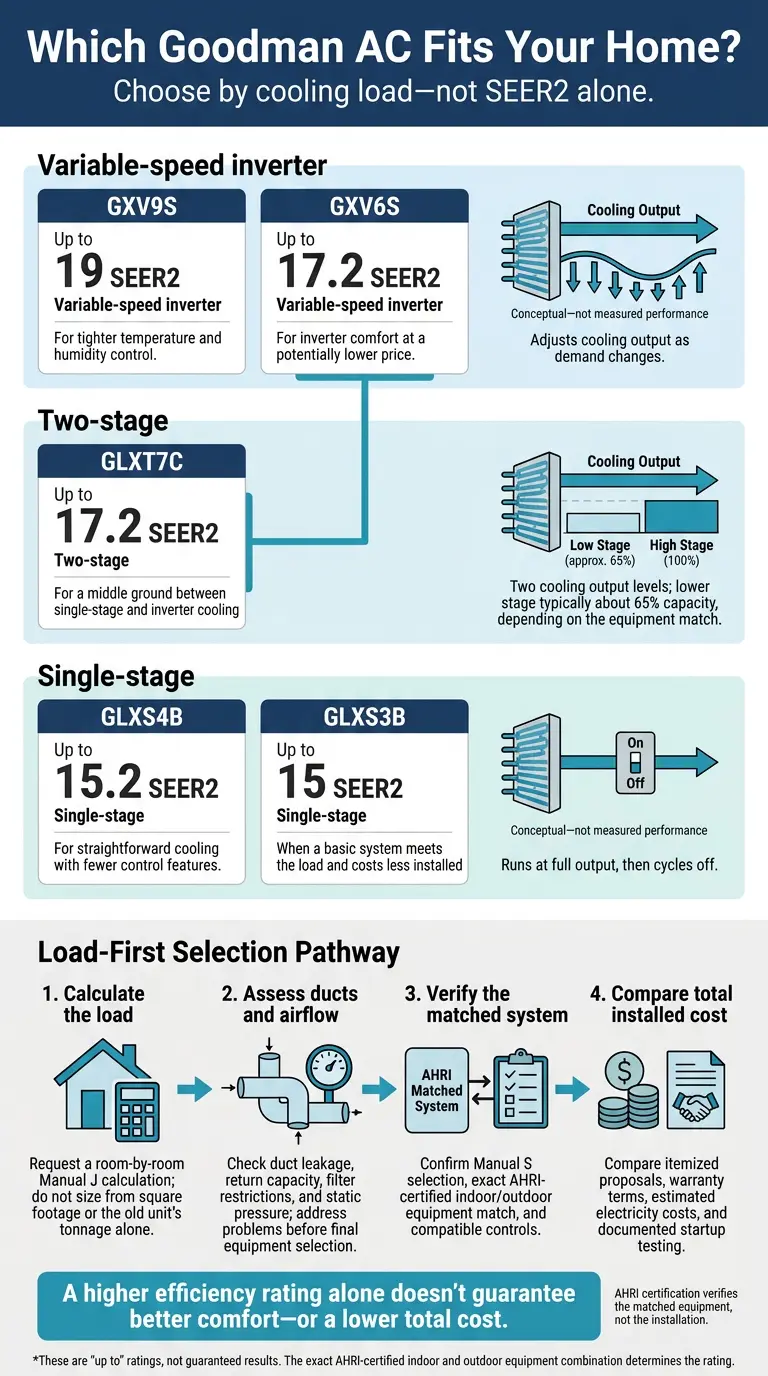
The five models offer three levels of cooling control. Here’s how I’d narrow the choice:
Quick Comparison
| Goodman model | Maximum SEER2* | Cooling control | When I’d consider it |
|---|---|---|---|
| GXV9S | 19 | Variable-speed inverter | For tighter temperature and humidity control |
| GXV6S | 17.2 | Variable-speed inverter | For inverter comfort at a potentially lower price |
| GLXT7C | 17.2 | Two-stage | For a middle ground between single-stage and inverter cooling |
| GLXS4B | 15.2 | Single-stage | For straightforward cooling with fewer control features |
| GLXS3B | 15 | Single-stage | When a basic system meets the load and costs less installed |
These are “up to” ratings, not guaranteed results. The exact AHRI-certified indoor and outdoor equipment combination determines the rating.
Before signing, I’d ask for <u>the equipment match, control requirements, duct assessment, and startup testing in writing</u>. I’d also compare itemized quotes, warranty coverage, and estimated electricity costs. A higher efficiency rating alone doesn’t guarantee better comfort – or a lower total cost.
Which Goodman AC Fits Your Home?
1. Goodman GXV9S
Efficiency and Compressor Operation
The GXV9S’s inverter-driven compressor adjusts cooling output as demand changes instead of starting at full capacity every time. Its up to 19 SEER2 rating is the maximum for a matched system – not a promise of energy savings. This model is best suited to homes that need tighter temperature control, rather than just a high SEER2 number.
Cooling Load and Home Conditions
The GXV9S suits homes that need precise temperature control and better humidity control when cooling demand is low. For larger or harder-to-cool homes, the calculated load and duct system must support the selection. If you rarely use cooling or have modest comfort needs, its added features may not justify the cost.
Once the load is known, check whether the home can support the system’s controls and airflow needs. Poor ductwork, insulation, and airflow can undermine premium equipment. Before sizing, verify return-air capacity, duct leakage, filter pressure drop, and static pressure.
System Compatibility and Installation
Use Goodman communicating indoor equipment and a compatible thermostat to achieve the matched system’s rated performance. In communicating mode, the outdoor unit uses two low-voltage wires. A standard thermostat won’t provide the same modulation or diagnostics.
Ask for a commissioning record that documents airflow, static pressure, refrigerant charge, safety checks, and communication between components. Current GXV9S models use R-32, so the installer must check piping, electrical service, condensate drainage, and safety requirements against the exact installation instructions.
If your home doesn’t need that level of control, the GXV6S offers a simpler high-efficiency alternative.
2. Goodman GXV6S
Efficiency and Compressor Operation
The GXV6S is rated up to 17.2 SEER2 and uses variable-speed inverter control to keep cooling steady and reduce temperature swings. It’s the next step down for homeowners who want inverter comfort without the GXV9S’s top-end price and controls.
Cooling Load and Home Conditions
Size the system for your home’s actual cooling load, not the old unit’s tonnage. Home size, insulation, window exposure, air leakage, and duct losses all affect how well the GXV6S can adjust its output.
Leaky ducts or undersized returns can limit the comfort gains you get from an inverter system. The GXV6S works best when cooling demand stays within its modulation range long enough to run at lower output – even as changing sunlight or the number of people at home creates uneven demand.
System Compatibility and Installation
Check the AHRI match and control package before ordering. The wrong thermostat can limit inverter operation. The GXV6S isn’t a direct substitute for the GLXT7C: their compressor designs, approved equipment matches, and control requirements differ. Control compatibility and system design matter as much as SEER2.
If you prefer a simpler setup and lower upfront cost, consider the next model down. Ask for an itemized installed quote covering equipment, controls, electrical changes, duct repairs, and commissioning. Weigh those costs against your cooling hours and comfort needs – not SEER2 alone.
3. Goodman GLXT7C
Efficiency and Compressor Operation
The GLXT7C sits between single-stage and inverter systems, offering steadier comfort without inverter-level control. It pairs a two-stage Copeland Ultra-Tech scroll compressor with a two-speed ECM outdoor fan and delivers up to 17.2 SEER2. Its two output levels give it more control than a single-stage system.
The lower stage typically runs at about 65% capacity, depending on the equipment match. Longer cycles at lower output can remove more moisture and reduce temperature swings. High stage handles heavier demand, but two stages can’t track changing loads as closely as an inverter.
Cooling Load and Home Conditions
Available sizes range from 2–5 tons, or approximately 24,000–60,000 Btu/h. Have your installer perform a room-by-room Manual J load calculation to check the home’s cooling needs and whether the lower stage will run long enough to control humidity. Even a small, well-insulated home may short-cycle if the lower stage delivers more cooling than the home needs.
In a two-story home, pay attention to duct balancing and upstairs return airflow. More capacity alone won’t fix uneven air delivery. Leaky ducts, weak returns, or high static pressure can wipe out the comfort gains of two-stage cooling.
System Compatibility and Installation
Have the installer verify ComfortBridge-compatible indoor equipment, the matched coil or air handler, and blower support for both stages. They should also measure total external static pressure and set airflow for each stage. Incorrect airflow can hurt humidity control and increase noise.
Compatible ComfortBridge equipment can manage staging within the system, so you won’t always need a two-stage wall thermostat. Ask the contractor to verify the wiring and control setup, then test both stages during commissioning. On supported equipment, CoolCloud supports setup and diagnostics. For two-stage control to help, the lower stage must match the home’s load closely enough to allow longer cycles.
If you don’t need two-stage cooling, the next model uses a simpler, lower-cost single-stage design.
4. Goodman GLXS4B
Efficiency and Compressor Operation
If the GLXT7C offers more comfort control than you need, the GLXS4B keeps cooling simple at a lower cost. It’s a single-stage R-32 unit rated up to 15.2 SEER2 in an AHRI-certified match. The compressor runs at full output, then cycles off. That simpler design can lower the upfront price, but it lacks the capacity control of Goodman models with more advanced compressor modulation.
Cooling Load and Home Conditions
The GLXS4B comes in 1.5–5-ton capacities, or about 18,000–60,000 Btu/h. Use a Manual J load calculation to size it – not the old unit’s tonnage. Your home’s size, insulation, windows, air leaks, and duct condition all affect the cooling load.
With single-stage cooling, oversizing can mean short cycles that cool the air without removing enough moisture. The result? A cool but humid home. Fix air leaks or duct restrictions before choosing a larger condenser to address comfort problems.
System Compatibility and Installation
The GLXS4B does not use ComfortBridge controls. Ask your installer to confirm the approved thermostat and wiring setup, along with the exact AHRI-approved R-32 coil and air handler combination. An existing R-410A coil isn’t an acceptable match just because it fits.
R-32 is a mildly flammable A2L refrigerant, so installation must follow manufacturer instructions and applicable safety codes. Get a written scope that covers refrigerant-line assessment, leak testing, evacuation, electrical protection, condensate drainage, measured airflow, and commissioning.
Replacing indoor components or ducts can drive up the total price of a lower-cost unit. Have those upgrades itemized before comparing installed costs.
For an even simpler, lower-cost option, the GLXS3B takes another step down in efficiency and features.
5. Goodman GLXS3B
Efficiency and Compressor Operation
The GLXS3B is Goodman’s simplest high-SEER2 option, rated up to 15 SEER2, though some matched combinations have lower ratings. Compare the exact AHRI match and installed price – not just the model name. Your home’s cooling load should guide whether a basic single-stage system makes sense.
Cooling Load and Home Conditions
The GLXS3B may suit a home with modest cooling demand, decent insulation, and ducts in usable condition. Use a room-by-room BTU calculator or Manual J calculation to size it, rather than copying the old unit’s tonnage. Check duct static pressure and airflow before replacing the equipment. Proper capacity and duct condition matter more than the model label.
System Compatibility and Installation
Use approved R-32 indoor components and controls. Don’t assume an existing indoor component can be reused.
The quote should specify the exact matched system, total installed price, warranty terms, and startup testing. Choose the GLXS3B only if that system and price make it the better fit, with capacity matched to the home’s actual cooling load and installation limits.
Match AC Capacity to Your Home and Comfort Needs
After comparing Goodman’s model types, let your home’s calculated cooling load guide the choice – not square footage alone. Ask for a room-by-room Manual J load calculation that accounts for orientation, windows, insulation, air leakage, occupancy, and internal heat gains under local summer design conditions.
Load is measured in Btu/h. Tons describe equipment size, not the home’s load. 1 ton equals 12,000 Btu/h.
Fix insulation and duct problems before choosing equipment. Check attic insulation, air leakage, duct sealing and insulation, return capacity, and restrictive filters. Recalculate the load after any improvements that change it. Duct cleaning removes debris; it won’t fix undersized ducts or poor design. Use Manual D to connect room loads to airflow needs rather than assuming 400 CFM per ton.
Use the calculated load to narrow the model family, then verify the exact equipment match.
| Home or comfort need | Best-fit model family | What must be verified |
|---|---|---|
| Longer operation at low capacity, quieter cooling, and advanced comfort control | GXV9S variable-speed | Capacity range, communicating controls, indoor match, and electrical requirements. |
| Variable-speed comfort with different budget or control priorities | GXV6S | Approved indoor combination, capacity at design conditions, controls, and installation requirements. |
| Staged cooling that balances comfort and equipment cost | GLXT7C two-stage | Low-stage capacity, minimum airflow, thermostat compatibility, sound ratings, and certified match. |
| Straightforward cooling with conventional controls | GLXS4B or GLXS3B single-stage | Actual capacity, approved indoor match, and duct airflow. |
Each option depends on calculated loads, approved equipment matches, suitable ducts, and commissioning results. Ask the contractor to document room-temperature targets, humidity expectations, sound ratings, and control settings. Check minimum capacity and airflow for mild weather and times when only a few rooms need cooling. Variable-speed and two-stage systems can improve comfort at partial load, but sizing, air distribution, and controls must support that operation.
With the load established, check compatibility, installation requirements, and total cost.
Check System Compatibility, Installation, and Total Cost
Once you’ve narrowed the model family by load, check the installation details that affect performance and cost. Before approving a model, require Manual J results, Manual S selection, manufacturer performance data at local design conditions, and an AHRI-certified match.
| Compatibility item | What to verify | Why it matters |
|---|---|---|
| Outdoor condenser and indoor coil or air handler | Exact model numbers and AHRI-certified match | Published ratings apply only to the listed combination |
| Manual J load | Room-by-room and whole-home design cooling load | Avoids choosing equipment based only on square footage |
| Manual S selection | Manufacturer data, sensible capacity, latent capacity, sensible heat ratio, and sizing limits | Checks whether the model can control temperature and humidity under local conditions |
| Refrigerant lines | Correct diameter, length, insulation, condition, and allowable elevation | Existing lines aren’t automatically reusable |
| Electrical service | Panel capacity, voltage, wiring, breaker, and disconnect | Existing electrical work may need changes |
| Available space | Cabinet dimensions, pad, service access, and manufacturer-required clearances | Equipment needs room for airflow and maintenance |
| Air distribution | Blower capacity, filter area, duct dimensions, leakage, insulation, and static pressure | Restrictions and leaks reduce delivered performance |
| Drainage and controls | Drain routing, overflow protection, thermostat compatibility, and communicating-control requirements | Helps prevent water damage and keeps the system working as intended |
| Commissioning | Leak testing, evacuation, refrigerant charge, airflow, temperature, pressure, electrical, and control checks | Checks the field installation – not just nameplate ratings |
AHRI certification verifies the matched equipment, not the installation. Ask for a startup record documenting evacuation, charging method, airflow, static pressure, temperatures, voltages, currents, and control checks. A temperature split alone doesn’t confirm correct charge, airflow, humidity control, duct delivery, or electrical operation.
After confirming compatibility, compare itemized installed quotes with the same scope. Each should account for outdoor equipment, the indoor coil or air handler, furnace, thermostat or controls, labor, refrigerant lines, electrical work, pad, disconnect, duct repairs, drainage, permits, disposal, and commissioning. Check whether the quoted efficiency requires replacing indoor equipment.
Review warranty terms separately: manufacturer parts coverage, compressor coverage, and labor coverage. Check registration requirements, exclusions, and maintenance-plan charges, too. If the system uses communicating controls, ask about replacement availability and costs after the warranty ends.
To estimate ownership costs, compare annual electricity use based on cooling hours and manufacturer data, then apply your actual electricity rate. Savings are estimates, not guaranteed payback. Count incentives only after checking current eligibility, dates, and installation requirements. Include maintenance and repair assumptions, plus a maintenance schedule for filters, coils, drains, electrical connections, and airflow.
Conclusion: Choose the Right Fit, Not Just Higher SEER2
The right Goodman system depends on your home – not just its efficiency rating. The GXV9S and GXV6S are variable-speed options, the GLXT7C is two-stage, and the GLXS4B and GLXS3B are single-stage budget models.
Base your choice on cooling load, insulation, duct condition, and humidity needs. Follow this order: load first, then system match, then price. A higher SEER2 rating alone doesn’t mean a system fits your home.
Before signing a contract, request a Manual J load calculation, duct assessment, AHRI match details, and itemized proposal. Use these to verify that the proposed system matches your home’s load, ducts, and comfort needs.
FAQs
Should I upgrade insulation before sizing my Goodman AC?
Yes. Improving insulation and sealing ductwork before sizing a new Goodman AC can reduce your home’s cooling load. A professional Manual J load calculation factors in those updates to determine the right system size. That could lower equipment costs and help the system run efficiently.
Eco Temp HVAC recommends fixing insulation gaps and duct leaks before replacement so your new system is sized for your home’s actual cooling needs.
How can I tell if my ducts can support variable-speed cooling?
Ask your contractor to inspect the entire duct system, including supply and return ducts, registers, grilles, dampers, and any restricted sections.
Request documented measurements – not estimates for airflow in cubic feet per minute (CFM) and static pressure in inches of water column. Compare those readings with the manufacturer’s requirements for the unit you’re considering. Have the contractor check that the ducts are properly sealed and insulated to limit air loss.
Is higher SEER2 worth it for Chicago summers?
The right choice depends on how much you use your AC and how long you plan to stay in your home. Chicago’s relatively short cooling season means a standard residential upgrade can take 14–15 years to pay for itself through energy savings.
High-SEER2 units have the lowest running costs and better humidity control. But 16–18 SEER2 often strikes the best balance between upfront cost and energy savings.
Eco Temp HVAC performs professional load calculations to help determine the right system for your home.