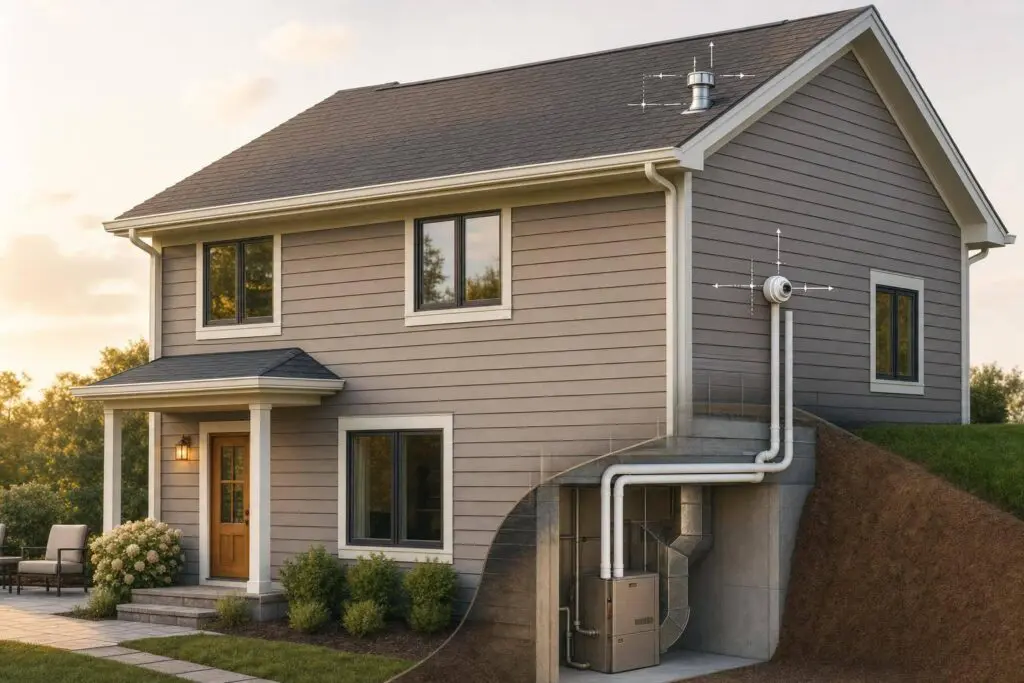

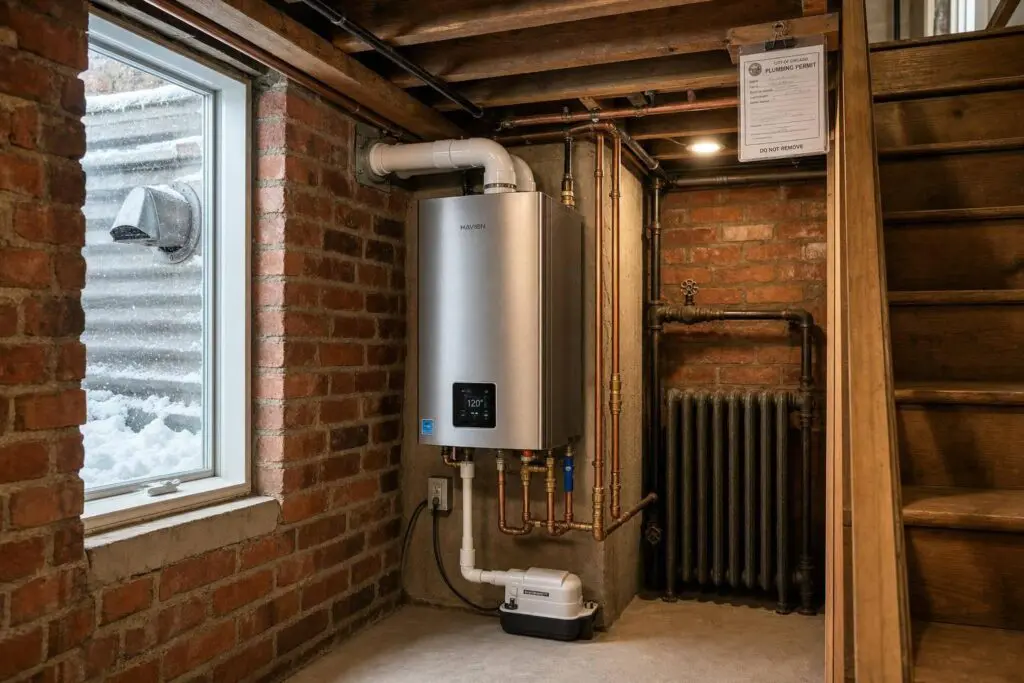
Boiler installation in Chicago is often a retrofit, not a simple swap. If I own an older home, I may face tight basement access, old radiators, venting limits, frozen condensate lines, and city permit steps before the new unit can even start.
Here’s the short version:
- Costs often range from $4,000 to $9,000, and hard retrofits can go past $12,000.
- Older homes often have steam systems, cast-iron radiators, narrow stairs, and chimneys that may need liners.
- Small mechanical rooms can limit boiler size, piping layout, clearances, combustion air, and drain routing.
- Old piping and radiators can lead to leaks, cold spots, noise, pressure issues, and uneven heat after startup.
- Condensing boilers need the right venting and a safe condensate path. In Chicago, -5°F winter design temperatures make frozen condensate lines a common shutdown risk.
- Permits and inspections matter. In Chicago, permit fees are often $100 to $300, and the project timeline can depend on city sign-off.
- Before installation, I’d want a Manual J load calculation, a venting plan, a drain plan, and a clear permit schedule.
If I had to boil it down, the main issue is simple: Chicago homes are old, winters are cold, and boiler installs depend on the house as much as the boiler itself.
This section pulls the article into one plain-language overview so I can see the main problems, costs, and planning steps at a glance.
The Unique Heating & Cooling Requirements of Chicago Bungalows (Webinar Recording)
sbb-itb-b5c10b1
1. Older Chicago Housing Makes Boiler Retrofits Harder
In many older Chicago homes, a boiler replacement isn’t just a swap. It turns into a retrofit fast.
A lot of older houses and two-flats still run on their original steam heating systems. That means the new boiler needs to fit the setup that’s already there. If it doesn’t, the job can expand in a hurry.
Old Chimneys, Flues, and Boiler Room Access
Older masonry chimneys often need liners before a modern boiler can connect to them. That’s why a chimney inspection matters before installation starts. If the chimney needs a new liner, that work has to be built into the plan from the start.
Access can also be a headache. Narrow stairs, tight doorways, and small basement entries make it harder to move equipment in and out. In some homes, installers need sectional equipment that can be carried down in pieces and put together on-site.
Switching Boiler Types Changes the Whole Retrofit
The simplest job is replacing a boiler with the same type.
Things get more involved when a homeowner moves from an older floor-mounted cast-iron unit to a modern condensing boiler. At that point, the retrofit changes in a big way. A different boiler type usually means new venting and drainage work, and condensing boilers are smaller and often wall-mounted.
Older home layouts don’t help much, either. They often leave very little room for piping and required clearances, which sets up the next round of installation problems.
2. Tight Mechanical Rooms and Aging Radiator Systems Add Installation Risk
Even if you pick the right boiler, the job can still go sideways in a cramped mechanical room. Once the boiler matches the home’s heating load, the next step is making sure the room and the old system can actually support the install.
Limited Space for Piping, Clearances, and Combustion Air
Chicago boiler retrofits often run into small utility rooms, awkward layouts, and limited access. And that matters more than it seems at first glance.
A proper install still needs safe front and side clearance around the unit. If there isn’t enough room, future service gets a lot harder. In some cases, a technician may need to pull apart nearby piping or other parts of the room just to reach the boiler.
Tight spaces also make pipe routing and condensate drainage harder to handle. Condensing boilers need proper condensate management, and combustion air can be limited in a sealed or undersized utility room. Compact boiler models fit tight utility areas better. Combi boilers are also worth a look because they provide both heating and on-demand hot water in a smaller footprint.
Old Radiators and Piping Can Cause Imbalance, Leaks, and Flow Problems
A new boiler often brings old system problems to the surface. Sludge, trapped air, corrosion, and poor balance inside aging piping don’t always show up until the new equipment is connected and started.
In older systems, those problems can lead to uneven heat, leaks, pressure loss, or noisy pipes. That’s why pre-installation testing matters. It helps catch hidden trouble before the job moves too far.
These issues usually appear during startup, balancing, and leak testing. The table below shows the symptoms installers most often find when tying a new boiler into an older radiator system, what usually causes them, and what should be checked before the install is signed off.
| Symptom | Likely Cause | Installation-Phase Check |
|---|---|---|
| Cold spots on radiators | Sludge buildup or trapped air | System flushing and radiator bleeding |
| Water pooling near pipe joints | Corroded piping or high pressure | Pressure testing and leak detection |
| Uneven heat between rooms | System imbalance | Balancing valves check and adjustment |
A startup check helps catch these problems before startup turns into a callback.
3. Venting and Condensate Problems Are Common in Chicago Winters
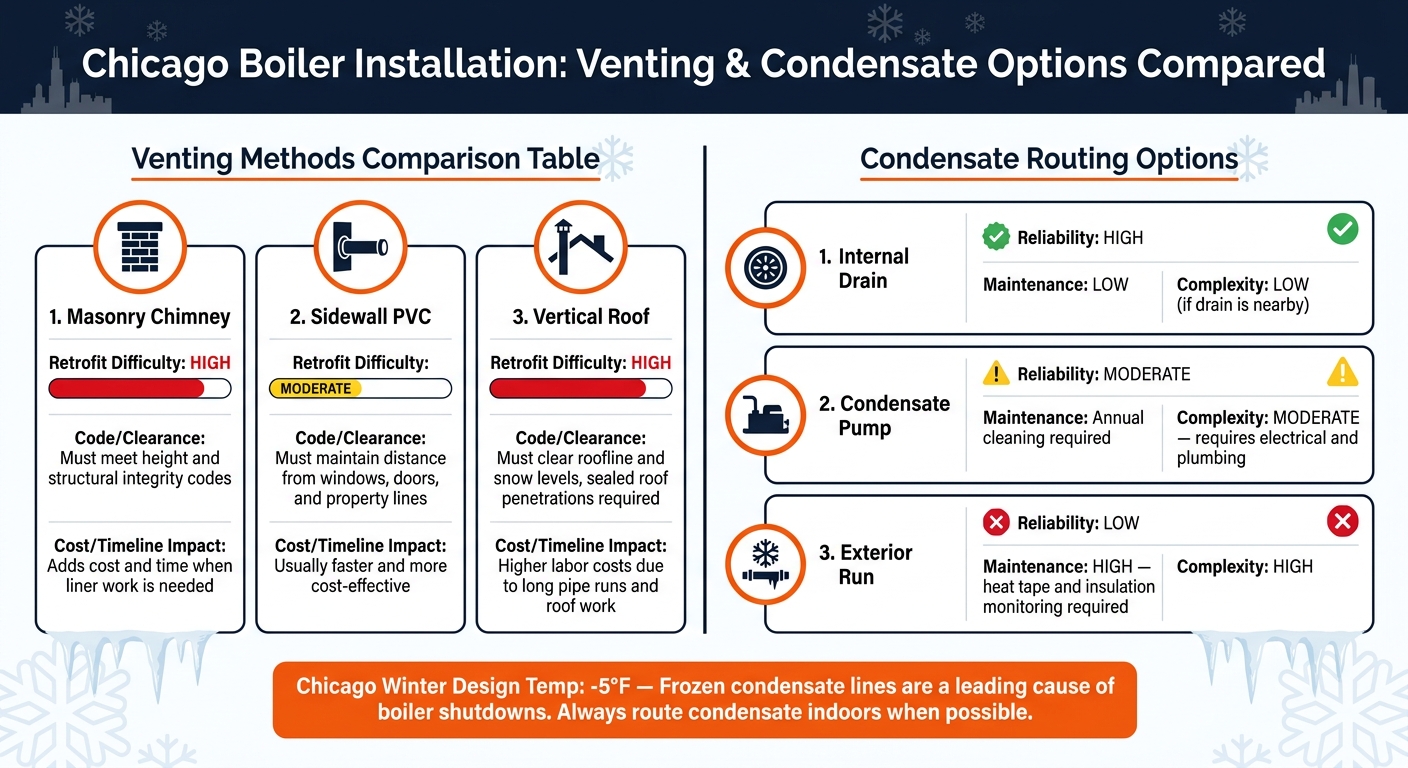
Chicago Boiler Installation: Venting Methods Compared
Once the boiler fits the space, venting and condensate routing become the next Chicago-specific hurdles.
Sidewall Venting and Chimney Reuse Are Not Always Simple
High-efficiency boilers produce cooler, pressurized exhaust. That exhaust can’t be vented safely into an unlined masonry chimney. If you do, moisture can form inside the flue and damage the chimney over time.
That’s why reusing an existing chimney is often less simple than it sounds. In many retrofits, the chimney needs a stainless steel liner first, which adds cost and usually brings masonry work into the job.
Sidewall venting with PVC is often the cleaner path for condensing boilers. But in Chicago, tight lot lines can make that tricky. Local code requires clearance from windows, doors, and property lines, so finding a legal exterior termination point isn’t always easy on narrow lots.
| Venting Method | Retrofit Difficulty | Code/Clearance Concerns | Impact on Cost/Timeline |
|---|---|---|---|
| Masonry Chimney | High; often needs liner or sizing work | Must meet height and structural integrity codes | Adds cost and time when liner work is needed |
| Sidewall (PVC) | Moderate; common for condensing boilers | Must maintain distance from windows, doors, and property lines | Usually faster and more cost-effective than chimney repair |
| Vertical (Roof) | High; requires routing through existing structure | Must clear roofline and snow levels, with sealed roof penetrations | Higher labor costs due to long pipe runs and roof work |
Venting also affects where condensate can go. In practice, these two choices are tied together.
Frozen Condensate Lines Can Shut Down Condensing Boilers
Chicago’s winter design temperature is -5°F. So if a condensate line runs through an unheated space or along an exterior wall, freezing is a real risk.
And when that line freezes, the boiler usually shuts down on a fault.
The most dependable setup is routing condensate to an indoor floor drain. That keeps the line out of the cold and cuts down freeze risk. The catch? Mechanical room layout doesn’t always make that possible.
If there’s no nearby indoor drain, a condensate pump can move the water to a better drain point. That can solve the layout problem, but it also adds another mechanical part that needs periodic service. A pump that gets neglected can become its own headache.
Exterior condensate runs should be the last option. If they can’t be avoided, they need heat tape and insulation checks to help reduce freeze risk.
| Condensate Routing | Reliability | Maintenance Needs | Installation Complexity |
|---|---|---|---|
| Internal Drain | High; protected from freezing | Low; requires clear path to floor drain | Low, if drain is nearby |
| Condensate Pump | Moderate; failure risk | Annual cleaning of pump reservoir | Moderate; requires electrical and plumbing |
| Exterior Run | Low; high freeze risk in Chicago winters | High; requires heat tape or insulation monitoring | High; must be protected against extreme cold |
Route the condensate path before installation starts. These details should be settled before permit review and final inspection.
4. Permits, Inspections, and Final Planning Steps
Once venting and condensate routing are settled, permits and inspections are the last step before startup.
Chicago Permit and Inspection Requirements
Boiler installation in Chicago isn’t just a mechanical job. It also comes with permit and inspection requirements. The City of Chicago requires permits and inspections for new boiler installations, and that process can affect both the timeline and the equipment you choose.
Local permit fees for boiler projects usually fall between $100 and $300. But the bigger issue isn’t the fee. It’s the inspection sequence. A boiler isn’t officially commissioned and started until the city signs off on the work. So this approval step needs to be part of the schedule from day one.
Chicago boiler work must meet the 2018 IECC and local energy code amendments, which often steers projects toward 90%+ AFUE condensing boilers.
Before work starts, confirm that your contractor is handling the permits and whether the fee is included in the quote. If permits are skipped, you could end up dealing with fines or problems during a home sale.
A few final checks can save a headache later:
- Complete a Manual J load calculation before locking in equipment so the boiler matches the home’s actual heat loss.
- Check rebate eligibility early, since some applications may need to be filed before installation.
Conclusion: Good Boiler Installs Start with Site-Specific Planning
Chicago boiler installation is a site-specific job, not a simple swap. When the venting path, condensate routing, radiator compatibility, and permit timeline are sorted out before the job begins, the install usually goes smoother and the system is set up better for long-term performance. That’s why the best installs start with a site visit, not an equipment order.
FAQs
How do I know if my boiler replacement is a retrofit?
A boiler replacement counts as a retrofit when the new unit has to fit into your home’s existing setup instead of going into a brand-new system.
That usually means working around what’s already there, like:
- current piping, venting, or radiators
- a switch from steam to hot water
- major repiping or chimney changes for a high-efficiency condensing boiler
This isn’t just a swap-out job. The new boiler needs to match the home’s layout and heating setup, or you can run into poor performance and higher energy bills.
That’s why a professional heat load calculation matters. It helps size the new boiler the right way based on your home’s heating needs, not just the size of the old unit.
Can my old radiators work with a new boiler?
Yes. Old radiators can often work with a new boiler, which means you may be able to keep your home’s original heating setup without adding new ductwork.
The main thing is to match the new boiler to the system you already have. If your home uses steam, you need a steam boiler. If it uses hot water, the boiler should be sized from a heat load calculation, because many older systems were built larger than needed.
How long can permits delay a boiler installation?
In Chicago, permits can push a boiler installation back by 2 to 4 weeks.
That’s because the city has its own mechanical code amendments, and the paperwork can get a little messy fast. Working with a qualified professional helps you stay on top of permits, inspections, and local code requirements. Eco Temp HVAC can help simplify the process and make sure the system meets Chicago’s rules from the start.