
If a hospital HEPA filter is in the wrong spot, the room can miss its air-control goal even if the filter itself is rated at 99.97% at 0.3 microns.
Here’s the short answer: HEPA placement depends on what the room must do. I’d use terminal supply HEPA for operating rooms and protective environment rooms, exhaust-side HEPA for isolation rooms when air can’t go straight outdoors, and portable HEPA units only as support, not as the main pressure-control method.
That comes down to five checks:
- Placement: central AHU, terminal supply, exhaust, or portable unit
- Pressure: negative for AIIRs, positive for PE rooms and many ORs
- Air path: where clean air goes and where dirty air leaves
- Service access: how staff will test and replace filters
- System load: added static pressure, fan demand, and airflow drop
A few numbers make the point fast:
- HEPA: 99.97% at 0.3 µm
- AIIR pressure target: about -0.01 in. w.g. (-2.5 Pa)
- PE room pressure target: about +0.01 in. w.g. (+2.5 Pa)
- HEPA pressure drop: often 1.0-1.5 in. w.g. at rated airflow
- Portable HEPA support: often 300-800 cfm, sized to help reach 12+ ACH when feasible
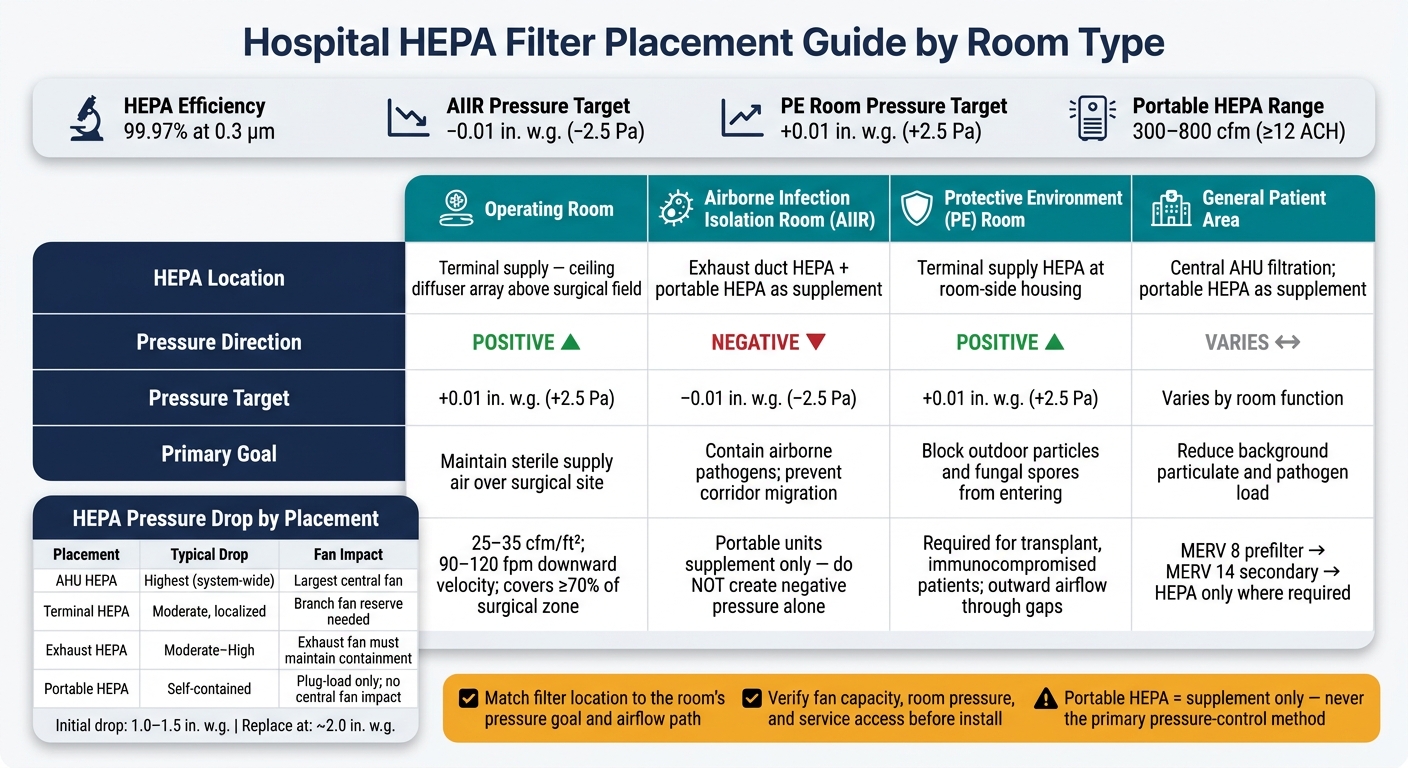
Hospital HEPA Filter Placement Guide by Room Type
Protective Environment Rooms: HEPA Placement | ASHRAE 170 & HFDP
sbb-itb-b5c10b1
Quick comparison
| Space | Usual HEPA location | Main goal | Pressure direction |
|---|---|---|---|
| Operating room | Terminal supply | Keep supply air clean over the sterile field | Positive |
| AIIR | Exhaust duct HEPA if needed; portable as support | Keep infectious aerosols from leaving the room | Negative |
| PE room | Terminal supply | Protect patient from airborne particles and spores | Positive |
| General patient area | Central filtration; portable only when needed | Lower background particle load | Varies |
So if you’re choosing hospital HEPA placement, I’d keep it simple: match the filter location to the room’s job, then verify fan capacity, room pressure, and service access before install.
Where HEPA filters are placed in hospital HVAC systems
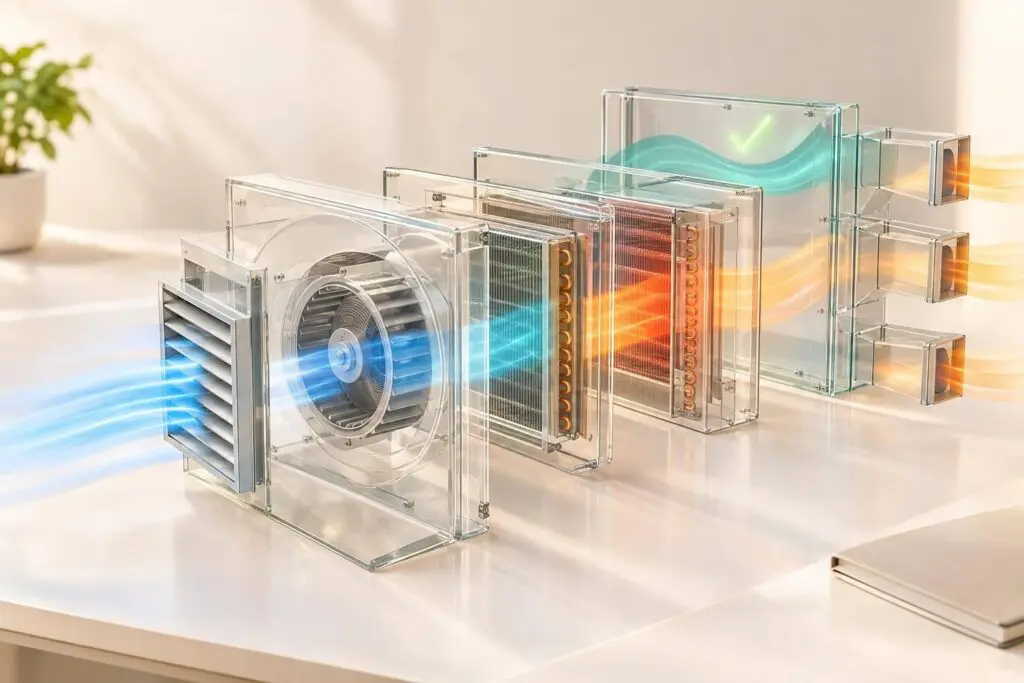
Hospital HVAC systems use HEPA filters in three main spots. And where the filter sits changes maintenance needs, contamination control, and airflow. In plain terms, placement decides whether HEPA filtration protects supply air, room air, or exhaust air.
Central HEPA filters in air-handling units
In most healthcare AHUs, the HEPA stage sits at the end of the supply filtration train, after prefiltration and final filtration stages. A common sequence is prefiltration, a higher-efficiency intermediate filter, then the HEPA bank. Cleaner air upstream helps cut HEPA loading and can extend service life.
The downside is resistance in the system. A full filtration train can add 1.5–2.0 in. w.g. or more to total static pressure. That pushes up fan motor size, power use, and operating costs in a building that runs 24/7. For that reason, central HEPA is usually kept for AHU branches that serve spaces that need it. If a room needs cleaner supply air right at the point of delivery, terminal placement becomes the better fit.
Terminal supply HEPA filters at the room level
Terminal HEPA filters are installed at, or just before, the supply outlet inside the room instead of in the central AHU. Common setups include ceiling diffusers, laminar-flow arrays, and fan-filter units. This approach gives last-point cleanliness because the air is filtered after it moves through the ductwork.
That also changes the design job. Since the filter is in or near the room, safe replacement access has to be built in from the start. Terminal HEPA works well for the most sensitive spaces, and it lets teams upgrade single rooms without reworking entire AHUs. When the focus moves from supply cleanliness to containment, exhaust placement becomes the main concern.
Exhaust and portable HEPA units for isolation spaces
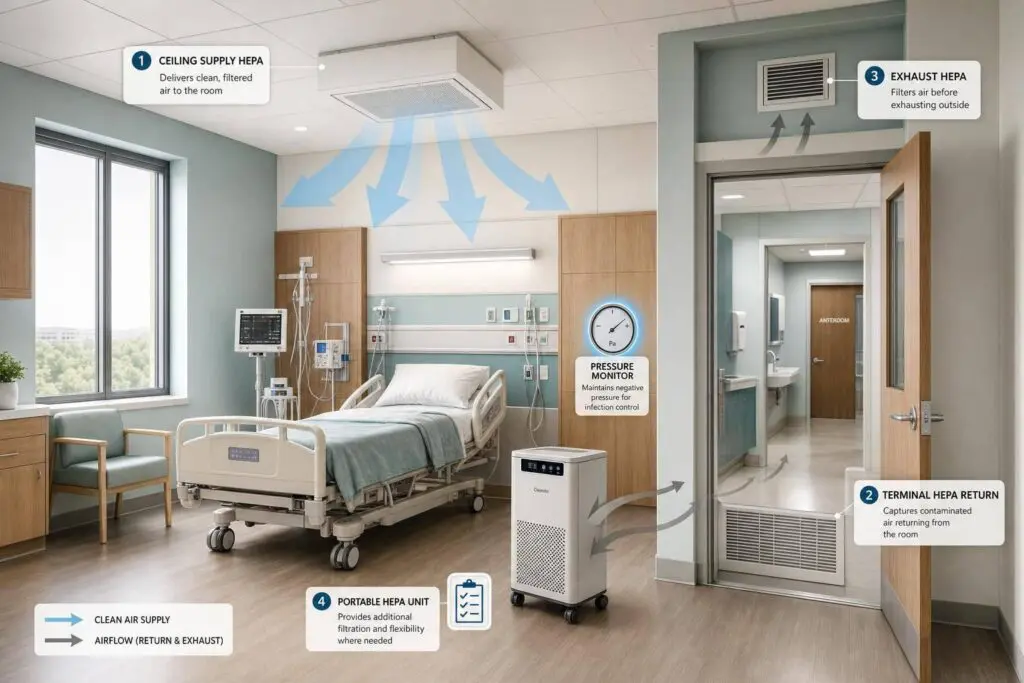
For airborne infection isolation rooms (AIIRs), the main approach is to exhaust air directly outdoors, away from air intakes and occupied areas. If that isn’t possible, HEPA should be installed in the exhaust duct before the air enters any shared system. In that setup, the exhaust fan pulls air from the AIIR, moves it through a dedicated HEPA housing, and then discharges it outdoors. Access doors and pressure taps make it possible to check performance and replace filters safely.
Portable units can help, but they don’t replace exhaust. They recirculate room air; they do not create negative pressure on their own. Instead, they work with mechanical exhaust to remove more particles from the room air. CDC guidance calls for portable units with 300–800 cfm capacity, sized to provide the equivalent of ≥12 air changes per hour (ACH) for the room volume when feasible.
Placement matters here too. The unit’s intake should face the aerosol source, and the discharge should point away from staff work areas. That simple detail can make a big difference. These units are often used for temporary isolation and aerosol-generating procedures.
These placement choices shape pressure control and the paths contaminants can take.
How placement affects pressure control and contamination pathways
Where you put a HEPA filter shapes room pressure and the route airborne contaminants take. It sets airflow direction, pressure balance, and where particles are likely to travel. The core issue is simple: does the room need to trap contaminants, block them out, or do some of both? Filter placement is what makes that happen.
Negative pressure in isolation rooms and positive pressure in protective environments
Airborne infection isolation rooms (AIIRs) usually use exhaust-side HEPA filtration. The goal is to pull air out of the room and keep the room at a slightly lower pressure than nearby spaces. In the U.S., a common design target is about –0.01 in. w.g. (about –2.5 Pa) relative to adjacent areas.
That pressure difference matters. It helps make sure air moves into the isolation room instead of leaking out into hallways or nearby patient spaces. To keep that setup working, engineers usually want:
- Short, direct exhaust paths
- As little duct leakage as possible upstream of the HEPA housing
- Continuous differential pressure monitoring
That last point is a big one. Doors open. Staff walk in and out. Conditions shift all day. Without constant pressure monitoring, a room can drift out of spec faster than people think.
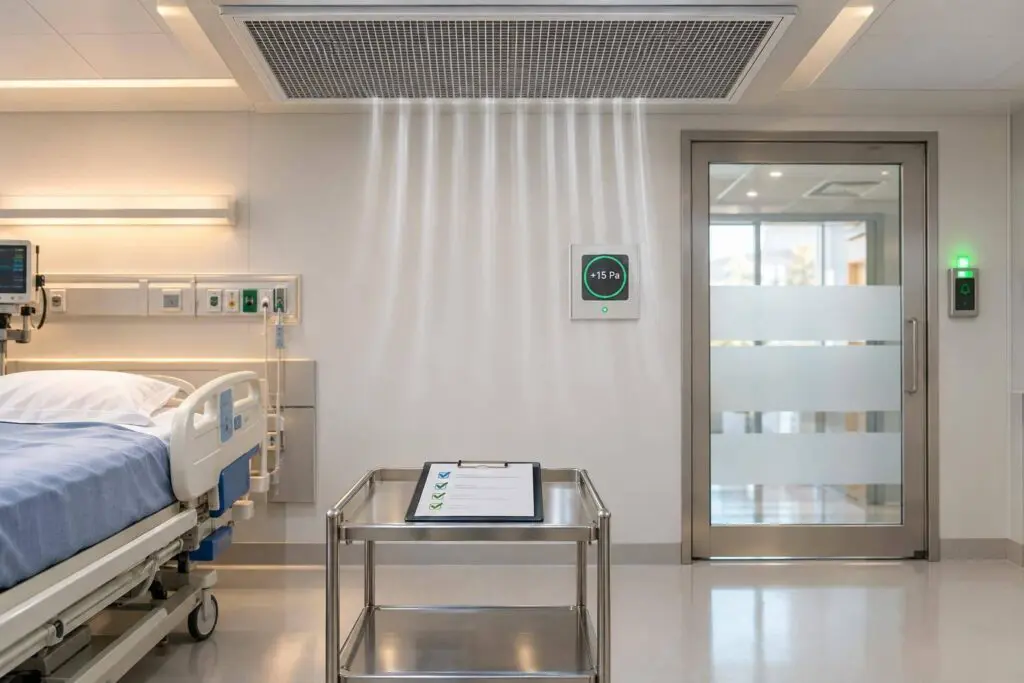
Protective environments work the other way around. Rooms used for severely immunocompromised patients, including bone marrow transplant units, are kept at about +0.01 in. w.g. (+2.5 Pa) or more relative to adjacent spaces. Instead of pulling air inward, these rooms push clean, filtered air into the space at a higher volume than the exhaust and leakage rate. So if air escapes through door gaps or wall cracks, it flows outward. That helps stop corridor contaminants from drifting in.
Airflow from clean to less clean areas in operating rooms and patient areas
Operating rooms take supply-side HEPA placement a step further. Here, ceiling-mounted HEPA diffuser arrays sit directly above the surgical table and send clean air downward across the sterile field in a near-unidirectional pattern.
Typical laminar flow ceilings:
- Deliver 25–35 cfm/ft² through HEPA filters
- Cover at least 70% of the surgical zone
- Keep downward air velocity at roughly 90–120 feet per minute
The idea is straightforward. Clean air comes down where the procedure happens first, then moves away from that zone before particles can settle on instruments, drapes, or the incision site. Low-level perimeter return grilles help finish the job by pulling air toward the room edges and away from the table.
Duct contamination, leakage control, and recirculation decisions
Placement also changes where contamination risk sits inside the HVAC system.
With central HEPA placement, downstream supply ducts stay clean. But that doesn’t mean the whole system is clean. Upstream sections, like mixed-air plenums and return ducts, can still carry contamination.
With terminal placement, the risk shifts. Upstream ducts carry only prefiltered air, and the last HEPA stage catches particles released before air enters the room. That can matter a lot in spaces where airborne fungal control is a top concern. One study found much higher airborne fungal counts when HEPA filters were placed centrally, with odds ratios of about 6.78 and 4.43 compared with terminal placement.
Recirculation adds another layer. If exhaust air from a high-risk space has to be reused, exhaust-side HEPA filtration becomes a must. It keeps infectious droplet nuclei out of shared return air streams. And there’s a mechanical side to this too: the exhaust fan has to overcome the HEPA pressure drop and still maintain the required negative pressure difference. If the fan can’t do that, the pressure plan falls apart.
Once the placement decision is made, the focus shifts to filter efficiency, pressure drop, and service access. Those airflow and pressure demands shape the filter choice.
How to select the right HEPA filter for each location
Efficiency ratings, housing types, and code requirements
Once you’ve picked the filter location, the next step is making sure the filter fits the room’s pressure target, airflow demand, and service path. In plain English: the filter can’t just fit the duct. It has to fit the room’s job.
ASHRAE 170 follows a step-by-step filtration setup: a MERV 8 prefilter at the air intake, a MERV 14 secondary filter for most patient-care areas, and terminal HEPA only where the room type calls for it. Protective environments and some operating rooms – including transplant, neurosurgery, orthopedic, and burn suites – must use HEPA filters at the air terminal device.
True HEPA means 99.97% capture at 0.3 μm at rated airflow. That number only matters if the housing is sealed well enough to stop bypass. HEPA and other high-efficiency filters need sealed housings for that reason. In terminal supply units for ORs or protective environments, that usually means gasketed or gel-seal terminal housings with room-side access. For exhaust systems serving isolation rooms, the housing also needs bag-in/bag-out service access, since the used filter may contain infectious material when it’s time for replacement.
Those seals help the filter do its job, but they also add resistance. And that resistance feeds straight into fan sizing.
Pressure drop, fan capacity, and energy impact
Filter location doesn’t just change where the air moves. It changes how hard the fan has to work.
Initial pressure drop is usually 1.0–1.5 in. w.g. (250–375 Pa) at rated face velocity. Replacement is typically done at about 2.0 in. w.g., or 1.5× the initial pressure drop. Where the HEPA sits – central, terminal, exhaust, or portable – changes where that penalty shows up.
| Placement | Typical pressure-drop impact | Fan implication | Likely energy tradeoff |
|---|---|---|---|
| AHU HEPA | Highest system-wide impact | Larger central fan or more fan power | Highest whole-system energy penalty |
| Terminal HEPA | Moderate, localized impact | Branch or terminal fan must overcome added resistance | Moderate energy increase, more zone-specific |
| Exhaust HEPA | Moderate to high on exhaust side | Exhaust fan must maintain containment as filters load | Energy rises as exhaust static increases |
| Portable HEPA | Self-contained internal resistance | Built-in fan handles load | Plug-load increase; no central fan impact |
With central AHU HEPA, that pressure hit is shared across every zone served by the unit. Terminal HEPA keeps the effect local, but the supply fan still needs enough reserve static pressure at that branch. Exhaust HEPA needs extra attention. As the filter loads, the exhaust fan has to push harder to keep the negative pressure differential that holds an isolation room in containment. If the fan runs out of headroom, the problem isn’t just a dirty filter – the room can fall out of pressure control.
Prefiltration, pressure monitoring, and service access
Prefilters take the first punch. They catch larger particles before they reach the HEPA stage, which helps the HEPA last longer and slows the rise in pressure drop that leads to changeout. In an AHU, a MERV 8 prefilter at the intake handles coarse debris before air moves into the later filtration stages. In portable units, the prefilter matters just as much because the unit depends on its own fan and filter stack.
Pressure monitoring is what turns this from guesswork into maintenance. One reading shows the filter’s condition today. A trend line shows where it’s headed. On exhaust HEPA serving an isolation room, a slow climb in pressure drop is an early sign that the filter is loading and the exhaust fan is under more strain. On terminal supply units, a loaded filter can quietly cut delivered airflow enough to push room pressure out of spec before anyone spots it.
Service access matters too. A good filter in a bad access setup can still become a problem. If staff can’t inspect or replace it easily, changeout gets delayed and bypass risk goes up. Room-side access on terminal HEPA housings lets staff replace filters without entering contaminated ductwork, though it may require a temporary room shutdown. Duct-mounted exhaust housings need larger access panels, closer coordination with engineering, and – when they serve isolation rooms – bag-out procedures and PPE for the used filter. The right choice is the one that staff can replace safely and on schedule in that space.
Application guide and conclusion
With placement and filter type already set, the last step is simple in theory: match each hospital space to the HEPA location that fits its airflow job.
Recommended HEPA placement by hospital space type
HEPA location should line up with what the room is trying to do. The table below gives the practical default for each space type.
| Space Type | Common HEPA Location | Pressure Goal | Contamination-Control Purpose |
|---|---|---|---|
| Operating room | Terminal supply (diffuser array above surgical field) | Positive relative to adjacent spaces | Maintain sterile supply air; direct clean-to-less-clean airflow away from the surgical site |
| Airborne infection isolation room (AIIR) | Exhaust duct HEPA or portable HEPA supplement | Negative (≥ −0.01 in. w.g.) | Contain airborne pathogens; prevent migration to corridor |
| Protective environment (PE) room | Terminal supply HEPA at room-side housing | Positive (≥ +0.01 in. w.g.) | Block outdoor particle and spore infiltration |
| General patient-care area | Central AHU filtration; portable HEPA as supplement | Varies by room function; central AHU filtration is the baseline | Reduce background particulate and pathogen load |
Portable HEPA units are supplements, not a pressure-control method. They help with local particle reduction, but they shouldn’t be treated as the main system in AIIRs or PE rooms.
If you change placement, check three things before moving ahead:
- Airflow capacity
- Room pressure
- Maintenance access
When to bring in professional HVAC support
If a project affects room pressure relationships, fan capacity, air balancing, or code compliance, bring in HVAC support. That includes room conversions, filtration retrofits, and any case where a HEPA filter is being added to a system that wasn’t originally sized for the extra resistance.
Why does that matter? Because a dense terminal filter can choke airflow if the system doesn’t have enough available static pressure. On paper, the filter may look fine. In the field, it can cut delivered airflow and push the room out of its pressure range.
For Chicagoland facilities, Eco Temp HVAC can help with airflow planning, filtration upgrades, and service access. Hospital work also needs coordination with healthcare ventilation standards such as ANSI/ASHRAE/ASHE Standard 170 and facility infection-control protocols, so HVAC support needs to work in step with those requirements.
Use these rules as the final check before commissioning.
Key takeaways
HEPA placement is not interchangeable. Supply, terminal, exhaust, and portable locations each serve a different purpose. Put filtration in the wrong place, and even a high-grade filter can fall short in the actual system.
Placement needs to match the room’s pressure target, airflow path, and service access. The right filter is the one that fits the room’s job, airflow route, and maintenance conditions, then gets verified at both initial and final resistance before the system goes into service. Before changing any filtration plan, hospitals should also confirm fit with ventilation standards, pressure requirements, and service access.
FAQs
Why isn’t HEPA efficiency enough?
HEPA efficiency alone isn’t enough. These filters add a lot of airflow resistance, and that often leads to a pressure drop of 0.5 to 1.5 inches of water column.
That extra resistance can create a chain reaction:
- Strain blower motors
- Cut airflow
- Increase energy use
And here’s the catch: those problems show up when the HVAC system wasn’t built for the extra load or hasn’t been modified to handle it.
Filtration also doesn’t replace pressure control. They’re not the same thing. A portable HEPA unit, for instance, does not create negative pressure unless it’s ducted outdoors.
When should a hospital use terminal vs. exhaust HEPA?
In hospitals, the right setup depends on what the room is meant to do and how its pressure has to be controlled.
Terminal HEPA units are usually installed on the supply side when filtration needs to happen right at the room boundary or over a patient care area. That’s common in spaces like a Protective Environment (PE) room, where tight control matters.
Exhaust HEPA is used in Airborne Infection Isolation (AII) rooms when sending exhaust air straight outdoors isn’t practical. In that case, the filter sits on the exhaust path to help contain infectious aerosols.
Can portable HEPA units replace pressure control?
No. Portable HEPA units clean the air inside a room, but by themselves they do not create negative pressure unless the unit’s discharge is ducted straight outdoors.
That’s because air cleaning and pressure control do two different jobs. A portable HEPA unit is best used as a supplemental tool for added air changes or extra surge capacity, not as a substitute for dedicated pressure control.