
If your HVAC system struggles in spring or fall, the usual causes are short cycling, poor airflow, thermostat problems, duct leaks, or hidden mechanical wear. In mild weather, many systems run in short bursts instead of long, steady cycles. That can make rooms feel uneven, leave humidity behind, and push energy use up.
Here’s the short version:
- Mild weather exposes weak spots because the system keeps stopping and starting.
- Dirty filters, blocked vents, and closed dampers cut airflow and make the blower work harder.
- Oversized equipment and bad thermostat readings can cause frequent cycling.
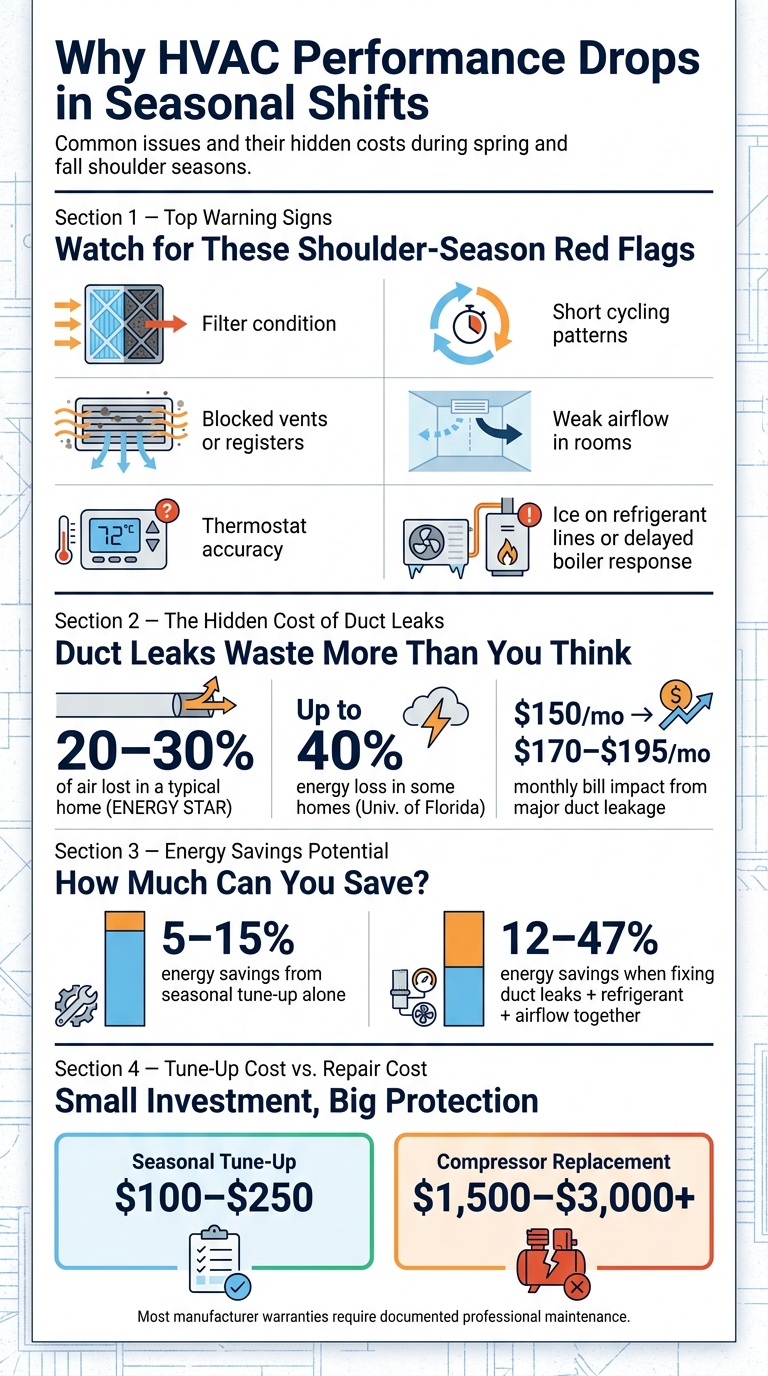
- Duct leaks can waste 20% to 30% of moving air, and in some homes, losses can reach 40%.
- Low refrigerant, boiler start-up trouble, and worn parts often show up during spring and fall.
- Seasonal service often cuts energy use by 5% to 15%, while fixing airflow, duct, and refrigerant issues together can cut use by 12% to 47%.
If I had to boil it down to one point, it’s this: shoulder-season weather doesn’t usually create HVAC problems – it exposes the ones already there. That’s why a small issue in September can turn into a much bigger repair in January or July.
Before the next heavy heating or cooling stretch, I’d focus on these checks first:
- Filter condition
- Open supply and return vents
- Thermostat reading and location
- Signs of short cycling
- Weak airflow in certain rooms
- Ice on refrigerant lines or delayed boiler response
This article breaks down what those warning signs mean, why they show up in spring and fall, and when it makes sense to call a technician.
HVAC Seasonal Performance: Key Stats & Warning Signs
Airflow Problems That Reduce Output and Efficiency
Restricted airflow is one of the most common reasons HVAC systems struggle in spring and fall. When air can’t move the way it should, static pressure goes up, the blower has to work harder, and energy use climbs with it. Even a small restriction can throw off comfort during mild weather.
That’s part of what makes shoulder seasons so revealing. Systems don’t run as steadily, so there’s less room for them to hide weak spots.
Dirty Filters After Heavy Summer or Winter Use
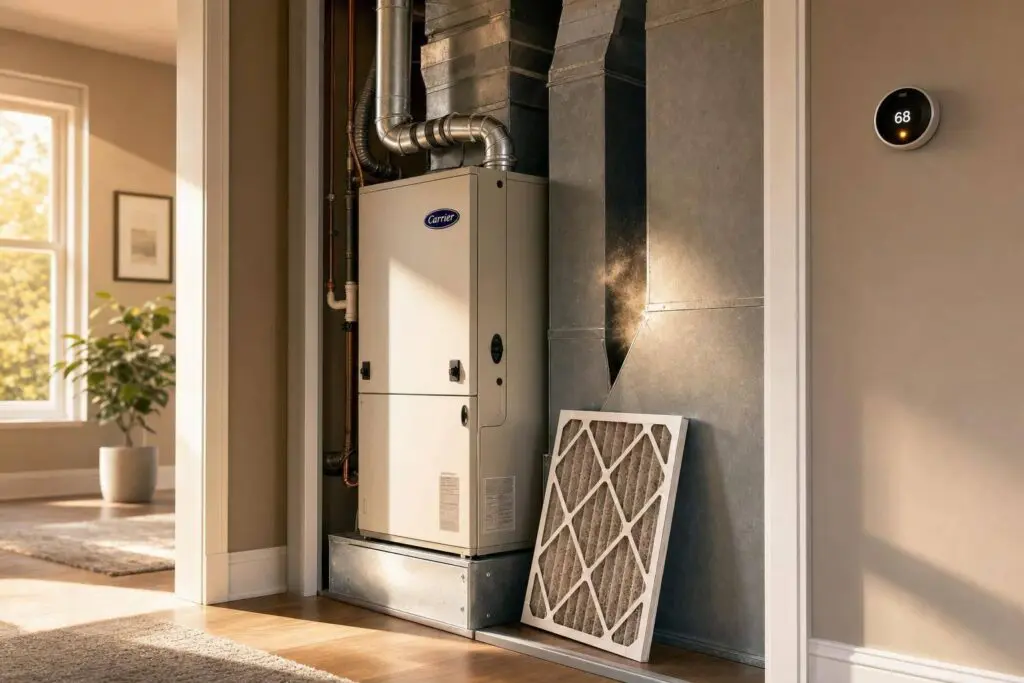
By spring or fall, filters may already be loaded with months of dust, pollen, pet hair, and other debris from heavy summer or winter use. That buildup doesn’t disappear on its own. It stays in the filter and slowly chokes the return air path.
When a filter gets clogged, the blower has to fight more resistance just to pull air through. That cuts airflow to the coil or heat exchanger and can make run times longer. Low airflow across the evaporator coil can hurt cooling performance and even lead to icing.
Check filters every 1 to 3 months. In dusty homes or homes with pets, check them monthly.
Blocked Registers and Closed Dampers That Restrict Airflow
Blocked registers and closed dampers can restrict airflow just as much as a dirty filter, and they’re often easier to miss. A couch pressed against a supply register, a storage box in front of a return grille, or a rug covering a floor vent can quietly choke airflow in that part of the system. The blower keeps running, but less air makes it through the vent.
In a multi-room home, this can show up as a basement that stays cold while upper floors go past the thermostat setting. In a storefront or office, blocked returns or closed dampers can create hot and cold spots that are hard to pin down.
Start with a simple walk-through:
- Check every supply register and return grille for furniture, boxes, signage, or anything else blocking airflow.
- Open closed dampers to their intended positions.
- Clean return grilles that have built up dust and lint. If buildup is extensive, professional duct cleaning may be necessary to restore airflow.
If clearing those obstructions doesn’t fix weak airflow, a technician should check static pressure, the coil, and perform duct system maintenance.
If airflow checks out, the next place to look is system control.
sbb-itb-b5c10b1
Short Cycling, Thermostat Mismatch, and Control Issues
If airflow looks fine, the next place to check is the controls and how often the system turns on and off.
Why Short Cycling Happens More in Mild Weather
In spring and fall, the weather can be mild enough that an HVAC system hits the thermostat setting fast. The problem is that the house itself may not have settled into an even temperature yet. So the system shuts off, the temperature drifts, then it starts again. That stop-start pattern can repeat all day.
Oversized equipment makes this worse. When a system has more capacity than the home needs, it can hit setpoint in a hurry and then sit idle until the temperature shifts again. Comfort tends to feel uneven, and humidity can become a problem too. Short cooling cycles pull out very little moisture, so the air may still feel damp even when the temperature looks fine.
Short cycling is also hard on the equipment. Compressors, burners, and blower motors all take a hit from constant starts and stops. It also wears down parts like bearings, contactors, and ignition systems faster, and those repairs aren’t cheap.
Thermostat Placement and Settings That Cause Wrong Readings
A thermostat can only read the temperature where it sits. If it’s in a bad spot, the whole system reacts to the wrong signal.
Common placement mistakes include installing the thermostat:
- Near a sunny window
- Too close to a supply vent
- Next to a kitchen
- Near a drafty exterior door
Each of those spots can throw off the reading. Direct sunlight can make the thermostat think the room is much warmer than it is. A thermostat near a supply register may get hit with conditioned air and shut the system off too early.
Another issue is sensor drift. It sounds minor, but it adds up. If a thermostat is off by just a few degrees from the actual room temperature, energy bills can go up by about 10%, based on U.S. Department of Energy guidance. A simple check can catch this: compare the thermostat reading with a thermometer you trust. If the gap stays there, recalibrate the thermostat or replace it.
Smart thermostats can make things a bit trickier. Features like minimum run time, minimum off time, and adaptive recovery are meant to help efficiency, but they need to match the equipment and the home’s load. If those settings are too aggressive, they can trigger short cycling even when the system is sized correctly.
During mild shoulder seasons, a slightly wider temperature band and fewer manual overrides can help cut down on extra cycling without hurting comfort.
If the thermostat location and settings look right but the cycling keeps happening, it’s time to move on to mechanical checks.
Hidden Mechanical Issues: Duct Leaks, Low Refrigerant, and Boiler Delays
If airflow and thermostat checks don’t fix the issue, the next stop is hidden mechanical trouble. These problems can waste energy even when the thermostat looks fine. Once the basic stuff checks out, the fault is often deeper in the system.
Duct Leaks and Pressure Imbalances That Raise Energy Bills
Duct leakage is much easier to miss than a clogged filter. According to ENERGY STAR, a typical home loses 20% to 30% of the air moving through its duct system because of leaks, holes, and poorly connected sections. University of Florida extension research puts the loss even higher in some homes – up to 40% of heating or cooling energy.
The weak points are usually joints, seams, takeoffs, and connections near the air handler. This is extra common in attics, crawl spaces, and garages, where heat, cold, and wear can loosen connections over time. When supply ducts leak into unconditioned spaces, rooms at the far end may not get enough air. When return ducts leak, they can pull in dust and outdoor air, which throws off pressure balance across the house.
That damage shows up on the utility bill. A home spending about $150/month on heating and cooling could end up at $170–$195/month with major duct leakage, even while some rooms still feel off. Professional testing can find the trouble spots with tools like duct pressure tests, smoke pencils, and thermal imaging.
Low Refrigerant and Boiler Start-Up Problems During Shoulder Seasons
Low refrigerant is a common spring and early fall issue, and it can be easy to misread. In mild weather, a system with a low charge may still cool a little, just not well enough. That can make the problem seem minor when it isn’t. The evaporator coil may drop below freezing, which lets ice build up on the coil or suction line. That cuts airflow even more and can trip a low-pressure switch. The usual pattern is weak cooling, ice on the coil, and low-pressure trips.
The fix is not just adding more refrigerant. Best practice means finding and repairing the leak, evacuating the system to remove air and moisture, and then charging it to the nameplate specification. For older systems still using R-22, repeat leak repairs may not make financial sense because of current refrigerant costs and EPA rules. In many cases, replacement is the smarter move.
Boilers can also act up after sitting idle for months. In the fall, they may start slowly or heat unevenly. Trapped air in hydronic lines can cause gurgling and leave radiators only partly warm. Stuck zone valves or circulator pumps can leave one part of the house cold while another heats normally. Ignition parts that haven’t fired in months may light late or fail to light at all.
Both of these issues need a pro to sort out. DOE data shows that fixing duct leakage, refrigerant charge, and airflow together can cut energy use by 12% to 47%. That’s why seasonal service matters before the next stretch of heavy heating or cooling. Professional HVAC maintenance plans can prevent these mechanical failures before they start.
When Seasonal Service Prevents Bigger Repairs and Higher Bills
Most HVAC problems don’t start with a dramatic breakdown. They start small: a utility bill goes up even though your usage didn’t, one room never hits the set temperature while another gets too warm, or the system keeps turning on and off more often than normal.
That’s why seasonal service matters. It gives you a chance to catch small problems before heavy summer heat or winter cold pushes the system into failure. If you notice repeated short cycling, weak airflow at registers, delayed boiler response, grinding or banging noises, or a furnace that shuts off before reaching setpoint, it’s time to book a professional inspection. Eco Temp HVAC serves homeowners and small businesses across Chicagoland with seasonal inspections built to catch these issues before the next heating or cooling stretch begins.
What a Seasonal Tune-Up Should Cover
A proper seasonal tune-up should focus on the same trouble spots that tend to show up during shoulder-season weather. A technician should:
- Clean coils
- Verify airflow and static pressure
- Check thermostat calibration
- Inspect ducts
- Test refrigerant charge
- Test boiler ignition and safety controls
- Check loose electrical connections, blower performance, and condensate drainage
This kind of maintenance can cut energy use by 5–15% compared to neglected systems. And the math is pretty simple: a seasonal tune-up usually costs $100–$250, while a compressor replacement can run $1,500–$3,000+. On top of that, many manufacturer warranties – especially for high-efficiency furnaces, heat pumps, and ductless mini-splits – require documented professional maintenance to remain valid.
Conclusion: Key Reasons Performance Drops and What to Do Next
The problems covered earlier won’t go away on their own. But they usually respond well when you deal with them early. Schedule service in early spring and early fall, before the next heating or cooling stretch turns a small repair into a much bigger bill.
FAQs
Why does my HVAC system short cycle in spring or fall?
Short cycling happens when your HVAC system starts, stops, and starts again too often. Spring and fall can set this off because outdoor temperatures swing more during those seasons. But weather isn’t the only reason. A bad thermostat, a clogged air filter, or blocked airflow can all cause the same pattern.
Sometimes short cycling is a sign of a deeper problem. Faulty sensors, electrical issues, or a system that’s the wrong size for the home can all be behind it. And because this puts extra strain on your equipment, it’s smart to have a certified technician check it out.
Can a bad thermostat location affect comfort and energy use?
Yes. If a thermostat sits near direct sunlight, drafts, or other heat sources, it can read the room wrong.
When that happens, your HVAC system may turn on and off at the wrong times. The result? Uneven temperatures around the house and higher energy bills.
For better accuracy, place the thermostat away from those trouble spots and check its reading against a nearby portable thermometer.
When should I call for HVAC service instead of troubleshooting it myself?
Handle simple jobs yourself, like swapping out filters or clearing away debris. For anything more involved, bring in a pro.
Turn the system off and call a technician if you notice:
- Burning smells
- Breakers that trip often
- Electrical problems
- Weak heating or cooling
- Strange noises
- Leaks
- A sudden jump in energy bills with no clear reason
Work involving refrigerant, gas lines, or deep cleaning should also be left to a certified technician.