
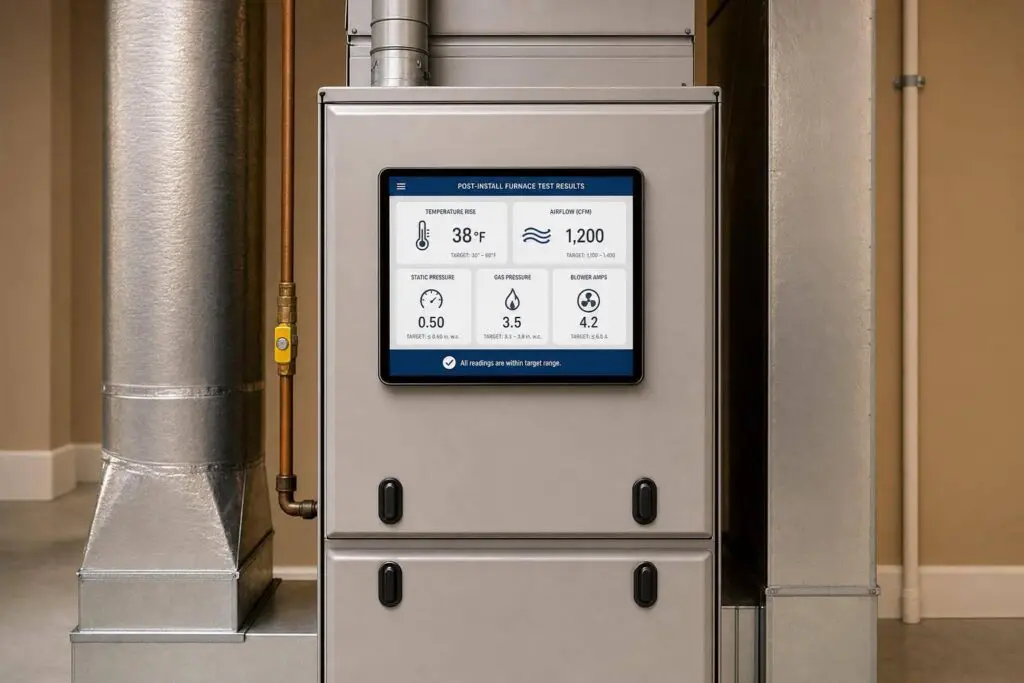
If a startup report does not show actual numbers, I would not treat the furnace setup as finished. A furnace can turn on and still be set wrong. The readings that matter most are temperature rise, airflow (CFM), static pressure, gas pressure, and blower motor amperage.
Here’s the short version:
- Temperature rise tells me if heat output and airflow match the unit’s listed range.
- Airflow and static pressure show if the blower is moving enough air or if the ducts, filter, or coil are restricting flow.
- Gas pressure checks whether the burners are getting the right fuel input.
- Motor amperage shows whether the blower motor is working within its rated limit.
- Safety and ignition checks confirm the furnace starts, runs, and shuts down the way it should.
A few numbers in the article stand out:
- Many gas furnaces are rated for about 0.50 in. w.c. total external static pressure.
- A static pressure reading around 0.8 in. w.c. or more often points to too much duct restriction.
- The furnace usually needs to run for 10 to 15 minutes before temperature rise is checked.
- A filter pressure drop above 0.1 in. w.c. or coil pressure drop above 0.2 in. w.c. can point to a restriction.
What I’d want to see on the report: the measured numbers, the furnace’s allowed range from the nameplate, and any setup changes made after testing.
| Check | What I look for | What it can point to |
|---|---|---|
| Temperature rise | Within the unit’s listed range | Airflow or gas input issue |
| Static pressure | Not too high for the system | Duct, filter, or coil restriction |
| Airflow | Matches blower setup and system needs | Blower speed or duct issue |
| Gas pressure | Matches manufacturer target | Firing setup issue |
| Amperage | Below motor nameplate limit | High load or motor problem |
So if I were reviewing a post-install furnace test, I’d start with one question: Do the numbers show the furnace is set up within manufacturer limits, not just that it turns on?
How to Commission a Gas Furnace w/ Jim Bergmann
sbb-itb-b5c10b1
Temperature Rise: The First Number to Check After a Furnace Install
Temperature rise, sometimes called Delta T, is the difference between the air going into the furnace and the air coming out. The formula is simple: Supply Temp − Return Temp = Temperature Rise. But that number means nothing by itself. You have to compare it with the range listed for that furnace.
Each furnace has its own allowed range printed on the unit nameplate, usually inside the blower door or burner compartment. There is no one-size-fits-all range, so the only safe move is to check the label on that exact unit instead of going by a rule of thumb.
Readings near the middle of the range tend to be easier to work with. If the rise is close to the top end, you have less room for adjustment. If it sits near the low end, the air can feel lukewarm or a bit drafty.
What High or Low Temperature Rise Usually Means
When temperature rise falls outside the listed range, the cause usually comes back to airflow or gas input. A temperature rise above the maker’s range usually points to restricted airflow. Common causes include:
- Dirty or restricted filters
- Closed registers
- Undersized ducts
- Low blower speed
When airflow gets choked down, heat builds up in the heat exchanger. That can trip the high-limit switch and make the furnace shut off before it should.
A temperature rise below the allowed range usually means too much airflow is moving through the system, or the gas input is not set right. The result can be lukewarm air at the vents and less efficient operation.
How Technicians Measure Temperature Rise Correctly
Getting a good reading comes down to timing and probe placement. The furnace should run for 10 to 15 minutes before readings are taken.
Return air is measured at the filter door or return plenum. Supply air is measured in the supply plenum just downstream of the heat exchanger. During the test, all supply and return registers should be fully open, and the filter should be clean. If registers are closed or the filter is dirty, airflow can look lower than it is, which throws off the reading.
A technician then waits for the thermometer probe to settle before writing down the numbers. That steady reading is the one compared with the nameplate range to check whether the system is set up the way it should be. If the temperature rise is out of range, airflow and static pressure usually tell the story.
Airflow and Static Pressure: How to Read the Numbers That Show System Performance
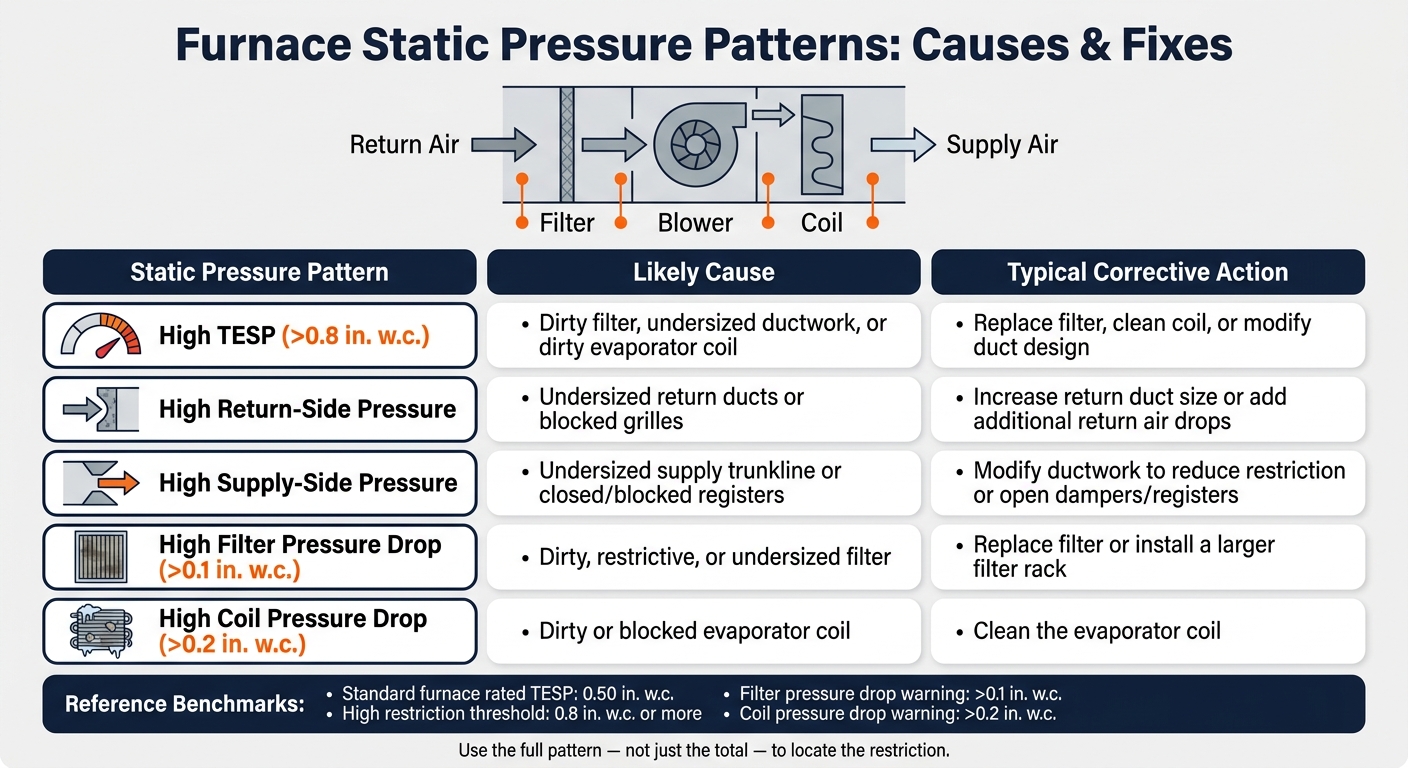
Furnace Static Pressure Patterns: Causes & Fixes
If temperature rise is out of range, airflow and static pressure usually tell you why.
After temperature rise, these are the next numbers to check if you want to know whether the blower is moving enough air. Airflow is measured in CFM. Total external static pressure, or TESP, is the resistance created by the ductwork, filter, and indoor coil, measured in in. w.c. When static pressure goes up, airflow goes down.
How Airflow Is Measured or Estimated After a Furnace Install
After a furnace install, technicians often estimate airflow with the furnace’s blower performance charts. They measure TESP, then compare that reading with the manufacturer’s chart to find the delivered CFM.
If the furnace also handles cooling, blower speed needs to line up with the cooling system’s required CFM. If it doesn’t, the system can drift out of spec fast.
What Static Pressure Tells You About Duct Restrictions
To measure TESP, a technician checks the return and supply pressure taps, then adds the readings together. A standard gas furnace is usually rated for 0.50 in. w.c., with a top limit around 0.8 in. w.c.
A single total number helps, but it doesn’t tell the whole story. Readings at four points, before the filter, after the filter, before the coil, and after the coil, make it much easier to spot where the restriction is. That pattern matters more than the total by itself.
| Static Pressure Pattern | Likely Cause | Typical Corrective Action |
|---|---|---|
| High TESP (>0.8 in. w.c.) | Dirty filter, undersized ductwork, or dirty evaporator coil | Replace filter, clean coil, or modify duct design |
| High return-side pressure | Undersized return ducts or blocked grilles | Increase return duct size or add additional return air drops |
| High supply-side pressure | Undersized supply trunkline or closed/blocked registers | Modify ductwork to reduce restriction or open dampers/registers |
| High filter pressure drop (>0.1 in. w.c.) | Dirty, restrictive, or undersized filter | Replace filter or install a larger filter rack |
| High coil pressure drop (>0.2 in. w.c.) | Dirty or blocked evaporator coil | Clean the evaporator coil |
Use the pattern, not just the total number, to track down the restriction.
When these readings are off, the fix usually points back to the blower setup, the filter, or the duct system.
When Test Results Point to Setup Changes or Duct Corrections
Out-of-range readings usually trace back to blower speed, duct layout, the filter, or gas input.
Common Result Patterns and What They Usually Trigger
Don’t look at one reading in isolation. The full pattern usually tells you what to adjust next.
| Result Pattern | Likely Cause | Typical Correction |
|---|---|---|
| High temp rise + high static pressure | Airflow restriction | Replace filter, clean coil, or enlarge ducts |
| Low temp rise + low static pressure | Low gas input, high blower speed, or duct leakage | Adjust manifold pressure, reduce blower speed, or inspect for duct leakage |
| High temp rise + low static pressure | Blower speed too low | Increase blower speed setting |
| Normal static pressure + uneven room comfort | Poor duct balancing | Adjust dampers or perform room-by-room airflow review |
Repeated short cycling can point to an oversized furnace, so it should lead to a load and airflow check.
If airflow is already at target, fix the duct restriction first. Reduce blower speed only when the blower is moving too much air for the application.
Why Combustion and Electrical Checks Still Matter
If airflow doesn’t explain the readings, move on to common furnace problems like gas input and motor load issues.
Airflow numbers won’t tell you everything. They don’t show gas input or motor load. So when temperature rise and static pressure look normal, the next place to look is often gas pressure and amperage.
Manifold pressure confirms proper gas input. If temperature rise is low and static pressure looks normal, low gas input is often the issue. That means the fix is a combustion check, not an airflow adjustment. Ignition performance is also verified at startup to confirm the burners are lighting cleanly and the flame is stable.
Blower motor amperage gets checked against the motor’s nameplate rating. If the motor is pulling more amps than rated, it’s working harder than it should. That usually points to high static pressure or a motor problem. Safety controls, including the high-limit switch, are tested to confirm proper shutdown on overheating. These checks help separate airflow problems from firing or motor faults.
Conclusion: What to Look for on a Furnace Startup Report
When the numbers show a change is needed, the startup report should make it plain: what was checked, what was adjusted, and why.
A solid startup report documents temperature rise, airflow, static pressure, combustion, and electrical checks against the furnace nameplate. The usual flow starts with temperature rise first, then moves to airflow, static pressure, combustion, and electrical checks.
If a reading lands outside the manufacturer-specified range, the system may need an adjustment before the job is done. That could mean a blower speed change, a duct correction, or a gas pressure adjustment.
The report should also spell out any balancing, gas, venting, or electrical changes made during startup.
If those readings are missing – temperature rise, CFM, static pressure, gas pressure, and amperage – the report doesn’t fully show how the furnace was commissioned.
FAQs
What should a furnace startup report include?
A furnace startup report should record the system’s baseline performance for warranty coverage and future service. Think of it as the unit’s starting snapshot. If issues come up later, this report shows how the system was set up and running on day one.
It should include model and serial numbers, electrical data, blower setup profiles, and any adjustments made during commissioning.
It should also log key readings such as total external static pressure, airflow verification, inlet and manifold gas pressures, temperature rise, combustion analysis including CO levels, along with duct, filter, and venting inspection notes.
What does high static pressure mean?
High static pressure means the furnace blower has to work too hard to push air through the system because something is creating too much resistance.
Common causes include restricted ductwork, undersized return ducts, clogged evaporator coils, and overloaded filters. When pressure goes above the recommended limit, airflow can drop, the blower motor can be strained, the heat exchanger can overheat, and the system may wear out sooner.
When do test results call for adjustments?
Adjustments are needed when measurements fall outside the manufacturer’s specified ranges on the furnace rating plate. Two common warning signs are a temperature rise outside 35–65°F and a flame that shows yellow tips instead of steady blue cones.
If static pressure points to airflow restrictions, the ductwork may need changes. And if readings are still unstable after 15–20 minutes of operation, the gas pressure or blower speed may need recalibration.