
If you size a commercial tankless water heater by the headline GPM alone, you can miss the mark. I’d start with usable flow at your actual temperature rise, because that is what decides whether a unit keeps up in a restaurant, hotel, school, or multifamily building.
Here’s the short answer:
- Navien NPE-240A2 usually holds more usable flow as temperature rise gets higher.
- In Chicagoland winter conditions, incoming water around 45°F to 50°F can push needed temperature rise to 70°F to 100°F.
- At about a 70°F to 75°F rise, Rinnai CU199 is around 4.4 to 5.5 GPM, while Navien NPE-240A2 is about 5.6 GPM.
- Rinnai can fit simpler single-unit jobs well.
- Navien often makes more sense for multi-unit cascade systems, especially where backup and staged output matter.
- Footprint, venting, condensate setup, gas piping, and yearly flushing all affect the final choice.
If you only remember one thing, make it this: commercial sizing should be based on fixture demand and water temperature needs, not the advertised max GPM.
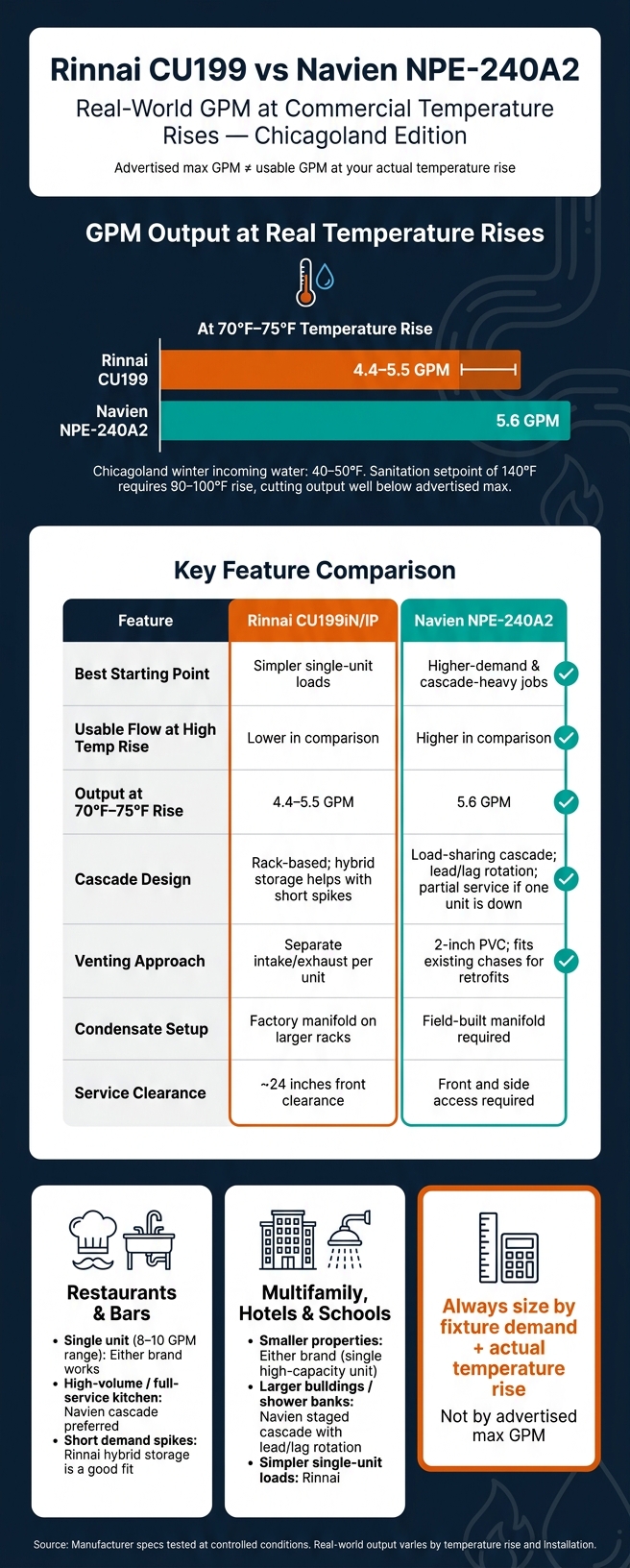
Rinnai CU199 vs Navien NPE-240A2: Real-World GPM & Commercial Fit
Rinnai vs Navien Tankless Water Heater – Best Features, Efficiency & Reliability Compared
sbb-itb-b5c10b1
Quick Comparison
| Criteria | Rinnai CU199iN / CU199IP | Navien NPE-240A2 |
|---|---|---|
| Best starting point | Simpler single-unit loads | Higher-demand and cascade-heavy jobs |
| Usable flow at higher temp rise | Lower in this comparison | Higher in this comparison |
| Approx. output at 70°F to 75°F rise | 4.4 to 5.5 GPM | 5.6 GPM |
| Cascade focus | Rack-based setups, hybrid storage can help with short spikes | Load-sharing cascade, lead/lag rotation, partial service if one unit is down |
| Venting approach | Separate intake/exhaust per unit | 2-inch PVC can help in retrofit layouts |
| Condensate setup | Rack drainage options on larger racks | Often needs field-built manifold |
| Service access | About 24 inches in front | Front and side access matter |
I’d read this comparison as a sizing guide first and a brand comparison second, because in commercial work, temperature rise, peak-use pattern, and backup planning matter more than the brochure number.
Rinnai vs Navien GPM at Real Commercial Temperature Rises
Once temperature rise is on the table, the next issue is simple: which unit keeps more usable hot-water flow when demand climbs? At the same temperature rise, the Navien NPE-240A2 generally holds more GPM than the Rinnai CU199 series.
Single-Unit Output: Advertised Flow vs Usable Hot Water
You see that gap most clearly when the unit is under partial load and still needs to keep outlet water steady. Rinnai modulates down to 15% of capacity, while Navien goes down to 20%. At the same time, Navien’s ComfortFlow® helps steady outlet temperature during heavier demand.
That matters in day-to-day use. In a busy kitchen, a restroom block, or a sanitation-heavy setup, steady hot water can matter just as much as top-end flow. A unit may post a strong peak GPM on paper, but if delivery swings under load, that can turn into a headache fast.
Cascade Capacity and Redundancy for Larger Loads
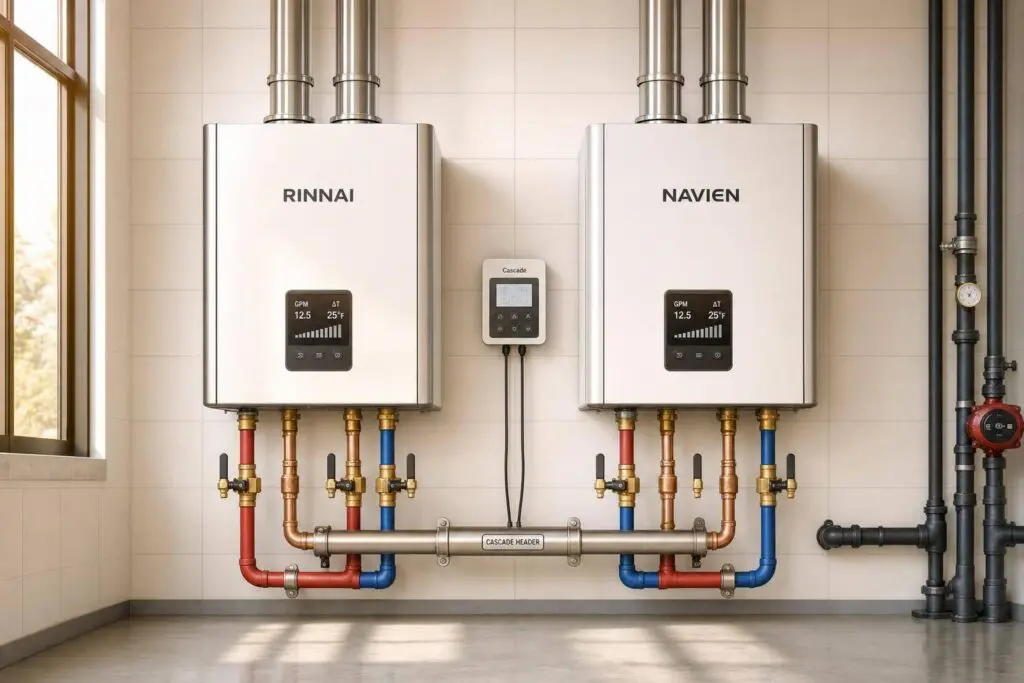
When one unit isn’t enough, cascade design starts to matter. Cascade setups increase total GPM and give you backup if one unit goes down. Navien’s load-sharing cascades spread demand across units, which fits restaurants and hotels that need service to keep going without gaps.
At higher temperature rises, actual output under load matters more than the advertised peak GPM number.
Installation Footprint and Maintenance: Rinnai vs Navien
Mechanical Room Space, Venting, and Layout
Once GPM is set, the next issue is simple: will the system fit the room, and can techs work on it without a headache?
Both brands offer wall-hung cascade systems, but they handle space in different ways. Rinnai’s TRS comes pre-assembled, which can make planning more straightforward. Navien’s Ready-Link kits are often a good match for retrofit jobs because they can use 2-in. PVC and fit existing vent paths.
Rinnai usually calls for dedicated intake and exhaust runs for each unit. Navien’s PVC venting can cut down on wall or roof penetrations and help move retrofit installs along faster.
Venting and drainage also shape how easy the system is to install and maintain. Both brands need properly trapped condensate drains. Rinnai racks can combine drainage on the rack itself, while Navien cascades often depend on field-built manifolds.
Service access matters too. Rinnai calls for about 24 inches of front clearance. Navien needs open front and side access so service work doesn’t turn into a tight squeeze.
| Factor | Rinnai (TRS) | Navien (Ready-Link) |
|---|---|---|
| Rack type | Pre-assembled wall or floor-standing | Wall or rack manifold kits |
| Venting | Individual intake/exhaust per unit | 2 in. PVC, existing chases can be used |
| Condensate | Factory manifold on larger racks | Field-built manifold required |
| Service clearance | About 24 in. in front | Front and side access are critical |
One more thing: gas piping and the meter need to be sized for the full cascaded BTU load, not just part of it.
Descaling, Service Access, and Long-Term Upkeep
After layout, upkeep is the next factor that shapes uptime.
With both brands, flushing should happen at least once a year. In hard-water, high-use buildings, service may need to happen more often. In Chicagoland, water hardness changes from one suburb to the next, so the right schedule depends on both location and demand.
Routine cascade maintenance also includes:
- Vent checks
- Condensate inspection
- Combustion testing
- Staging verification
These jobs may sound small on their own, but together they help keep a multi-unit system running the way it should.
For Chicagoland properties, Eco Temp HVAC can coordinate multi-unit maintenance and service planning.
These footprint and maintenance differences show up most clearly in the commercial spaces that come next.
Which Brand Fits Each Commercial Use Case
With output, footprint, and upkeep covered, the next step is figuring out which brand matches each load pattern.
Restaurants, Bars, and Sanitation-Heavy Operations
In a busy kitchen or bar, hot water demand rarely stays even. It hits in sharp bursts. Dish machines, pot sinks, bar glass washers, and hand sinks may all run at once, and sanitation-heavy operations often need 140°F water or more. That higher setpoint cuts usable GPM well below the number on the spec sheet.
For smaller restaurants or bars with modest fixture counts, a single high-capacity Rinnai or Navien unit in the 8–10 GPM range can work. But sizing has to come from actual fixture flow at the needed temperature rise, not the headline rating alone.
For full-service kitchens or high-volume bars, Navien’s cascade platform is often the better match. Navien’s larger cascade arrays give more headroom and backup for full-service kitchens. Rinnai’s hybrid storage approach can be a good fit for short, hard demand spikes.
So the restaurant decision isn’t just about peak GPM. It’s about how the system handles sudden surges.
Multifamily, Hotels, Schools, and Light Commercial Buildings
These properties have a shared problem: demand shows up in waves, not in a smooth pattern across the day. A morning shower rush can push a single unit past its practical output in a hurry.
For smaller properties, one high-capacity tankless unit from either brand may be enough. But in larger multifamily buildings, hotels, or schools with locker-room shower banks, a single failure can disrupt hot water service. Staged multi-unit systems are the better fit. Navien’s cascade logic rotates lead/lag units to balance run time and keeps partial service running if one unit goes down.
For schools, offices, and clinics with lighter, intermittent demand, either brand can work:
- Use Rinnai for simpler single-unit loads
- Use Navien for scalable multi-unit systems
Once loads get bigger or less predictable, the choice moves beyond single-unit output and toward staged backup.
Why Professional Sizing Matters in Chicagoland
Manufacturer GPM specs are tested at low temperature rise under controlled conditions. In winter, incoming water can fall to 40–50°F, so a system aiming for a 140°F sanitation setpoint may need to deliver about a 90–100°F rise. That cuts per-unit output well below the advertised maximum. Gas line capacity, vent routing, and local code rules add more variables that brochure numbers don’t show.
Getting sizing right means working from fixture counts and realistic peak scenarios, not just headline GPM numbers. In Chicagoland, that load-based approach matters a lot before a commercial tankless install. Eco Temp HVAC serves Chicagoland and can size, install, and maintain commercial tankless systems.
Those sizing calls shape the final brand recommendation.
Conclusion: Choosing the Right Brand for Your GPM Requirements
Start with usable GPM at your actual temperature rise. In Chicagoland, cold incoming water cuts into real-world flow, so the advertised GPM number doesn’t tell the whole story.
After that, look at fit. The better pick is the one that works with your mechanical room and your service plan. Once flow is covered, compare the footprint, venting needs, and service access to see which system makes more sense.
Then there’s maintenance. It often becomes the next big uptime factor after installation. Annual professional maintenance helps keep either system closer to its rated performance.
And none of this works if sizing and commissioning are off. Those two steps often decide whether the system does what you expect it to do. For Chicagoland projects, Eco Temp HVAC can size, install, and maintain commercial tankless systems.
FAQs
How do I calculate the right temperature rise for my building?
Calculate temperature rise by subtracting the incoming groundwater temperature from your target output temperature: ΔT = output temperature – incoming groundwater temperature.
For year-round sizing, use the coldest groundwater temperature you expect in winter. In the U.S., groundwater can range from 35°F to 75°F. If the incoming water is colder, the temperature rise is higher, which means you need more BTU output to keep the same flow rate.
When should I choose a cascade system instead of one larger unit?
Choose a cascade system when hot water demand is higher than one unit can handle, usually above 8 GPM or 200,000 BTU/h. In a setup like this, multiple units run in parallel to deliver the flow needed for heavy, simultaneous commercial use.
A cascaded system also adds redundancy. That means hot water can still keep flowing during maintenance, which is a big deal in busy commercial spaces. Before installation, check that the gas meter and gas lines can support the combined BTU input. If they can’t, you may run into temperature swings.
How does water hardness affect tankless performance and maintenance?
Water hardness can take a real toll on tankless performance. The main problem is scale buildup on the heat exchanger, and that buildup can cut efficiency by 20% to 30%.
In places with hard water, scale can also choke water flow enough to push it below the 0.5 GPM activation threshold. When that happens, the unit may shut down or send out sudden bursts of cold water.
To keep things running well, clean the inlet filters on a regular basis and schedule professional descaling every 6 to 12 months. If you live in a high-hardness area, plan on descaling every 6 months.