
If you’re wiring a smart boiler in a commercial building, the job is not just “residential wiring, but more of it.” The big shift is that you now have to plan for branch power, 24 VAC control wiring, C-wire support, network cabling, and code checks at the same time.
Here’s the short version:
- Homes often use a simple R and W heat call on 24 VAC
- Smart thermostats usually need a C-wire for steady power
- Commercial buildings add more zones, more devices, and central control
- Many commercial systems connect to a BMS using CAT-5e or CAT-6
- Wiring also has to line up with NEC/NFPA 70 and local inspection rules
- Poor control wiring can cause chatter, ghost calls, or thermostat reboots
- In homes, smart controls may cut heating use by about 8% to 23%, depending on setup and use
If I had to boil it down to one point, it’s this: residential smart boiler wiring is usually a thermostat job; commercial smart boiler wiring is a system-design job. That affects cost, labor, service access, drawings, conduit, and how the boiler works with pumps, valves, fans, and other HVAC gear.
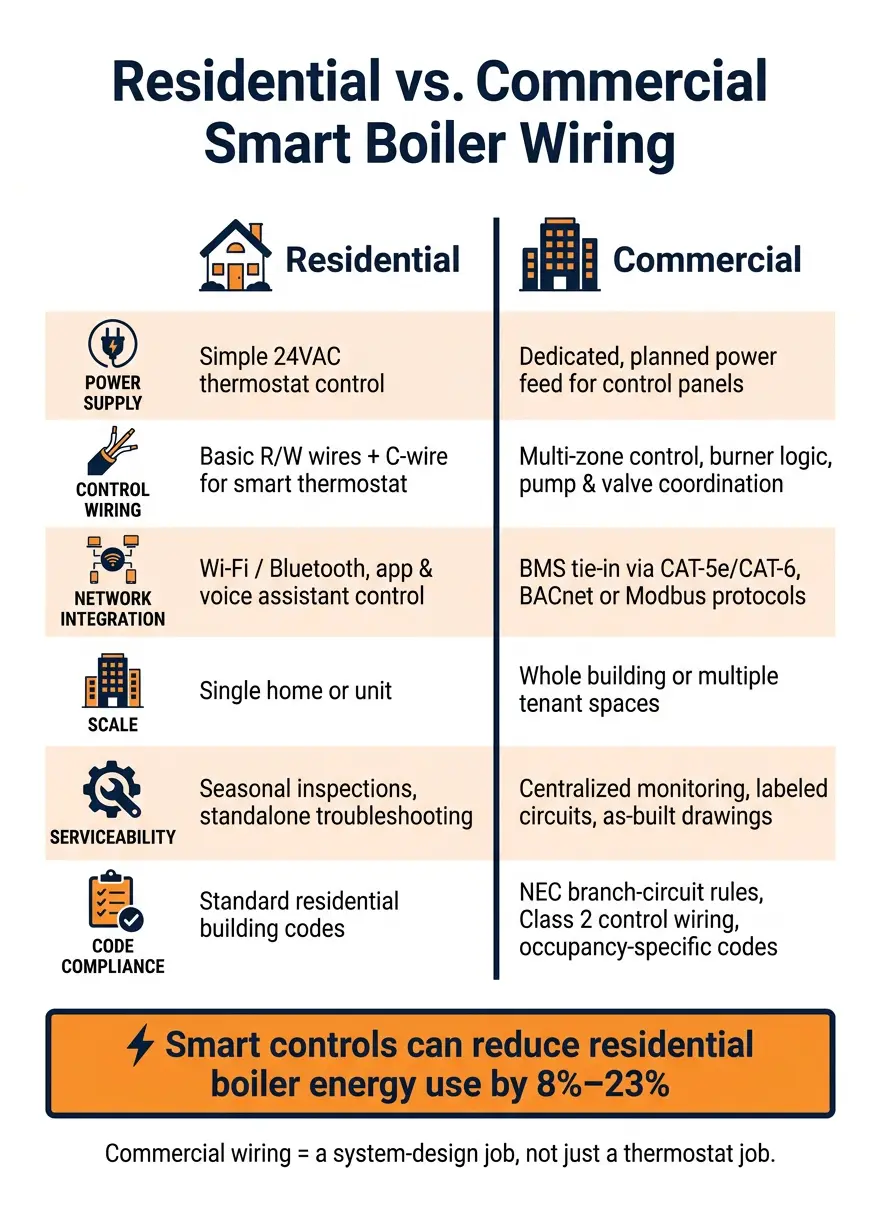
Residential vs. Commercial Smart Boiler Wiring: Key Differences
Wiring & Configuring the tekmar Smart Boiler Control 294
Quick Comparison
| Area | Residential | Commercial |
|---|---|---|
| Power | Simple low-voltage thermostat control | Planned power feed for controls and panels |
| Control wiring | Basic R/W, often add C-wire | Multi-zone control, burner and pump logic |
| Network | Wi-Fi/Bluetooth app control | BMS tie-in, often via CAT-5e/CAT-6 |
| Scale | One home or one unit | Whole building or many tenant spaces |
| Service | Simple troubleshooting | Labeled circuits, drawings, central monitoring |
| Code | Standard home checks | Stricter local and occupancy-based checks |
So if you manage a house, a mixed-use site, or a multifamily property, the wiring plan changes with the building type. And once a boiler joins a BMS, the hard part is often not the boiler – it’s the controls, the wiring layout, and passing inspection without rework.
1. Residential Smart Boiler Wiring
Power Supply
In most homes, boiler control wiring stays pretty simple. The thermostat switches the aquastat relay with 24VAC.
Control Wiring
The standard residential setup uses two wires: R (power) and W (heat). Those wires send a basic on/off signal to the aquastat relay.
Most smart thermostats also need a C-wire (Common). That wire gives the thermostat steady 24VAC power for the Wi-Fi radio and display.
No C-wire in the wall? You usually have a few paths:
- Run a new C-wire
- Add a 24V transformer or C-wire adapter
- Use a thermostat built to work without one
This part matters more than it seems. Without a true C-wire, some boiler relays can chatter or send false heat calls, especially on touchy systems.
Network Integration
Once the power and thermostat wiring are set, many residential systems tie into app-based controls. Smart boiler controls often connect through Wi-Fi and Bluetooth and work with common home apps and voice assistants.
That opens the door to features like:
- Geofencing
- App-based scheduling
Used well, those settings can help with comfort and cut residential boiler energy use by about 8% to 23%, depending on how the system is used and configured.
Code Compliance
Residential smart boiler wiring is fairly simple, but you still need to check system match before connecting anything. Confirm the boiler control voltage first. Millivolt systems are not compatible with most smart thermostats.
Compared with commercial jobs, residential installs are often more DIY-friendly. Even so, the boiler controls still have to match the thermostat’s wiring needs.
Commercial systems add BMS integration, network cabling, and tighter code rules.
2. Commercial Smart Boiler Wiring
Commercial smart boiler wiring is a different beast from residential work. You’re dealing with central control, more zones, and stricter code rules.
Power Supply
Commercial boiler controls need a dedicated, code-compliant power source built into the system design. In plain English: the electrical setup that feeds those controls has to be planned early, not treated like an afterthought.
Control Wiring
Commercial boiler wiring goes well beyond a basic on/off call. These systems often support modulating burners, multi-speed circulators, and separate zone controls. A server room, a retail space, and an office suite may all need different control logic.
A true common wire matters here. Power-stealing controls can lead to chattering, ghost calls, or reboots.
That extra wiring complexity is one reason commercial systems usually connect to central monitoring instead of relying on standalone thermostats.
Network Integration
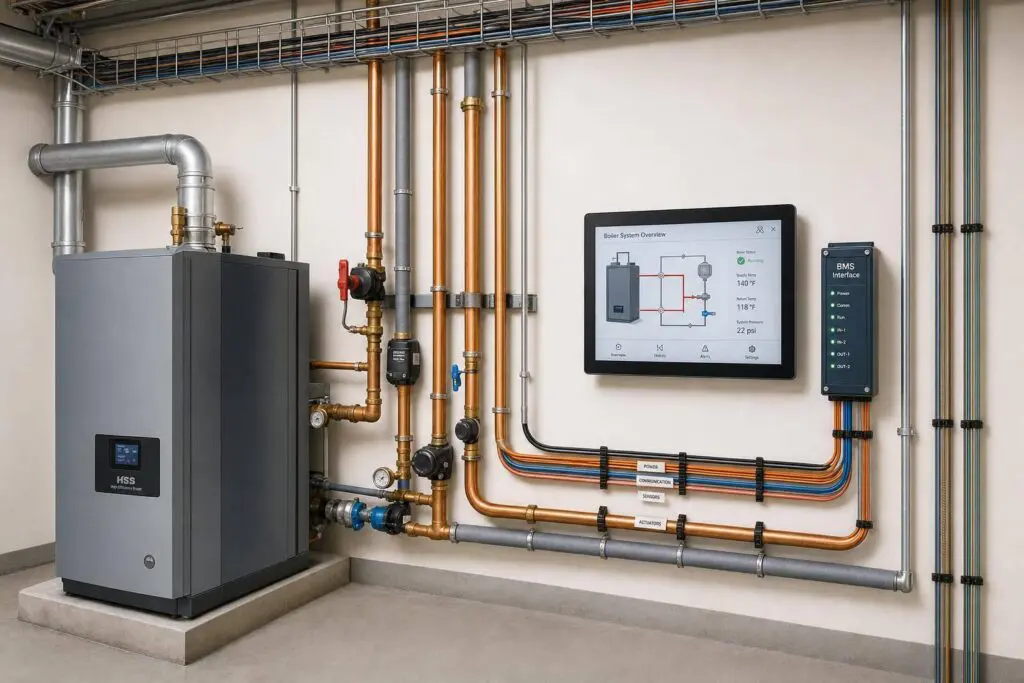
Commercial systems often tie into Building Management Systems (BMS). That gives facility managers real-time visibility across zones and helps cut energy waste while improving occupant comfort.
These boiler controls may also need to coordinate with other mechanical equipment inside the same control network. So the boiler isn’t working alone. It’s part of a larger setup that has to stay in sync.
Code Compliance
Commercial wiring has stricter code and inspection rules than residential work. Installations must meet local building codes and occupancy-specific requirements, especially in high-occupancy spaces where ventilation and exhaust controls are tightly regulated.
Older buildings can make the job harder too. They often bring access, verification, and documentation challenges.
Pros and Cons of Each Wiring Approach
The main difference comes down to scale. Residential wiring usually serves one home or one unit. Commercial wiring is built to manage control across an entire building. So the better fit depends on the size of the space, how it’s used, and how much control the system needs.
On the residential side, things are usually simpler. But “simple” doesn’t always mean easy. Older homes and cramped mechanical rooms can make even a basic install harder than expected. There’s also less room to grow. You can add wireless sensors to help even out room temperatures, but the setup still remains a standalone system.
Commercial wiring is a different animal. It’s built for scale, with hardwired zones, BMS integration, and tied-in equipment like makeup air and exhaust fans. That extra complexity matters in spaces like restaurants, gyms, and data centers, where tight control and steady operation aren’t optional.
You can see the gap most clearly in installation, flexibility, expandability, service, and code requirements.
| Feature | Residential Smart Wiring | Commercial Smart Wiring |
|---|---|---|
| Installation Complexity | Low to moderate; often DIY-friendly, though older homes add difficulty | High; requires custom project planning and BMS integration |
| Flexibility | Moderate; focused on individual comfort with basic scheduling and geofencing | High; supports independent zone control for different spaces and tenant needs |
| Expandability | Limited; adding wireless sensors is possible, but the system stays standalone | High; designed to scale with the facility and integrate with additional HVAC equipment |
| Serviceability | Standard; typically handled during seasonal inspections or after a failure | Centralized; often monitored and maintained on a schedule |
| Compliance Demands | Standard residential building codes | Strict; must meet commercial codes and tighter IAQ rules |
Cost tends to follow the same pattern. Residential smart thermostat wiring is usually less expensive upfront, though adding a C-wire, adapter, or a new wire run can increase labor and parts costs. Commercial work is usually custom quoted because the control setup, building load, and connected equipment vary from one project to the next.
Conclusion
Both residential and commercial smart boilers run on 24 V AC control. The split happens when the system gets bigger. Commercial setups add more zones, more devices, and a lot more wiring to keep straight.
That’s why commercial installs need careful load planning, dedicated control panels, and wiring runs protected in conduit. They also need coordination with a BMS through protocols like BACnet or Modbus, so boilers, pumps, valves, and sensors can work from one interface instead of acting like separate islands.
Once the wiring moves past a basic thermostat loop, the main challenge isn’t the boiler itself. It’s the code and the controls. Commercial wiring has to meet NEC branch-circuit sizing rules, Class 2 control-wiring rules, and local inspection standards.
The wiring design usually comes down to four things: building size, zoning needs, BMS integration requirements, and local inspection demands. A small restaurant and a multi-tenant office building might both use smart boilers, but the wiring behind those systems can look completely different.
In day-to-day use, those choices shape whether the system is easy to service after installation or a headache waiting to happen. On commercial jobs, working with qualified HVAC and electrical pros matters more than it does in a house. And the paperwork matters too. Labeled circuits, as-built drawings, and control diagrams are what make a commercial install maintainable, ready for inspection, and built for the long haul. The right design is safe, code-compliant, and matched to the building’s load.
FAQs
Do I need a C-wire for a smart boiler thermostat?
Usually, yes. A C-wire gives a smart thermostat the steady 24V power it needs to run Wi-Fi, the touchscreen, and built-in sensors.
With boiler systems, you’ll often see only two wires: R and W. That means a C-wire may not be there. If it’s missing, a power extender kit or C-wire adapter can sometimes solve the problem. For steady operation, you may need a pro to handle rewiring or install the adapter.
When does a boiler need BMS integration?
A boiler usually needs BMS or BAS integration in commercial buildings where HVAC control is handled from one central system.
This matters most when the facility has a more complex setup, such as:
- Remote monitoring across many zones
- AI-driven occupancy sensing to cut energy use
- Wireless sensors for live system tracking
- Automatic adjustments tied into a larger commercial HVAC network
In short, BMS/BAS integration makes the most sense when the boiler is part of a connected building system, not running as a stand-alone piece of equipment.
What code issues matter most for commercial boiler wiring?
Commercial boiler wiring has to meet strict safety and code rules. The main standards include ASME BPVC for construction and safety, ASME CSD-1 for units under 12,500,000 Btu/hr, and NFPA 85 for larger systems.
Installations also need to follow the IMC and any applicable UL certifications. In most cases, inspectors and insurers will ask for documentation that covers control diagrams, burner management tests, and safety devices like low-water cutoffs and flame safeguards.