
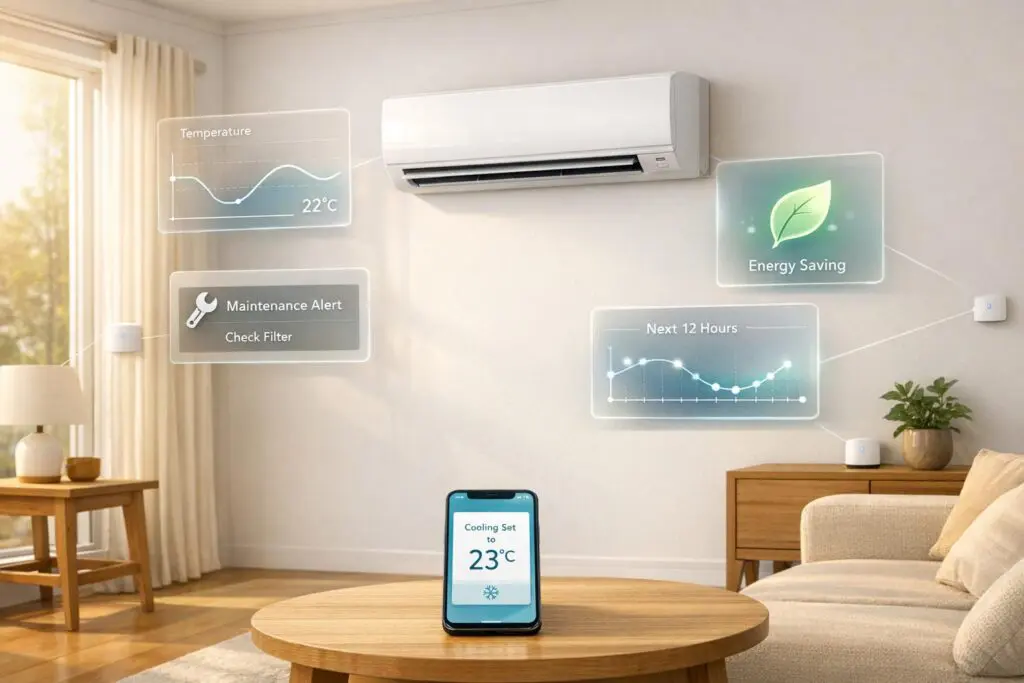
AI and IoT are reshaping air conditioning systems, making them smarter, more efficient, and user-friendly. By combining real-time data from IoT sensors with AI’s decision-making capabilities, these systems predict cooling needs, reduce energy consumption, and improve indoor comfort. Key benefits include:
- Energy Savings: Smart thermostat solutions can cut energy use by 10–30%. You can estimate your potential reductions with a smart thermostat savings planner.
- Comfort: Predictive cooling adjusts settings before discomfort occurs.
- Maintenance: IoT sensors enable early detection of issues, reducing breakdowns.
- Smart Integration: Systems sync with home energy usage, optimizing costs.
This shift from reactive to predictive cooling offers significant advantages for both homes and businesses, paving the way for smarter climate control solutions.
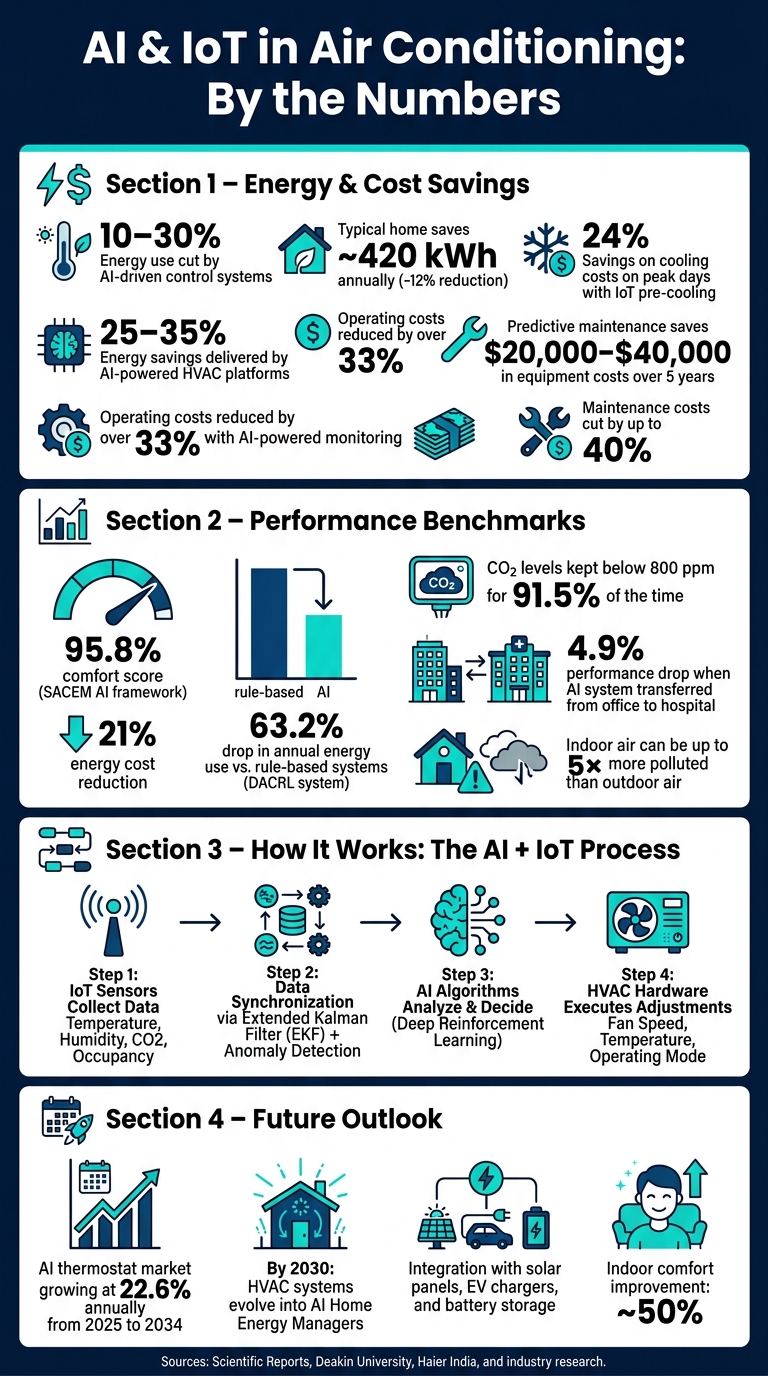
AI & IoT in AC: Key Stats, Benefits & Energy Savings
How AI Controls Cooling in Modern ACs 🤖❄️ | Smart Inverter AC Explained
sbb-itb-b5c10b1
Key Components of an AI and IoT-Powered AC System
Smart AC systems blend hardware and software to sense, decide, and act autonomously. Each part of the system has a specific function, working together to create a seamless cooling experience.
IoT Sensors and Devices
Temperature and humidity sensors provide real-time data to keep the indoor climate comfortable. Some advanced setups go a step further, monitoring air quality by tracking pollutants like CO2, Total Volatile Organic Compounds (TVOCs), and fine particulate matter (PM2.5). When indoor air quality dips, these systems can automatically activate ventilation or filtration. It’s worth noting that indoor air can be up to 5 times more polluted than outdoor air.
Occupancy detectors, powered by motion sensors or smartphone geofencing, ensure cooling is only active when needed. They can turn off the AC when rooms are empty and even pre-cool spaces before people arrive.
Once the sensor data is collected, smart thermostats step in to transform it into actionable adjustments for the AC system.
Smart Thermostats and Controllers
Smart thermostats and controllers serve as the system’s brain, processing sensor data and sending commands to adjust temperature, fan speed, or operating modes. Many modern controllers, like those using infrared (IR) signals, can retrofit older AC units, upgrading them without requiring a full replacement. For example, the Bosch Climate 7100i employs the Matter over Wi-Fi protocol, ensuring compatibility with platforms like Amazon Alexa, Google Home, and Apple HomeKit.
These controllers also work hand-in-hand with AI algorithms, which refine and enhance system performance in real time.
AI Algorithms and Data Analytics
While sensors and thermostats handle data collection, AI algorithms are responsible for interpreting this information. They analyze inputs from multiple sources – such as occupancy trends, thermal load, outdoor weather conditions, and even electricity pricing – to make smarter cooling decisions. For instance, the system might pre-cool during off-peak electricity hours, maximize cooling during midday solar energy generation, or adjust output based on a room’s heat retention.
Advanced frameworks, like SACEM, combine Deep Reinforcement Learning with short-horizon optimization to strike a balance between comfort and energy efficiency. Here’s an example of its effectiveness:
"SACEM achieves a comfort score of 95.8%, while reducing energy consumption and operating cost by approximately 21% relative to the strongest baseline." – Abdullah Alshammari, Department of Computer Science and Engineering, University of Hafr Al Batin
Seamless connectivity ensures that all components – from sensors to AI software – work together smoothly, creating a fully integrated system.
How AI and IoT Work Together in AC Systems
Let’s dive deeper into how sensors, controllers, and AI algorithms interact to create smarter air conditioning systems. AI and IoT collaborate through a structured process: sensors gather data, inputs are synchronized, AI processes the information and makes decisions, and HVAC hardware executes those decisions.
Data Collection and Analysis
IoT sensors constantly monitor key environmental factors like temperature, humidity, CO2 levels, occupancy, and lighting. These readings are sent to a central processing layer where synchronization methods, such as the Extended Kalman Filter (EKF), align the data for AI analysis. Any faulty or inconsistent readings are flagged and filtered out through anomaly detection, ensuring the AI works with accurate information. Once the data is cleaned and aligned, the system transitions to automated control, improving energy efficiency and maintaining a comfortable indoor environment through professional HVAC services.
Automated Control and Optimization
After processing the data, the AI determines the best course of action. Instead of relying on basic on/off cycles, advanced systems using Deep Actor-Critic Reinforcement Learning (DACRL) adjust variables like fan speed, temperature settings, and operating modes. This allows the system to achieve multiple goals at once, such as reducing energy costs, flattening demand peaks, and maintaining consistent comfort.
A study published in Scientific Reports in 2025 highlighted the effectiveness of this approach. Researchers tested a DACRL system in office and data center environments, often utilizing rooftop air conditioner installation for scale, using STM32L0 microcontrollers and LoRa communication modules. The results? A 63.2% drop in annual energy use compared to traditional rule-based systems, while keeping CO2 levels below 800 ppm for 91.5% of the time. When paired with variable-speed inverter technology, these systems become even more efficient by modulating output smoothly instead of operating at full power and shutting off repeatedly. This adaptive control strategy sets the stage for ongoing learning and improvements.
Continuous Learning Over Time
What makes AI-driven AC systems stand out is their ability to get better over time. Unlike standard programmable thermostats, these systems refine their understanding of a building’s unique characteristics, such as insulation quality, sun exposure, and occupancy trends. The AI updates its model continuously as it learns.
"The core advantage of deep reinforcement learning is that it can continuously learn and optimize decision-making strategies through interaction with complex environments." – Scientific Reports
In one study, an AI system transitioned from managing an office building to a hospital with only a 4.9% drop in performance, stabilizing within approximately 15,000 training steps. This adaptability makes continuous learning a key strength of AI-powered AC systems, ensuring they stay efficient and effective in various settings while maintaining indoor comfort.
Uses and Benefits of AI and IoT in AC
Continuous adaptive control brings noticeable improvements in comfort, energy efficiency, and system reliability.
Better Comfort and Indoor Air Quality
Traditional thermostats only respond to temperature changes after they occur. AI-powered systems, on the other hand, predict your needs and adjust before discomfort sets in.
By learning patterns like your favorite sleeping temperature or how quickly a room heats up in the afternoon, these systems fine-tune fan speeds and cooling output gradually. This prevents the constant on-off cycling of traditional systems, creating a more consistent and comfortable indoor environment.
"Comfort is not a fixed number. It is a moving target. And most traditional air conditioners expect you to manage that movement manually." – Haier India
Additionally, occupancy sensors ensure cooling focuses on spaces that are actively used, enhancing both comfort and energy savings.
Energy Efficiency and Cost Savings
AI and IoT don’t just improve comfort – they help cut energy use significantly. AI-driven thermostats and control systems can reduce cooling energy consumption by 10% to 30%. For a typical single-family home, this translates to savings of about 420 kWh annually – roughly a 12% reduction.
One standout feature is pre-cooling, which runs the AC during off-peak hours and "coasts" through peak periods. A 2022 study by Deakin University demonstrated this using real energy data from New South Wales, Australia. On the hottest day of January 2013, homes with IoT-enabled pre-cooling systems saved 24% on cooling costs, largely by shifting energy use to times of high solar power availability and lower utility rates.
AI-enabled inverter compressors also play a key role. By adjusting output continuously, they maintain stable temperatures while using less energy – a game-changer during long, sweltering summer days when AC units are running non-stop.
Beyond saving money, these technologies also extend the lifespan of your AC system through smarter maintenance.
Predictive Maintenance and System Reliability
AI and IoT work together to catch potential problems early, preventing costly breakdowns. IoT sensors monitor critical factors like temperature, humidity, vibration, and overall operating conditions, feeding this data to AI algorithms designed to detect warning signs.
For example, predictive maintenance can identify issues like harsh compressor cycling, refrigerant leaks, or clogged filters before they lead to system failures.
"The convergence of IoT and AI in HVAC systems offers a sustainable path forward, with the potential to revolutionize climate control in buildings and contribute to broader energy conservation goals." – Sai Preetham Anumasu, Research Scholar, Vaagdevi Engineering College
How to Implement AI and IoT in AC Systems
Integrating AI and IoT into your AC system involves a step-by-step approach to ensure everything works smoothly. Let’s break down the process.
Checking Compatibility with Existing Systems
The first step is to determine whether your current AC unit can support smart technology. Many modern AC systems come with built-in ports for external controllers, often using connectors like JST-GH or USB-A. These ports make it easier to integrate IoT controllers directly. If your unit lacks these ports, you can opt for an IR-based solution, which doesn’t require invasive modifications. For systems requiring hardwired connections, ensure the signal interface operates on 5V. Using an incompatible controller can result in permanent damage to your AC system.
Choosing the Right Hardware and Software
Selecting the right components is crucial. For hardware, consider a microcontroller like the ESP32-S3, paired with sensors such as the SHT45 or BME280 for temperature and humidity monitoring. Placement matters – keep sensors away from direct AC airflow or heat-emitting devices to avoid skewed readings. Poor placement can lead to inaccurate data, which will disrupt the performance of your AI algorithms.
"Home Assistant enables smarter decision-making over standard IR remotes." – Esp32.co.uk
On the software side, platforms like Home Assistant with ESPHome firmware are highly recommended. These tools allow for local control without relying on cloud services. For larger properties or multi-unit systems, LoRaWAN networks are gaining popularity. Unlike Wi-Fi, LoRaWAN operates on a private, secure network, making it ideal for environments where internet reliability is a concern. Once connected, AI-driven automations can handle tasks like adjusting settings based on occupancy or time of day, eliminating the need for manual input.
After selecting and configuring your system, professional installation ensures everything works as intended.
The Role of Professional HVAC Services
While tech-savvy homeowners might attempt a DIY setup, professional HVAC services offer a more reliable solution. Certified technicians can handle critical tasks like ensuring proper signal voltage, selecting the best communication protocols, and accurately positioning sensors for optimal performance.
For example, Eco Temp HVAC in the Chicagoland area offers comprehensive services, including smart thermostat installation, full HVAC integration, and AI-compatible Mitsubishi systems with a 12-year warranty. Their expertise covers everything from initial compatibility checks to ongoing maintenance, ensuring your system runs efficiently.
The benefits of professional services are clear. Properties using AI-powered HVAC monitoring have reduced operating costs by over 33%, while predictive maintenance has saved property owners between $20,000 and $40,000 in equipment replacement costs over five years. These numbers highlight the long-term value of investing in professional integration and monitoring.
Conclusion: What AI and IoT Mean for the Future of AC
The transition from reactive cooling to systems that predict your needs is already happening. As discussed in this guide, advancements like continuous learning and real-time adjustments are transforming air conditioning. Instead of basic on/off cycles, these systems now anticipate your comfort needs, adapting to factors like weather forecasts, occupancy trends, and even electricity pricing based on the time of day.
The results are impressive. AI-powered HVAC platforms are delivering energy savings between 25–35%, cutting maintenance costs by up to 40%, and improving indoor comfort by about 50%. These numbers aren’t just theoretical – they’re being achieved in real-world installations today.
Looking ahead, the integration of AI into home energy systems will only deepen. By 2030, HVAC systems are expected to evolve into fully-fledged AI Home Energy Managers, seamlessly coordinating cooling with solar panels, EV chargers, and battery storage. The market for AI thermostats is also set to expand significantly, with a projected annual growth rate of 22.6% from 2025 to 2034.
Whether you’re enhancing a home or overseeing a commercial property, AI and IoT offer a clear path to lower costs, fewer disruptions, and better indoor environments. These technologies are redefining what air conditioning can achieve. If you’re ready to explore these advancements, Eco Temp HVAC is here to guide you toward the future of cooling.
FAQs
Will AI and IoT work with my existing AC unit?
Absolutely! Many existing AC units can be upgraded with AI and IoT capabilities. One of the easiest solutions for most homes is installing a smart, Wi-Fi-enabled thermostat. These devices let you control your AC remotely and even learn your preferences over time.
If your AC system uses infrared (IR) or radio frequency (RF) remotes, you can use an IR/RF bridge or smart controller to bring it into the smart home ecosystem. For more advanced setups, universal controllers can connect your AC to broader smart home platforms, giving you even more control and automation options.
For homeowners in Chicagoland, Eco Temp HVAC offers professional installation services to ensure everything works smoothly and efficiently.
Do smart AC systems still work if the internet goes down?
Yes, smart AC systems can still work even without an internet connection. The basic functions, like cooling and adjusting the thermostat, run independently of the internet. However, you’ll lose access to features like controlling the system through an app, using voice assistants, or receiving real-time alerts. In these situations, you can still manage the system manually using the physical thermostat controls or a local remote.
What sensors should a smart AC system include?
A smart AC system combines various sensors and technologies to ensure efficient and comfortable climate control. It should feature temperature and humidity sensors, pressure sensors, and anemometers to monitor airflow accurately. To maintain air quality, it needs sensors that detect TVOC (Total Volatile Organic Compounds), CO2 levels, and particulate matter.
For occupancy detection, the system can rely on PIR sensors, people-counting technology, or even wearable devices. Cutting-edge systems may go a step further by incorporating computer vision to monitor activity within the space. Companies like Eco Temp HVAC specialize in integrating these technologies, making it easier to achieve optimal performance for both homes and businesses.