
AI is transforming HVAC maintenance by predicting failures 3–8 weeks before they occur. By analyzing data from IoT sensors, it identifies early warning signs like rising vibration levels, fluctuating electrical loads, or pressure changes. This helps avoid costly breakdowns, reduce downtime, and cut maintenance expenses by up to 40%. For example, a Chicago office building reduced unplanned failures by 91% and saved 38% on maintenance costs within 18 months. AI also extends equipment life by 20–30% and improves energy efficiency by 15–40%, making it a smarter way to manage HVAC systems.
Key takeaways:
- Predicts failures weeks in advance using IoT sensors and machine learning.
- Reduces emergency repairs by up to 60% and downtime by up to 91%.
- Lowers energy costs by 15–40% and maintenance costs by 30–40%.
- Extends equipment lifespan by 20–30%.
AI-powered HVAC maintenance ensures systems run efficiently, prevents major failures, and saves money over time.
What Is AI-Driven Predictive Maintenance? HVAC, Refrigeration & MEP Explained
How AI Predicts HVAC Failures: Step-by-Step Process
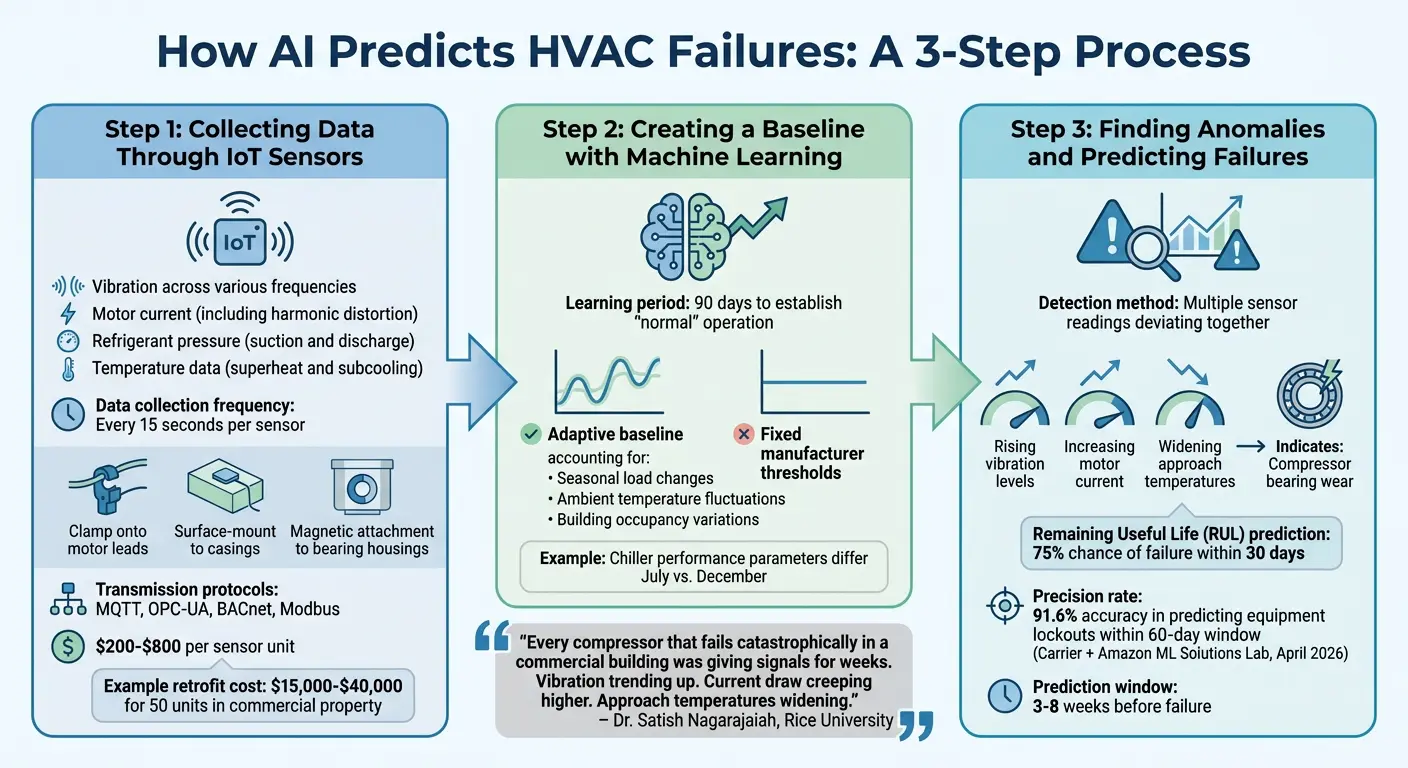
How AI Predicts HVAC Failures: 3-Step Process
AI can predict HVAC failures well in advance, helping avoid disruptions to operations. By continuously monitoring systems and learning their typical behavior, AI identifies even minor changes that could indicate a potential issue. This process unfolds in three key stages, creating a 24/7 early warning system.
Step 1: Collecting Data Through IoT Sensors
IoT sensors are the backbone of this system, keeping tabs on critical HVAC components like compressors, fans, coils, and chillers. These sensors track important metrics such as:
- Vibration across various frequencies
- Motor current, including harmonic distortion
- Refrigerant pressure at suction and discharge points
- Temperature data for superheat and subcooling
Data collection happens at high frequencies – sometimes every 15 seconds per sensor.
These sensors can be easily retrofitted onto older systems. They are installed by clamping onto motor leads, surface-mounting to casings, or magnetically attaching to bearing housings. Once in place, they transmit data using protocols like MQTT, OPC-UA, BACnet, or Modbus to edge devices or cloud platforms for analysis. Costs for these wireless sensors range between $200 and $800 per unit, and retrofitting a commercial property with 50 units could cost anywhere from $15,000 to $40,000 in hardware.
Step 2: Creating a Baseline with Machine Learning
AI systems spend approximately 90 days learning what "normal" operation looks like for a specific HVAC setup. During this time, machine learning models establish a rolling statistical baseline tailored to each system. This baseline accounts for factors like:
- Seasonal load changes
- Fluctuations in ambient temperatures
- Variations in building occupancy
Unlike traditional systems that rely on fixed manufacturer thresholds, this adaptive baseline mirrors real-world conditions. For example, a chiller’s performance parameters in July will naturally differ from those in December. By learning these patterns, the system can spot even slight deviations that may signal potential issues.
Step 3: Finding Anomalies and Predicting Failures
AI identifies problems when multiple sensor readings deviate together. For example, if vibration levels rise, motor current increases, and approach temperatures widen at the same time, the system interprets these as early warnings of compressor bearing wear.
"Every compressor that fails catastrophically in a commercial building was giving signals for weeks. Vibration trending up. Current draw creeping higher. Approach temperatures widening."
– Dr. Satish Nagarajaiah, Professor of Civil & Mechanical Engineering, Rice University
Advanced AI models also estimate the Remaining Useful Life (RUL) of equipment, offering detailed probability windows. For instance, they might predict a 75% chance of failure within the next 30 days. In April 2026, Carrier collaborated with the Amazon Machine Learning Solutions Lab to analyze over 50 TB of historical sensor data. Their temporal transformer model achieved 91.6% precision in predicting equipment lockouts within a 60-day window. This precision means maintenance teams can receive actionable alerts weeks before a breakdown, ensuring timely interventions and smoother operations.
Common HVAC Problems AI Can Detect
AI monitoring systems are incredibly effective at identifying HVAC issues weeks before they lead to AC breakdowns. By analyzing data from multiple sensors, these systems pick up on early warning signs that might otherwise go unnoticed. Here’s a closer look at some of the most common problems AI can detect and how it identifies them.
Compressor Failures
Compressor failures are among the most expensive HVAC issues, but AI can detect them 6–16 weeks before they occur. Using Motor Current Signature Analysis (MCSA), AI monitors harmonic distortion and fluctuations in current draw, spotting electrical faults 4–8 weeks in advance. It also uses vibration envelope analysis to track bearing fatigue through subtle changes in vibration patterns that often go undetected by traditional alarms.
For example, AI might flag a problem if vibration levels rise by 8–12% while motor current increases under a steady load – signs of bearing degradation. Additionally, pressure inconsistencies paired with increased current draw and higher approach temperatures are key indicators of trouble. A healthcare system managing 187 compressors used AI to detect 14 developing failures in a single year, including two cases of centrifugal bearing degradation. By planning repairs ahead of time, they saved around $620,000 compared to emergency replacements. This kind of foresight minimizes downtime and avoids unnecessary expenses.
Motor Misalignments and Vibrations
AI excels at identifying motor misalignments 6–12 weeks before they become serious. It uses tri-axial MEMS accelerometers to detect sub-harmonic shifts and monitors belt harmonics to predict drive wear 3–4 weeks in advance. Misalignments or bearing defects create distinct frequency changes in vibration data, which AI pinpoints with high accuracy.
By combining data from multiple sensors, AI reduces false alarms and can also spot other issues like rotor bar defects or aging VFD capacitors 6–10 weeks before they cause downtime. This early detection allows for timely maintenance, preventing damage that could lead to expensive repairs or system failures.
Clogged Filters and Reduced Airflow
Airflow problems, often caused by clogged filters or duct obstructions, are another area where AI proves invaluable. It tracks differential pressure across filters and coils to identify blockages 4–6 weeks before they become critical. As filters collect dust and debris, static pressure rises, and supply air temperatures drift from normal levels. AI links these changes with rising suction temperatures and wider approach temperature gaps (the difference between refrigerant temperature and cooled air), revealing not just clogged filters but also duct obstructions and belt slippage.
The system even detects belt glazing by analyzing vibration data for changes in belt frequency harmonics. Addressing these issues early prevents energy waste – airflow restrictions can reduce system efficiency by 20% or more. With AI, facilities can maintain peak efficiency through professional cooling services and avoid unnecessary energy costs.
Benefits of AI-Powered Predictive Maintenance
AI-powered predictive maintenance offers a smarter way to manage costs, boost energy efficiency, and extend the lifespan of equipment.
Lower Downtime and Repair Costs
AI can identify warning signs of equipment failure 3–8 weeks in advance, significantly reducing the likelihood of costly unplanned shutdowns. These shutdowns typically cost between $8,400 and $22,000 per event. By addressing issues early, organizations can cut unplanned downtime costs by 72% to 91% and reduce emergency repair calls by 40–60%. This proactive approach often delivers an impressive return on investment (ROI) of 8x to 35x, with payback periods ranging from just 3 to 8 months.
Planned maintenance is far more cost-effective than reactive "run-to-failure" approaches. In fact, reactive maintenance can cost 3 to 9 times more than scheduled repairs. By minimizing downtime and repair costs, AI-powered solutions provide a clear financial advantage.
Better Energy Efficiency
Heating, ventilation, and air conditioning (HVAC) systems are major energy consumers, accounting for 40% to 60% of a commercial building’s total energy expenses. AI-driven energy optimization uncovers inefficiencies that might otherwise go unnoticed, such as sticking dampers, minor refrigerant charge issues, or gradual coil fouling. These inefficiencies can snowball into significant energy drains over time.
Organizations adopting AI for predictive maintenance report energy savings of 15% to 40%. For instance, even a small refrigerant charge deficit of 10% can reduce system efficiency by 20%, while coil fouling can cause a 1% to 2% efficiency loss for every degree increase in approach temperature. A real-world example comes from a Class A office tower in Riyadh’s King Abdullah Financial District, where AI analysis of two years of building management system data led to a 10.6% reduction in HVAC electricity consumption and a 47.6% drop in unplanned outages. These energy savings not only lower costs but also help maintain equipment health over time.
Longer Equipment Lifespan
AI can extend equipment lifespans by 20–30%, allowing systems to operate at 100–125% of their design life. This is a significant improvement over reactive maintenance, which typically achieves only 60–75% of design life, and even traditional preventive maintenance, which extends life to 85–100%.
The key to this longevity lies in AI’s ability to prevent cascading failures. For example, early detection of bearing wear can prevent severe damage to compressors or contamination of refrigerant circuits. Unlike traditional preventive maintenance, which relies on periodic checks and misses 67% of failures that occur between inspections, AI provides continuous 24/7 monitoring. This constant oversight ensures systems operate within optimal parameters, reducing mechanical stress and heat that accelerate aging.
In addition to extending lifespan, AI also lowers maintenance costs. Predictive maintenance powered by AI typically costs $8 to $16 per ton, compared to $18 to $35 per ton for reactive maintenance. These cost savings, combined with enhanced reliability, explain why modern HVAC systems are increasingly adopting AI solutions and why specialized service providers are embracing this technology.
Working with Eco Temp HVAC for AI-Driven HVAC Solutions

Eco Temp HVAC brings AI-powered predictive maintenance to the Chicagoland area, ensuring consistent comfort with advanced monitoring and expert service.
Certified Technicians and Advanced Diagnostics
Eco Temp HVAC stands out as a Mitsubishi Diamond Elite Contractor and Navien Service Specialist, leveraging these certifications to enhance repair precision through AI diagnostics. For instance, if the system identifies potential issues – like bearing degradation weeks before failure – it automatically generates detailed work orders. These include fault specifics, trend charts, and recommended parts, removing the guesswork typical of traditional diagnostics. Additionally, their Mitsubishi Diamond Elite status allows them to provide a 12-year warranty on Mitsubishi products, offering clients both cutting-edge AI monitoring and long-term reliability.
24/7 Monitoring for Proactive Maintenance
By incorporating IoT sensors into their maintenance plans, Eco Temp HVAC ensures constant monitoring of critical metrics such as vibration, power usage, refrigerant pressure, and airflow. The AI system creates a 90-day baseline, adjusted for seasonal and local climate patterns. When multiple sensors detect anomalies – like increased vibration paired with higher current draw – the system initiates work orders automatically, often weeks before a breakdown. This proactive method has been shown to cut emergency service calls by 40% to 60%, enabling repairs to be scheduled during regular hours instead of middle-of-the-night emergencies. It’s a seamless approach that highlights Eco Temp HVAC’s dedication to efficient, tech-forward service.
Local Knowledge and Tailored Solutions
Eco Temp HVAC combines its 24/7 monitoring capabilities with a deep understanding of Chicagoland’s specific needs. Serving areas like Chicago, St. Charles, Bartlett, Lemont, Downers Grove, and Palatine, they customize their services to address the region’s unique environmental challenges, including seasonal and load variations. Whether it’s for a commercial facility or a residential property, their condition-based monitoring ensures HVAC systems run efficiently all year. By focusing on high-value assets like chillers, compressors, and large air handlers, Eco Temp HVAC helps clients get the most out of their AI-driven maintenance investments.
Conclusion
AI-driven maintenance is changing the game for HVAC care. Instead of scrambling to fix unexpected breakdowns, facilities now benefit from proactive, data-driven alerts that can predict failures 3 to 8 weeks in advance. This shift leads to impressive results: energy savings of 15% to 35% and equipment lifespans extended by 20% to 30%. Plus, technicians are better prepared with early warnings, avoiding the chaos of emergency repairs.
The financial impact is just as compelling. AI-guided maintenance interventions cost 60% to 70% less than emergency fixes, and most facilities see a full return on investment within 3 to 8 months – often by sidestepping a single major compressor failure. These benefits make AI maintenance not just a smart operational choice but a strategic one.
Eco Temp HVAC brings these advantages to Chicagoland with its AI-driven maintenance solutions. Offering 24/7 monitoring, certified technicians, and local expertise across Chicago, St. Charles, Bartlett, Lemont, Downers Grove, and Palatine, Eco Temp HVAC delivers cutting-edge service. As a Mitsubishi Diamond Elite Contractor, they combine IoT-enabled diagnostics with a reliable 12-year Mitsubishi warranty. Their condition-based approach minimizes downtime, cuts energy costs, and extends equipment life – providing the precise, proactive care modern HVAC systems require.
Discover Eco Temp HVAC’s AI-driven services and make the leap from reacting to failures to preventing them altogether.
FAQs
Do I need a brand-new HVAC system to use AI monitoring?
No, you don’t need to invest in a brand-new HVAC system to benefit from AI monitoring. AI-driven predictive maintenance can seamlessly integrate with your current setup. It works by identifying potential issues weeks before they become serious problems. This proactive approach helps you avoid expensive repairs and keeps your system running smoothly, ensuring consistent comfort.
How long does AI take to learn what “normal” looks like for my HVAC equipment?
AI typically needs 3 to 8 weeks to analyze sensor data and establish baseline patterns for your HVAC equipment. During this time, it learns the system’s normal behavior, allowing it to spot potential issues early. This proactive approach helps avoid expensive repairs and reduces downtime.
What happens after AI detects an issue – do I get an alert or a service visit?
When AI identifies a possible problem, it usually sends a notification to bring it to your attention. This gives your maintenance team the chance to plan and schedule a service visit ahead of time, reducing the risk of sudden breakdowns and expensive repairs.