
When it comes to heating your home efficiently, boiler size matters more than you might think. Here’s why:
- Oversized boilers waste energy by constantly cycling on and off, leading to higher fuel costs, faster wear, and uneven heating.
- Undersized boilers struggle to meet heating demands, especially in cold climates, causing continuous operation, higher energy use, and reduced system lifespan.
- Proper sizing ensures better performance, lower costs, and longer equipment life.
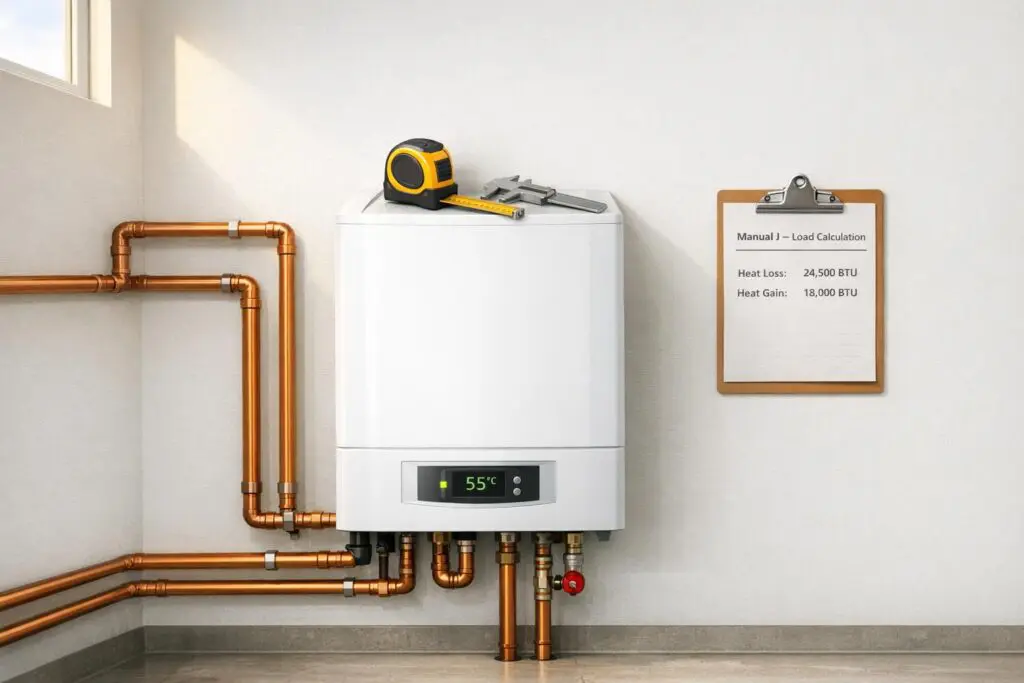
For accurate sizing, a Manual J calculation is essential. This evaluates your home’s heating needs based on factors like insulation, windows, and square footage. Modern homes often require smaller boilers due to better insulation and energy-efficient designs.
Switching to the right size boiler, especially a high-efficiency model, can save you hundreds of dollars and reduce carbon emissions significantly. Professional guidance ensures your boiler is tailored to your home, avoiding costly mistakes.
Boiler Sizing Basics and Measurement Standards
Factors That Determine Boiler Size
Boiler size is measured in BTUs, which indicate the heating power of the unit. A higher BTU rating means more heating capacity. To choose the right size, you’ll need to match the boiler’s capacity to your specific building requirements.
A Manual J calculation is the go-to method for determining the appropriate boiler size. This detailed assessment considers factors like insulation quality, the efficiency of windows and doors, ceiling height, and the materials used in construction. For homes in Chicagoland, which fall within climate zones 5 and 6, the general rule of thumb is 50–60 BTUs per square foot. For example, a 1,500-square-foot home in Chicago would typically require a boiler with a capacity of 75,000–90,000 BTUs.
The type of heating system also plays a role in sizing. Steam and traditional radiator systems demand higher BTU ratings compared to hot water or underfloor radiant systems. If you’re considering a combination (combi) boiler that provides both space heating and hot water, you’ll also need to factor in the number of bathrooms and your household’s water usage habits.
Upgrading insulation or installing energy-efficient windows can sometimes allow for a smaller boiler, saving both energy and money. It’s also worth addressing heat losses from unconditioned piping, which can waste as much as 35% of energy. Tackling these inefficiencies first ensures the boiler’s capacity matches the building’s needs while keeping operating costs in check.
Plant Size Ratio (PSR) Explained
Beyond just capacity, the Plant Size Ratio (PSR) is key to efficient boiler operation. This ratio compares the boiler’s total capacity to the building’s actual heating demand. An oversized boiler with a high PSR can lead to frequent on-and-off cycling, known as short-cycling. This not only wastes fuel but also causes unnecessary wear on the system’s components. On the other hand, a low PSR indicates an undersized boiler, which may struggle to maintain comfortable temperatures during colder periods.
Modern boilers often feature modulating burners, which adjust output to match heating demand. The Department of Energy suggests a minimum turndown ratio of 5:1 for gas-fired hot water boilers. This means the boiler can efficiently operate at just 20% of its maximum capacity, reducing the risks associated with short-cycling. For commercial buildings with fluctuating heating needs, using multiple smaller modular boilers is often more efficient than a single large unit. Modular setups allow individual boilers to be turned off during low-demand periods, minimizing standby losses.
Choosing the Right Size Boiler – How to Calculate?
Problems with Incorrect Boiler Sizing
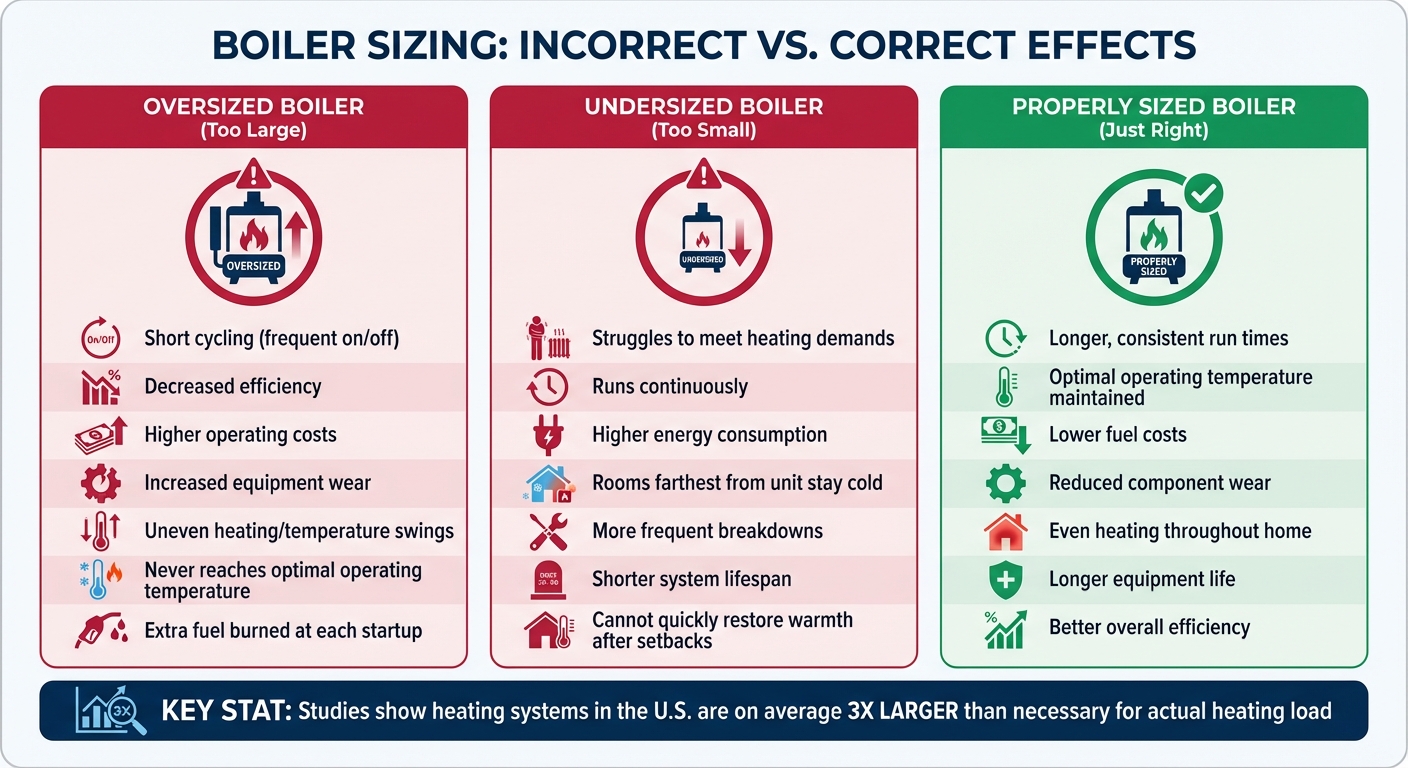
Effects of Oversized vs Undersized vs Properly Sized Boilers on Energy Efficiency
Choosing the wrong boiler size – whether too large or too small – can disrupt comfort, inflate energy bills, and shorten equipment life. These issues stem from how improperly sized boilers operate under real-world conditions.
Issues with Oversized Boilers
When a boiler is too large for a home, it reaches its target temperature quickly, only to shut off and restart repeatedly. This process is known as short cycling. As Don DeCarr, Hydronic/Warm Air Product Manager at ECR Intl., explains:
"Oversizing leads to short cycling, decreased efficiency, increased operating costs, and equipment wear".
Short cycling prevents the boiler from running efficiently, as it never stays on long enough to reach its optimal operating temperature. Each startup burns extra fuel, which drives up utility costs. On top of that, the constant on-and-off cycling can cause uneven heating, leading to noticeable temperature swings throughout the house.
While an oversized boiler wastes energy and creates uneven heating, an undersized boiler brings its own set of challenges.
Issues with Undersized Boilers
A boiler that’s too small for a home’s heating demands will struggle to maintain comfortable temperatures, especially during extremely cold weather. For instance, during a harsh Chicago winter, an undersized boiler might leave certain rooms – particularly those farthest from the unit – uncomfortably cold.
Because it’s always working to keep up, an undersized boiler runs continuously, consuming more energy and putting extra wear on its components. This constant strain often leads to more frequent breakdowns and a shorter lifespan for the system. Additionally, if the home uses nighttime temperature setbacks, the boiler may lack the capacity to quickly restore warmth in the morning, leaving residents waiting longer for comfort.
To avoid these issues, precise load calculations and professional guidance are essential when selecting a boiler. Proper sizing ensures efficient operation, consistent comfort, and a longer system life.
sbb-itb-b5c10b1
How to Select the Right Boiler Size
Choosing the correct boiler size is all about precision. Relying on the capacity of your old boiler without reassessment often carries forward outdated oversizing issues. Proper load calculations are essential for ensuring efficient operation, longer system life, and optimal performance.
Calculating Your Heating Load
An ACCA Manual J calculation is the gold standard for determining your heating load. This process evaluates your home’s heat loss on the coldest days by factoring in square footage, ceiling height, insulation levels, window types, air leakage, and your location’s 99% outdoor design temperature – the temperature that your area stays above 99% of the time.
Surprisingly, studies reveal that heating systems are often overbuilt, with some oversized by up to 200%. On average, systems in the U.S. are three times larger than necessary for the actual heating load. To avoid inefficiency, ASHRAE advises sizing equipment at 1.4 times the calculated heat load, striking a balance between comfort and energy efficiency.
Longer Run Times for Greater Efficiency
Once you’ve calculated your heating load, the goal is to ensure the boiler operates efficiently. A properly sized boiler will run for longer, consistent periods, rather than constantly cycling on and off. This steady operation allows the system to maintain its optimal temperature, improving efficiency. Gerry Hogan, Director of Training and Applied Technology at PB Heat LLC, uses a relatable analogy:
"When the piping is too small, the boiler reaches the target quickly and will short-cycle, with the burner starting and stopping frequently. This effect is often compared to ‘city driving’ of a car with a resulting lower efficiency".
Extended run times not only boost efficiency but also reduce wear on critical components like burners and heat exchangers. For condensing boilers, operating at lower temperatures can save 1% in fuel for every 3°F reduction in supply water temperature.
The Value of Certified HVAC Professionals
Certified HVAC technicians bring the expertise and tools needed for precise load calculations that go beyond what homeowners can achieve. The International Residential Code mandates that heating equipment be sized using Manual J or an equivalent method. Professionals also account for the unique requirements of different systems. For example, steam boilers require measuring each radiator’s Equivalence of Direct Radiation (EDR), while hot water systems are based on calculated heat loss. This specialized knowledge helps avoid the inefficiencies and problems caused by improper sizing.
Eco Temp HVAC employs certified technicians skilled in proper boiler sizing and installation. Serving the Chicagoland area – including Chicago, St Charles, Bartlett, Lemont, Downers Grove, and Palatine – they are available 24/7. With certifications like Navien Service Specialist, their team ensures your boiler is tailored to your home’s needs, delivering efficiency, comfort, and long-lasting performance.
Conclusion
Benefits of Correct Boiler Sizing
Getting the size of your boiler right offers both immediate and long-term perks. For starters, a properly sized boiler avoids short cycling, which not only reduces fuel waste but also keeps your heating bills in check. For example, opting for a 90% AFUE gas boiler instead of an 84% model can save you $1,150 in lifetime energy costs. That’s a substantial return on investment over time.
Additionally, correct sizing helps your equipment last longer. Frequent cycling can wear out components, but a well-sized boiler operates more efficiently, keeping your home comfortable while minimizing repair costs. Since heating and cooling account for about 40% of a household’s yearly energy usage, ensuring your boiler is appropriately sized can significantly cut down your biggest energy expense. These advantages highlight why professional installation and precise sizing are so critical.
Eco Temp HVAC‘s Boiler Services
The benefits of proper boiler sizing become even more impactful when paired with expert installation. That’s where Eco Temp HVAC steps in. Serving the Chicagoland area, their team of certified professionals uses industry-standard Manual J calculations to determine exactly what your home needs. They consider everything from insulation levels to window efficiency and even Illinois’s chilly winters to ensure your boiler is the perfect match for your space.
As Navien Service Specialists and American Standard Customer Care Dealers, Eco Temp HVAC guarantees precise installations based on modern standards – not outdated assumptions. Their services are available 24/7 across Chicago, St Charles, Bartlett, Lemont, Downers Grove, and Palatine. From initial assessments to installation and maintenance, they take a whole-house approach, factoring in upgrades like improved air sealing or added insulation to avoid costly oversizing. Whether you’re replacing an old system or upgrading for better efficiency, their certified team ensures your boiler delivers peak performance and maximum savings.
FAQs
How do I choose the right boiler size for my home?
Choosing the right boiler size for your home is crucial for maintaining both energy efficiency and comfort. Don’t just go with the size of your current boiler – it might not be the best fit. Instead, focus on calculating your home’s actual heating and hot water needs. Boiler size is typically measured in either BTUs (British Thermal Units) or kilowatts (kW), which reflect the system’s energy output.
The most reliable way to determine the right size is through a professional load calculation. This process takes into account important factors like your home’s insulation, square footage, layout, and even the local climate. Why does this matter? An oversized boiler can waste energy and wear out faster due to constant on-and-off cycling. On the other hand, an undersized boiler might struggle to keep up with your heating needs, leaving you cold when you need warmth the most.
To ensure you get it right, consult a certified technician. Professionals, such as those at Eco Temp HVAC, can evaluate your home’s specific requirements to help you choose a boiler that delivers optimal energy efficiency and long-term dependability.
What happens if my boiler is too big or too small?
Choosing the wrong boiler size can create a host of energy and comfort problems. For example, a boiler that’s too large will often turn on and off in quick cycles – this is called short cycling. Not only does this waste energy, but it also drives up your utility bills and puts unnecessary strain on the system, potentially cutting its lifespan short. On the flip side, a boiler that’s too small may struggle to heat your home effectively, especially in colder weather. This can lead to it running constantly, resulting in higher energy bills and less comfort.
Getting the right boiler size is key to avoiding these issues. It all starts with accurate heat load calculations, which factor in things like the size of your home, the quality of insulation, and your local climate. A properly sized boiler delivers better energy efficiency, lower costs, and dependable performance for years to come. For expert help, you might want to consult professionals like Eco Temp HVAC, who specialize in energy-efficient heating solutions tailored to your needs.
Why is it important to perform a Manual J calculation when sizing a boiler?
Getting the right boiler size for your home isn’t just about guessing or choosing the most powerful option – it’s a calculated process. A Manual J calculation evaluates your home’s heating load by factoring in things like square footage, insulation levels, window types, and even your local climate. This ensures your boiler is tailored to your home’s specific needs.
Why is this important? A boiler that’s too large can waste energy and drive up utility costs, while one that’s too small might struggle to keep your home warm, leading to uneven heating and unnecessary strain on the system. Both scenarios can result in higher bills and more frequent repairs.
When your boiler is correctly sized, you’re not just saving money on energy. You’re also extending the life of the equipment and maintaining consistent, reliable comfort throughout your home. If you’re unsure about sizing or want expert advice, Eco Temp HVAC offers guidance and solutions to help you choose the best option for your heating needs.