
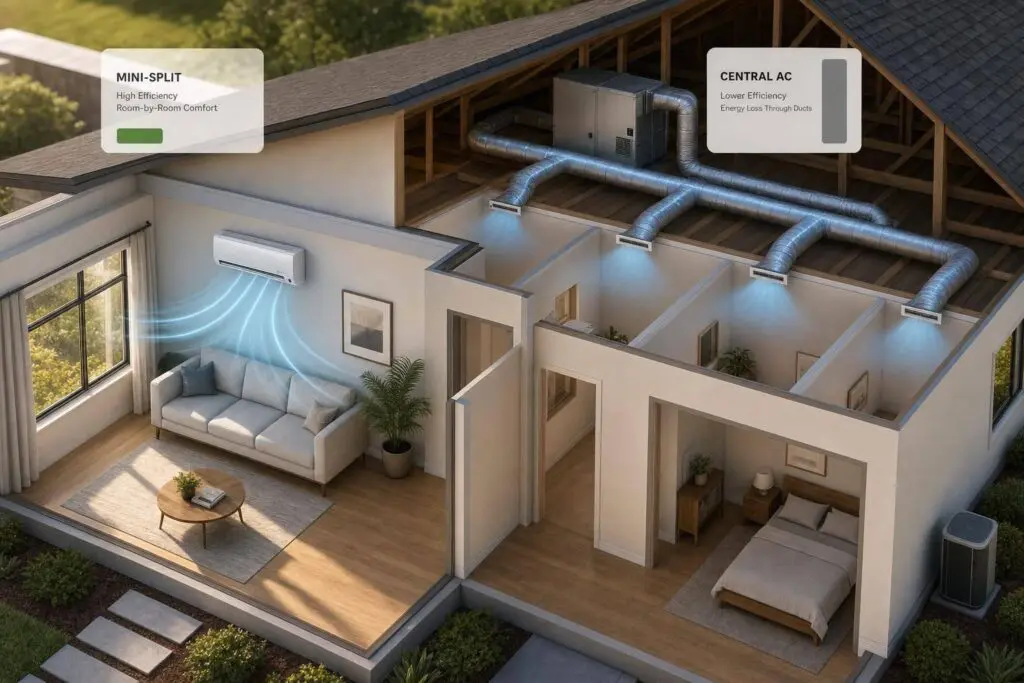
Yes – mini-splits often use less electricity than central AC. In many homes, they win because they skip duct losses, run at variable speeds, and let you cool one room at a time instead of the whole house.
Here’s the short answer in plain English:
- Mini-splits often rate around 20–30+ SEER2
- Many central AC systems rate around 14–22 SEER2
- Ducts can waste 20%–30% of cooled air when they leak or run through hot attics, crawlspaces, or unfinished basements
- If your home has tight, insulated ducts and you cool most rooms most of the day, central AC can still make sense
- Your insulation, floor plan, and daily room use often matter as much as the equipment
So if you only cool bedrooms at night or a home office during the day, I’d expect a mini-split to use less power in many cases. If you cool the whole house all day and your ductwork is in good shape, the gap may be much smaller.
Mini Splits vs Central Air: The REAL Cost & Efficiency Truth
sbb-itb-b5c10b1
Quick Comparison
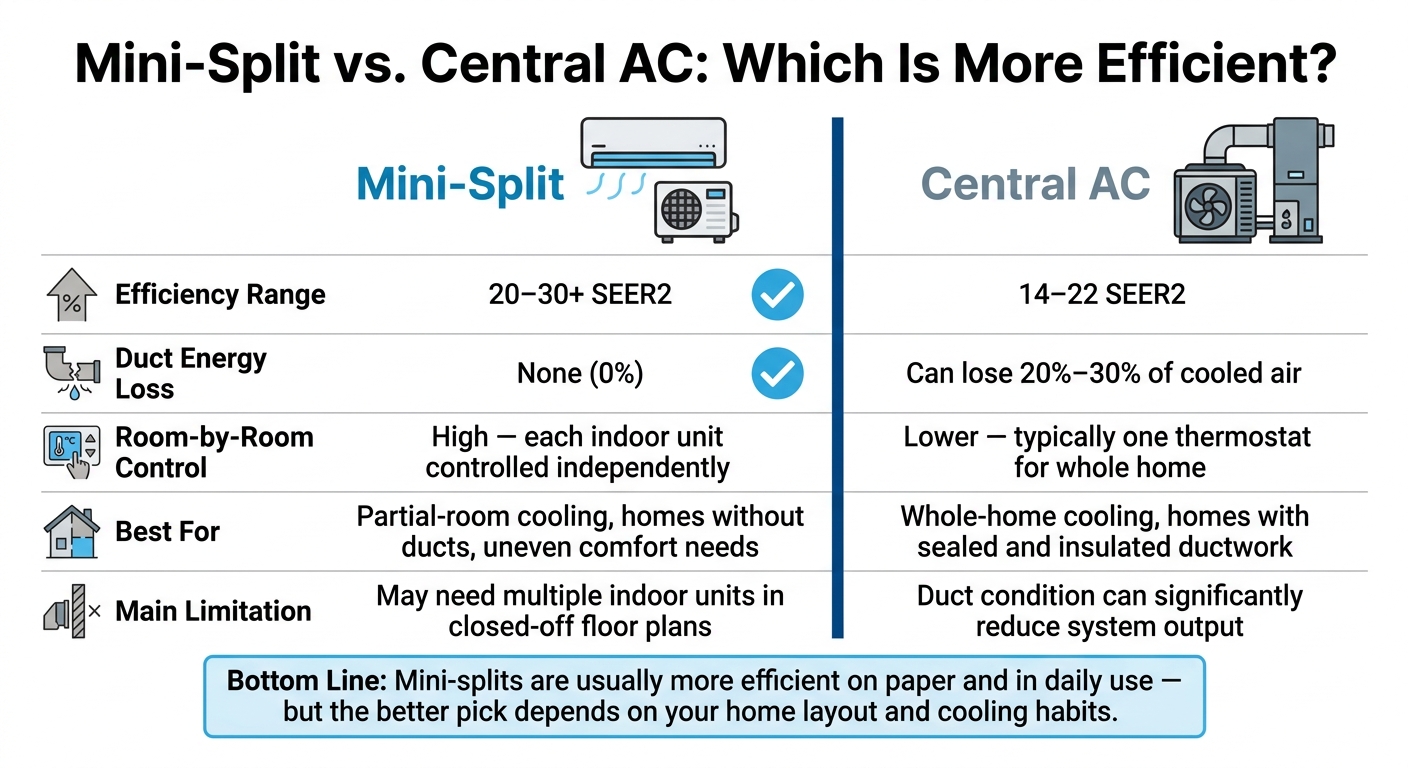
Mini-Split vs Central AC: Efficiency Comparison at a Glance
| Factor | Mini-Split | Central AC |
|---|---|---|
| Efficiency range | 20–30+ SEER2 | 14–22 SEER2 |
| Duct losses | None | Can lose 20%–30% |
| Room control | High | Usually lower without zoning |
| Best for | Partial-room cooling, homes without ducts, uneven comfort | Whole-home cooling services, homes with solid ducts |
| Main limit | May need more indoor units in closed-off layouts | Duct condition can cut system output |
Bottom line: I’d sum it up this way – mini-splits are usually more efficient on paper and often in day-to-day use, but the better pick depends on your home setup and how you cool it.
Why mini-splits often use less power than central AC
Mini-splits often use less power for three simple reasons: no duct losses, variable-speed cooling, and room-by-room control.
No ducts mean less energy loss
Central AC can lose energy through ductwork, especially when ducts run through hot attics or crawlspaces. Mini-splits skip that problem because they send air straight into the room.
That direct delivery is a big part of why they use less power, but it’s not the only reason.
Variable-speed operation lets mini-splits match the cooling demand
Many mini-splits use inverter-driven compressors. That means they can speed up or slow down as needed instead of blasting at full power, shutting off, and then starting again.
That steadier operation cuts cycling losses and helps keep indoor temperatures more even.
Cooling only the rooms you use cuts waste
Each indoor unit can be controlled on its own. So you can cool upstairs bedrooms at night, a home office during work hours, or a finished basement only when someone’s down there. In plain English: you cool the rooms you’re using, not the whole house.
A central system usually pushes air through the full duct network whether every room needs cooling or not. Central AC can still be a good fit when the ducts work well and you want one system to cool the entire house.
When central AC can still be the right choice
Mini-splits aren’t always the best pick. Central AC can make just as much sense – and in some homes, it can be the better fit. It mostly comes down to what you already have and how you use the house day to day. The main thing to look at is simple: do your ducts and your living patterns make central cooling efficient enough?
Good existing ductwork can narrow the efficiency gap
If your ducts are sealed, insulated, and located inside conditioned space, central AC wastes much less cooled air. Add a high-efficiency variable-speed system, and the gap between central AC and ductless can get a lot smaller.
In newer homes with solid ductwork, fixing leaks and upgrading the equipment may make more sense than switching fully to ductless. At that point, the decision often comes down to your home’s layout, insulation, and how each room gets used.
Whole-home cooling is often simpler with one central system
If most rooms are occupied for much of the day, the zoning edge that mini-splits offer starts to matter less. You’re cooling the whole house either way, so one central system with a single thermostat can do the job in a clean, simple way. When the entire home stays in use, that simplicity becomes a bigger plus.
For larger homes with steady, whole-house use, central AC is often the simpler fit.
The real deciding factors: insulation, layout, and how you use the space
Even a high-efficiency system can struggle in the wrong building. In many cases, insulation, layout, and day-to-day use matter more than the equipment itself. The same setup can work great in one home or business and fall short in another.
Better insulation and air sealing reduce cooling demand for either system
Air sealing and insulation cut down the amount of heat getting inside in the first place. That means any cooling system has less work to do and runs for less time.
Hot, humid summers make this even more important. If ductwork runs through unconditioned spaces, it can lose more energy along the way, which can drag down central AC performance. That’s why fixing the building envelope before swapping out equipment often delivers the biggest efficiency gains.
Once the envelope is in good shape, the next thing to look at is the floor plan.
Open layouts and closed-off rooms affect which system fits best
Layout has a big impact on what works best in practice. Open floor plans usually need fewer indoor units. Closed-off rooms, on the other hand, often need more zones or a zoned central system to cool each area well.
You see the same thing in offices and storefronts. When different spaces have different schedules or cooling needs, zoning becomes much more useful.
Then there’s the day-to-day part: how often each area is used.
How you use the space often matters more than the system type
Partial occupancy tends to favor mini-splits. If the whole space needs cooling all day, the difference between systems gets smaller.
For example, a family that only cools upstairs bedrooms at night can get a clear efficiency edge from mini-splits. But a commercial space that needs every room cooled all day may find that a properly sized central system is just as competitive.
The best fit comes down to matching the system to the layout of the building and the way people use the space.
Conclusion: Match the system to how you actually cool the property
The right answer has less to do with the name on the box and more to do with how your property gains heat and how you use cooling day to day.
Mini-splits are often the more efficient option because they skip duct losses, adjust output as needed, and cool only the rooms you’re using. That can make a big difference, especially in homes where cooling needs change from room to room.
Central AC can still be a smart fit when the ductwork is sealed and insulated well, and when the home is cooled more evenly as a whole. In plenty of cases, the building itself and your cooling habits matter more than the equipment type.
If you want help sorting through those factors for your own property, Eco Temp HVAC can help Chicagoland property owners compare mini-split and central AC costs and options and choose the right system for the space.
FAQs
How much do leaky ducts reduce central AC efficiency?
Leaky ducts can take a big bite out of central AC performance. In many homes, ducts lose about 20% to 40% of the cooled air moving through them, especially when they pass through spaces like attics or crawl spaces that aren’t cooled.
That means a chunk of the air your system already paid to cool never makes it into your rooms. As a result, duct leaks can account for more than 30% of a home’s space-conditioning energy use.
Does a mini-split still save energy if I cool the whole house?
Yes. A mini-split can still use less energy than central AC, even when you’re cooling your entire house.
The big edge is zoned control. You cool the rooms you use instead of pushing air through every part of the house. Mini-splits also skip the 20% to 30% duct losses that are common with central systems. On top of that, they use inverter-driven, variable-speed compressors, so they adjust output as needed instead of constantly turning on and off.
Which home layouts work best with mini-splits?
Mini-splits make the most sense in homes without ductwork or in spots that are tough to cool with a standard HVAC setup. They’re often a smart pick for multi-story homes, historic bungalows, finished basements, attics, garages, and room additions.
They also suit homes where comfort needs change from room to room. A few units may handle an open floor plan just fine, while enclosed rooms usually do better with their own control.