
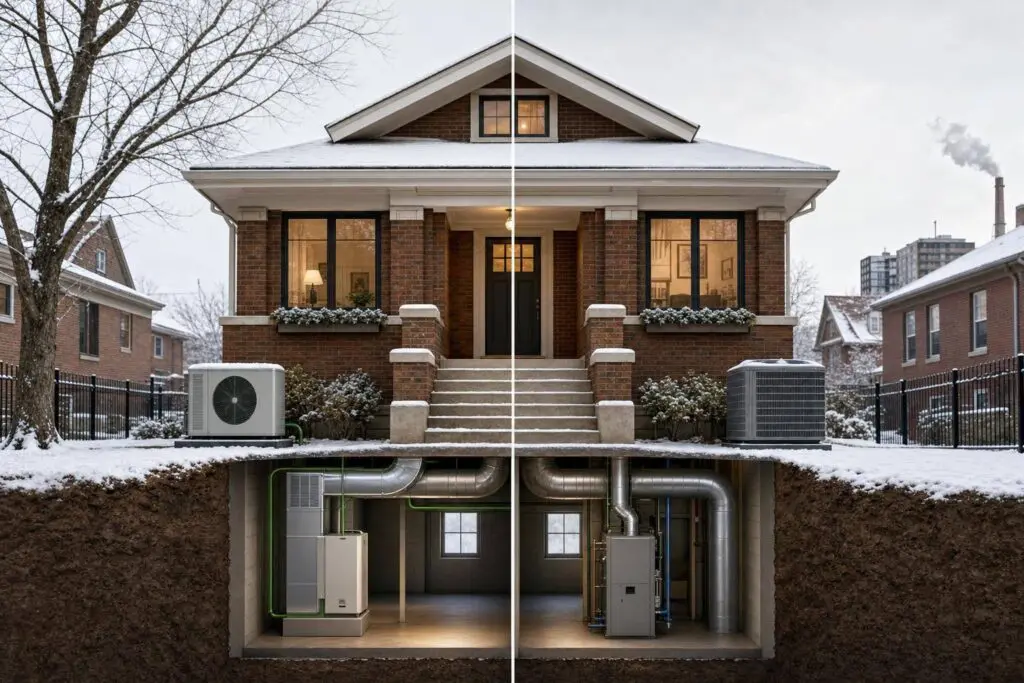
If you live in Chicago, this choice is mostly about winter heat, not summer cooling. A heat pump can heat and cool your home, while central air cools only and still needs a furnace or other heat source.
Here’s the short answer:
- Pick a heat pump if you’re replacing both your AC and furnace, want one system for both seasons, or want to use less gas.
- Pick central air if your furnace is still in good shape and you only need to replace the cooling side.
- Pay close attention to winter performance. Chicago gets about 6,339 heating degree days and only about 842 cooling degree days, so heating does far more work over the year.
- Expect backup heat with many heat pump setups. Chicago’s winter design temperature is about -4°F, and some homes need a furnace to help during very cold weather.
- Do not ignore ductwork. Leaky, undersized, or unbalanced ducts can hurt comfort and efficiency no matter which system you choose.
- Sizing matters in summer too. An oversized system can leave the house cool but still damp.
If I were making this decision, I’d look at three things first: the age of the furnace, how well the ducts move air, and whether I want one system or a furnace-plus-AC setup.
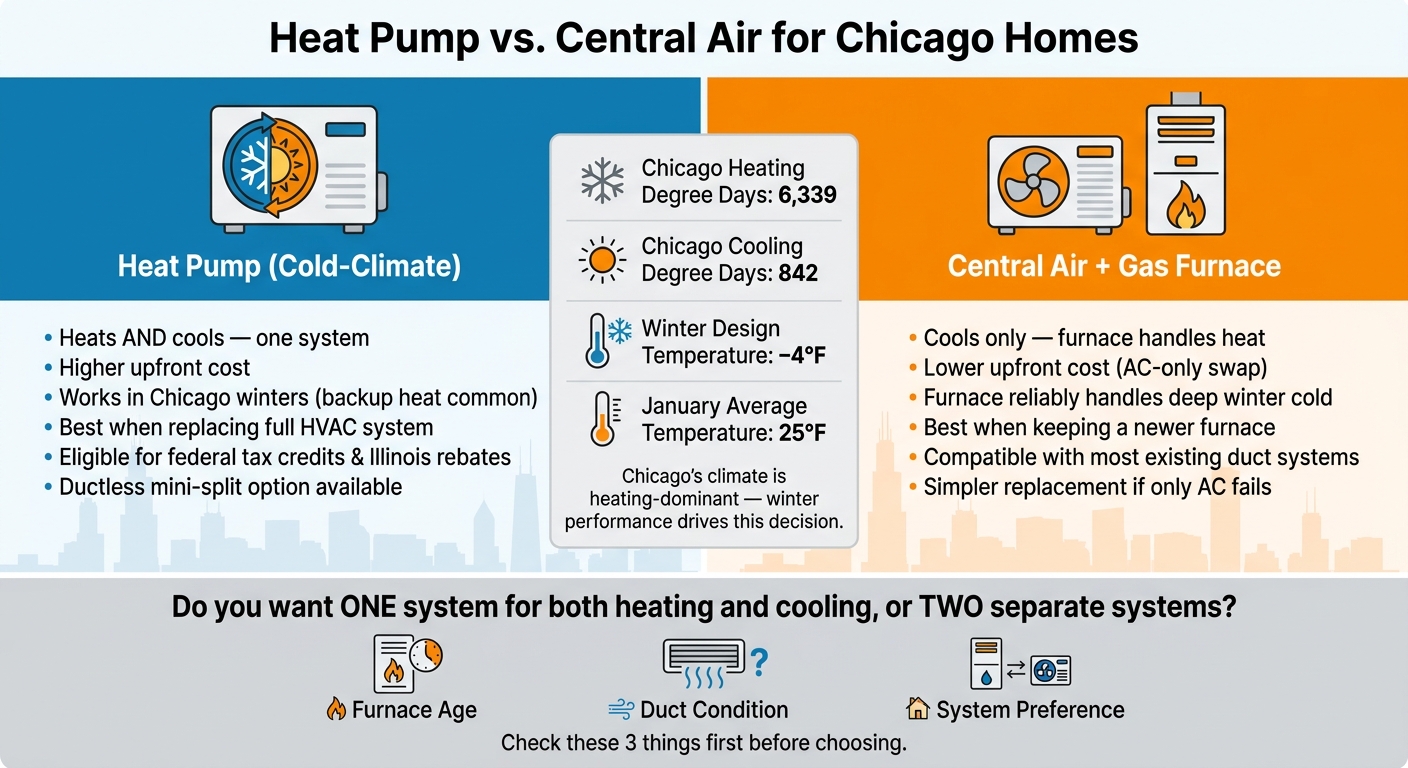
Heat Pump vs. Central Air for Chicago Homes: Side-by-Side Comparison
How does a heat pump differ from an AC and furnace?
sbb-itb-b5c10b1
Quick Comparison
| Topic | Heat Pump | Central Air |
|---|---|---|
| Heating | Yes | No |
| Cooling | Yes | Yes |
| Needs separate heat source | Sometimes; backup is common in Chicago | Yes |
| Best when | Replacing full HVAC system | Keeping a newer furnace |
| Upfront cost | Higher | Lower for AC-only swap |
| Cold-weather note | Cold-climate models work better; backup heat is common | Furnace handles deep winter cold |
So the decision is simple in one way: Do you want one system for heating and cooling, or do you want to keep heating and cooling separate?
Heat Pump vs. Central Air: What Each System Does
A heat pump handles both heating and cooling. Central air handles cooling only.
That’s the big split. They may look similar from the outside, but they don’t do the same job once winter hits.
How a Heat Pump Heats and Cools Year-Round
A heat pump moves heat using refrigerant. In summer, it pulls heat from inside your home and releases it outdoors. That’s the same basic cooling process a central AC system uses.
In winter, the system flips that process. Instead of sending heat out, it pulls heat in.
A reversing valve changes the direction of refrigerant flow, so the indoor and outdoor coils switch roles depending on the season.
For Chicago, the kind of heat pump you choose makes a big difference. Standard models lose heating capacity as outdoor temperatures fall. Cold-climate heat pumps keep more of that heating capacity at lower temperatures, often down to about −5°F to −13°F. In a Chicago cold snap, that isn’t a small detail.
Many homes in Chicago use a dual-fuel setup. The heat pump covers most of the heating season, and the furnace steps in during extreme cold. In this market, the backup-heat question often matters more than cooling output by itself.
How Central Air Works and What It Does Not Do
Central air cools your home by removing heat and humidity from indoor air and releasing that heat outside. A blower, often the same one used with your furnace, pushes cooled air through the ductwork and into each room.
What it does not do is heat your home.
Once temperatures drop, the central AC shuts down for the season, and the furnace takes over completely.
| Feature | Heat Pump | Central Air |
|---|---|---|
| Summer cooling | Yes | Yes |
| Winter heating | Yes, by reversing refrigerant flow | No |
| Needs a separate heat source | Not always; backup is common in Chicago | Yes, always |
| Best fit | Homes wanting one system for both seasons | Homes with a reliable furnace already in place |
In Chicago, this difference shows up fast. Winters are cold, summers are humid, and many homes already have ductwork in place. That makes the heating side of the equation hard to ignore, especially when planning a new HVAC installation.
How Chicago’s Climate Affects the Decision
Chicago puts HVAC equipment through a lot. Winters are long and cold, summers are hot and muggy, and the gap between seasons is no joke.
Winter Performance and When Backup Heat Is Needed
In Chicago, winter performance usually decides choosing the right HVAC system. January has an average mean temperature of about 25°F, and the city’s design temperature is close to −4°F.
That matters because even cold-climate heat pumps can hit their limits during the harshest hours. They do better in low temperatures than older models, but many homes in Chicago still need backup heat built into the plan. If the heat pump can’t carry the load during the coldest parts of winter, something else has to step in.
For many Chicago homeowners, a dual-fuel setup strikes the right balance between efficiency and dependability. That means pairing a cold-climate heat pump with a gas furnace. The heat pump handles most of the heating season, and during the bitter cold snaps, the furnace takes over.
Cooling is less complicated, but Chicago’s humidity still makes system sizing a big deal.
Summer Cooling in Chicago’s Humid Conditions
In summer, both systems cool in much the same way. The bigger issue in Chicago is moisture control.
Variable-speed equipment usually does a better job pulling humidity out of the air. Oversized systems, on the other hand, cycle on and off too often. When that happens, rooms can feel cool but still clammy. That’s why many Chicago homes need careful sizing to stay comfortable during muggy weather.
Ductwork, Home Size, and Installation Fit
Once climate points you toward a heat pump or central air, ductwork and layout determine whether that system will perform well in your home.
Older Ducts, Existing Homes, and Airflow Issues
Even the right equipment can fall short if the ducts don’t move air evenly. Central air and ducted heat pumps both send conditioned air through the same duct network. In older Chicagoland homes, common problems include leaky joints, crushed or disconnected runs, too little return air, and ducts that were never sized correctly for the home’s layout. The result is familiar: weak airflow at vents, rooms that stay too hot or too cold, and higher utility bills.
A ducted heat pump is especially sensitive to airflow. These systems often run longer cycles at lower output, so they depend on steady airflow to do their job. A common design target is about 400 CFM per ton of cooling. If the duct system can’t deliver that, you can end up with uneven cooling, lower efficiency, and more strain on the equipment.
Before you commit to either system, ask a contractor to inspect the ductwork, check duct pressure, and test airflow at the vents. That step matters more than many homeowners think.
If the ducts are in decent shape, sealing and balancing may solve the problem. If they’re damaged or badly undersized, replacement may make more sense. In plenty of homes, airflow issues matter more than the equipment choice itself.
After airflow, the next step is making sure the system fits the home’s size and layout.
Home Size, Layout, and Room-by-Room Comfort
Chicago homes usually need much more heating capacity than cooling capacity. That matters a lot in this area, where older homes, additions, and multi-story layouts are common. Ceiling height, insulation quality, window orientation, and number of stories all change how much heating and cooling a house needs.
Multi-story homes can be especially tricky. Without proper duct balancing and return-air paths, upper floors often run warmer in summer and colder in winter. Zoning dampers, added return ducts, or separate systems for different levels are practical ways to cut down those temperature swings.
The same issue shows up in finished basements, attic rooms, and home additions, where the original duct layout often wasn’t built to serve those spaces evenly.
If a home has no ducts, or if an addition or converted space can’t be served well by the current system, ductless mini-split heat pumps deserve a close look. They don’t need ductwork and let you control comfort by zone. A Manual J load calculation should guide the final equipment choice.
Costs, Efficiency, and Which System Fits Your Chicago Home
Once climate and ductwork are off the table, this choice usually comes down to upfront price, day-to-day energy use, and whether you want one system or two. Central air usually costs less at the start when you’re replacing cooling only. A heat pump costs more because it can handle both heating and cooling.
Here’s the practical breakdown for Chicago homes:
Side-by-Side Comparison Table for Chicago Homes
| Feature | Heat Pump (Cold-Climate) | Central Air + Gas Furnace |
|---|---|---|
| Equipment Role | Heating and cooling in one system | Cooling only plus a separate furnace for heat |
| Upfront Cost | Higher upfront cost | Lower upfront cost for AC-only replacement |
| Winter Heating | Works in Chicago winters, but backup heat is common | Furnace handles winter heating reliably |
| Summer Cooling | Cools well when properly sized | Cools well when properly sized |
| Ductwork Needs | Works best with balanced, well-sealed ducts; ductless options are available | Compatible with most existing ducted furnace setups |
| Ideal Home Type | Homes replacing both AC and furnace, or homeowners pursuing electrification | Homes with a newer, reliable gas furnace |
When a Heat Pump Is the Better Choice
A heat pump tends to make more sense when both your AC and furnace are getting old, or when you’re replacing the whole setup at once. In that case, a cold-climate heat pump or a dual-fuel system can make good long-term sense, especially if you want lower energy use, less carbon output, or electrification.
The higher upfront price can sting, but federal tax credits and Illinois rebates may help trim that cost. That said, the install has to be done right. A proper job should include a Manual J load calculation and the right cold-weather settings. If those pieces are missed, even a good system can underperform.
When Central Air Is the Better Choice
If your furnace is still fairly new and your AC is the part that’s failing, central air replacement is usually the simpler call. You keep the heating setup you already trust and swap out the cooling side only.
For homeowners who are fine sticking with gas heat and don’t plan to electrify, a properly sized central AC can deliver strong summer comfort without turning the whole house upside down.
Key Takeaways for Chicago Homeowners
In Chicago, winter heat is what usually decides this. Cooling results are close either way. The big choice is whether you want one system that does both jobs or two separate systems.
FAQs
Can a heat pump handle a Chicago winter by itself?
Yes. Modern cold-climate heat pumps can serve as the main heating system in Chicago homes, but how well they work depends on the unit you choose and the temperature outside.
That’s why many homeowners go with a dual-fuel system. The heat pump handles heating during milder weather, then a gas furnace steps in during severe cold snaps.
Some advanced models can keep delivering heat even when outdoor temperatures drop to -15°F or -20°F.
Should I replace my furnace and AC at the same time?
Often, yes, especially if you’re putting in a new system like a heat pump that can take the place of both units. If your home has separate heating and cooling systems, replacing them at the same time can help with compatibility, energy use, and upkeep.
For many Chicago homes, a dual-fuel setup with a heat pump and gas furnace is an efficient choice. Eco Temp HVAC can check your ductwork and electrical capacity to see whether replacing both is the better move.
How do I know if my ductwork can support a heat pump?
Check your ductwork’s condition and size. Leaky or older ducts can waste up to 30% of your system’s energy. And if the ducts aren’t sized right, airflow can suffer.
A licensed HVAC professional can inspect the ducts for leaks and make sure they work with the system. If the ductwork is in bad shape or isn’t a fit, you may need repairs or a full replacement.