

Where you live in Illinois directly affects HVAC installation costs. Urban areas like Chicago are more expensive due to union labor, strict codes, and higher permit fees. Suburban regions share similar costs but avoid some urban logistical challenges. Rural areas are cheaper, thanks to lower labor rates and simpler regulations, though travel fees and limited contractor availability can add to the expense.
Key Takeaways:
- Urban (Chicago): Average cost $10,350. Higher labor rates, 10.25% sales tax, and complex permits drive up prices.
- Suburban (Naperville): Similar to urban costs due to proximity to Chicago’s labor market.
- Rural (Springfield/Rockford): Lower average cost of $7,650 due to reduced labor rates and fewer regulations but may include travel fees.
Major Cost Factors:
- Labor Rates: 40%-60% of total cost. Urban areas have unionized labor, increasing prices by 30%-50%.
- Permits and Codes: Urban permit fees can exceed $350; rural permits are often under $150.
- Building Age: Older buildings may require upgrades like asbestos removal ($500-$3,000).
- System Type: Ductless mini-splits ($2,000-$14,000) are common in urban areas, while rural homes often use geothermal systems ($15,000-$30,000).
Understanding these differences helps homeowners budget effectively and choose the right contractor for their location.
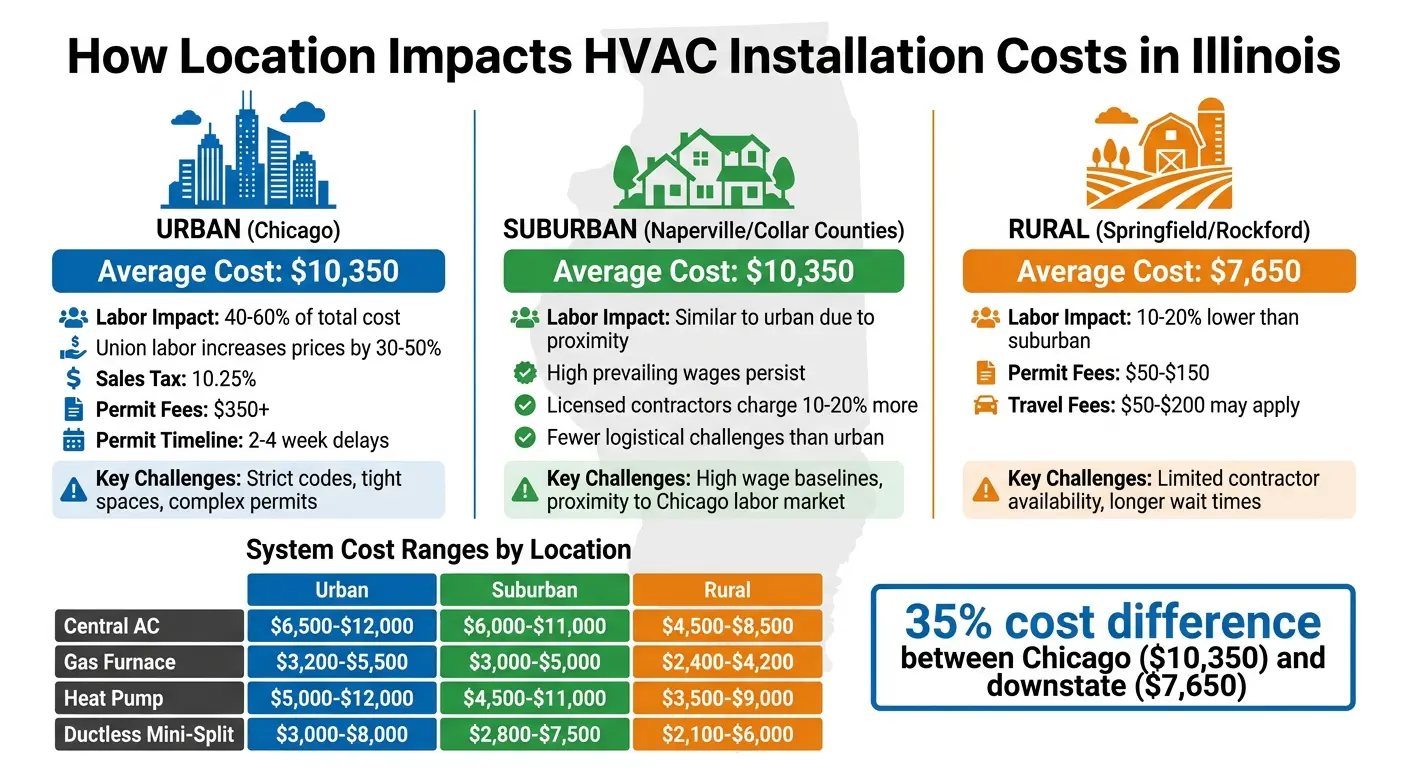
Illinois HVAC Installation Costs by Location: Urban vs Suburban vs Rural Comparison
How HVAC Contractors Set Prices
Urban vs. Suburban vs. Rural Cost Differences in Illinois
HVAC installation costs in Illinois show a wide range depending on the location. For instance, the average cost in Chicago is $10,350 per system, while cities like Springfield and Rockford average $7,650 – a difference of about 35%. This disparity stems from variations in labor markets, regulations, and local economic conditions. Let’s take a closer look at how urban, suburban, and rural areas differ in terms of cost.
Urban HVAC Installation Costs
In Chicago, HVAC installation costs are about 15% higher than the national average of $9,000. Unionized labor plays a significant role here, driving up costs but also ensuring quality and compliance with insurance standards. The city’s combined sales tax of 10.25% further increases the price of equipment and supplies. On top of that, the permitting process can extend project timelines by 2 to 4 weeks.
"Chicago’s costs reflect local labor rates driven by the finance-manufacturing-logistics economy, humid-continental climate conditions that affect materials and scheduling, and moderate permitting requirements." – CostWhale
Chicago’s strict mechanical codes and the challenges of working in tight utility spaces – like those found in Greystone buildings – add another layer of complexity to installations.
Suburban HVAC Installation Costs
Suburban areas, such as Naperville, share similar labor costs with urban markets but face fewer logistical challenges. Installation costs in these areas also average around $10,350, partly because of their proximity to Chicago’s labor market and comparable wage requirements. In Cook County and nearby collar counties, higher wage baselines persist, keeping prices elevated. Licensed contractors, who charge 10%–20% more than their unlicensed counterparts, are often preferred for their reliability and adherence to codes. That said, suburban installations avoid the extreme accessibility issues often seen in urban environments.
Rural HVAC Installation Costs
Rural areas benefit from lower costs, averaging $7,650 for full system replacements. This is largely due to reduced labor rates and a less stringent regulatory environment, with fewer code amendments and simpler permitting processes. However, technician availability in these regions can be limited, which may result in longer wait times during peak seasons.
| Location Type | Representative City | Average Installation Cost | Key Cost Drivers |
|---|---|---|---|
| Urban | Chicago | $10,350 | Union labor, 10.25% sales tax, strict codes, permit delays |
| Suburban | Naperville | $10,350 | High prevailing wages, collar county rates |
| Rural/Downstate | Springfield/Rockford | $7,650 | Lower labor rates, fewer regulatory requirements |
What Drives Cost Differences by Location
In Illinois, HVAC installation costs can vary significantly depending on whether you’re in an urban, suburban, or rural area. These differences are shaped by factors like labor market conditions and local regulations, which homeowners should understand to better plan their budgets.
Labor Rates and Cost of Living
Labor costs make up a big part of HVAC installation expenses – typically 40% to 60% of the total cost. In cities like Chicago, labor rates can be 30% to 50% higher than in suburban areas. This increase is driven by unionized labor markets in Cook County, which ensure high-quality work and compliance with insurance requirements. On the other hand, rural areas in central and southern Illinois experience labor rates that are 10% to 20% lower than suburban averages, largely due to the lower cost of living in those regions.
Hourly labor rates across the Midwest typically range from $35 to $50 per hour. However, rural installations may include travel fees ranging from $50 to $200, which can offset the lower hourly rates. If you’re planning an installation in a rural area, it’s a good idea to check whether travel fees are included in your initial estimate.
Labor isn’t the only factor, though. Local building codes and permit requirements also play a major role in shaping costs.
Building Codes and Permit Requirements
Permit fees in Illinois vary widely depending on the municipality, which can lead to significant cost differences. Chicago, for instance, has unique mechanical code amendments that add complexity and extra expenses beyond the state’s standard requirements.
"Work performed in municipalities with local mechanical code amendments – including Chicago – may carry additional permit fees and inspection steps not reflected in statewide baseline figures." – Illinois HVAC Authority
Urban installations often come with added challenges, particularly in older buildings. Homes built before 1980 may require additional work, such as asbestos removal, electrical upgrades, or flue reconfigurations, which can add $500 to $3,000 to the project. If you own an older property in Illinois, make sure your quote includes these possible upgrades to avoid unexpected costs during the installation process.
Climate Demands and System Customization
Illinois’ intense climate plays a big role in shaping HVAC system needs and costs. Classified in the U.S. Department of Energy’s "North region", the state must adhere to specific efficiency standards for new equipment. With frigid winters and scorching summers, homeowners in Illinois require systems that can handle these drastic temperature swings. This creates a strong need for systems that are both properly sized and energy-efficient.
System Sizing for Illinois Climate
Getting the size of your HVAC system right is crucial. Contractors should rely on Manual J load calculations to avoid systems that are either too large or too small – both of which can lead to higher costs over time. For instance, a typical 2,000-square-foot home in Illinois usually requires a system with a capacity of 40,000 to 60,000 BTU (roughly 3 to 5 tons). However, factors like insulation, ceiling height, and the number of windows can significantly impact this calculation.
If you own a larger home, be prepared for higher costs, as adding capacity can increase expenses by $1,000–$3,000. For example, a 3-ton system for an 1,800-square-foot home costs $3,500–$6,500 installed, while larger homes will see even higher installation costs.
Urban areas like Chicago often require compact, specialized systems, such as ductless mini-splits for older buildings without ductwork. These systems typically cost $2,000 to $4,500 for single-zone setups. In contrast, suburban and rural homes with more space usually need larger split systems, which range from $3,000 to $10,000+ depending on the size and complexity.
Energy Efficiency Needs
Energy efficiency is a top priority for managing operating costs in Illinois’ harsh climate. New central air conditioning units must meet a minimum SEER2 rating of 14.3 to comply with regional standards set by the DOE. For heating, high-efficiency condensing gas furnaces with a 96% AFUE rating are highly recommended for Illinois winters. While these furnaces cost $300 to $800 more upfront compared to standard 80% AFUE models, they deliver significant savings over time.
Investing in high-efficiency systems can cut energy bills by 20% to 40% compared to standard units. For instance, a high-efficiency furnace in the Chicago metro area costs $3,200 to $5,500 installed, while a mid-efficiency model runs between $2,400 and $4,200.
Although comparing heat pumps vs. furnaces shows that while heat pumps are excellent for moderate climates, Illinois’ extreme winters make traditional gas furnaces the go-to choice for reliability. To ensure your system can handle the state’s demanding conditions, make sure contractors use Manual J load calculations instead of outdated "rule of thumb" methods. Additionally, Illinois utilities like ComEd and Nicor Gas offer rebate programs to help offset the higher initial costs of energy-efficient equipment. These factors all contribute to the varying installation costs across urban, suburban, and rural areas in the state.
Accessibility Challenges and Installation Complexity
The location and layout of a property play a big role in how challenging – and costly – an HVAC installation might be. Urban and rural areas each come with their own hurdles, requiring contractors to adapt their approach, which can add both time and expense to the project.
Urban Accessibility Issues
Installing HVAC systems in cities like Chicago often means dealing with tight spaces and logistical headaches. For example, equipment might need to be hoisted onto rooftops or squeezed into small mechanical rooms in high-rises or densely packed neighborhoods. In cases where traditional ductwork just isn’t feasible, ductless mini-split vs. traditional HVAC systems can be a lifesaver. These systems cost anywhere from $2,000 to $14,000, depending on how many zones are needed.
For homeowners in the Chicagoland area, companies like Eco Temp HVAC (https://ecotemphvac.com) specialize in navigating these urban-specific challenges, offering expertise that can make the installation process smoother and more efficient. But while urban installations are all about working around cramped spaces, rural installations bring a completely different kind of complexity.
Rural Installation Complexity
Rural properties face their own set of challenges, often tied to distance and infrastructure. Did you know that while 97% of the U.S. land area is considered rural, only about 19.3% of the population – roughly 64.5 million people – live there?. This low population density means contractors often have to travel long distances to reach these sites, which increases costs.
On top of that, rural properties are more likely to require complex systems like geothermal heat pumps, which involve intricate loop field configurations and depend on specific soil conditions. These systems don’t come cheap, with residential installations in Illinois typically running between $15,000 and $30,000 or more. Aging infrastructure adds to the challenge, with issues like rugged roads and limited electrical capacity complicating the process. While rural jobs often involve higher travel costs, homeowners in central and southern Illinois benefit from lower labor rates, which can help balance out the overall expense.
Cost Comparison: Urban, Suburban, and Rural Installations
HVAC installation costs in Illinois can differ quite a bit depending on where you live. Urban, suburban, and rural areas each have unique factors that influence pricing, from labor rates to permitting requirements.
As of 2026, the average installation cost in Chicago is about $10,350, while rural areas like Springfield or Rockford see lower averages around $7,650. Suburban areas such as Downers Grove and Naperville tend to align with Chicago’s pricing, also averaging $10,350, due to similar labor market conditions.
What’s behind these differences? A lot of it comes down to labor costs and the complexity of local permitting. Chicago’s higher costs reflect unionized labor and higher prevailing wages. In contrast, central and southern Illinois enjoy lower labor rates and simpler permitting processes, with fees ranging from $50 to $150, compared to Chicago’s $350 or more.
Installation Cost Breakdown by Location
Here’s a closer look at how location shapes the pricing for different HVAC systems across Illinois:
| System Type | Urban (Chicago) | Suburban (Collar Counties) | Rural (Downstate) |
|---|---|---|---|
| Central AC | $6,500–$12,000 | $6,000–$11,000 | $4,500–$8,500 |
| Gas Furnace | $3,200–$5,500 | $3,000–$5,000 | $2,400–$4,200 |
| Heat Pump | $5,000–$12,000 | $4,500–$11,000 | $3,500–$9,000 |
| Ductless Mini-Split | $3,000–$8,000 | $2,800–$7,500 | $2,100–$6,000 |
Chicago’s 10.25% sales tax adds another layer of cost, making equipment and materials more expensive compared to rural areas. On top of that, older urban buildings often require extra work – like asbestos removal or electrical upgrades – which can add $500 to $3,000 to the final bill.
For homeowners in the Chicagoland area, navigating these costs and challenges can seem overwhelming. Partnering with experienced contractors, such as Eco Temp HVAC (https://ecotemphvac.com), can make a big difference. Serving Chicago, Downers Grove, and nearby communities, they help clients manage complex projects while staying on budget. Knowing these regional differences can help you better plan for your HVAC installation and choose the right team for the job.
Conclusion
Where you live in Illinois plays a big role in determining HVAC installation costs. For example, urban areas like Chicago and its surrounding suburbs average around $10,350 for complete systems. Meanwhile, downstate locations such as Springfield and Rockford average closer to $7,650. These price differences come down to factors like labor rates, permit fees, building age, and local regulations.
Understanding these variations is key to planning your budget. In Chicago, higher costs are often tied to union labor markets and complex permitting processes. While this may raise expenses, it also tends to ensure quality work and better insurance coverage. On the other hand, rural areas benefit from lower labor rates and simpler regulations but may face challenges like fewer contractor options.
To save money, consider scheduling installations during the off-season and taking advantage of utility rebates and federal tax credits of up to 30%. Also, request a Manual J load calculation to avoid overspending on an oversized system.
When selecting a contractor, choose one who is licensed and bonded to ensure compliance with local codes and to protect your investment. For those in the Chicagoland area, working with experienced providers like Eco Temp HVAC can make a big difference. They offer professional installations that meet all local requirements while staying within your budget. Serving Chicago, Downers Grove, Palatine, and neighboring communities, they provide fast and reliable service, ensuring your HVAC system runs efficiently and meets all local standards, as outlined in this guide.
FAQs
How can I estimate my HVAC install cost based on my Illinois ZIP code?
When estimating HVAC installation costs in Illinois, several factors come into play. Key considerations include the type of system you choose, the size of your home, labor rates in your area, any required permits, and the local climate. For instance, in Chicago, installation costs generally fall between $7,000 and $15,000. However, this range can vary significantly depending on where you live within the state, as regional differences heavily influence the final estimate.
What permits and inspections will my HVAC installation need in my town?
In Chicago and throughout Illinois, installing or upgrading HVAC systems generally requires permits and inspections to comply with local building codes. For tasks like replacements, system upgrades, new installations, or changes to ductwork, a mechanical permit is often necessary. These permits typically cost between $82 and $1,100. After securing a permit, inspections are conducted to ensure the work meets safety standards and regulations. Hiring a licensed contractor can simplify this process, as they can handle the permits and ensure everything aligns with local requirements.
How do I avoid buying an oversized HVAC system for my home?
To make sure you don’t end up with an oversized HVAC system, it’s crucial to have a professional conduct a detailed load calculation. This process takes into account things like your home’s insulation, the efficiency of your windows, and the local climate. The goal is to ensure the system is sized just right for your home’s specific needs.
Why is this important? Oversized systems might seem like a good idea, but they often lead to inefficiency, higher energy bills, and even unnecessary wear and tear. By working with a licensed contractor, you can ensure the system is properly sized and energy-efficient, giving you the comfort you need without wasting money.