
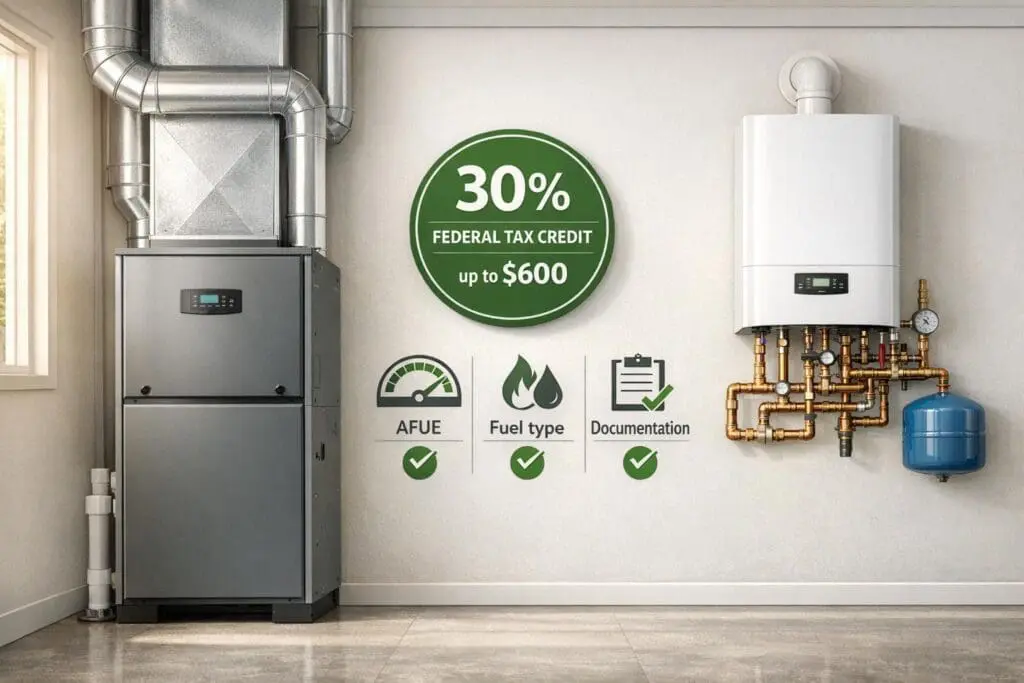
If you’re deciding between a furnace or boiler for your home, here’s the key takeaway: both systems qualify for a 30% federal tax credit on installation costs, capped at $600 per unit. The credits are part of the Energy Efficient Home Improvement Credit, which expires on December 31, 2025. To qualify, systems must meet strict efficiency standards:
- Furnaces: Require a 97% AFUE (Annual Fuel Utilization Efficiency) rating or higher.
- Boilers: Require a 95% AFUE for gas/propane or a 20% biofuel blend for oil systems.
If you’re considering a biomass boiler, you could claim up to $2,000 in credits. These credits are nonrefundable, meaning they only reduce your tax liability to zero without resulting in a refund. Pairing federal credits with local utility rebates can maximize your savings.
Quick Tip: Spread upgrades over multiple years to stay within the annual $1,200 credit cap for energy property improvements. Proper documentation, including receipts and efficiency certifications, is essential to claim these credits.
Federal Tax Credits for Furnaces
Furnace Efficiency Standards
To qualify for federal tax credits, gas furnaces must meet specific performance standards. Your furnace needs to be ENERGY STAR certified and achieve an Annual Fuel Utilization Efficiency (AFUE) rating of 97% or higher. This means the furnace converts 97% of its fuel into usable heat, with only 3% lost as exhaust. This 97% efficiency level is the highest tier set by the Consortium for Energy Efficiency (CEE). ENERGY STAR further clarifies:
Under the tax code, eligible equipment must "meet or exceed the highest efficiency tier (not including any advanced tier) established by the Consortium for Energy Efficiency which is in effect as of the beginning of the calendar year."
For installations in 2025, ensure the furnace manufacturer is an IRS "Qualified Manufacturer" and that the model appears in the AHRI directory. You’ll need its Product Identification Number (PIN) and four-digit QM code to confirm eligibility.
Fuel Type Requirements
The tax credit applies to furnaces powered by natural gas, propane, or oil, but there are specific conditions for each:
- Natural Gas and Propane Furnaces: Must be ENERGY STAR certified with a 97% AFUE rating.
- Oil Furnaces: Must also be ENERGY STAR certified but must support fuel blends containing at least 20% biodiesel, renewable diesel, or second-generation biofuel. Standard heating oil doesn’t qualify unless it meets this 20% blend requirement.
How Much You Can Claim
Homeowners can claim 30% of the total project cost, including both equipment and furnace installation labor, up to a maximum of $600 per furnace. This credit is part of a larger annual limit of $1,200 for "energy property", which includes other upgrades like boilers, central air conditioners, and building envelope components. If you’re planning multiple home improvements – such as a new furnace and window replacements – you might want to spread these projects over different tax years to maximize your credits.
One important note: this credit is nonrefundable. As Anne Fonda, a Content Writer at American Standard®, explains:
The federal tax credits under the IRA are non-refundable. This means that once your tax liability is reduced to $0, you don’t get any leftover amount of the tax credit as a refund.
To take full advantage of the credit, ensure you have enough tax liability in the year your furnace is installed. This explanation lays the groundwork for comparing furnace and boiler tax credits in the next section.
Federal Tax Credits for Boilers
Boiler Efficiency Standards
Boilers have specific efficiency requirements that differ from those for furnaces. For gas and propane boilers, the minimum standard is an AFUE (Annual Fuel Utilization Efficiency) of 95%, along with compliance with the highest efficiency tier established by the CEE (Consortium for Energy Efficiency) at the installation year’s start. This contrasts with furnaces, which require a 97% AFUE rating.
Oil boilers, on the other hand, must meet or exceed the 2021 ENERGY STAR efficiency criteria, rather than adhering to a specific AFUE percentage. For biomass boilers, the standard is at least 75% thermal efficiency, measured using the higher heating value of the fuel.
Fuel Type Requirements
The type of fuel a boiler uses plays a crucial role in determining eligibility for tax credits:
- Natural gas and propane boilers only need to meet the 95% AFUE requirement, with no additional fuel restrictions.
- Oil boilers must be certified by the manufacturer for use with blends containing at least 20% biodiesel, renewable diesel, or second-generation biofuel. Boilers using standard heating oil do not qualify unless the fuel meets this blend requirement.
- Biomass boilers are more flexible, as they can use a variety of organic fuels, such as agricultural crops, trees, wood, wood waste, pellets, plants, grasses, and fibers. These boilers often qualify for higher tax credits because they rely on renewable fuel sources.
These fuel-specific criteria directly influence the amount of federal tax credits available for each boiler type.
How Much You Can Claim
Homeowners installing qualifying boilers can claim a federal tax credit equal to 30% of the total project cost. The maximum credit varies by boiler type:
- Natural gas, propane, or oil boilers: Up to $600 per unit.
- Biomass boilers: A higher annual limit of $2,000 applies.
These are nonrefundable credits, meaning they can only reduce your tax liability to zero. The $600 credit for boilers is part of a $1,200 annual limit for general energy property, while the $2,000 credit for biomass boilers falls under a separate limit shared with heat pumps and heat pump water heaters. Importantly, there is no lifetime cap on these credits, allowing homeowners to claim the maximum amount for each year they make eligible upgrades.
Federal tax breaks for some home energy upgrades ending soon
Side-by-Side Tax Credit Comparison
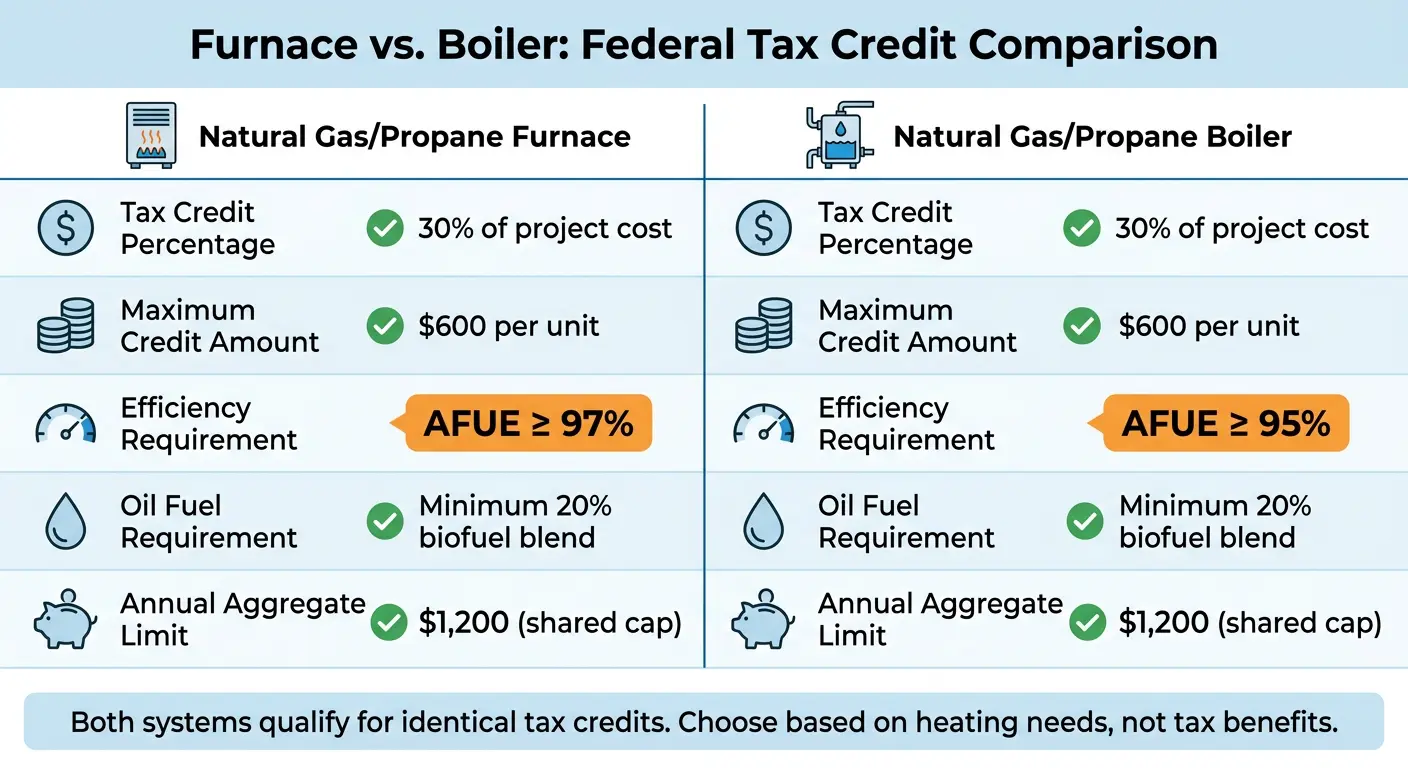
Furnace vs Boiler Federal Tax Credit Comparison Chart
Credit Amounts and Limits
Furnaces and boilers both qualify for a federal tax credit that covers 30% of the total project cost, which includes both equipment and installation. However, the credit is capped at $600 per unit. These systems also fall under a shared annual aggregate limit of $1,200 for energy property improvements. This limit includes other upgrades like central air conditioners, windows, doors, and insulation. So, if you claim the full $600 credit for one system, your remaining credit for other qualifying upgrades that year will be reduced accordingly.
| Feature | Natural Gas/Propane Furnace | Natural Gas/Propane Boiler |
|---|---|---|
| Tax Credit Percentage | 30% of project cost | 30% of project cost |
| Maximum Credit Amount | $600 per unit | $600 per unit |
| Efficiency Requirement | AFUE ≥ 97% | AFUE ≥ 95% |
| Oil Fuel Requirement | Minimum 20% biofuel blend | Minimum 20% biofuel blend |
| Annual Aggregate Limit | $1,200 (shared cap) | $1,200 (shared cap) |
Now, let’s explore how efficiency and fuel requirements set these systems apart.
Efficiency and Fuel Differences
Furnaces need to meet a higher efficiency standard, with a minimum 97% AFUE (Annual Fuel Utilization Efficiency), compared to the 95% AFUE required for boilers. This difference is tied to how each system delivers heat – furnaces use forced air, while boilers rely on hot water or steam.
For oil-powered systems, both furnaces and boilers must use a fuel blend that contains at least 20% biofuel to qualify for the credit.
Which System Offers Better Tax Savings
When it comes to tax savings, there’s no clear winner. Both furnaces and boilers are eligible for the same 30% credit up to $600 per unit, and both are subject to the $1,200 annual cap. The deciding factor should be your specific heating needs, the existing setup in your home, and personal preferences – not the tax benefits. For example, a project costing $2,000 or more would allow you to claim the maximum $600 credit, regardless of whether you choose a furnace or a boiler.
Working Within Annual Credit Caps
The Energy Efficient Home Improvement Credit allows homeowners to claim up to $3,200 annually through 2032. This is divided into $1,200 for energy upgrades like furnaces and boilers, and $2,000 for heat pumps. Whether you’re upgrading to a furnace or a boiler, the same strategies can help you get the most out of these credits.
Timing Your Installation
Spread your upgrades across multiple years to make the most of the annual credit limits. For example, you could install a furnace in one year and claim a $600 credit, then tackle central air conditioning or insulation upgrades the next year to claim up to $1,200. Keep in mind that credits are based on when the equipment becomes operational, so ensure installations are completed by December 31 of the respective year.
"Plan HVAC upgrades over 2–3 years to fully leverage the annual $3,200 credit." – Ile Kauppila, SEO Writer
Pairing Multiple Upgrades
Combining different upgrades in the same year can also maximize your tax benefits. For instance, you could install a furnace (qualifying for a $600 credit) along with a heat pump (eligible for up to $2,000) in the same year. This pairing could result in a $2,600 total credit, staying within the limits for each category. To reach the full $3,200 cap, you could use the remaining $600 energy property credit for improvements like exterior doors, windows, or attic insulation. If your project requires a panel upgrade, you might qualify for an additional $600 credit.
How to Claim Your Tax Credit
Using IRS Form 5695
To claim your tax credit, you’ll need IRS Form 5695, specifically Part II (Residential Energy Credits). This section is where you calculate your Energy Efficient Home Improvement Credit, which allows you to claim 30% of your total project cost. This includes both equipment and labor expenses. Just remember, the credit applies to the tax year when your system is installed, not when it’s purchased.
If your installation is completed in 2025, you’ll need to ensure the manufacturer is IRS-registered. You’ll also need to include the Product Identification Number (PIN) and the four-digit Qualified Manufacturer (QM) code. Don’t forget to subtract any rebates or subsidies you received from manufacturers or utility companies, as these reduce the amount you can claim.
"You must claim the credit for the tax year when the property is installed, not merely purchased." – Internal Revenue Service
Once you’ve filled out the form, double-check that you have all the required documents to back up your claim.
Documentation and Record Keeping
Hold onto all relevant records for at least three years after filing your taxes. These records should include:
- Itemized receipts that clearly separate equipment costs from labor charges.
- The manufacturer’s certification statement verifying efficiency ratings (e.g., AFUE ≥ 97% for gas furnaces or AFUE ≥ 95% for gas boilers).
- Proof of the installation date.
- Copies of contractor licenses and building permits.
- Documentation confirming model eligibility from the AHRI directory.
For installations completed in 2025, make sure your contractor provides the Product Identification Number (PIN) for your unit, as this is a required detail for claiming the credit. Proper documentation is key to ensuring a smooth process when filing your claim.
Conclusion
When it comes to federal tax credits, furnaces and boilers qualify for the same incentives. Both are eligible for a 30% credit on the total project cost, capped at $600 per year. They also share a $1,200 annual limit for general energy improvements. To qualify, the systems must meet ENERGY STAR standards, with gas furnaces requiring an AFUE of ≥ 97% and gas boilers needing an AFUE of ≥ 95%. This means your choice should focus on your home’s heating needs rather than any differences in tax credits.
Timing and documentation are key to maximizing savings. By spreading upgrades across different tax years, you can avoid exceeding the annual limits too quickly. Be sure to keep your manufacturer’s certification statement and detailed receipts for at least three years after filing your taxes.
For those in the Chicagoland area, pairing federal tax credits with local utility rebates from companies like Peoples Gas, North Shore Gas, and Nicor Gas can further lower upfront costs. Success in navigating tax credits depends on proper documentation and timely installation. Eco Temp HVAC serves Chicago, St. Charles, Bartlett, Lemont, Downers Grove, and Palatine with technicians who are well-versed in both the technical and paperwork requirements for tax credit eligibility. Whether you’re installing a high-efficiency furnace or boiler, their team simplifies the process to help you secure the maximum tax credits. Visit ecotemphvac.com or call to explore energy-efficient heating options that meet federal standards.
FAQs
Does my furnace or boiler need to be ENERGY STAR certified to qualify?
If you’re considering a tax credit for your furnace or boiler, it doesn’t necessarily have to be ENERGY STAR certified. However, opting for an ENERGY STAR model with higher efficiency ratings could unlock additional savings. For instance, furnaces with an AFUE of 97% or higher may qualify for credits of up to $600. Choosing a high-efficiency unit can be a smart way to boost your savings over time.
Do rebates lower the tax credit amount I can claim?
Rebates and tax credits are two separate financial benefits, and one does not impact the other. Rebates, typically offered by utility companies or local programs, help reduce your initial out-of-pocket expenses. On the other hand, tax credits – such as the federal 25C credit – are applied when you file your taxes. These credits are calculated as a percentage of the system’s cost, up to a set maximum. Since they work independently, claiming a rebate won’t reduce the amount of tax credit you’re eligible for.
What happens if my tax credit is bigger than my tax bill?
If your tax credit exceeds the amount of your tax bill, the surplus generally won’t be refunded or carried forward to future years. Tax credits are designed to lower your tax liability but can only reduce it to zero – any leftover amount isn’t returned to you as a refund.