
Pressure sensors are the backbone of smart HVAC systems, ensuring energy efficiency, precise performance, and early issue detection. These sensors track air and refrigerant pressures, enabling real-time adjustments to optimize airflow, fan speeds, and damper settings. Here’s what you need to know:
- Types of Pressure Sensors: Differential sensors monitor air filters and duct pressure, gauge sensors handle refrigerant pressures, and absolute sensors exclude atmospheric changes.
- Energy Savings: Smart systems with pressure sensors cut energy use by 15–25%, reducing costs and environmental impact.
- Predictive Maintenance: Detect common residential HVAC issues like clogged filters or refrigerant leaks early, avoiding breakdowns and expensive repairs.
- Wireless Integration: Modern sensors connect seamlessly to Building Automation Systems (BAS), simplifying retrofits and enabling remote monitoring.
Whether for residential comfort or commercial precision, pressure sensors are essential for reliable, efficient HVAC performance.
HVAC Applications for Differential Pressure Sensors
How Pressure Sensors Work in HVAC Systems
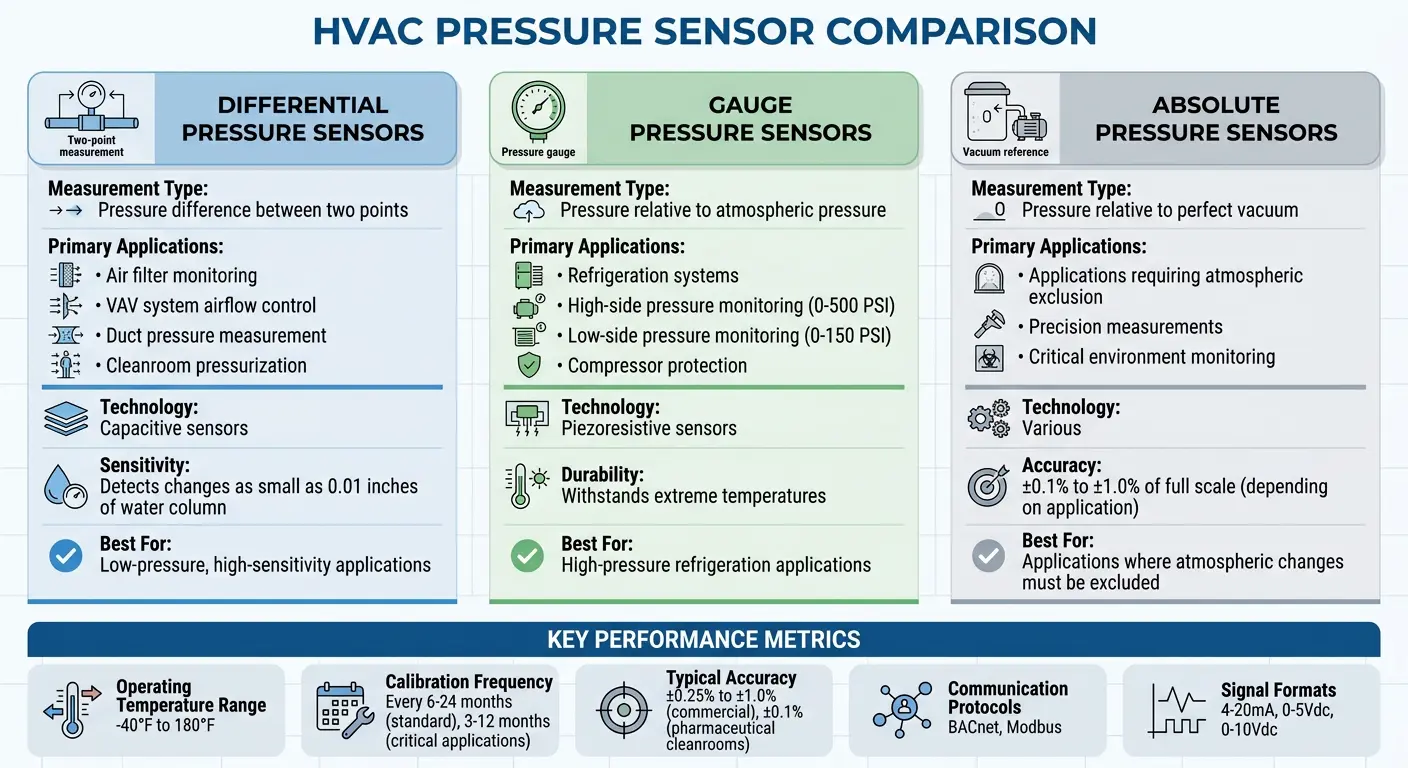
Types of HVAC Pressure Sensors: Applications and Specifications Comparison
Types of Pressure Sensors Used in HVAC
Pressure sensors play a crucial role in ensuring HVAC systems operate efficiently by providing accurate and diverse measurement capabilities. There are three primary types of pressure sensors used in HVAC systems, each tailored for specific applications:
- Differential pressure sensors: These measure the pressure difference between two points, making them essential for tasks like monitoring air filter conditions and controlling airflow in Variable Air Volume (VAV) systems.
- Gauge pressure sensors: Designed to measure pressure relative to atmospheric pressure, these are commonly used in refrigeration systems. They monitor both high-side pressures (0–500 PSI) and low-side pressures (0–150 PSI).
- Absolute pressure sensors: These measure pressure relative to a perfect vacuum, making them ideal for applications where atmospheric changes need to be excluded from measurements.
The underlying technology in these sensors also varies. Piezoresistive sensors, for example, rely on a diaphragm with embedded resistors that change electrical resistance when deformed by pressure. These are highly durable and can withstand extreme temperature ranges, making them a good fit for refrigeration systems. Meanwhile, capacitive sensors detect minute diaphragm movements by measuring changes in electrical capacitance. These sensors are highly sensitive, capable of detecting pressure changes as small as 0.01 inches of water column, making them perfect for cleanroom pressurization and filter monitoring.
How Pressure Sensors Monitor HVAC Performance
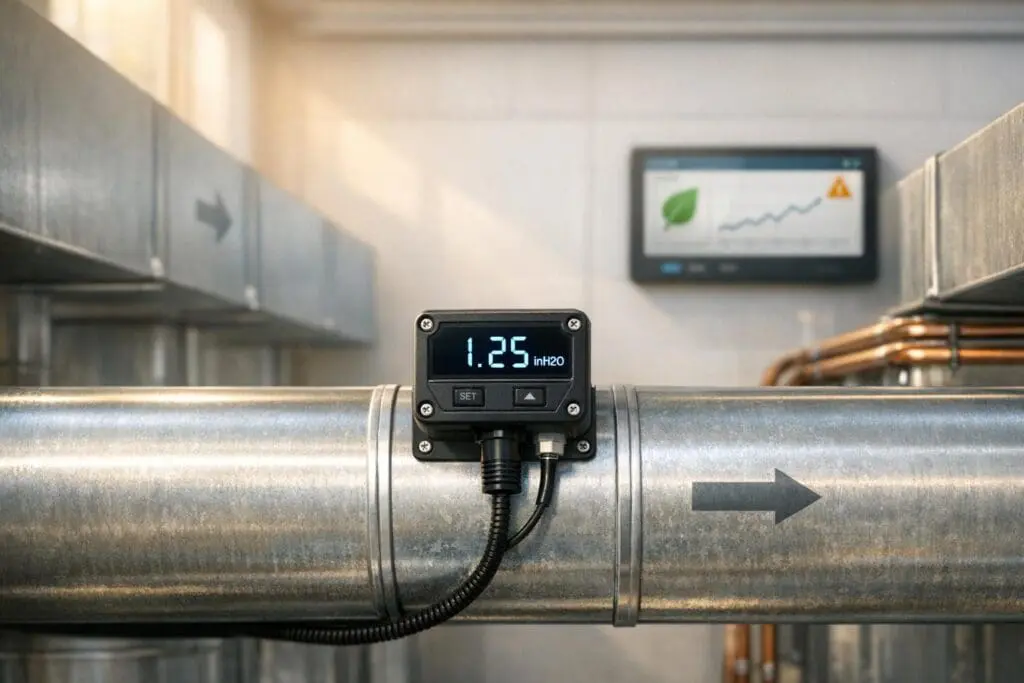
Pressure sensors provide continuous monitoring and are key to maintaining optimal system performance. For instance, in air handling units, differential pressure sensors track the pressure drop across air filters. As filters collect dust, the pressure drop increases, signaling the need for maintenance. This prevents the fan from overworking, which would otherwise lead to energy waste.
In refrigeration systems, gauge pressure sensors monitor both high-side and low-side refrigerant lines. If refrigerant pressure exceeds safe limits, the sensors immediately alert control systems to take corrective action, such as adjusting settings or shutting down the compressor, thereby preventing costly equipment damage. Similarly, in VAV systems, sensors measure static duct pressure to dynamically adjust fan speeds and damper positions. This ensures the system operates based on actual occupancy and demand, rather than running at fixed capacities throughout the day.
These real-time insights allow HVAC systems to respond to changing conditions efficiently, optimizing performance while reducing energy consumption.
How Pressure Sensors Connect to Smart Systems
Modern pressure sensors go beyond simple monitoring by seamlessly integrating with Building Automation Systems (BAS). Using communication protocols like BACnet and Modbus, these sensors share real-time data with BAS, enabling automated system adjustments. Signals are typically transmitted in formats such as 4-20mA, 0-5Vdc, or 0-10Vdc, which the BAS uses to make decisions about fan speeds, damper settings, and overall system operations.
Wireless sensors are becoming increasingly popular, especially for retrofitting older buildings. Using technologies like LoRa, NB-IoT, and 4G, these sensors transmit data without the need for extensive rewiring, reducing installation complexity and cost. Additionally, digital sensors are gaining traction over analog ones due to their ability to maintain accuracy over longer periods, requiring less frequent recalibration.
Where Pressure Sensors Are Used in Smart HVAC Systems
Pressure sensors play a crucial role in the energy efficiency and automated functionality of smart HVAC systems. Their targeted use in various applications ensures optimal performance and reliability.
Air Handling Units and Filter Monitoring
In air handling units, differential pressure sensors are used to monitor pressure drops across filters. When pressure increases, it signals the need for maintenance, shifting the approach from reactive to preventive. These sensors also measure static duct pressure to ensure proper air distribution based on occupancy levels. Brandon Rogers from Setra Systems highlights their importance:
Pressure drops across rooms or across a filter can alert service technicians for maintenance.
In busy environments like shopping malls, these sensors ensure sufficient airflow to manage CO₂ levels. They’re also essential for specialized tasks, such as maintaining stairwell pressurization or meeting the stringent requirements of cleanrooms. Beyond air handling, pressure sensors are equally important for monitoring refrigerant and fluid systems.
Refrigerant and Fluid Pressure Management
Pressure sensors are integrated into key HVAC components – compressors, coolers, boilers, and heat recovery systems – to monitor refrigerant and fluid conditions. They act as an early warning system for potential issues like leaks, blockages, or malfunctions. By keeping refrigerant pressure within safe legal and manufacturer-recommended limits, these sensors protect both the equipment and building occupants while reducing unnecessary energy consumption.
Their role extends beyond individual components, as they also support dynamic adjustments in variable air volume systems.
Variable Air Volume Systems and Damper Control
In variable air volume (VAV) systems, differential pressure sensors at VAV terminal box inlets measure airflow. This data allows controllers to adjust damper positions, ensuring proper airflow even as duct pressure fluctuates. Static pressure sensors in the main duct – usually placed between the midpoint and two-thirds of its length – monitor supply fan pressure, enabling fan speed adjustments through variable frequency drives. Sensirion‘s differential pressure sensors now dominate over half of the market for VAV damper control. These sensors enable demand-controlled ventilation, supplying fresh air only where it’s needed. As Sensirion explains:
The highly accurate measurement signal resolution and sensitivity at low air flows allows the ventilation system to operate at the lowest pressures, which noticeably increases energy efficiency.
Additionally, pressure-independent VAV boxes use flow sensors to maintain consistent airflow regardless of inlet pressure changes. This minimizes temperature fluctuations and reduces noise, offering a quieter and more comfortable environment compared to older pressure-dependent systems.
Benefits of Pressure Sensors for Energy Efficiency and Maintenance
Energy Savings and System Performance
Pressure sensors play a critical role in smart HVAC systems by promoting energy efficiency and enabling proactive maintenance. These sensors allow systems to adjust in real-time to demand, rather than running at full capacity continuously. This capability can reduce energy consumption by 15–25% compared to systems without sensor-based controls. By dynamically managing fan speeds and damper positions based on actual conditions, sensors help avoid over-ventilation in spaces that aren’t occupied.
Another key advantage is their ability to monitor air filters using differential pressure measurements. This prevents fans from overworking to compensate for clogged filters, saving energy and reducing wear. Brandon Rogers from Setra Systems highlights this maintenance connection:
Detecting areas for maintenance can also reduce energy costs by preventing unnecessary energy loads from malfunctioning equipment.
Pressure sensors also integrate seamlessly with occupancy-based controls. When paired with motion detectors, they can cut heating and cooling energy use by up to 20%. Multi-room zoning systems, which rely heavily on these sensors, can deliver over 35% in annual electricity savings. These energy savings not only lower costs but also complement better maintenance practices.
Early Problem Detection and Preventive Maintenance
Beyond energy efficiency, pressure sensors excel at identifying issues early, allowing for preventive maintenance. By tracking pressure drops across filters, rooms, and critical components like boilers and compressors, they alert technicians to potential problems before they escalate. For instance, a steady rise in duct pressure signals the need for filter replacement or duct cleaning, helping to avoid costly repairs and unexpected system failures.
This proactive approach can significantly extend equipment lifespan, often surpassing the standard 10–15 years for HVAC systems. Sensors can detect refrigerant imbalances, airflow restrictions, or abnormal pressure cycles, enabling building managers to address these issues during scheduled maintenance rather than during emergency breakdowns. This reduces reliance on the "$5,000 Rule", which calculates whether repair or replacement is more cost-effective, as early detection often prevents major failures altogether.
Pros and Cons of Pressure Sensor Integration
| Feature | Benefits (Pros) | Challenges (Cons) |
|---|---|---|
| Energy Efficiency | Cuts energy use by 15–25% through real-time adjustments | High-accuracy sensors come with a higher initial cost |
| Maintenance | Supports predictive maintenance, catching issues like clogged filters early | Requires regular calibration every 6–24 months to ensure accuracy |
| System Life | Prolongs equipment lifespan by preventing over-pressurization and mechanical stress | Must endure extreme conditions (-40°F to 180°F, high humidity) and resist chemical exposure |
| Integration | Smart sensors (BACnet/Modbus) enable centralized automation and remote monitoring | Wireless models need battery management, with typical lifespans of 5–10 years |
Although precision sensors and their calibration add upfront and ongoing costs, the energy savings and reduced repair expenses typically offset these investments within just a few years of operation.
Integration with Smart Building Management Systems
Data Sharing Across Systems
Pressure sensors play a key role in modern Building Automation Systems (BAS) by supplying real-time pressure data. These sensors measure absolute, gauge, and differential pressures in various HVAC components like air handlers, filters, refrigerant lines, and ductwork. The collected data is then transmitted using standardized protocols such as BACnet and Modbus, allowing seamless communication with smart thermostats, IoT platforms, and other building systems.
This integration changes the way HVAC systems operate. Instead of running at a constant capacity, smart systems analyze pressure data to make demand-based adjustments. For instance, differential pressure sensors monitor filter conditions and send alerts when filters need replacing, preventing airflow blockages and reducing energy waste. Likewise, static duct pressure data helps the BAS optimize fan speeds and damper positions in real time, ensuring the system matches the building’s actual needs.
The benefits don’t stop at HVAC control. Advanced systems adopt demand-based reset strategies, where chilled water supply temperatures adjust dynamically based on the current load instead of sticking to a fixed setpoint. This approach has been shown to cut chiller energy consumption by 8% to 20%. Considering HVAC systems typically account for 40% to 50% of a commercial building’s energy use, these adjustments can lead to significant savings.
Such seamless data sharing lays the foundation for greater automation and remote system management.
Automation and Remote Monitoring
With real-time data integration, automation and remote monitoring become highly effective. Pressure sensors enable building managers to oversee system performance, track historical trends, and analyze fault codes through cloud-based platforms – all without needing to be on-site. IoT gateways process sensor data locally using edge computing, which allows inefficiencies to be identified quickly.
This setup supports predictive maintenance by responding to real-time conditions. As Mark Strong explains:
The gap is not hardware, it is connecting that data to a platform that can act on it.
When pressure levels deviate from expected values, the system sends alerts to technicians, helping them address minor issues before they escalate into costly failures. This proactive approach has demonstrated a 50% reduction in unplanned downtime, minimizing emergency repairs and improving overall energy efficiency.
The financial benefits are equally noteworthy. For example, a commercial building spanning 10,000 m² (about 107,600 ft²) with a central chiller plant and 8–12 air handling units could require an investment of $15,000 to $45,000 for hardware and connectivity. However, the return on investment typically occurs within 12 to 24 months. Enhanced BAS integration can cut total energy use in commercial buildings by around 29%, while occupancy-based HVAC scheduling enabled by sensors can achieve energy savings of 10% to 30% compared to continuous operation.
Pressure Sensors in Residential and Commercial HVAC Systems
Pressure sensors play a critical role in improving the performance and energy efficiency of HVAC systems, whether in homes or commercial buildings. Let’s dive into how these sensors are used in both settings.
Residential Applications
In residential HVAC systems, pressure sensors contribute to better comfort and energy savings by monitoring key components like filters, airflow, and refrigerant levels.
For instance, pressure sensors help homeowners by detecting clogged filters and sending alerts. This prevents fans from overworking, which not only saves energy but also extends the system’s lifespan. Additionally, static duct pressure sensors dynamically adjust fan speeds and damper positions to ensure air is distributed based on each room’s needs. This helps maintain consistent temperatures and proper humidity levels, reducing the risk of mold growth. Refrigerant sensors, on the other hand, monitor pressure levels and make automatic adjustments to protect compressors from damage when pressures exceed safe limits.
The financial benefits are equally compelling. Smart HVAC systems equipped with advanced pressure monitoring can cut energy use by 15% to 25% compared to traditional systems. While installation costs range between $200 and $1,000 depending on complexity, individual sensors typically cost $100 to $200, with labor adding $100 to $500. To ensure these systems remain accurate and efficient, homeowners should respond promptly to filter alerts and schedule sensor calibration every 12 to 24 months.
Commercial Applications
In commercial HVAC systems, pressure sensors take on an even more significant role, focusing on real-time energy optimization and ensuring compliance in critical environments like hospitals, data centers, and cleanrooms.
These sensors adjust fan speeds and damper positions in real time to match building demands, while refrigerant pressure monitoring in chillers prevents over-pressurization and optimizes flow rates. In specialized environments like cleanrooms, differential pressure monitoring is crucial. For example, pharmaceutical facilities often require sensors with accuracies as tight as ±0.1% of full scale to maintain sterile conditions, whereas standard commercial setups typically operate with accuracies between ±0.25% and ±1.0%.
Brandon Rogers from Setra Systems highlights the importance of these sensors:
Pressure sensors closely monitor pressure changes and indicate if a predicament arises. Pressure drops across rooms or across a filter can alert service technicians for maintenance.
Much like in residential systems, commercial HVAC systems benefit from significant energy savings. IoT-enabled HVAC technology has helped businesses reduce energy costs by up to 30%, while intelligent pressure monitoring alone can cut energy use in air handling units by 15% to 25% . To maintain reliability, critical applications require sensor calibration every 3 to 12 months, while standard systems may only need calibration every 24 months.
Choosing the right sensor technology is essential for specific tasks. For example, piezoresistive sensors are well-suited for high-pressure refrigeration applications due to their durability, while capacitive sensors are better for low-pressure tasks like filter monitoring because of their sensitivity.
Conclusion
Key Takeaways
Pressure sensors play a crucial role in modern HVAC systems, driving efficiency and comfort by enabling systems to adapt in real-time. Instead of operating at fixed capacities, these sensors adjust fan speeds and damper positions based on current demand, leading to significant energy savings – typically between 15% and 25% in HVAC energy use. Some businesses have reported up to 30% reductions in overall energy costs when incorporating IoT-enabled systems.
These sensors offer more than just energy efficiency. They help identify potential problems early, allowing for preventive maintenance. For example, they can detect clogged filters, monitor refrigerant pressure to prevent compressor damage, and alert technicians to issues before equipment failure occurs. From maintaining precise differential pressures in pharmaceutical cleanrooms to monitoring filter conditions in residential systems, pressure sensors provide valuable insights that keep systems running smoothly.
By integrating with Building Management Systems using protocols like BACnet and Modbus, pressure sensors enable centralized control, remote monitoring, and automated energy management. Whether you’re a homeowner seeking improved comfort or managing a commercial facility with strict compliance needs, these sensors offer tangible benefits. They protect equipment, maintain indoor air quality, and ensure optimal performance in spaces with high demands. However, achieving these benefits requires proper installation and regular maintenance.
Eco Temp HVAC: Your Partner for Smart HVAC Solutions

Installing advanced HVAC systems equipped with pressure sensors calls for professional expertise. Eco Temp HVAC serves residential and commercial clients across the Chicagoland area, including Chicago, St. Charles, Bartlett, Lemont, Downers Grove, and Palatine, with a team of certified technicians and specialized knowledge.
With credentials like Mitsubishi Diamond Elite Contractor (offering 12-year warranties on Mitsubishi products), Navien Service Specialist, and American Standard Customer Care Dealer, Eco Temp HVAC ensures systems are installed, calibrated, and maintained for peak performance. Whether you need a solution for a single-family home or a large-scale commercial facility, their 24/7 availability and dedication to customer satisfaction make them a trusted choice. Visit Eco Temp HVAC to learn how pressure sensor technology can elevate your heating, cooling, and air quality systems.
FAQs
Do I need a differential, gauge, or absolute pressure sensor?
The type of sensor you need depends on your HVAC system’s requirements:
- Gauge sensors measure pressure relative to atmospheric pressure. They’re typically used for tasks like monitoring airflow or fans.
- Differential sensors focus on pressure differences, making them great for diagnosing issues with filters or airflow.
- Absolute sensors measure pressure against a vacuum. While less common, they’re essential for precise applications like refrigeration.
For most residential and commercial HVAC systems, gauge and differential sensors are the go-to options.
Where should pressure sensors be installed in an HVAC system?
Pressure sensors need to be installed in spots where they can reliably measure static or differential pressure without interference from turbulence or external factors. For instance, avoid placing them close to trees, chimneys, or buildings, as these can disrupt accuracy. For building pressure control, sensors are typically placed on roofs, connected to air tubing, and mounted near walls. This setup helps reduce the tubing length and minimizes potential measurement errors.
How often do HVAC pressure sensors need calibration or replacement?
HVAC pressure sensors should be calibrated at least twice a year to ensure they provide accurate readings. However, the need for calibration or even replacement might differ depending on the sensor’s condition and how well the system is performing. Staying on top of regular maintenance helps keep the system running efficiently and ensures it operates at its best.