
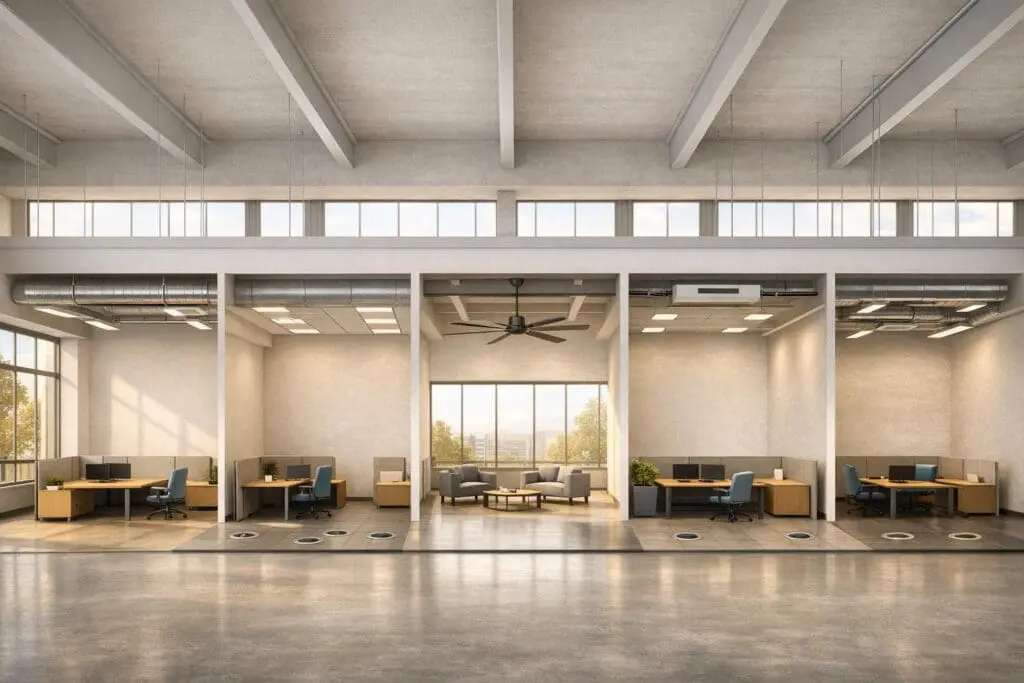
Designing an HVAC system for large commercial spaces can be challenging due to factors like uneven temperatures, varying occupancy, and energy efficiency demands. This article covers five main strategies for air distribution:
- Overhead Ducted Systems: Common and cost-effective but prone to thermal losses and noise if poorly designed. Best for standard layouts.
- Underfloor Air Distribution (UFAD): Delivers air through raised floor plenums, improving air quality and saving energy but with higher initial costs.
- High-Volume Low-Speed (HVLS) Fans: Used with ducted systems to eliminate temperature stratification and reduce heating/cooling costs.
- Ductless VRF Systems: Precise, energy-efficient zoning without ductwork, though installation costs are higher, and outdoor air must be handled separately.
- Hybrid Systems: Combines ducted, ductless, and energy recovery systems for maximum flexibility and efficiency but requires complex setup and maintenance.
Each system has its advantages depending on building size, layout, and usage. Proper design and expert planning are critical to achieving energy savings and maintaining comfort.
HVAC Design for Warehouses and Other Large Open Spaces 4.26.22
1. Overhead Ducted Distribution with High Sidewall or Ceiling Diffusers
Overhead ducted systems are the go-to HVAC setup for large commercial buildings. These systems deliver conditioned air via ducts above the ceiling, which is then distributed into spaces through ceiling diffusers or high sidewall registers. This design is widely used because it’s familiar to contractors, easier to install, and typically costs less than options like raised floor systems.
Comfort and Thermal Performance
Achieving consistent comfort with overhead systems relies on maintaining the right air velocity and pressure balance. If ducts are too large, air velocity drops, causing the conditioned air to stay near the ceiling instead of reaching the occupied areas. This can leave the lower parts of the room uncomfortably warm. On the flip side, undersized ducts push air too quickly, creating turbulence and noise at the registers – something no one wants in an office or retail setting.
To manage this, commercial supply ducts are categorized by velocity. Low-velocity systems aim for about 1,200 feet per minute (FPM), while high-velocity systems can hit up to 4,000 FPM. For most large buildings, keeping trunk duct velocities between 600–900 FPM strikes a good balance between effective air distribution and noise control.
Return air placement is another critical factor. The supply and return systems are connected, and an unbalanced return can either pressurize or depressurize a room. This imbalance reduces the effectiveness of ceiling diffusers and creates uneven temperature zones.
Energy Efficiency
Overhead systems can deliver air directly to where it’s needed, often requiring a lower total volume of conditioned air compared to raised floor setups. But this efficiency can drop significantly if ducts run through unconditioned spaces like ceiling plenums outside the building’s thermal envelope. In such cases, thermal conduction losses can account for 25–40% of HVAC energy waste.
Another efficiency challenge comes from duct layout. For example, a single 90-degree elbow in a 6-inch duct adds the equivalent of 10–25 feet of resistance. This reduces airflow and forces the system to work harder to meet demand. Multiply that by dozens of fittings in a large space, and the inefficiency adds up quickly.
Installation Complexity and Cost
Overhead systems generally cost less to install than raised floor systems because they don’t require specialized floor panels or grid systems. However, complexity increases in larger commercial layouts. Trunk-and-branch designs are effective for rectangular spaces but struggle to balance pressure in distant branches. Extended plenum designs improve some of these issues but can experience velocity drops at the far end. For large, multi-zone spaces, VAV (Variable Air Volume) systems are the most efficient choice, though they require advanced controls.
| Topology | Pressure Balance | Best Application | Key Limitation |
|---|---|---|---|
| Trunk-and-Branch | Requires balancing | Rectangular light commercial | High resistance in distant branches |
| Extended Plenum | Velocity imbalance along plenum | Long rectangular buildings | Velocity drop at the far end |
| VAV Distribution | Dynamic (pressure-dependent) | Large multi-zone commercial | Requires complex controls integration |
Flexibility and Adaptability
A notable trend in overhead systems is the use of fabric ducting. These ducts are equipped with adjustable nozzles that distribute air at lower velocities, offering better directional control. This makes them ideal for large, open spaces where occupancy patterns frequently change.
Overhead systems are also relatively easy to reconfigure when tenant layouts shift. Pairing these systems with VAV boxes allows for re-zoning without needing major ductwork changes.
Maintenance Requirements
Overhead systems are favored for maintenance because technicians can access components without disrupting operations below. This is a big advantage over raised floor systems, where removing tiles can compromise pressurization and overall system performance.
One often-overlooked detail is the quality of duct sealants. Standard cloth duct tape typically fails within 2–5 years in environments with temperature fluctuations. To prevent air leaks that degrade comfort and efficiency, installations must use UL 181B-FX verified mastic or foil-backed tape.
This overview lays the groundwork for examining alternative HVAC designs that could further improve performance in large commercial spaces.
2. Underfloor Air Distribution and Raised Floor Plenum Designs
Underfloor Air Distribution (UFAD) flips the script on traditional HVAC systems. Instead of relying on overhead ductwork, it uses a pressurized underfloor plenum to circulate air, which is then delivered through floor-mounted diffusers. This design minimizes the need for bulky overhead ducts, simplifying construction and saving space.
Comfort and Thermal Performance
UFAD takes a different approach to air delivery, focusing on displacement ventilation rather than the high-speed mixing used in conventional systems. Conditioned air enters the space at around 65°F–67°F and rises naturally, carrying heat and pollutants up to ceiling-level exhausts. This process not only creates a cleaner breathing zone but also eliminates the cold drafts often associated with ceiling-mounted diffusers.
"Displacement ventilation is 20% more effective at delivering fresh air to the breathing zone than conventional mixing systems." – Doug Pierce, AIA, LEED AP, Senior Associate, Perkins+Will
A standout example is the Great River Energy headquarters in Maple Grove, MN. This 165,000-square-foot LEED Platinum-certified building uses UFAD combined with geothermal systems to deliver air at a steady 67°F. By reducing compressor use during mild seasons and exceeding ASHRAE fresh air standards by 30%, the building achieved LEED indoor air quality credits. Another early adopter was Chicago’s Bank One Center. Environmental Systems Design paired UFAD with perimeter hydronic fan coils to handle the city’s extreme seasonal changes, enabling precise temperature control for each floor.
Energy Efficiency
UFAD systems are also highly energy-efficient. Their lower static pressure reduces the workload on fans, cutting HVAC energy use by 10–15%. Additionally, the system’s reliance on a pressurized plenum instead of extensive ductwork reduces material costs and energy losses.
There’s even a structural bonus. Removing overhead ducts can shrink floor-to-floor heights by 6 inches or more. As David Atwood, General Manager of Integrated Interiors, noted:
"We have modeled an 11-story building, and it gained an entire floor from the reduced plenum heights."
Installation Complexity and Cost
While UFAD systems come with an initial cost premium of about $3.50 per square foot compared to traditional overhead setups, the price gap narrows when a raised floor is already needed for cabling. For instance, at Dynamic Systems Inc.’s new facility in Buda, TX, integrating UFAD with perimeter convectors and fan columns cut HVAC installation costs by nearly $30,000, or about $1.43 per square foot. The building also reported a 35% reduction in energy use per square foot.
That said, installation requires careful coordination. Overhead tasks like electrical wiring, plumbing, and fire suppression must be completed before the raised floor is installed. Any penetrations in the plenum, such as utility closets or elevator shafts, must be sealed airtight to maintain system performance.
Flexibility and Adaptability
One of UFAD’s standout features is its flexibility. Rearranging a traditional overhead system often involves cutting into ceilings, rerouting ducts, and repairing finishes. With UFAD, reconfigurations are much simpler – just move a floor tile and relocate the diffuser.
This was demonstrated at Discover Financial Services in Riverwoods, IL. Their 340,000-square-foot office and training center was equipped with adjustable floor grilles every 90 square feet to handle a churn rate of over 50%. This meant more than half of the office layout could be reconfigured regularly without major disruptions.
Maintenance Requirements
Maintenance is relatively straightforward. Technicians can access components by lifting individual floor tiles, making repairs quick and easy. However, because removing a tile temporarily affects plenum pressure, maintenance schedules need to be carefully planned to avoid disrupting airflow. These operational considerations set UFAD apart from traditional systems, offering both challenges and opportunities.
| Factor | UFAD (Underfloor Air Distribution) | Overhead Ducted System |
|---|---|---|
| Air Delivery Method | Low-velocity displacement | High-velocity mixing |
| Diffuser Temperature | 65°F–67°F | ~55°F |
| Fan Energy Use | Lower (low static pressure) | Higher (high static pressure) |
| First Cost | ~$3.50/sq. ft. premium | Baseline |
| Flexibility | Floor tiles/diffusers can be moved | Requires extensive ductwork changes |
| Fresh Air Effectiveness | ~20% more effective | Baseline |
3. Destratification and High-Volume Low-Speed Fans Used with Ducted Systems
Pairing High-Volume Low-Speed (HVLS) fans with ducted HVAC systems offers a practical solution to combat thermal stratification in large commercial spaces. In places like warehouses, gyms, and manufacturing facilities, warm air tends to rise and collect near the ceiling, leaving the lower, occupied areas cooler. This uneven temperature distribution forces heating systems to work harder, driving up energy costs. HVLS fans address this by continuously circulating air, ensuring a more uniform temperature from floor to ceiling.
Comfort and Thermal Performance
HVLS fans move air in all directions, creating a gentle downward and outward flow that eliminates uneven temperatures without causing uncomfortable drafts. During summer, the airflow creates a wind-chill effect, making the space feel 10 to 12°F cooler than the actual thermostat setting. In winter, running the fans in reverse at a low speed brings warm air trapped near the ceiling back down to the occupied zone, improving comfort without introducing a cooling sensation. This consistent air movement not only enhances comfort but also results in noticeable energy savings.
"Air destratification with an HVLS fan recirculates the warm air trapped at the ceiling level down to the ground floor. It improves working conditions while reducing heating costs." – Mark D’Agostino, General Manager and Senior Vice President, Hunter Industrial Fans
Energy Efficiency
By redistributing warm air trapped near the ceiling, HVLS fans can cut heating costs by 20% to 30% during colder months. In the summer, the wind-chill effect allows HVAC systems to maintain comfort at thermostat settings up to 5°F higher. Considering that heating can account for over 35% of a commercial building’s annual energy expenses, these savings quickly add up. Some HVLS fan models cost less than $1 per day to operate, and a case study by Hunter Industrial Fans highlighted annual energy savings of around $2,500, with a return on investment typically achieved within six months to two years.
Installation Complexity and Cost
While the performance benefits are clear, installation requires thoughtful planning. HVLS fans, which range from 5 to 24 feet in diameter, can integrate with building automation systems to adjust speed based on occupancy and weather conditions. Placement is crucial: fans shouldn’t be installed directly under HVAC discharge points, and the discharge outlet should be at least twice the fan’s diameter away from the fan’s swept area. For a 24-foot fan, optimal mounting heights range from 20 to 30 feet, with spacing between fans maintained at 60 to 120 feet. A single 24-foot fan can cover up to 22,000 square feet.
Flexibility and Adaptability
HVLS fans are versatile enough to handle seasonal changes. In summer, they operate in a forward direction to push air downward, while in winter, they run in reverse at a lower speed to destratify the air without cooling occupants. This dual-mode functionality makes them effective year-round, even in spaces with obstacles like pallet racks or mezzanine levels.
Maintenance Requirements
Maintenance for HVLS fans is straightforward, requiring occasional cleaning of the blades and periodic checks of the motor and mounting hardware. In dusty environments, cleaning may need to happen more frequently. Additionally, the continuous air movement helps control humidity and moisture levels, reducing the risk of mold growth and speeding up the drying of floors after spills. These benefits contribute to fewer slip-and-fall accidents and lower microbial contamination.
| Feature | HVLS Fans | Traditional High-Speed Fans |
|---|---|---|
| Blade Diameter | 5 to 24 feet | Typically 3 to 5 feet |
| Operating Speed | 71–200 RPM | Up to 230+ RPM |
| Air Distribution | 360-degree air column | Concentrated, directional stream |
| Winter Energy Savings | 20%–30% reduction | Minimal |
| Daily Operating Cost | Less than $1/day | Higher |
4. Ductless VRF and Mini-Split Zoning for Large Spaces
When it comes to energy efficiency, VRF (Variable Refrigerant Flow) and mini-split systems stand out as ductless solutions that eliminate energy losses caused by duct leakage. Instead of relying on ductwork, these systems deliver refrigerant directly to indoor units positioned throughout the space. This design sidesteps one of the most common inefficiencies in traditional HVAC systems: duct leakage, which can account for 25% to 40% of total energy loss in conventional setups. Below, we’ll examine how these systems measure up in terms of comfort, energy performance, installation, flexibility, and maintenance.
Comfort and Thermal Performance
VRF systems use Electronic Expansion Valves (EEVs) to adjust refrigerant flow based on the specific load of each zone. This ensures consistent temperatures and avoids pressure imbalances. A single outdoor unit can support anywhere from 2 to 64 indoor units, depending on the system manufacturer. These indoor units come in various configurations – such as wall-mounted, floor-mounted, concealed ducted, or ceiling cassettes – allowing the system to adapt to different room layouts and sizes.
Energy Efficiency
In commercial spaces, HVAC systems often operate at less than 40% of their peak design load for most of the year. VRF systems are designed with this in mind. Their inverter-driven compressors achieve a Coefficient of Performance (COP) of 3.5 to 5.5 during part-load conditions, outperforming fixed-speed systems, which average a COP of 2.5 to 3.2. Additionally, Heat Recovery (HR) VRF models can transfer waste heat from cooling zones to areas needing heating, making them ideal for buildings with mixed thermal demands, such as offices with server rooms.
Installation Complexity and Cost
While VRF systems offer excellent performance, they come with a higher upfront investment. Costs range from $1,800 to $3,500 per ton, compared to $1,200 to $2,200 per ton for conventional DX systems. Heat Recovery configurations, which use a 3-pipe system, add a 15% to 25% cost premium over standard Heat Pump VRF setups.
Compliance with ASHRAE Standard 15 requires installing leak detection systems in confined spaces, given that a 20-ton VRF system can contain 80 to 120 pounds of refrigerant. These detection systems can add $5,000 to $30,000 to the project cost. It’s also worth noting that VRF systems don’t provide outdoor air, so a dedicated DOAS (Dedicated Outdoor Air System) is necessary to meet ASHRAE 62.1 ventilation standards.
Flexibility and Adaptability
For spaces that evolve over time – such as offices undergoing reconfigurations or tenant buildouts – VRF systems provide unmatched flexibility. Outdoor units can be combined in modular setups to exceed 100 tons of capacity. Adding zones is straightforward and doesn’t require modifying existing ductwork. With refrigerant pipe runs reaching up to 3,000 feet and vertical separations of up to 300 feet, these systems are well-suited for large commercial environments.
Maintenance Requirements
Maintaining VRF systems requires specialized training. Technicians need expertise in inverter drive diagnostics and EEV calibration, in addition to standard EPA 608 certification. Most VRF systems are proprietary, meaning that indoor and outdoor units must come from the same manufacturer. This can lead to vendor dependency for parts and service.
For example, Eco Temp HVAC technicians are factory-trained as Mitsubishi Diamond Elite Contractors, ensuring expertise in Mitsubishi’s VRF systems. This certification also allows customers to access a 12-year warranty on qualifying Mitsubishi products.
| Metric | VRF System | Conventional DX Multi-Zone |
|---|---|---|
| Part-Load COP | 3.5–5.5 | 2.5–3.2 |
| Duct Losses | None (ductless config.) | 25–40% |
| Zoning Granularity | Per room/unit | Per zone group |
| Installed Cost/Ton | $1,800–$3,500 | $1,200–$2,200 |
| Simultaneous Heat/Cool | Yes (HR models) | No (typically) |
| Maintenance Level | High – proprietary/specialized | Medium |
5. Hybrid Layouts Combining Ducted, Ductless, and Local Ventilation
Hybrid HVAC layouts combine the strengths of ducted systems, ductless VRF or mini-splits, and local ventilation components like Energy Recovery Ventilators (ERVs) to create a unified design. This approach addresses the limitations of any single system, making it ideal for large commercial buildings with diverse needs.
Comfort and Thermal Performance
Hybrid systems excel at maintaining consistent comfort by leveraging advanced controls. Smart thermostats and sensors can automatically switch between heat sources, such as using an electric heat pump in mild conditions and a gas furnace or boiler during colder weather. Motorized dampers and Discharge Air Temperature (DAT) sensors ensure precise zone temperature control without disrupting overall airflow. When a zone is closed, bypass dampers redirect excess air pressure to common areas like hallways, protecting blower motors from pressure-related damage. The system’s built-in redundancy ensures uninterrupted operation.
Energy Efficiency
With HVAC responsible for 39% of energy use in U.S. commercial buildings, hybrid layouts aim to cut that figure significantly. ERVs can recover up to 90% of thermal energy from exhaust air, reducing the workload on primary heating and cooling systems. This preconditioning allows for smaller, more efficient equipment, lowering upfront costs and extending the system’s lifespan. Additionally, CO₂-based controls adjust ventilation based on real-time occupancy, ensuring the system only works as hard as necessary. When paired with whole-building design strategies, these measures can reduce energy consumption by 40% to 70%.
"Commercial HVAC is no longer just about heating and cooling – ventilation is now a core part of the system." – Panasonic North America
Installation Complexity and Cost
Hybrid systems are complex to design and install, requiring the integration of multiple components like RTUs, VRF units, ERVs, bypass dampers, and zone controls. Custom ductwork and precise static pressure management are essential. For example, in 2026, Greentech Engineering revamped a multi-suite office building in Dallas (ZIP 75248) with a hybrid layout to replace a failing system. The project involved installing five new zone dampers, motorized dampers with DAT sensors, and insulated metal plenums. The result not only eliminated thermal imbalances but also qualified the building for the Oncor 2026 Commercial Energy Efficiency Program, thanks to reduced peak energy demand. This showcases how hybrid systems can bridge the gap between performance and adaptability.
Flexibility and Adaptability
The modular nature of hybrid systems makes them ideal for buildings that evolve over time. VRF components can be added to serve specific areas – like a server room or conference wing – without overhauling the main system. Instead of oversizing equipment for hypothetical future needs, hybrid designs focus on flexible distribution systems that can accommodate future expansions. Mechanical rooms are designed to leave space for additional equipment as needed. Since HVAC systems typically operate at peak capacity only 1% to 2.5% of the time, hybrid layouts handle the remaining 97.5% of operation more efficiently, often running at 50% capacity or less.
Maintenance Requirements
Maintaining hybrid systems requires technicians with expertise in multiple areas, including ducted air handlers, ductless VRF units, ERVs, and building automation controls. Predictive maintenance tools, such as smart sensors, are crucial for identifying performance issues early. Regular duct inspections and cleaning are also essential, as leaks can force the entire system to work harder. While maintenance costs are higher compared to single-system layouts, the trade-off is a more efficient and resilient system.
| Feature | Hybrid Layout | Traditional Single-Source Layout |
|---|---|---|
| Energy Source | Dual (e.g., electric + gas) | Single (gas, oil, or electric) |
| Zoning | Precise, independent suite control | Limited (often floor- or building-wide) |
| Redundancy | Built-in backup source | None – full loss if system fails |
| Part-Load Efficiency | High – optimized for 50%+ of operating hours | Lower – designed for peak, not average loads |
| Initial Cost | Higher (complex engineering) | Lower (standard equipment) |
| Maintenance | Specialized, multi-system expertise required | Standard, widely available service |
Pros and Cons
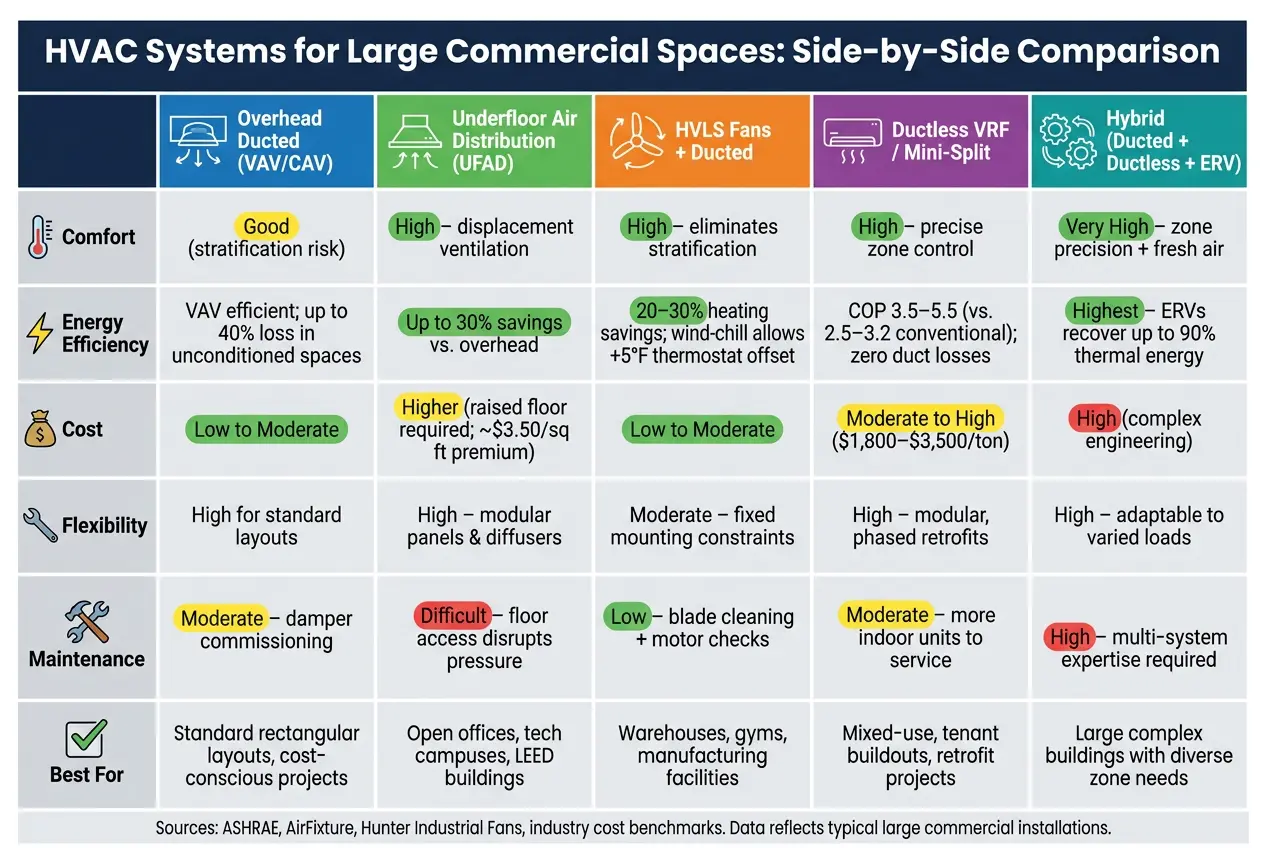
HVAC Systems for Large Commercial Spaces: Side-by-Side Comparison
Each HVAC layout has its own strengths and limitations, making the "right choice" dependent on factors like your building’s size, budget, occupancy patterns, and future flexibility needs. Here’s a breakdown of the key points to help simplify the decision-making process.
Overhead ducted systems are a common and cost-effective option for large commercial spaces. Despite their popularity, Variable Air Volume (VAV) systems can struggle with uneven air distribution when operating under low loads. Additionally, duct systems located in unconditioned spaces may waste up to 40% of HVAC energy due to thermal loss and leakage. High-velocity configurations also introduce acoustic challenges at registers and fittings.
Underfloor air distribution (UFAD), operating at just 0.5 inches of static pressure, offers up to 30% energy savings compared to overhead systems. However, the raised floor system required for UFAD increases initial costs. Maintenance can also be tricky, as lifting floor tiles for access may temporarily disrupt pressure and cooling performance.
"This setup allows you to reduce your energy costs by up to 30%." – Joe Hullebusch, AirFixture
Ductless VRF and mini-split systems shine when it comes to precise zone control and part-load efficiency. However, they lack built-in outdoor-air handling, which means you’ll need a separate ventilation strategy to meet building codes.
Hybrid systems, which combine ducted, ductless, and energy recovery ventilators (ERVs), offer unmatched performance. They provide precise zoning along with integrated ventilation, recovering up to 90% of thermal energy through ERVs. The trade-off? Increased complexity, higher maintenance demands, and the need for technicians skilled in multi-system setups.
| Approach | Comfort | Energy Efficiency | Cost | Flexibility | Maintenance |
|---|---|---|---|---|---|
| Overhead Ducted (VAV/CAV) | Good; risk of stratification at low velocity | VAV is efficient; CAV reheat is not | Low to moderate | High for standard layouts | Moderate; requires damper commissioning |
| Underfloor Air Distribution (UFAD) | High; displacement ventilation improves air quality | High; up to 30% savings | Higher (raised floor required) | High; modular panels and diffusers | Difficult; floor access disrupts pressure |
| Ductless VRF / Mini-Split | High; precise individual zone control | High; tight modulation | Moderate to high | High; modular and phased retrofits | Moderate; more indoor units to service |
| Hybrid (Ducted + Ductless + ERV) | Very high; zone precision with integrated fresh air | Highest; ERVs recover up to 90% thermal energy | High (complex engineering) | High; adaptable to varied loads | High; requires multi-system expertise |
Conclusion
Choosing the right HVAC setup for large commercial spaces boils down to understanding the specific needs of the building. For example, a spacious open-plan office might work best with a VAV system, while a mid-size mixed-use property could see better results from a VRF system combined with a dedicated outdoor air system (DOAS). The key is to tailor the system to the building’s actual requirements instead of defaulting to generic solutions.
With HVAC systems accounting for about 40% of a building’s energy use, their design is not just about comfort – it’s also a financial consideration. Proper duct sizing, zoning, and compliance with ASHRAE 62.1-2022 ventilation standards can significantly cut operating costs over time.
In regions like Chicagoland, where temperatures can exceed 110°F, precise load calculations are critical. Relying on rough estimates based on square footage alone can lead to inefficiencies and higher costs.
"The problem isn’t the equipment quality – it’s the sizing calculation that happened before installation ever began." – Universal HVAC Group
This highlights the importance of careful planning and expert advice when designing an HVAC system. Working with a skilled contractor can make a world of difference. Eco Temp HVAC supports businesses throughout Chicagoland – including areas like Chicago, Downers Grove, Palatine, and St. Charles – offering certified technicians who are well-versed in local climate challenges and building codes. Whether you’re considering a hybrid system, upgrading to a VRF setup, or rethinking ductwork for a large open area, a thorough site assessment is the first step. Align your HVAC strategy – whether VAV, VRF, or a hybrid approach – with your building’s unique needs to achieve both energy efficiency and long-term savings.
FAQs
Which HVAC layout fits my building best?
The ideal HVAC layout for your building hinges on factors like its size, design, and specific heating and cooling demands. Two common systems are trunk and branch or radial layouts, with the choice often depending on the structure’s design and how it’s used. For larger buildings, careful ductwork planning, zoning, and smart airflow management play a key role in maintaining energy efficiency and ensuring comfort. To determine the best setup for your building, it’s a good idea to consult with HVAC professionals who can tailor the design to your needs.
Do I need a DOAS with a VRF system?
Whether you need a Dedicated Outdoor Air System (DOAS) alongside a Variable Refrigerant Flow (VRF) system depends on your building’s specific requirements for ventilation, humidity control, and energy efficiency. While VRF systems are excellent at handling heating and cooling, they aren’t designed to manage ventilation or dehumidification.
Using a DOAS is strongly recommended when precise humidity control, better air quality, or compliance with ventilation standards like ASHRAE 62.1 is necessary – especially in large commercial spaces.
How can I reduce stratification in high-ceiling spaces?
To tackle uneven temperature layers in high-ceiling spaces, focus on improving air circulation and distribution. One effective approach is installing large industrial ceiling fans, which help mix the air and reduce temperature stratification. Pair this with an optimized HVAC system that includes strategically placed ductwork and variable air volume (VAV) systems to enhance airflow and ensure better mixing.
These methods not only create a more uniform temperature but also boost energy efficiency and improve comfort for anyone using the space.