
When deciding on a new air conditioner, you’ll encounter SEER ratings – a measure of energy efficiency. Higher SEER systems (21+) promise lower energy bills and better performance but come with a higher price tag. For example, a 21-SEER system costs $13,800–$16,200, compared to $9,800 for a baseline system (13–15 SEER). While high-SEER units can save you $300–$900 annually in energy costs, the payback period depends on your location and AC usage. In hot climates, you might break even in 5–8 years, but in cooler areas, it could take over 12 years. Federal tax credits and rebates can help offset costs. Ultimately, the right choice depends on your budget, climate, and how often you use your AC.
This SEER AC Mistake Could Cost You THOUSANDS!
1. Baseline SEER Systems (13–15)
Baseline SEER systems represent the minimum efficiency standards required by law in the U.S. As of 2023, northern states mandate systems with an effective rating of about 13.4 SEER2 (commonly marketed as 14 SEER). Meanwhile, the South and Southwest require units rated around 14.3 SEER2 (approximately 15 SEER). These systems are typically less expensive upfront since they meet only the minimum legal standards.
Upfront Cost
For a 1,700-square-foot home, a baseline system rated at 14.3 SEER2 costs about $9,800 in total. This breaks down to roughly $8,400 for the equipment and $1,400 for installation. If you’re considering choosing the right HVAC system for an upgrade to a 16-SEER unit, expect an additional equipment cost of $300 to $800. For heat pump options, 13 SEER2 models are available for around $6,000, including installation.
Energy Savings
Modern systems can significantly reduce energy consumption compared to older units. For instance, upgrading from an aging SEER 10 unit to a 16 SEER system can cut cooling wattage by about 38%. The actual savings, however, depend on your location and climate. In Fort Myers, Florida – where air conditioners run approximately 3,300 hours annually – upgrading from a 14 SEER to a 16 SEER system could save about $118 per year. In Lynchburg, Virginia, which averages 1,050 cooling hours annually, the same upgrade would save about $39.52 per year. These savings play a key role in determining how quickly you can recover your initial investment.
Payback Period
The time it takes to recoup the cost of upgrading depends on energy savings, which vary by region. For example, in Phoenix, Arizona, upgrading from a 14 SEER to a 16 SEER system has a payback period of about 4.2 years. In Lynchburg, Virginia, the payback period extends to approximately 7.6 years. In colder areas like Kalispell, Montana, where cooling needs are minimal, the payback period can exceed 36 years – often longer than the system’s lifespan.
Financial Incentives
Baseline systems rarely qualify for federal high-efficiency tax credits since they only meet the minimum standards. However, some local utility companies offer rebates for systems that exceed regional efficiency requirements. These rebates typically range from $200 to $800 for professionally installed equipment. To find out what’s available, check with your local utility provider.
2. High-SEER Systems (21+)
High-SEER systems, with ratings between 21 and 25 SEER, represent the top tier of energy efficiency for residential air conditioning. These advanced systems feature cutting-edge components like variable-speed compressors and ECM blowers, which not only improve efficiency but also maintain consistent indoor temperatures and better humidity control. While these systems come at a higher price, their performance and energy-saving benefits make them a worthwhile option for many homeowners.
Upfront Cost
The cost difference between standard and high-efficiency systems is significant. For a 1,700-square-foot home, installing a 21+ SEER2 premium system typically costs between $13,800 and $16,200. This is about $4,000 to $6,400 more than a baseline 14.3 SEER2 system. For larger homes or setups requiring ultra-efficient heat pumps, the total cost can climb to as much as $25,000. Equipment costs alone range from $12,000 to $14,000, with labor adding another $1,800 to $2,200.
Energy Savings
Switching from an older 9 SEER unit to a 21+ SEER2 system can cut electricity use by around 52% annually. Depending on your location and usage, this translates to yearly utility savings of $300 to $900. In areas with long, hot summers – like Houston or Tampa, where compressors can run up to 2,800 hours a year – savings are typically on the higher end of this range.
Payback Period
The time it takes to recoup your investment depends on your climate. In hot and humid regions such as Houston or Tampa, you can expect to break even in 5 to 8 years. In cities with more moderate climates, like Denver or Portland, the payback period extends to 8 to 12 years. For areas with minimal AC use, such as Seattle or Buffalo, the payback period may stretch beyond 12 years, which could exceed half the system’s typical lifespan of 15 to 20 years. Proper installation is critical to ensure the system operates at its rated efficiency.
Financial Incentives
High-efficiency systems often qualify for rebates and tax credits that standard models don’t. The federal Energy Efficient Home Improvement Credit (also known as the 25C credit) offers up to $2,000 for eligible systems. Additionally, local utility companies may provide rebates ranging from $200 to $800 for professionally installed high-SEER equipment. These incentives are typically limited and awarded on a first-come, first-served basis, so it’s smart to submit your paperwork promptly after installation.
For homeowners in the Chicagoland area, Eco Temp HVAC (https://ecotemphvac.com) provides expert installation and tailored advice on high-SEER systems. Their certified technicians specialize in delivering energy-efficient solutions for heating, cooling, and air quality needs.
Pros and Cons
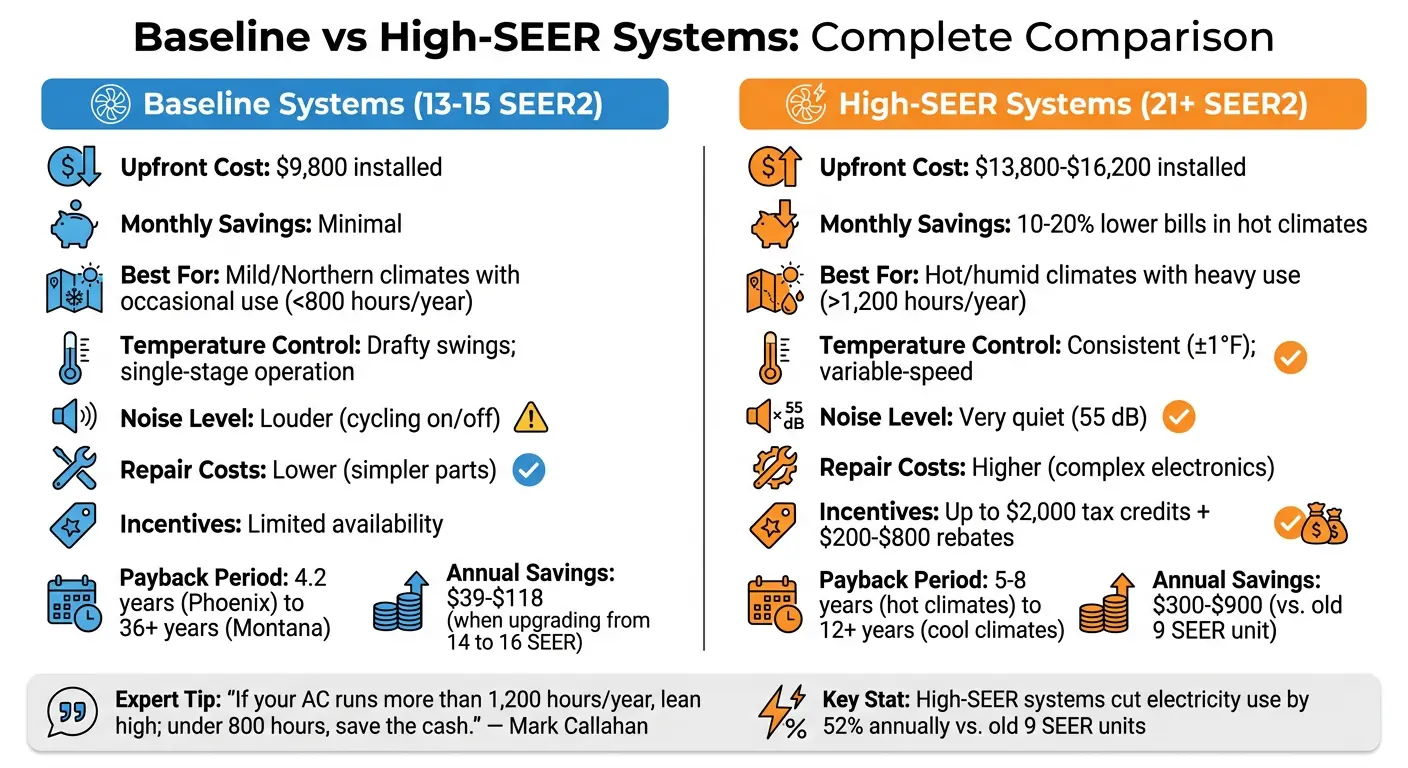
Baseline vs High-SEER AC Systems Cost and Savings Comparison
Your choice ultimately depends on factors like your budget, local climate, and how much you use your air conditioning each year. Each system type comes with its own set of trade-offs, so it’s worth taking a closer look.
Baseline systems (13–15 SEER2) are the more affordable option, starting at about $9,800 for installation in a typical 1,700-square-foot home. They use straightforward technology, which keeps repair costs down. If you live in a mild northern climate where your AC runs fewer than 800 hours annually, these systems make financial sense. The limited usage means you’re unlikely to offset the higher upfront cost of a high-efficiency system over its 15- to 20-year lifespan.
On the other hand, high-SEER systems (21+ SEER2) are designed for regions with long, hot, and humid summers. In areas where compressors run between 2,000 and 3,000 hours per season, these systems can cut monthly cooling bills by 10%–20%. Beyond energy savings, they offer perks like precise temperature control (holding within ±1°F), better humidity management, and whisper-quiet operation at just 55 dB. However, these benefits come at a steep cost – installation typically ranges from $13,800 to $16,200 – and the advanced electronics mean higher repair expenses.
"If your AC runs more than 1,200 hours/year, lean high; under 800 hours, save the cash." – Mark Callahan
Here’s a quick side-by-side comparison to help you weigh your options:
| Factor | Baseline Systems (13–15 SEER2) | High‑SEER Systems (21+ SEER2) |
|---|---|---|
| Upfront Cost | Lower (~$9,800 installed) | Higher ($13,800–$16,200 installed) |
| Monthly Savings | Minimal | 10–20% lower bills in hot climates |
| Best Climate | Mild/Northern (occasional use) | Hot/Humid (heavy use) |
| Temperature Control | Drafty swings; single-stage | Consistent (±1°F); variable-speed |
| Noise Level | Louder (cycling on/off) | Very quiet (as low as 55 dB) |
| Repair Costs | Lower; simpler parts | Higher; complex electronics |
| Incentives | Limited | Up to $2,000 tax credits + rebates |
This breakdown highlights whether a high-SEER system could be worth the extra investment. If your AC usage exceeds 1,200 hours a year, the energy savings could pay off the higher cost in just 5 to 8 years, particularly in hot climates. In cooler regions, however, the payback period might stretch to over 12 years. Federal tax credits and local rebates can shorten this timeline by 1–2 years, making the decision even more nuanced.
Conclusion
High-SEER systems aren’t a universal solution for everyone. The right choice depends on factors like how often your air conditioner runs, local electricity costs, and available rebates or tax credits. For example, if you live in a hot, humid area where the AC works overtime, a high-SEER2 system can save a lot on energy bills and often pays for itself within 5–8 years. On the other hand, in places with milder summers, like Chicagoland, mid-tier systems (16–18 SEER2) might strike a better balance between upfront costs and long-term savings. Evaluating this balance is crucial when considering your investment.
Don’t overlook financial incentives when making your decision. The federal Energy Efficient Home Improvement Credit offers up to $2,000 in tax credits for qualifying systems, while local utility rebates can add another $200–$1,000. Together, these incentives can shave up to two years off your system’s payback period. This makes it easier to weigh whether repairing your current unit or upgrading to a more efficient model is the smarter move.
If your system is between 10 and 15 years old, the "$5,000 Rule" is a helpful guideline: multiply your unit’s age by the estimated repair cost. If the total exceeds $5,000, it’s more cost-effective to replace it with a high-SEER model. Plus, any new system will meet the Department of Energy’s 2023 SEER2 standards, meaning even the most basic models will run more efficiently than older ones.
Lastly, professional installation is a must to ensure your system performs as promised. Poor sizing or mismatched components can wipe out the benefits of a high-SEER unit. For homeowners in the Chicagoland area, Eco Temp HVAC provides certified installation and maintenance. As a Mitsubishi Diamond Elite Contractor, they offer a 12-year warranty, giving you peace of mind that your system is set up for peak efficiency.
FAQs
How do I estimate my AC hours per year?
To figure out how many hours your AC runs each year, you can use cooling degree days. This metric shows how much outdoor temperatures go above a specific baseline (usually 65°F) to estimate cooling needs.
Look up your area’s annual cooling degree days in local weather data. This will give you a good idea of how often your AC might operate, depending on outdoor conditions. Keep in mind that factors like your home’s insulation and your personal comfort settings also play a role in determining yearly usage.
Will a high-SEER system need more expensive repairs?
High-SEER systems can come with pricier repair bills due to their advanced technology and specialized components. These systems are designed for energy efficiency, but their complexity often means that replacement parts and the skilled labor needed for repairs can drive up maintenance costs over time.
What SEER2 rating qualifies for the $2,000 tax credit?
To be eligible for the $2,000 tax credit, the system must have a SEER2 rating of 17.0 or higher. Meeting this energy efficiency standard not only qualifies you for the credit but can also lower your energy expenses over time, offering both immediate and long-term savings.